Artspace Research Commission: Hijack

HIJACK is a commission offering artists and curators the opportunity to make radical architectural/artistic interventions in the Artspace building; responding to its history and location and hijacking its usual purposes to create an unusual find for a public event.extract from ARC: HIJACK project brief

[…] I will research, develop and install a series of small interactive interventions within the Artspace building and immediate surroundings. These contraptions will be responsive to the presence of people in these spaces. Where possible, I’d also like them to resonate with the stories of those that have passed through the various histories of the building.

Using a variety of sensors such as proximity, motion, heat and humidity sensors, mechanisms will move, shake, rattle, roll, reveal, hide, strike, ping, scrape, dangle and waft as people move into their awareness. […]

Itchy questions I want to scratch at:

  • What does it feel like to have a building watching you?
  • How does this flip our assumptions for Open Heritage Day if a) the fabric of the building is woven through with technology and, rather than people going to look at the building, the building is looking at the people?
  • What playfulness can be instigated and how will this result in people moving their bodies through the spaces of the building?

Extract from my proposal

Constructing indoor, fixed constructions was something of a new context for me since starting to work with sensors and physical computing, although I did find that my starting point was very similar: what spaces do I want to amplify and what movement/behaviour would I like to instigate in the audience? I identified a wishlist of places (non-places) and the sorts of flows and pauses I wanted to try and instigate within them. From these I was able to get 5 devices designed, made and installed ready for the Heritage Open Day weekend:

Tweeting Members’ Room – Automatically logging a selection of activities in the (off-limits) Members’ Room and publishing their occurrence on the internet.
Ghost (Town) Tapper – Making the fabric of the basement resonate with the echoes of the past. Hoping to instigate a bit of a boogie.
Dodge Errol – Animated decoupage cobboulage. Encouraging people to hang out in the pseudo gallery space in the corridor by the loos.
Trapeze Monkey – Turning the empty space of the Community Room into something of a ballroom. Can groups of visitors coordinate inaction to entice a monkey down from the rafters?
Secret Police Disco – Something that must be hunted out or discovered completely by chance. Marking the threshold to the basement with a reference to a Police social club.

The Artspace building and humans were both a delight to work with and for. So many stories; so many questions; so much enthusiasm. It was also great to be making things for the Heritage Open Day audience and to able to make things that, on the surface at least, were very playful.

As ever, though – and as all research projects should – we unearthed more questions with our experiments and noticings. Save the date of Wednesday the 19th of September for an evening Answer and Question session (different to a Question and Answer session!), where together we shall be looking at what happened, what might have happened, and what we might want to try and make happen next…

In the meantime, I’ll be adding further blog posts here with initial documentation and observations.

Please do not startle the monkey

Or feed it.

One of my installations available for discovery and interaction at Artspace in Coventry.

Free, today and tomorrow, 11-4.

Coventry Artspace, 16 Lower Holyhead Road, Coventry, CV1 3AU [map]

I’m around for chatting, asking “what if” and coming up with crazy ideas – would be lovely to see you.

Monkey + mechanical advantage

Problem: the monkey is too heavy for the stepper motor to lift.

Solution: science.

monkey

Members (and Twitter users) only

As part of my application for the current Artspace Research Commission, I was asked to consider how I “would share the project/involve others via social media etc”.

Beyond Flickr and Vimeo etc I don’t really use any social media platforms, but the prompt (and the expectations wrapped up within it) got me thinking: what if the building did the tweeting? What interesting questions might that highlight.

Table monkey

The table monitor. And a monkey.

So, for the last couple of days I’ve been wiring different sensors into a room at Artspace that is, I understand, usually kept as a space reserved for the studio members (think staff room crossed with meeting room crossed with common room).

That private space is now publishing messages to Twitter whenever the photocopier lid is lifted, the kettle boiled or the table clunked. As I type, my glamorous assistant Reece is working away on one of our other interactive devices, so the table monitor is being triggered quite a lot!

See @ArtspaceMonitor for the feed.

Objects updating status messages onto the Twitter platform is by no means a new idea and the occurrences I’m logging are not particularly dramatic, but I think it raises some interesting points for discussion. (Like when Reece goes to lunch!)

Kettle corner

The kettle corner, with additional electronic items

brew monitor

The brew monitor

The pool of message texts it selects from are not very extensive, so it’ll be interesting to see how followers of the account respond to the inevitable repetition.

It was also very interesting to sit down and try to imagine what voice the room would use and how it might perceive the activities taking place. What I really needed there was a team of 4-year-olds on the case, as I’m sure they would have found the task a lot easier!

Anyway, we have a demonstration up and working and you’re invited to have a glimpse at the things going on within the Members’ Room. Here on the inside we’ll be watching carefully to see if people end up changing their behaviour once they know echoes of it are being heard outside the walls…

Again, the Twitter stream is at @ArtspaceMonitor.

router corner

Ethernet shield sitting in the corner taking care of things

Seeking out Artspace’s non spaces

So, first job with the Artspace residency was to have a good ol’ look at the building and seek out the spaces that have potential.

For me this turned out to mean seeking out the non spaces. Also the liminal spaces between more obvious locations.
Here are some of the places that caught my eye:

From these (or maybe some others) I’ve shortlisted the sites I’d like to work with and identified the sorts of questions I’d like to ask through the devices I’ll be making. (Sorry, can’t tell you too much or it wouldn’t be a surprise, would it?!)

I’ve ordered motion sensors, sonar range finders, an ethernet shield and various other goodies. Hoping tomorrow will be a Good Post Day.

On Monday we start making.

Upcoming residency at Coventry Artspace

Next week I’ll be based at Coventry Artspace as the recipient of one of their 5 Artspace Research Commissions (ARC).

I’m HIJACK; tasked with making architectural interventions in the Artspace building, hijacking its usual purposes to create an unusual find for a public event.

Artspace

My unusual finds will be in the form of small interactive interventions. Using a variety of sensors such as proximity, motion, heat and humidity sensors, mechanisms will move, shake, rattle, roll, reveal, hide, strike, ping, scrape, dangle and waft as people move into their awareness.
In the best of research traditions, we don’t know what will come out of this work, but we’re curious to find out.

My proposal is based around the Heritage Open Day weekend coming up on the 8th and 9th of September and the question “how does it flip our assumptions for Heritage Open Days if, rather than people going to look at the building, the building is looking at the people?”

Now I’ve had a chance to delve a little deeper, it might perhaps be more accurate to say the residency will aim to instigate conversations responding to the next wave of questions that arise after you ask the one above.

  • Should the devices be integral – of the existing structure – or superficial – new additions placed onto surfaces?
  • Does the building communicate with us?
  • If so, about what? In what sort of voice?
  • Can we affect the flows of people around the building?
  • Would we want to make people uncomfortable?
  • If so, how uncomfortable would we be comfortable making them?
  • What might the devices reveal about the building …or about the people?

The Artspace building has a rich history to draw from, but time is limited, so it’ll be interesting to find out which of its many stories bubble up to the surface in that time.

I’m also curious to find out what the research reveals of me and my practice.

Back in July I attended the Interactive Architecture day at MADE. I went into it thinking “yeah, spaces and sensors and that: this is totally what I do”, but soon found out I was really struggling with the shift from putting the tech on the people to putting the tech on the architecture.

Here’s where I start to question what I want from interactive architecture.

If you’d like to see how far I’ve managed to explore in a week, please do come along on either Saturday 8th and Sunday 9th September between 11am and 4pm to find out.

It’s free, there are other tours and stuff happening as well, and we’ve already decided we don’t want to make people too uncomfortable. Probably…

Coventry Artspace, 16 Lower Holyhead Road, Coventry, CV1 3AU [map]

Gretton Explorers – a day at Gretton Primary School

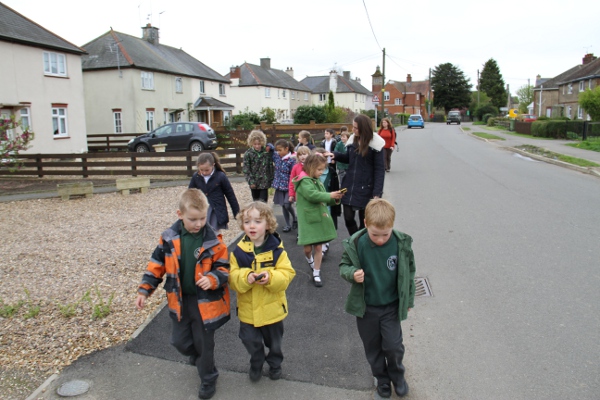
The final part of my commission for Fermynwoods Contemporary Art was to spend a day working with Year 1 and Year 2 pupils at Gretton Primary School.

Working blind with people and place that I hadn’t met before and also up against a forecast for torrential downpour, I armed myself with a large rucksack filled with explorer-y things, a story about having been sent to explore Gretton and some mild consternation that my explorer equipment hadn’t been delivered yet.

With the pupils’ expert assistance we did some excellent exploring that was sure to make Yasmin Boss extremely proud.

Pictures, pictures, pictures…
Those marked (JS) courtesy of James Steventon, Fermynwoods Contemporary Art.

Settling down to making our map bits

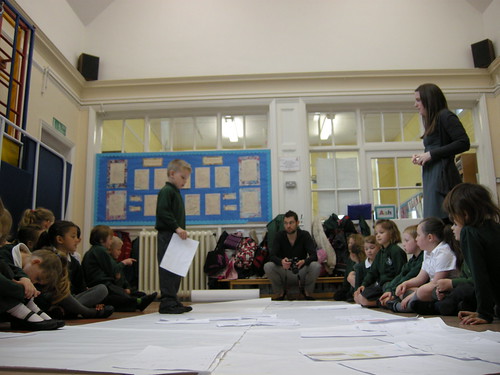
The group decides that we need a map before we can start exploring and everyone settles down to draw a mapbit of something interesting/important in the village

Figuring out where all the map bits go on the ginormo map

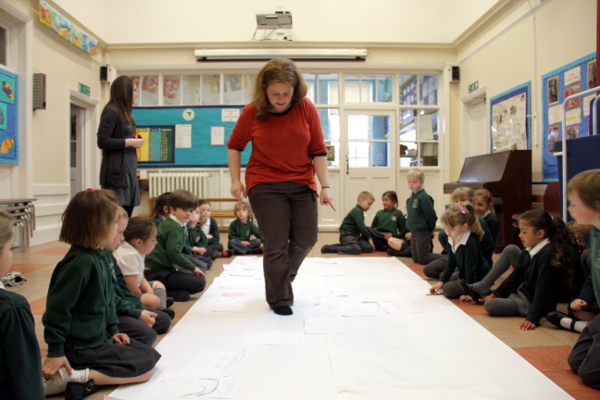
The group decides that we're going to need a *really* big piece of paper to put all these mapbits on. Next job is to work out where all the mapbits go...

But how do we get from one mapbit to another? (JS)

Paths, roads and other details added to the gaps in the map. (JS)

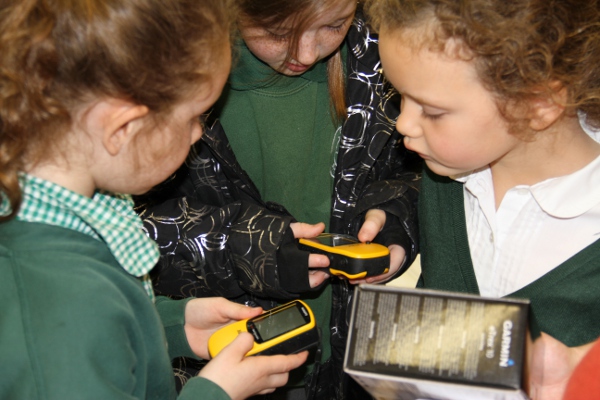
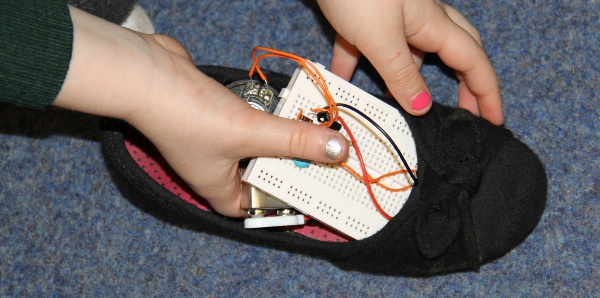
A few of the girls hang behind at breaktime because they think they've figured out what the recently-delivered devices are. (JS)

Explorers set out to walk to some of the places on the map. (JS)

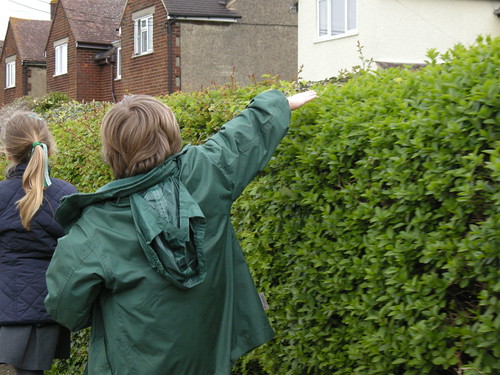
using all our senses

Using all our senses...

A confused Nikki The Explorer needing some things about the village hall explained to her. (JS)

The Pocket Park: many things to discover and examine. (JS)

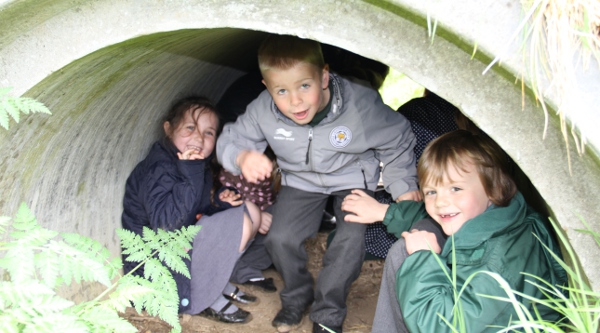
Walking through the tunnel with the GPS devices to see what effect it has. (JS)

Explorers in the tunnel. (JS)

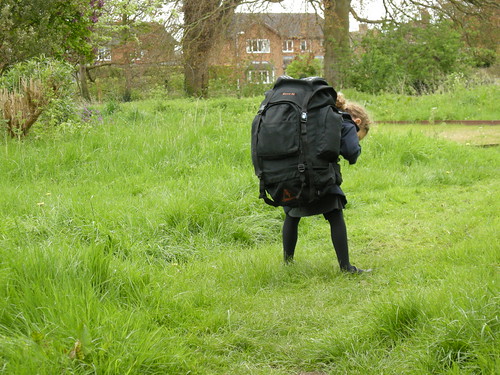
small child and large rucksack

Small child. Large rucksack.

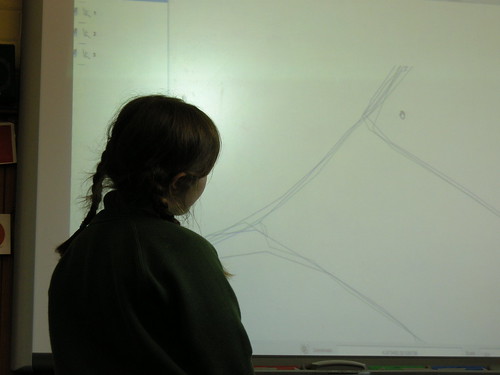
Discovering that drawing a line of where we've just been is actually quite difficult. (JS)

trying to figure out where her house was

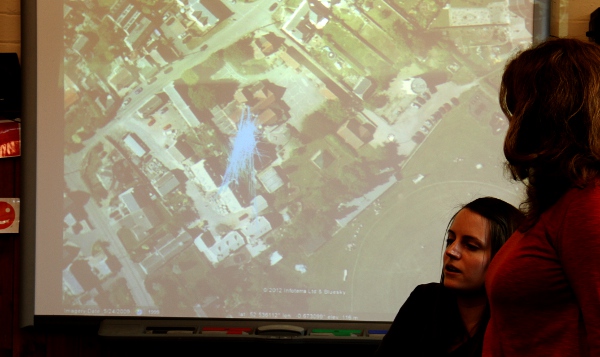
Recognising where home is on the device-drawn traces is even harder...

Recognising places. (JS)

My home-made GPS gadgets get the thumbs up. (JS)

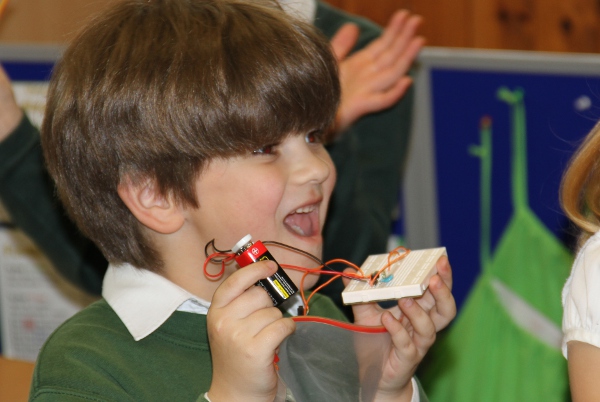
Because - regardless of age - that moment when the LEDs come on is always a good one... (JS)

Investigating dark places and their effect on the gadgets we made. (JS)

Success!. (JS)

Someone puts forward the hypothesis that the trace from the GPS module placed on the windowsill is the way it is because of all of the excitement in the room when we were making our gadgets. (JS)

A great day and a really nice group of people to work with.
Thanks to Garmin for supporting the day through the loan of several GPS devices.

My Flickr set of photos from the day is here.

Walk with landscape-reactive sashes: Fermyn Woods to Lyveden New Bield

The third of the three walking events I did for Fermynwoods Contemporary Arts again using the landscape-reactive sashes, this time on a 3 mile walk between Fermyn Woods Country Park and the National Trust property Lyveden New Bield.

Fermyn Woods Country Park to Lyveden New Bield

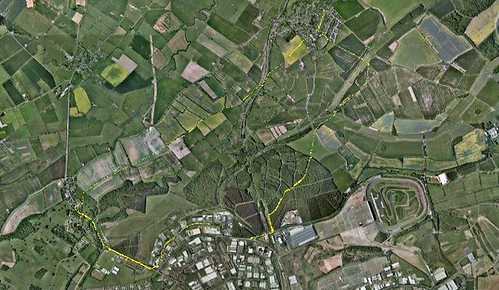
This walk was to take us through woods and across open fields before ending at the roofless, unfinished Elizabethan building, so we were curious to see what traces these different environments would produce.

The results are below… For more in-depth discussion about the traces and how they relate to landscape, please see the previous post about the walk around Gretton, Brookfield Plantation and Rockingham.

We walked from left to right, and for each image you can click through for a larger version.

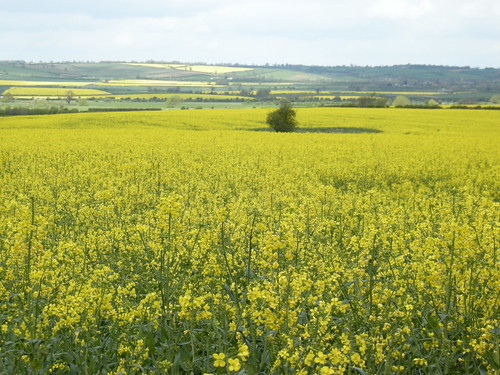
Overview of the route taken (click for larger version). I like how the tracts of rapeseed echo the yellow of the marks we made

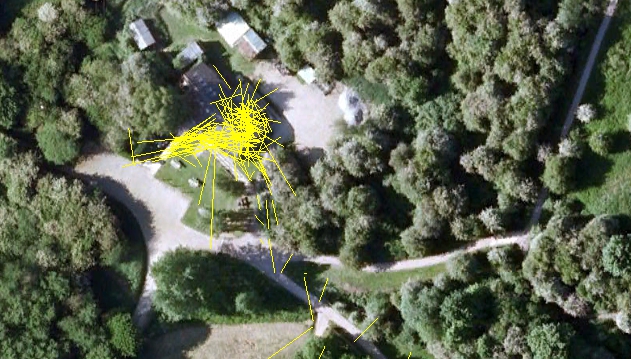
The traces start and end at the Skylark Café. We were here quite a while getting everyone togged up, which is why the lines are really dense. They're long and all over the place because we were inside and the GPS data gathered was inconsistent.

The traces get longer as we enter the woods, and there is another cluster as we pause at the Complaints Choir's hut. These traces are from the bag that James was carrying.

Here are my traces from inside the hut. (Clearer if you click through to the larger version)

Inside the woods, the lines are quite long, but they get shorter again once we emerge onto the field with a clear view of the sky

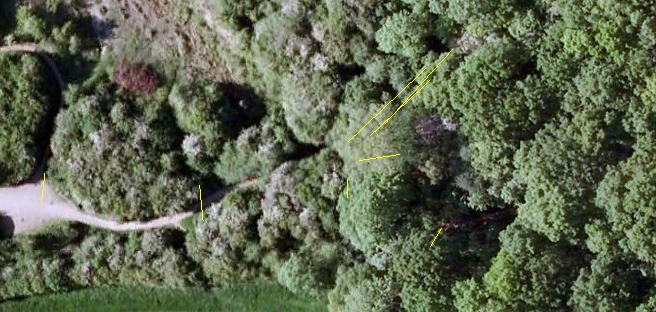
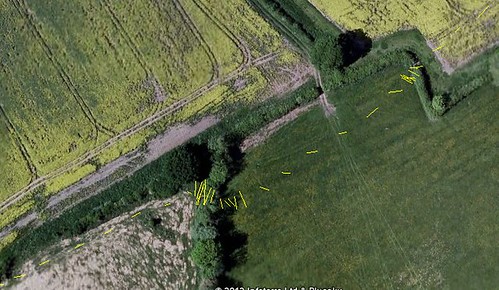
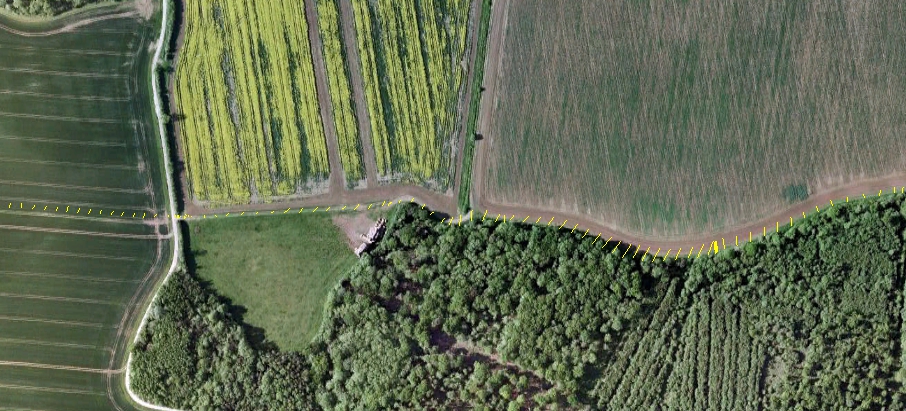
Here you can see three different characteristic traces from walking in the fields: the first as we walk across the field of young wheat; then the lines decrease in length as we walk across grass; then the lines get longer again as we walk with the trees close on one side

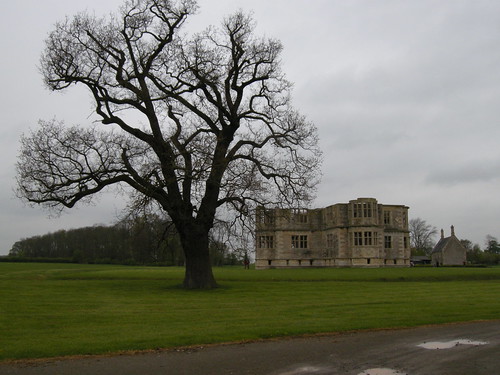
And here we are at the end of the walk. We enter from the bottom of the image and, after pausing by the big oak tree and the moat, have an explore around the shell of the building. Then we sup some hot chocolate by the hut at top left before making our way down the path to the car park and sit in the shed whilst we wait for the minibus to arrive.

You can download the traces from the walk as .kml files and open them in Google Earth to have a closer look.

My trace (controlling the buzzing, in two parts because I had to change the battery): Part 1, Part 2
James’s trace (logging more frequently): Part 1

I’ve also uploaded my photos to Flickr at http://www.flickr.com/photos/nikki_pugh/sets/72157629634011060/

Here are a selection of images from the walk:

Thanks to everyone who braved the drizzly weather and the mud to have a strange buzzing thing wrapped around them!

Walk with landscape-reactive sashes: Gretton, Brookfield Plantation and Rockingham

A collation of data, documentation and discussion for participants of the walk around Gretton, the Brookfield Plantation and Rockingham that took place on the 6th of May…

Walk leader David Craddock from the Ramblers was kind enough to let us infiltrate his 8 mile walk with the landscape-reactive sashes.

This was the first outing for the sashes and also the first time I had used my differential GPS set-up in a rural landscape, so quite a step into the unknown…

So many people had volunteered to wear sashes that there was none for me to wear, so my feedback on how things were working was mostly done by quizzing people as we walked or listening carefully to try and hear the buzzes!

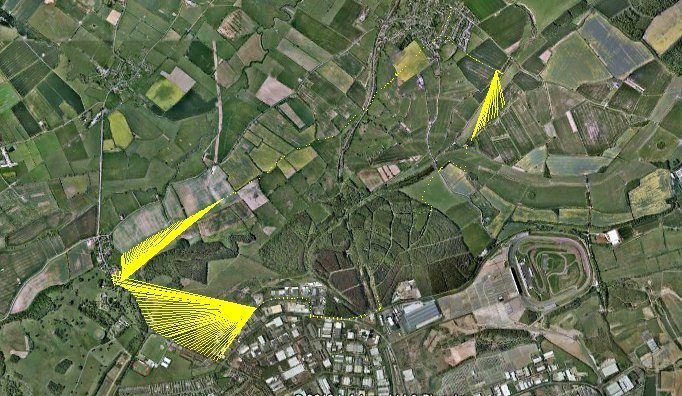
Here is a screenshot of my traces from the morning overlaid onto Google Earth.

Gretton Walk GPS traces

It was a long route, so the lines don’t really show up at this level of zoom, except for the ‘major incidents’…

Starting clockwise from the top, the first spray of lines is fairly apt, as this marks the spot where one of my GPS modules fell off! It was some time before I noticed, and a while after that before, retracing our steps, we eventually found it submerged in a muddly puddle. Many, many thanks to the lady (Karen?) who came back with me to help me look. She also donated some tissue for the clean-up and, miraculously, a few minutes later the module was dried off, plugged in and working again. Phew!

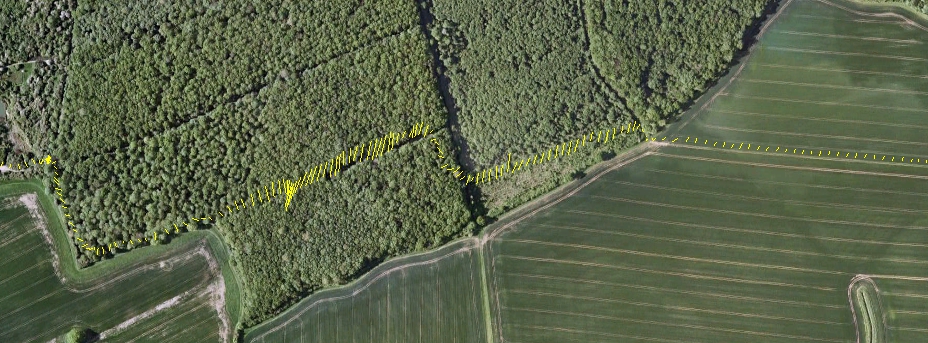
My lines disappear as we enter the Rockingham Plantation; not due to interference, but the slightly more mundane reason of the battery running out! Although this was spotted pretty quickly, it was some time before the logging commenced again and, since we were still hot-footing it to try and catch up with the rest of the group, we covered quite a lot of ground in that interval.

The sight below was a very welcome one and made that much sweeter by the flecks of yellow from the sashes and the cries announcing that they had suddenly resumed buzzing as I came back into range!

Walk with landscape-reactive sashes, Gretton

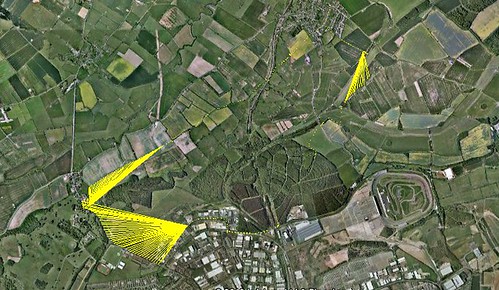
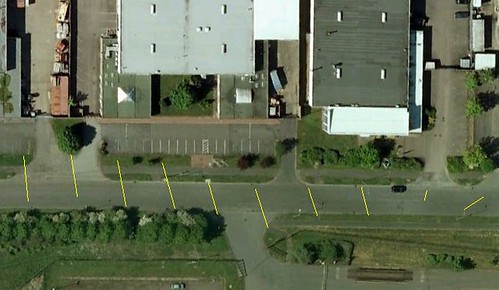
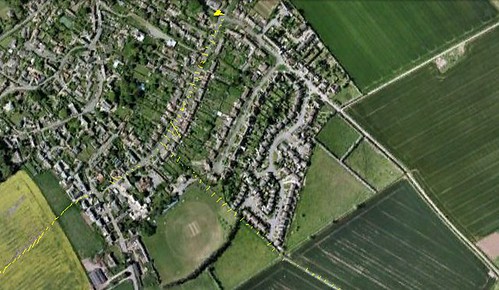
The above point also marked the transition of the walk from rural to urban landscape as our route skirted along the edge of industrial parks on the outskirts of Corby. If you click through to the original – and slightly larger – image you can just about make out that at this point the lines get a bit longer.

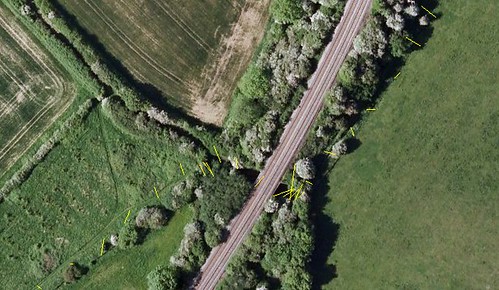
Each line represents where my two GPS modules think they are at a moment in time – one end of the line is one module, the other end the other module. Therefore, the more they disagree, the longer the line is.

Out in the open, the modules get a pretty much direct line-of-sight connection to the signals coming from the satellites – the modules calculate similar positions and the lines are very short. (The sashes would have given a few short, weak buzzes.)

As we make our way through the large warehouses and factories, however, the GPS signals are more likely to reach the modules by indirect routes, bouncing off the buildings en route. The extra amount of time this takes affects the calculations of position. My lines get longer and your buzzes get more energetic.

As our route bends around to the left, something happens to cause one of my modules to lose its fix altogether. Here one end of the lines are fixed to a single point, whilst the other ends follow the route we walked. This happens again as we turn off the road onto the Jurassic Way (I think I changed batteries here.)

So, an interesting set of lines that tell a story, although it wasn’t what I set out to find out about! The lines from Charlotte’s logging device tell that particular story a lot better. Below are some excerpts (click on the images to see the original on Flickr), or you can download the .kml files, open them in Google Earth and have a good ol’ poke around. Part 1, Part 2.

Overview of the route taken (no major incidents!)

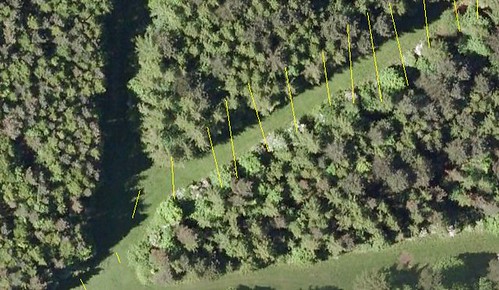
Smaller lines get bigger as the group enters the dense woodland of the plantation

Close-up of the lines produced when walking through the plantation - here it's obvious that the GPS modules think they're much further apart than they really are

The large buildings of the industrial units also produce long lines

Clusters of longer lines show where the group paused under trees to take turns crossing the stiles

The tunnel under the railway track

Leaving and entering Gretton village at both ends of the walk

So, some nice results there – both expected and unexpected!

I really liked how the group looked wearing their sashes and the resulting traces tell some interesting stories about the physicality of the landscape(s) we moved through.

You can try the GPS tag for more blog posts I’ve written relating to my work with GPS around the world, and the full set of my photos from this walk is at http://www.flickr.com/photos/nikki_pugh/sets/72157629978908541/with/7002887160/. Edited highlights here: http://www.flickr.com/photos/nikki_pugh/sets/72157629635144548/

Thanks to everyone who took part and to David for leading the walk.

Landscape-reactive sashes

Fermyn Woods Country Park to Lyveden New Bield

Supported by the current residency with Fermynwoods Contemporary Art I developed these sashes to further explore ideas of group identity and interconnectedness. This follows on from the recent residency with Phoenix Square and feeds in to the ongoing series of research projects relating to Colony.

The basic principle was to have a group of people all linked visually through the wearing of the sashes, but also connected through a network formed by radio transceivers built into the sashes.

One member of the group also wears a microcontroller unit that analyses discrepancies in GPS data and broadcasts instructions to the sashes to vibrate differently in accordance with the results. In this way, everyone who accepts the invitation to become a member of the group is able to feel what the broadcaster senses.

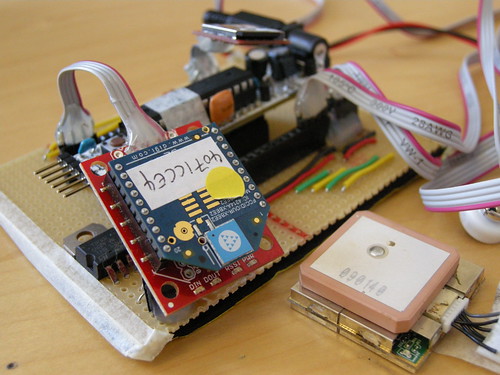
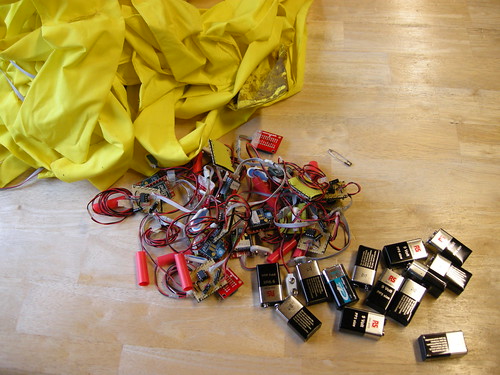
Broadcast unit with GPS modules, data logger and XBee radio for transmitting to the sashes

Sashes and sash innards - ATtiny85 microcontrollers, XBee radios and pager motors

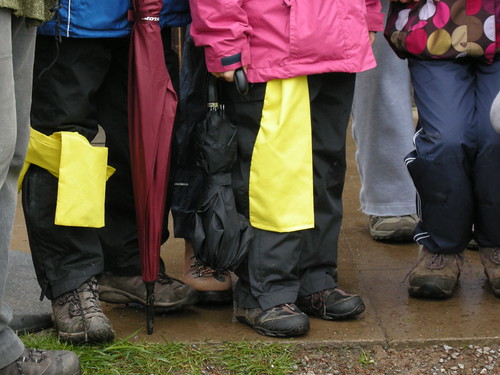
The use of coloured armbands to signify the wearer to be a member of (or outcast from) a particular group is something we humans have been doing for a long, long time. Some research into the subject quickly seemed to suggest that there wasn’t any colour that didn’t have a loaded history so I chose to reclaim my yellow on the grounds that it did what I wanted it to do.

The yellow of the sashes makes the group visible as they move through the landscape. This weekend we’ve mostly been moving through and around fields of rapeseed.

Walk with landscape-reactive sashes, Gretton

In this context of distributed senses, I’m also interested in a reference to the armband worn in Germany and Austria to signify visual impairment:

Those dots could very easily be modified into a network diagram, right?

~~~

So, for the last few days I’ve been inviting people to walk with me as part of a group.

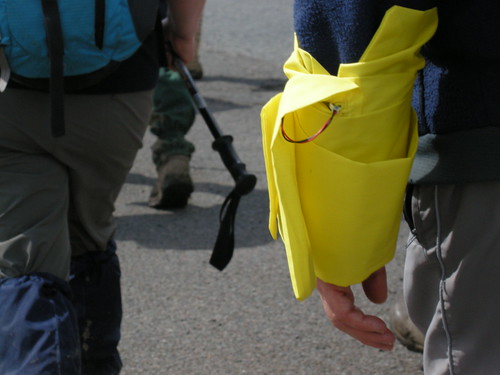
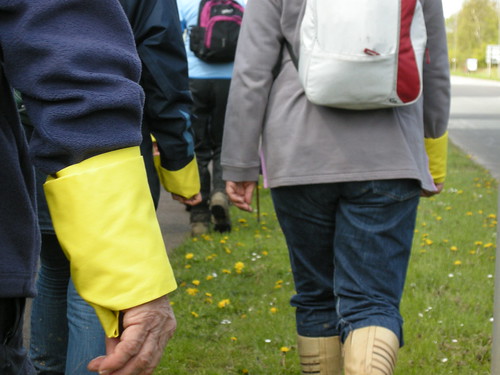
You can wear the sash in any way that seems appropriate to you – on your arm, on your wrist, around your tummy, over your shoulder, around your leg… I impose a few restrictions; mostly just that the radios are on the top and the vibration motors are near your skin. It’s nice if the yellow fabric is visible, but keeping the electronics dry takes precedence, so this weekend quite a few were worn under waterproofs!

Together we have been learning about what restrictions the system puts on us: how far radio waves travel; how radio waves do not go around particular corners/bends; how long batteries last for etc

Walk with landscape-reactive sashes, Gretton

Walk with landscape-reactive sashes, Gretton

Walk with landscape-reactive sashes, Gretton

Thanks to everyone who joined in and took part.


Copyright and permissions:

General blog contents released under a Creative Commons by-nc-sa license. Artworks and other projects copyright Nicola Pugh 2003-2026, all rights reserved.
If in doubt, ask.
The theme used on this WordPress-powered site started off life as Modern Clix, by Rodrigo Galindez.

RSS Feed.