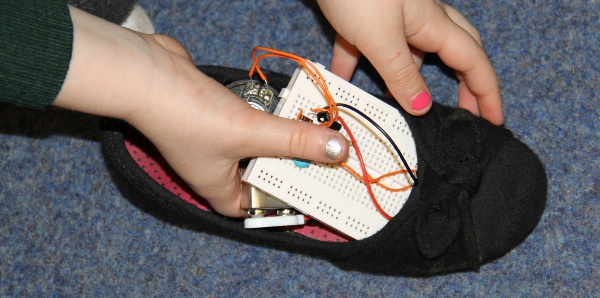
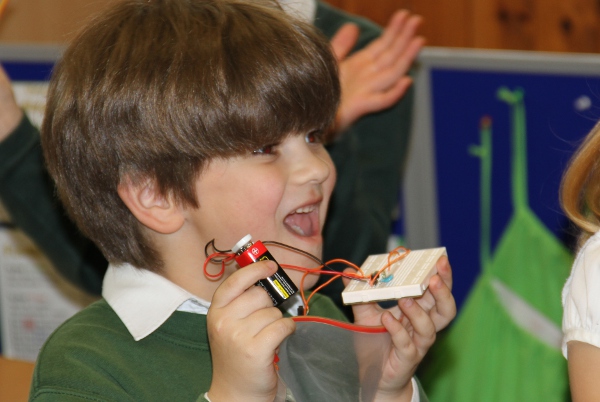
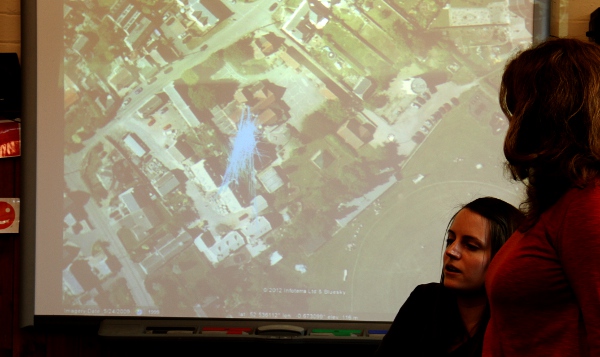
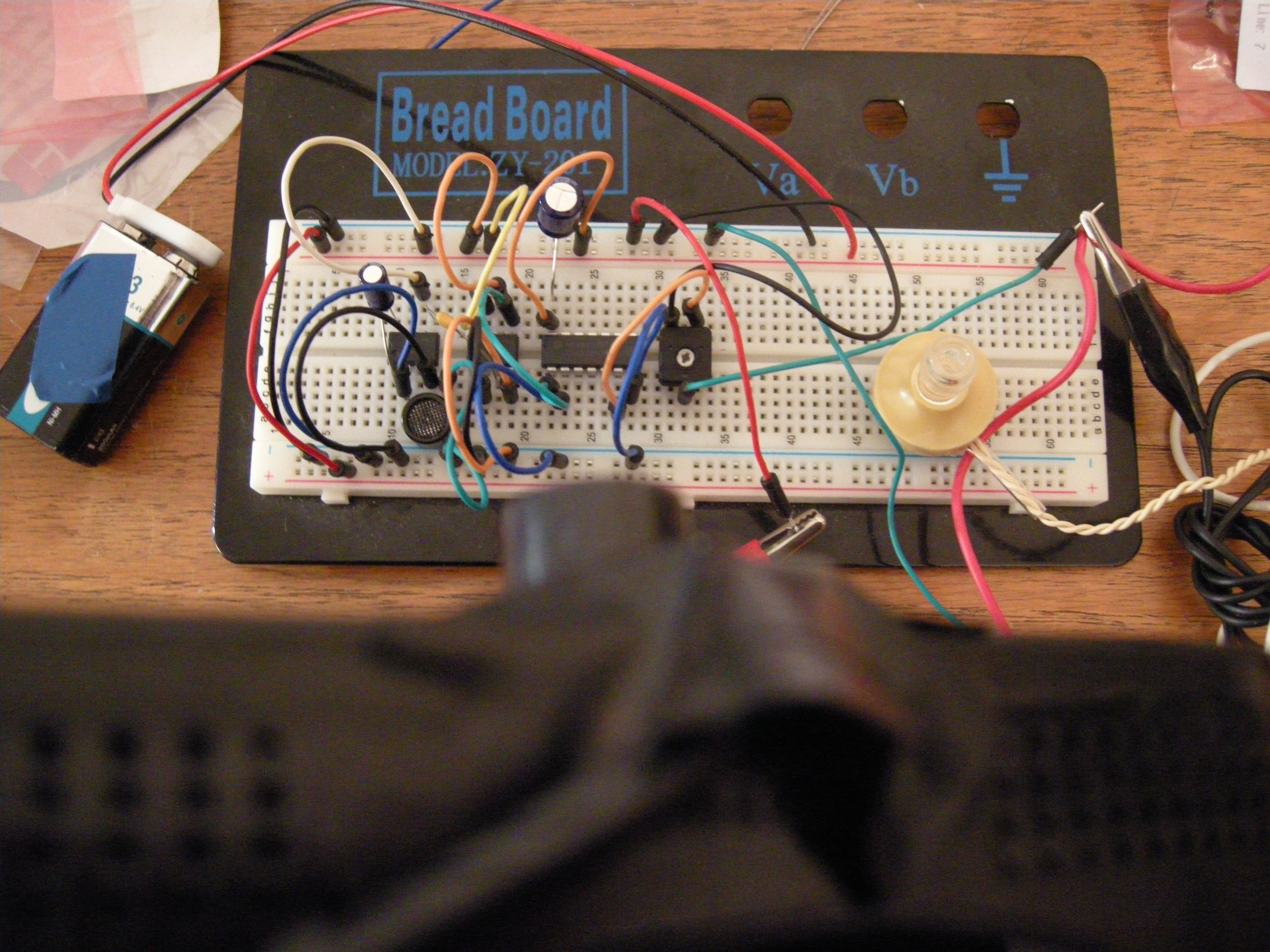
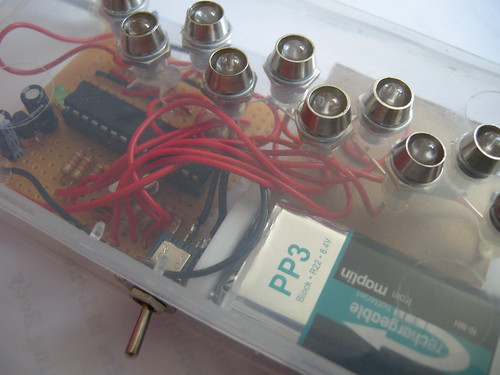
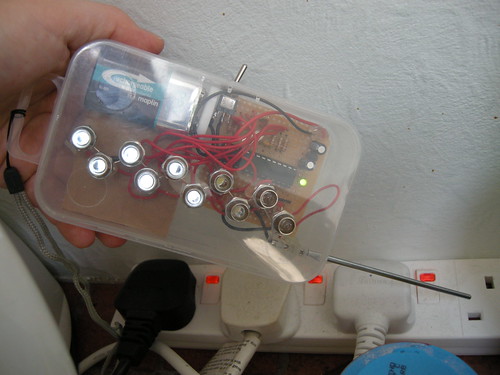
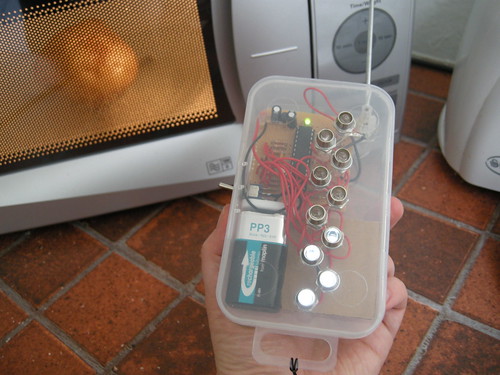
As an extra tool for us to use in our investigation into the unseen, I constructed an Arduino-based electromotive force (emf) detector. I’ve made breadboard versions of this before, but now it was time to build something a little more permanent.
barebones Arduino, 10 LEDs and a plastic case from a pound shop screw set
The LEDs light up in proportion to the strength of electromagnetic field detected. Since electrical currents are intrinsically linked with magnetic fields (can’t quite remember my A-level Physics) placing the antenna near to power sockets and electrical items light up some of the LEDs.
4-way gang lights 'em up
bing
The microwave seems reassuringly well shielded:
But my clock radio and bedside lamp are a tad alarming!
It’s very interesting hunting around the room for different effects. Orientation of the antenna changes the number of lit LEDs, as does switching things on and off. I’m curious to see how the detector responds to big classroom equipment such as smartboards and projectors, but of course the main point is observing how the children respond to being able to visualise things they wouldn’t otherwise be aware of.
Earlier this week I had a planning meeting with the Y3 and Y4 teacher of a school I’m working at. The theme of the project will be based around the idea of investigating the things we can’t see.
The doings will kick off with me coming to the school asking for help in locating the source of a strange sound. I’m not much of a sound engineer, but when my tummy started gurgling enthusiastically after a breakfast of cold pizza this morning I grabbed my binaural mics, a digital voice recorder and the opportunity to see what would happen if I manipulated the sound a bit.
Here’s a gurgle amplified, noise removal-ed, slowed down, lowered in pitch and then overlaid with slightly off-set versions of itself.
Note to self: must make more notes to self so I can reproduce the sequence of applied effects.
Yesterday morning, whist reading through their weekly newsletter – the Bredon Bugle – the agents noticed a strange article which they recognised as being in some sort of code.
Coded message in the Bredon Bugle
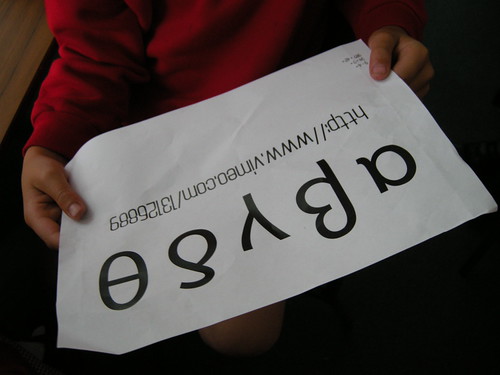
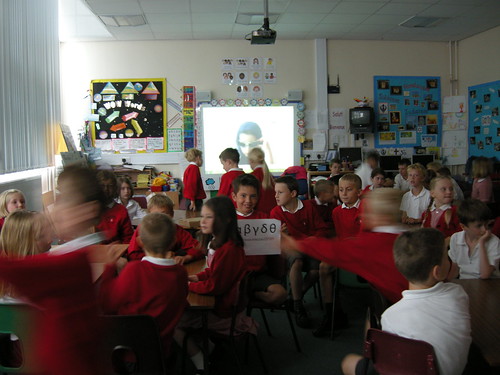
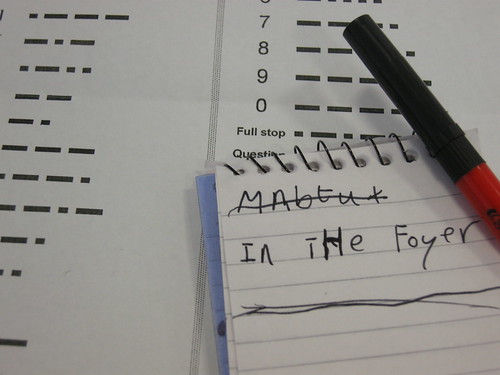
They phoned me and by the time I had rushed out of my office in iGenCa HQ and driven over to join them, they had donned their special agent ID badges, got out their investigation packs, started work with their code wheels and begun to decode the message. After a little bit of work, this is what we found it said:
To the bird of the night,
and another brightest blue.
I have taken something
That belongs to you.
Have you got what it takes,
To unravel the mystery?
You’ll need teamwork and brains,
Or your item is history.
Your entry point,
is where it begins.
Your imagination and mine:
Let’s see who wins…
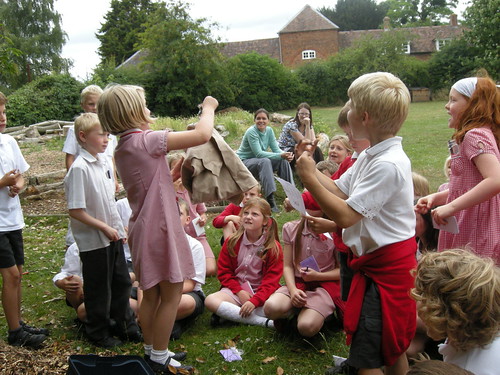
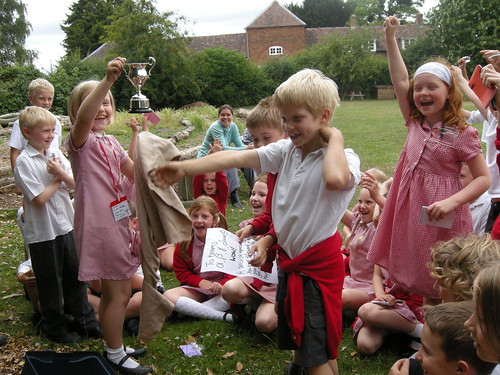
It didn’t take us long to figure out that “bird of the night, and another brightest blue” was a reference to the agents in their normal pupil roles as Owls and Kingfishers, but what did the rest of the message mean?
I called a team to help me work through the rest of the verses and someone suggested that ‘entry point’ could mean the main entrance to the school. Another agent had spotted some new state-of-the-art security cameras had been installed in that area, so we went out to have a look.
We located two of these cameras and decided we would have a look at the files on them to see if they had caught anything useful on tape.
They had!
The first one we watched showed us a person (that we recognised from previously intercepted footage) breaking into the school and then leaving again having wrapped something up and put it in her rucksack. She had some sort of device that zapped the camera though, so we couldn’t see everything.
When we looked at the footage from the other camera (that the intruder hadn’t spotted or zapped) it helped answer some of our questions: she had taken the sports trophy!
Here’s the combined footage from both cameras that shows what happened:
Now the coded message from the Bugle made a lot more sense! We also knew we had to get permission to launch a full-blown mission, so our next task was to summarise what had happened in a report to Agent A to explain why it was important for us to investigate this.
Mission initiation report. What do we need to put in it?
One of the special agents sets out what had happened that morning
We sent the reports off, but then realised we had to act fast if we were to be able to interview someone who was likely to provide some key evidence in our investigation: Mrs Greenwood the cleaner went home after lunch so we had to speak to her fast!
Here’s what was written on the paper:
Research challengers
Are they are good enough?
Think of a way to test them
Be sneaky
See what they do and who they tell?
Are they a good team?
Wait for contact
???
What were we to make of that?
While we were thinking, a message came back from Agent A giving us permission to go ahead with the mission. We used the school’s recording devices to interview the head mistress (who had information about the security cameras) and the secretary (who had information about what state her office was in when she arrived at work that morning).
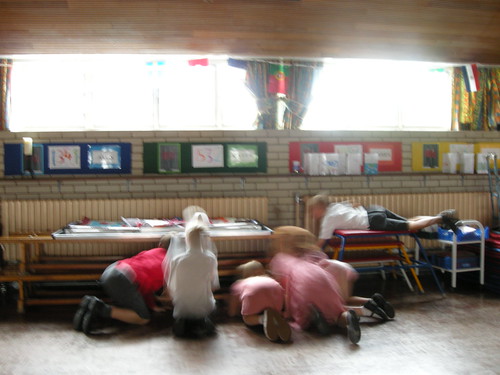
From what the cleaner and the secretary had told us, we decided to see if we could lift any fingerprints from the scene of the crime. First we practised getting prints from our own fingers and then a few of us went to look in the foyer to see if we could get any off the remaining trophies, the door or the reception hatch.
Examining the fingerprints on the large trophy
Unfortunately we were unable to lift any of these prints, but we had a really close look and decided that the ones on the door and the hatch were probably the same.
From the to-do list that the intruder dropped, we knew she was watching us to see who we would tell about what had happened.
I was unable to join the special agents today, but I believe they were compiling a special edition of the Bredon Bugle to tell EVERYONE.
Another post relating to Phase 1 of delivery of an Agent N project designed to inspire creative writing and foster curiosity amongst a group of Y3 and Y4 pupils.
Whilst the pupils were winding up the training camp with a piece of reflexive writing, I took the opportunity to take a couple of them outside for a bit of feedback on the goings-on of the previous two days.
Rather than shoving a microphone in their face, I used some binaural microphones that look like earphones and just wore them around my neck. I’m repeating most things they say because I wasn’t sure if the mic was picking them up or not!
Last week I spent the first 2 of what will be approximately 6 days working with the Year 3 and 4 classes at Bredon Hancock’s Endowed First School in rural Worcestershire.
My brief was initially to “inspire their children and staff to write with imagination, creativity, enthusiasm and confidence”, but this has since (I think in part as a result of conversations at my interview, which I did in role as Agent N) been expanded out to also try and foster a spirit of creativity, experimentation and enquiring minds in a more general sense. Staff and pupils.
I’ve worked on several Agent N projects up until now: immersive experiences taking place over 3-5 days in which the pupils have an overarching challenge to work on and, as a part of this, investigate different areas of the curriculum. Whilst I’ve had enormously positive feedback on the effects of these, I think there’s still plenty of scope for improvement, so with this project I have changed the structure to explore ways in which to hand some of the authorship back to the children. This has resulted in the delivery being split up into sections. Last week was the first of those sections: a 2-day special agent training camp.
Relinquishing some of the design decisions started well in advance of the delivery time in school when I recruited a friend – 8-year-old Agent M – to help me prepare a video for the trainees to respond to.
The message from Agent A requesting that we look at the top secret footage
I wanted a video of an operative in action. The action involved had to be exciting and intriguing, but not so prescribed that the the pupils in school couldn’t come up with a large range of different interpretations. I had a few locations in mind, but the filming was done as part of a weekend away with friends, so even those decisions had to be flexible.
Here’s the result after some basic prompts for Agent M to run with plus a bit of video editing:
I’ve never seen 40 children sat with such rapt attention before!
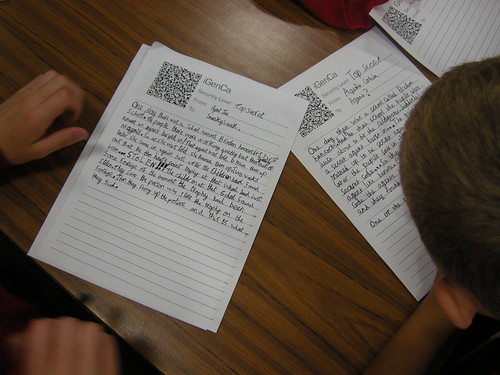
We played the video a few more times, pausing in places to give the trainee agents a chance to write down any important details or questions in their special agent notepads.
After a bit of discussion to get a general idea of what they thought was going on, the children were asked to write up their reports for Agent A.
A trainee agent prepares their report...
Here are a few excerpts (spellings etc corrected):
In the film there was a girl disguised as a young child. At the start the girl was at an airport. At a machine she got some tickets. The code was AQZP. After she caught a plane and got dropped off at a wood. Why did she feel the tree?
The lady typed in AQZP. She walked up to a plane netting and stopped. The man walked to the plane. The lady ran to a tree and found a bag with a book in it. It might have been a clue. She ran to a farm track and stopped and ran a bit more and stopped again then suddenly pointed at a farm house. She ran down to a beach and crouched down to touch the sand. She was concentrating on the texture of the sand. Then she ran to a castle on a hill. I think she might be an agent on a mission.
She was wearing black and she looked like she was on a top secret mission. She typed into the computer AQZP which looked like a code. She thought carefully about what she was doing as if the time was running out. She recorded stuff in her notepad. She thought carefully about stuff she found and used it to help her. She looked around carefully in case anyone watched. She looks as if the time was running out and she had to go with the flow. She was just guessing and running. She wrote something into the sand. She felt the tree as if the tree had put it there.
Agent Harry's report on the video
On the DVD I think that there was a girl in an airport and she went there. A cash machine or ticket machine and then she looked at the plane and went to a woodland when a plane went overhead. I don’t think she wanted to be seen because she was sneaking. She picked up a bag and ran to the beach and made a sign in the sand. It was something like this [picture of an arrow]. She was disguised as an old gran. She had glasses like this [picture of glasses].
Agent Jemma's report
I think that the code at the beginning was that she was ordering some clues to find where she needs to go next. Next thing she was taking facts about the airport. Trying to get the right plane. Missed the plane. I think that she was undercover because she has glasses and a hoody.
I saw some dead drops that the agent was finding. It was an agent on a mission I think or she was finding information. An agent was on a computer on Flybe. In the corner of the screen I saw a word that was WHSmiths. The agent at the end was a bad agent finding clues about the good agent. I can’t work out why the agent at the end was feeling a tree and feeling the sand. The agent was writing the code AQZP to get permission.
The report from Agent Cara
Ideas from these reports and from other pieces of writing generated over the training camp will be used in the next phase of delivery…
I’m working on a massive Creative Partnerships project in a Leicestershire primary school with several other practitioners from various disciplines including, music, dance, architecture, story-telling, illustration and greenwood structures. Our brief: to make sure the staff can do what we do after we’ve gone.
We’re starting off on two threads of enquiry. One is to look at how we can encourage more imaginative play amongst the foundation level classes (3-5 years old) and the other is nominally working with years 3 and 4 (7-9 years). I say nominally, because actually I think we’ve discovered it’s more about exploring how the teachers can move away from teaching for a specific outcome and move more towards child-led learning where the outcome comes out of the process.
Last week this message was delivered in assembly:
The message delivered to the pupils last week
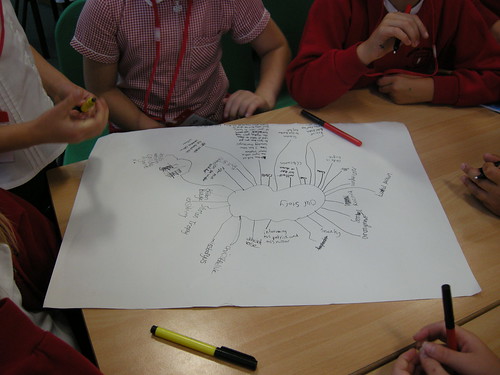
On Friday the pupils worked with some of the practitioners on brainstorming their initial ideas and questions.
Tomorrow I will go in and liaise.
Today I am trying to plan the day without actually planning the day.
It’s counter-intuitive and a bit scary, but we need questions and then we need answers. In that order.
Milton – the pathogen-introducing game I’m making for a Coventry school – gets its first playing on Friday, so I’m in full-on production mode making the cards that determine the players’ roles.
Here’s a quick peek at the bacteria who will be trying to infect as many pathologists as possible:
I’ve been working with a school in Coventry to help them develop activities for their Year 8 Flexible Learning Day focusing on science and creative writing.
As a result of this I’ve been commissioned to design a game to teach and reinforce concepts and vocabulary relating to pathogens: how they spread and how we can protect ourselves against the nasty ones.
Game flow and card design
I’ve had the school’s permission to release the game’s rules under a creative commons license, and the basic description and mechanics are now up on the Ludocity website: http://ludocity.org/wiki/Milton.
I’m currently working on designing the cards that will be used in the game and making sure they also double up as instructional prompts for the players – expect that ruleset to develop! In the meantime, I’m also soliciting feedback in advance of the game’s first plays on April 30th.
I work in the grey areas between and across Art, Science and Technology, instigating enquiry-led processes that are
often highly participatory in nature. This website is where I track the projects I'm involved in and the things that feed
into and sprout off from my work.
You can also find me at fizzPOP (hackerspace) and BARG (pervasive games).
I'm primarily interested in issues around interaction: how we interact with spaces; how we interact with each other; and how we interact with objects.
For a general overview of my work, try the projects and cv pages.
If you'd like to start a conversation regarding a new piece of work, then there's more information on the commissions & collaborations page.
General blog contents released under a Creative Commons
by-nc-sa license.
Artworks and other projects copyright Nicola Pugh 2003-2010, all rights reserved.
If in doubt, ask.
The theme used on this site started off life as Modern Clix, by Rodrigo Galindez.