March 13, 2011

Modes of Practice in [and out of] an Age of Austerity

Yesterday I went up to Stoke-on-Trent to take part in the Modes of Practice in an Age of Austerity event being run by New Generation Space, where 20 or so artists of different types met and discussed the issues important to them.
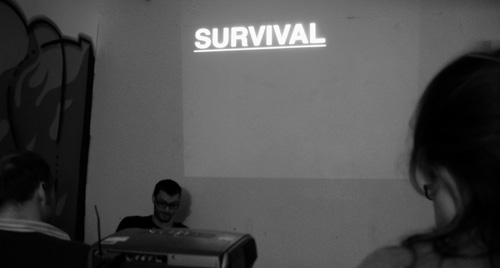
SURVIVAL

I was particularly attracted by the prospect of some interesting brain fodder from artists Emily Speed (‘Getting Paid’) and Rich White (“how a practitioner whose work is not saleable in the traditional sense survives in these difficult times”) as well as a chance to check out The Exchange, which seems to have been popping up on my radar a bit recently. Really though, it’s always good to get the chance to find out about the nuts and bolts of how others function as artists, so it was nice to just be in a room with other people talking about this sort of stuff and galvanising my own practice.
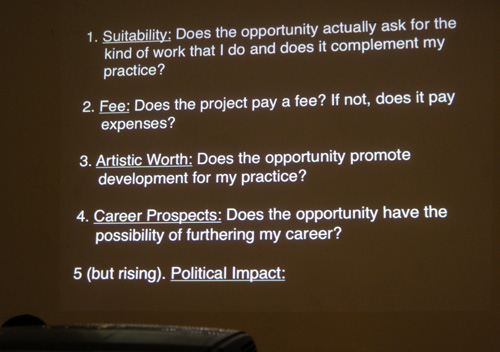
Rich's checklist for deciding what opportunities to pursue

The presentations from Emily and Rich were both very thought-provoking – naturally there were references to money, but there were also strong themes around questions of when we should say no to offered opportunities and assessing different types of value.
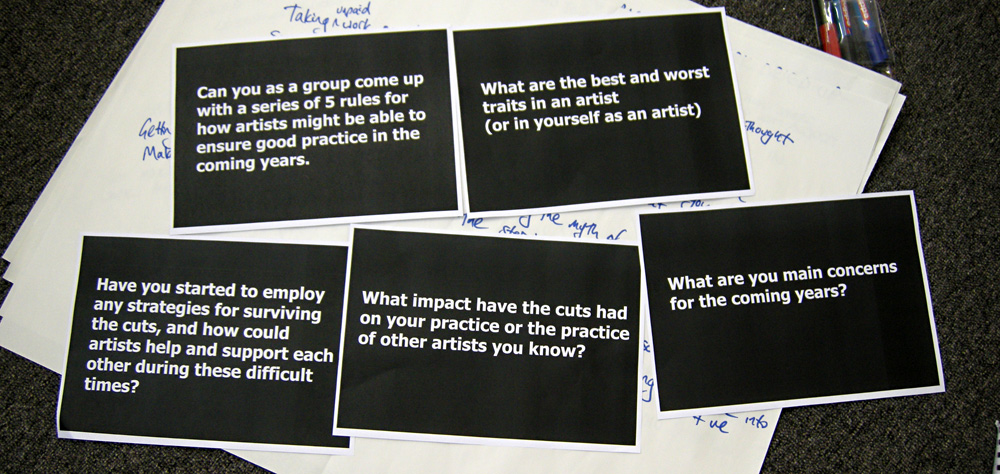
The five prompts for discussion

After the presentations we split up into smaller groups and spent some time responding to prompts for sharing our thoughts and experiences:

  • What impact have the cuts had on your practice or the practice of other artists you know?
  • What are your main concerns for the coming years?
  • Have you started to employ any strategies for surviving the cuts, and how could artists help and support each other during these difficult times?
  • What are the best and worst traits in an artist?
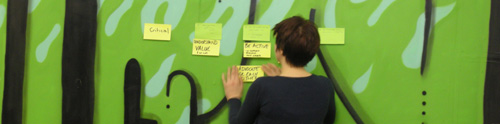
The Wall

Our fifth prompt was to decide on five rules to ensure good practice. These were then pooled and voted on until we had a mini manifesto of sorts.
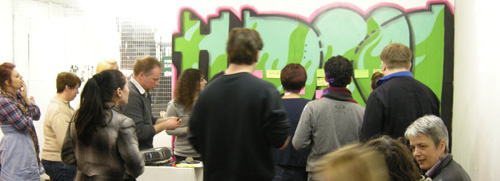
Participants vote for the items they think are most important

I didn’t make a copy of the final list per se, although it was interesting to note that the rules all seemed to me to be independent of the current economic climate. The issues of prime concern to us were to keep making work of high quality; to be rewarded (financially or otherwise) fairly for our work; and to be part of wider, mutually and innovatively generous networks.

The blocks we are encountering to these come from perceptions and expectations from society as a whole and we have not always been guilt free of perpetuating them ourselves. If I have one hope for what might result from activism catalysed by the cuts, it is that we may do something towards addressing these attitudes.

If you would like to receive a copy of the manifesto that was produced during this session – or can think of people, institutions, organisations that you think should receive a copy – I suggest you add your request to the comments on the event’s page.

Update: Anna Francis’ post here: http://annafrancis.blogspot.com/2011/03/modes-of-practice-in-age-of-austerity.html

WE ARE THE SPLACISTS!

A year ago Paul Conneally contacted me voicing his dislike of our recent work being labelled as “psychogeography” and “situationist”; for these are terms that are left-overs from the 70s.

He invited me to join him in Splacism: “a new movement a new set of ideologies […] with manifestos and the like – all still to be written including the definitions describing the movement”.

~~~

Last Tuesday I gathered people from different disciplines around me to give feedback on a newly-started project. After bemoaning the perceived lack of a peer group to one group of guests, the response was that I should celebrate my unique position between disciplines and become my own movement.

Later conversation rather suggested that one Hannah Nicklin identified with that too.

~~~

It wasn’t until later that evening that I remembered I already had my own movement – technosplacism as a subset of splacism.

24 hours later Hannah and I were brainstorming a manifesto.

~~~

WE ARE THE SPLACISTS

We will own this city.
We will take it back.
We will link and shift.
We will affect and be affected.
We will look, and be seen.
We will expose and re-see.
We will glory in the moment, the collage, the marking and then passing on.
We reject the beginning, middle and end.
We reject your shopping centre, your pavement, your cultural quarter.
We will build our own constructs.
We will build our own bridges.
We will find the edges and push them.
We will fail spectacularly, vitally, elegantly.
We will span.
We will look up, down, under and behind.
We will leap.
We will invite others to do these things too.
We will make exchanges.
We will make adventures.
We will make beautiful moments.
We will reveal the ugly.
We will hold your hand.
We will whisper in your ear ‘let go’.
We will run, skip and jump.
We will be motionless.
We might dance.
We will dream.
We will be generous, but we may subtle about it, too.
We will reclaim the city, not for you, but with you.
We are you.

WE ARE ALSO THE TECHNOLSPLACISTS

We will learn how to use the tools that make the things we want to happen happen.
We will help others learn wherever we can.
We will construct our manifesto – collaboratively – online, because the Internet is also a space :)
We will shift between space, online and off, taking on the form and the arena that suits us best.
We will bodily augment the layers of virtual space, story, marketing, capitalism, that exist in the city, with our own stories.
We will hold the data-harvesting done in the city in the name of ‘games’ (foursquare, loyalty cards) accountable.
We will find our own energy sources.
We will learn how to flex the central nervous system of the city – the data streams in its weather detectors, CCTV, red light cameras – for our own aims.
We will release all that we can via creative commons, so that they can be reclaimed, remixed, re-purposed.
We will cut, and we will paste.
“Plagiarism is necessary, progress demands it.”
We will pervade.
We will not be technosplacist when being splacist will suffice.
We will never underestimate the power of gaffa/electrical/masking tape
We will be artful. We will be skillful. We will fail usefully.

~~~

I don’t know if this is the Splacism Paul had in mind all that time ago – I’m not even 100% sure if this is the Splacism I have in mind now – but it’s a mighty fine start and writing the manifesto was a very interesting process.

We’ll let them sit for a while and see what they evolve into. As Paul said: “let [the words] become themselves and more…”

Journey around the solar system

I spent last Friday working with two Year 5 classes at Wyvern Primary School in Leicester as we explored an alternative method of teaching the Sun, Earth and Moon module. (scheme of work).

Working alongside one of the Y5 teachers and another artist Linda Harding we designed two days of activities. The first, with Linda, in which the pupils made models of the planets and then the second with me where planets and pupils went outside…

Jupiter and a slightly inconveniently located water hazard

The day I worked on was split into 2 2-hour sessions, one with each class. I burst into the lesson, announced launch to be in T minus 20 minutes and set about calling out the crew names whilst the teacher set the countdown timer going on the whiteboard.

After locating notebooks, donning space helmets and checking our gravity boots I gave them the mission brief: NASA had ‘acquired’ a couple of items that claimed to be some sort of aid for travellers. I played them a sample entry:

[audio:http://www.npugh.co.uk/media/02-The%20Hitch%20Hikers%20Guide%20to%20the%20Galaxy.mp3]

Our mission was a fact-finding one – we had to check the accuracy of the Guide’s entries in order to determine if we wanted to try and obtain the full version (the versions we had were trial versions limited to the solar system only).

After launch and hyper drive out to the edge of the field solar system, our teams of astronauts navigated their way sun-wards visiting different planets and checking the information given by the Guide against what they already knew or could deduce.

Unfortunately the entry for planet Earth was entirely unacceptable, so we agreed to spend time collating our own facts which we would then send to the publishers so they could put this straight.

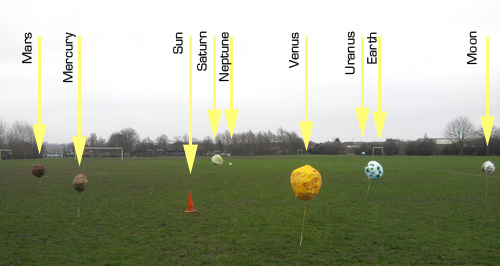
I placed the planets out on the field so the relative distances between them were correctly scaled (although I forgot to get an orbit diameter for the moon). The planets themselves were not to scale, which is just as well because with these distances between them, we’d have had to have made the Sun 15cm across and Earth only 1.3mm across.

The planets at their relative distances from the Sun

A favourite moment was glancing back onto the field after I’d placed the planets in position to see a crowd of dogwalkers and dogs gathered around Saturn scratching their heads and wondering what was going on!

Dogwalkers in orbit around Saturn

Colony prototype, in Holly’s words

http://www.hideandseek.net/nikki-pughs-colony-prototype/

It’s been deadline central around here for the last couple of weeks, so various things have slipped through the blogging net. Fortunately, Holly Gramazio has written a lovely insightful post outlining precisely what what going on last Tuesday:

We went out in a group of four, and wandered around, occasionally passing the bundle between us – just to see what it was like, how the vibrations felt, whether people looked at us oddly or didn’t notice, whether we felt friendly and warm towards the bundle or annoyed by it. In the end we wandered arond for an hour or so, everyone taking a couple of turns with the bundle.

The first thing we noticed was that was that holding the bundle gives you an immense feeling of entitlement. Only you can tell when it’s vibrating; only you can interpret its whims. Is it happy? Which way does it want to go? Does it have a name, and if so, what is it? Holding the bundle makes you feel like these are your decisions to make, even when you know perfectly well that the vibrations are random and you’re interpreting them pretty much as you like. It invests you with power.

Please go and read the whole thing!

Colony prototyping #1

I’ve been developing a project that investigates taking the phenomena I use to generate work such as Uncertain Eastside and 19,264 seconds of qualitative and quantitative data (Curzon Street, 2010) and turning it into a real-time experience as you move through the landscape.

The early stages of this are supported by Fierce’s Platinum development programme and yesterday was a sharing event to which guests were invited to sample the nascent work from the 6 artists taking part and offer constructive criticism and feedback.

Many thanks to all those who walked the streets of Digbeth with me and my bubblewrap-encased GPS receivers and vibration motors sharing ideas and exploring possibilities. Here are a few photos from the day:

Would you like me to work for you?

For the last couple of months I’ve been doing OfficeJobThatPaysTheBills on a temporary contract 3 days a week. They’ve just offered to extend this to a year’s contract so I’m just checking what my options are before I say yea or nay…

Is there anyone out there thinking “we’d love to work with Nikki from the end of March”?

My basic threshold is that I need to earn a regular £600/£700 a month to pay my rent and main bills, so I can consider anything that brings that in (so long as it still leaves me at least 3 or 4 days a week to work on my art practice). A couple of days a week doing something not-particularly-exciting 9-5? A handful of days a month as an artist doing creative stuff? Something in between?

Got something interesting coming up but it doesn’t meet that threshold? Get in touch anyway – someone else may have something else we can double it up with…

Head on over to the home page for an overview of the territory I work in as an artist (interactions, place, playfulness, applications of technology…). Obviously I’d love it if you offered me a creative something that I simply couldn’t not get involved in, but things being what they are with the economic situation there’s also something to be said for hum-drum-but-secure. Day job stylee I have good project management skills and am comfortable with problem solving, customer service and core wordprocessing/spreadsheet stuff etc. I’ll almost certainly politely decline anything sales/retail, but have done several years front line in libraries and really quite enjoyed that!

Send me an email and let’s talk!

The Play Ground residency draws nearer

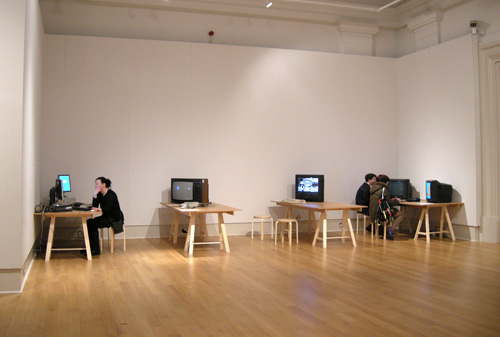
The Play Ground residency draws nearer: on Monday next week this corner of the New Walk Museum and Art Gallery, Leicester, will have been cleared of the trestle tables and retro computer games (don’t worry, they’ll not have been moved far!), and the Ministry of Rules will have set up their new headquarters there instead.

The soon-to-be Ministry of Rules HQ

I’ll be inviting visitors to the exhibition to join me in becoming Inspectors for the Ministry of Rules and together we will shape the investigations that will take place over the 5 days of the residency (21st – 25th of February). Our main task for the first day is therefore to construct the hugemongous mind map that will help us decide what we collectively want to focus our energies on for the remainder of the time.

On Monday afternoon we also have a sign-writing activity that will see the more adventurous amongst us surreptitiously placing new rules around the museum building. We wouldn’t want it to be too much about the paperwork now, would we?

From that point on I have no idea how things are going to evolve. Personally, I’ll be looking to explore physical spaces, unspoken rules, looking at things from a different angle, emergent playfulness, and poking the edges of conventions. If you’ve enjoyed the work I’ve done previously around pervasive games and interventions in public spaces then I strongly recommend you try and get over to New Walk Gallery over half term. Also, there’s a bouncy castle!

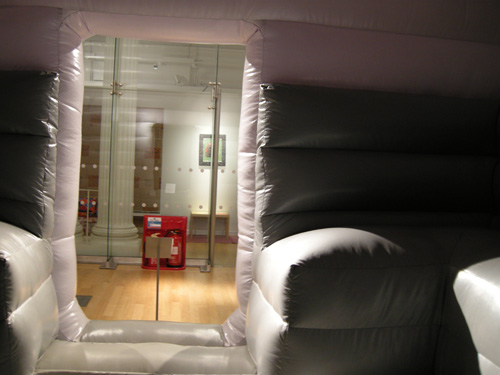
The only non-blurry photo I have from the inside of Mungo Thomson's Skyspace Bouncehouse.

I know the hours of 11-4 may be unfriendly to those with day jobs, but fear not: we’ll be making the most of the MoR blog at http://ministryofrules.npugh.co.uk/ and there could well be more chances to get involved remotely such as the Find-an-Interesting-Sign challenge that readers of this blog so wonderfully road-tested last week.

I’ve ordered the Inspector ID badges, requested the colourful wool and located the large box full of assorted sticky tape. We found a fox in a box, too, but apparently that’s just normal museum stuff…

Fox. In a box.

Sonar goggle sampler

I’m one of six artists currently taking part in Fierce‘s Platinum professional development programme. As part of the early doings we each ran a 30 minute workshop to introduce everyone else to an element of our practice.

Since I’ll be using Platinum to explore possibilities for applying elements of playfulness and interactive/responsive technology to my core interest of investigating interactions with spaces, part of my workshop included a chance to sample the sonar goggles I made for the game The Bloop last year. More on what the first part of the workshop entailed later…

Although I was on invigilator duty to make sure everything was running safely etc, I still managed to get in some observation and even take a few photos.

The goggles drew a lot of interest from the other people in that part of the arts centre, and a few people from outside our workshop also wanted to take part. Who am I to say no?!

What’s struck me most, looking back at the photos now, are the different hand and arm positions…

Make life easier: how to sign up for Google Docs

I’m in the middle of no less than 3 projects at the moment that would each be made that much easier if everyone involved could work collaboratively on various documents. Artists, teachers and museum staff; lists, budgets, plans and texts.

Unfortunately, a lot of the online collaborative tools I take for granted haven’t filtered out into general use and suggestions of using things like Google Docs are met with everything ranging from blank looks to outright terror. Then we’re stuck using group emails where confusion and time delays generally make things harder than they need to be…

Here then is a quick guide for the uninitiated. We’ll work through setting up a Google account and from there you can access a whole new world of getting things done more easily!

***

You need a Google account

You need a Google account in order to be able to access Google’s free services. Files etc are stored online, so this is needed to match you up to your stuff. The sign up is minimal – you won’t need to share lots of addresses and personal details – and is well worth the couple of minutes spent.

Do I already have a Google account?

NB. A Google email account is not the same as a Google account.

If you already have a Google email account (gmail or googlemail) then you automatically have a Google account and can skip a few steps.

If you don’t already have a Google email account a) it’s worth thinking about – free, excellent spam filters etc etc but b) don’t worry, because you can hook up an alternative email address (eg hotmail or yahoo) to a Google account and access lots of great tools anyway.

These instructions assume you don’t already have a Google account…

Sign up for an account

Follow this link to the sign-up page.

Creating a Google account - click on this image to see a larger version

Fill in your existing email address and give yourself a password. This will be what you will sign in with in once you’re all set up. The password is for your new Google account, not the one you use to access your existing email account.

Fill in the remaining parts of the form and click the button to send it.

Confirm your account and verify your email

All being well, you’ll see the confirmation screen. If you’ve made a mistake filling in the form then you’ll be sent back and you’ll need to fill in the bits with red error messages again.

The confirmation screen looks like this:

Confirmation screen - click image to see a larger version

It’s letting you know your account has been confirmed, but that you need to check your email for a message to confirm that the email address is correct.

Go to your email account and open up the email from Google. If you can’t see it in you inbox, then double-check the spam folder.

The verification email - click image for a larger version

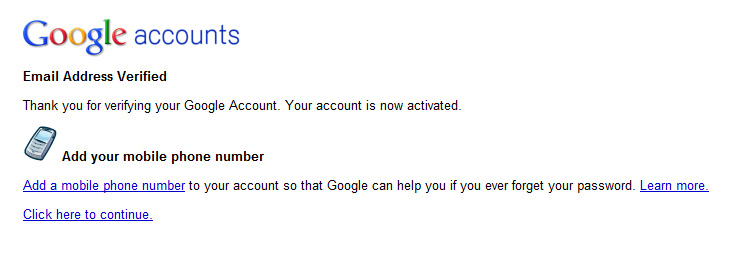
After clicking on the link it gives you, the following page should open in your internet browser:

Verification verified...

I’ve never linked my mobile up to it, but that’s not to say you shouldn’t if you want to…

If you click on the last line “Click here to continue” then you’ll be taken to the next stage in the sign up process. Oh wait! There isn’t one!

You’re in!

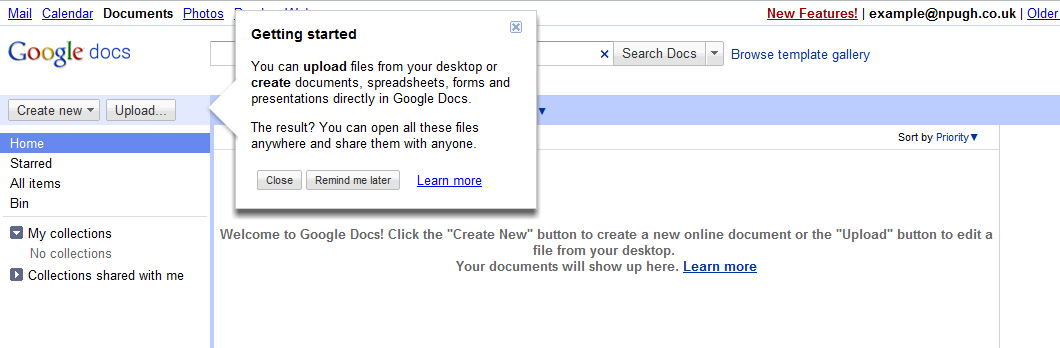
That continue link takes you straight to your new Google docs area!

Welcome to Google Docs

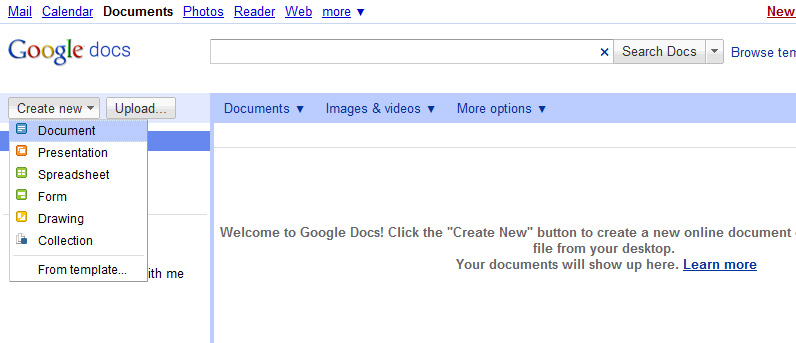
It’s empty at the moment because you haven’t created any files yet. If you go to “Create new” in the top left hand corner you can select what type of document you’d like to create. The selection is fairly standard.

Drop-down menu for creating new documents

Getting back in again

All good, but how do you get to your docs normally, now you’ve got an account?

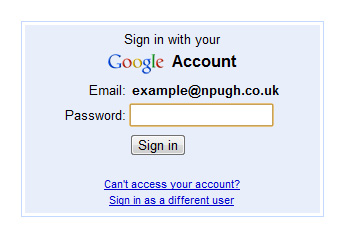
Click on the “sign out” link in the top right hand corner. You’ll be taken to a sign in screen.

To get to here at a later date you can either:
a) bookmark this page now
b) google “google docs”
c) go to docs.google.com/

Sign in area

To sign in you will need to enter your email address and your Google account password. Click on “sign in” and you’ll get back to the area where your docs are kept.

Doing stuff

From here I’ll hand you over to the official support pages.

If you’re comfortable working with word processors and office suites already, creating and editing documents should be fairly intuitive.

It’s the collaborative aspect that makes this useful for project work though, so make sure you read the pages about sharing documents (so others can see what you’ve written) and collaborating (so others can edit the same document with you). If you’re working on a project with me, at this stage I’ll probably invite you to collaborate on a document I’ve set up.

Other useful things to be aware of are things like the chat window you can use when 2 or more collaborators are online and working; uploading and exporting from and to other formats; using forms to do surveys etc and automatically enter the responses into a spreadsheet.

Onwards to a shiny new collaborative future!

edit 06/02/2011:

Testing, testing…

Please ensure the gate is bolted after entry and exit.

I’m test-driving a few ideas and approaches in preparation for a week in residence at New Walk Gallery as part of their Play Ground exhibition programme:

What rules do we follow in galleries? What rules would you most like to break? What new rules would you write?

The Ministry of Rules (MoR) is a fictional organisation that will be based in the Play Ground exhibition. The MoR needs your help to research, observe, explore, enforce and re-write the rules people may or may not be following in the art gallery and museum.

As part of this I want to check having a Flickr account that people can post to. Would you help me out, please?

I’m looking for examples of signs and notices with some sort of imperative about them. The theme is rules, so the sorts of things that tell you to do this, or not do that or that such-and-such is forbidden.

I suspect road signs and other massively mass-produced signage might get a little dull, but there are loads of examples out there that are custom-made or more interesting because of their context. Can you help me hunt them down and then email them to church20arts@photos.flickr.com ?

Just add the photo as an attachment and, if you want, put a title as the email’s subject. The photos will get posted to this photostream: http://www.flickr.com/photos/therepositoryofrules/

I’ll leave it running for about a week to see how it shapes up. Get noticing!

Things we have learned #1:

You can add descriptions for the photos in the main text of the email. If your email automatically adds a signature with your contact details etc, you may wish to remove it…

Things we have learned #2:

If you don’t add a title via the subject line, Flickr will use the file name of the image.


Copyright and permissions:

General blog contents released under a Creative Commons by-nc-sa license. Artworks and other projects copyright Nicola Pugh 2003-2026, all rights reserved.
If in doubt, ask.
The theme used on this WordPress-powered site started off life as Modern Clix, by Rodrigo Galindez.

RSS Feed.