Archived entries for pervasive games

story for a flow chart

I’d be really interested in hearing more about who you consider your influences or precursors in installation art – I’m vaguely drawing up an enormous Flowchart Of Pervasive Games And Where They Come From And All That Sort Of Thing, which is obviously never going to be even slightly exhaustive but which might be fun to have around. I don’t have much from installation art there – any suggestions?

Holly in the comments for a previous post

I was pretty rubbish for about the first 2 of my 3 years doing A-Level Art and Design, so I’m guessing this happened in about 1996/7, after a certain rollicking from Hillary regarding some lino prints got me thinking more about process and journey.

I got the train up from Southampton to London to Go And Look At Some Art. I think what I did was to rock up, find a newsagents, have a flick through Time Out and see what looked interesting. …and so I ended up in somewhere I think was probably Mile End.

This was a part of London I’d never been to before and it was all pretty scary. When I finally found the address given in Time Out, the building was big, not at all what I was expecting (like an old town house or civic building of some sort) and very locked looking. In fact, very boarded-up looking…

After a bit of hesitation and hopeful looking around for any indication at all that this might have been a gallery, I plucked up the courage to ring the buzzer indicated by a note attached to the door that might have been referring to the art I was seeking. When the door was opened, and the correct place had been confirmed, I was led inside and it became apparent that the building was well on its way to becoming derelict: I was guided around holes in the stairs and there were bare floorboards and bare wires.

A few storeys up, we came to a door with a small wooden chair placed next to it.

I was to go inside and be careful. The man would be waiting for me outside.

The dark room I stepped into was one of those where there would ordinarily have been 3 or 4 steps down from the door to floor level. However, the artist had constructed his own floor that began at door level and then cut through the room sloping both up and away towards the back of the room and also from left to right. The new floor was made of metal grill, so as my eyes became accustomed to the dark I could begin to make out the cables snaking across the original floor below, a couple of vertical columns piercing up through the grill from below and also some faint light associated with those columns.

I slowly made my way across the metal structure, all the while aware of my location in the middle of the room. Approaching and then looking down into one of the columns, it became apparent that there was a monitor at the bottom showing some video. I can’t remember much about the video, except my impression is that it was a blueish monochrome and the images might have been abstracted shots of human bodies. I don’t recall there being a narrative or a soundtrack (although there might have been sound).

…and that was it, really: a wonky floor and a few monitors you could look down on through rectangular tubes. I was in there for so long that the artist sat waiting outside was wondering whether he should come in and check on me!

When I did finally leave the room, I was invited to chat with the artist for a little while. I’m not sure if he and the other artists working in the building were squatting or not, but he was living – for the time being at least – in a small room not much bigger than the mattress on the floor and cooking from a primus type thing in the corner.

We talked for a bit and then I left to continue my day of art-looking.

I don’t remember anything else I saw that day.

I do, however, remember telling the story of seeing that installation over and over again when I got back to college. My tutors were concerned that I had put myself in danger, and in retrospect I probably had. Fortunately though, it had all worked out fine and for the last year of that A-Level my work was predominantly installation-based and so much the better for it.

***
So, an experience of installation art that had a big influence me. If we’re drawing lines from that day to my thoughts and doings with pervasive games now, it would be tempting to label them thus:

  • Following a scrap of tempting information into the unknown.
  • Pushing beyond the edge of your comfort zone.
  • Putting your trust in strangers.
  • Only you and the other thing.
  • Experiencing with all the senses.
  • Forgotten or overlooked spaces.
  • Because we want to make something.
  • Sharing the story afterwards.

London and Tokyo, via Bournville village green.

Since doing an exchange visit there in 2005, my contact with Joshibi University of Art and Design and its students has included: helping to host their exchange students coming to Birmingham; effectively working there as a technician for a month; countless days just sort of hanging out there; keeping in contact with several pupils and alumni, including visiting their homes and having them stay with me in the UK; and hearing from alumni friends their tales of working as artists post-graduation and their encounters with graduates from other universities. As a result, I have a pretty well-formed idea of some of the things I would like to do to shake things up a bit, beyond my low-level “So, have you ever considered showing your work, outside of a gallery context” vibrations.

In 2006, 2007 and 2008 I also coordinated and delivered the social programme as part of the annual Joshibi Summer School. This involved sorting out all the pastoral and evening/weekend social stuff for the 30-or-so students who would spend a month based at Bournville Centre for the Visual Arts (BCVA).

We’ve had many conversations about how the Summer School programme could be improved. The main problems from my point of view are that the students arrive as a group; take over a block in a halls of residence as a group; are the only group studying at Bournville over the summer; have an interpreter with them the whole time; and have negligible contact with anyone outside of the staff and the other Summer School students. They may get to experience something of a different way of approaching art education, but there’s a lot missing in terms of cultural exchange and development of language skills.

I decided I didn’t want to work on the social programme this year, but was later invited to provide a day’s teaching for the Summer School. Based on last year’s werewolf success, and my recent work with BARG, there was no doubt that a game would be involved.

dead pikachu

My contribution was to form a starting point for a larger project where the students would go on to develop work that contrasts London and Tokyo. I ran two workshops in the morning where we compared the places in Japan they recommended I visited to the places that actually had meaning to them in their day-to-day lives. This got us from guidebook staples such as the Emperor’s Palace and Kiyomizu-dera to stories of favourite ice-cream shops, overheard sounds of children playing in campsites and stars as seen above car parks.

We also looked at the landmarks that we give significance to in our journeys through landscapes that we are very familiar with. Taking our journeys to university as an example, we drew maps and uncovered more stories. I’m familiar enough with the bus ride to the Joshibi Sagamihara campus that I could recount my personal map of that journey and compare it to theirs. This experience lasting only a few seconds is so completely and vividly on my map that I’m genuinely shocked to realise now that it’s a memory from 4 years ago.

As expected, the smell of the chicken farms featured prominently in the cycled versions of the journey…

question card

For the afternoon, I’d prepared a scavenger hunt around Bournville Green and the surrounding area.

This was designed as a team game, but with significant components where each student would be very much working alone (…unless they plucked up the courage to ask passers by for assistance!). Use of the Japanese language was, of course, banned throughout.

consultation

The students randomly selected a question to tackle and then had some time to discuss it with their team mates. The questions were worded to avoid typical Japanese constructions of English. I also tried to avoid making them so simple that no discussion was needed to fully understand them.

Examples include.

  • There is a car park at the Western edge of the park. Around it, with one end in the ground, are wooden “dragon’s teeth”. How many dragon’s teeth are there?
  • Stand between the Porter’s Lodge and the church. Look at the church. Can you see the carved wooden panel? How many flowers does it have? What is the man holding in his left hand?
  • Go to the chemists and find a lilac-coloured dog hanging up by a door. What colour is his collar, and how many diamonds are on the front of it?
  • In the alleyway between the chemists and Louise’s, there are some old style posters. What is the name of a UK city written on one of them?
  • Go to the butchers shop. What is the name of the sheep on the counter near the window?
  • Go to the Wyevale garden centre. There is a scarecrow near one of the doors. How much did his hat cost?

There were a range of strategies employed in designing the questions. Some of them, such as the sheep’s name question above, could only be answered if the student asked the appropriate question of the relevant shop keeper. Others would be made infinitely easier if they asked a member of the public for help in explaining what a particular word refers to (e.g. dragon’s teeth).

The other major aim was to get the students out and into parts of Bournville that they would never normally go to. This had the intended bonus of meaning that I had to seek out these places first. I was a student at BCVA for 5 years, and yet there were so many places in that tiny area that I had never been to until the planning stages of this game. I had lots of adventures and conversations: so much of Bournville is hidden away in a secret second-layer-back, and there are some truly class acts working there.

I was also determined that I would work with what was already in situ, and not parachute in any foreign bodies to plant for the game. The sharks, Iggle Piggles and Bill Oddies were all there already, waiting to be discovered and played with.

Right, so we had the basic mechanism of having to go to places and find answers to questions. The other aspect of the game design was about how to make this an intense, sometimes visceral experience.

tech amnesty

Prior to explaining the game rules, we’d confiscated (in a nice way!) all their mobile phones, electronic dictionaries and phrasebooks. This was originally done to ensure that looking things up didn’t replace discussion, but I think it also had quite a wrenching effect, because this technology is usually very heavily relied upon.

maybe the man with the plant knows where the garden centre is

I deliberately made it so that, after the initial discussion phase, each player then had to go off independently to find the answer. This took away another safety net of group decision making.

The other thing to do was to add a magic vest in the form of some hats for the players to wear whist they were out and about.

consulting the map

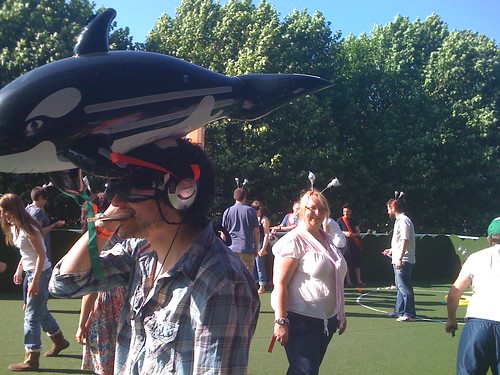
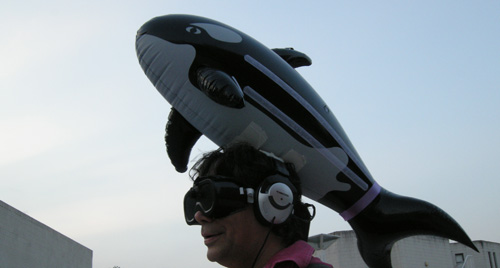
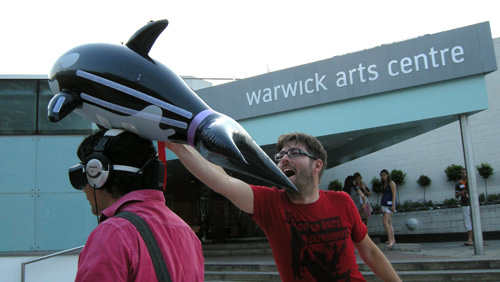
This covered my usual criterion for having an element of silliness involved in order to break down a few barriers, but as Holly Gramazio pointed out at Hide and Speak, your players look like criminals and, if the students were going to be in the bank counting CCTV cameras, I wanted it to be clear that they probably weren’t dangerous! The “help me find stuff” labels on the hats were intended as an invitation for people not involved in the game to approach the students and initiate conversations.

The weather was drizzly, the students were extremely tired after spending a long weekend in London (not to mention the jet lag!), energy levels were low, and I had to tweak some stuff on the fly to increase the pacing, but it all worked! It worked a treat!

magic hat and green

run

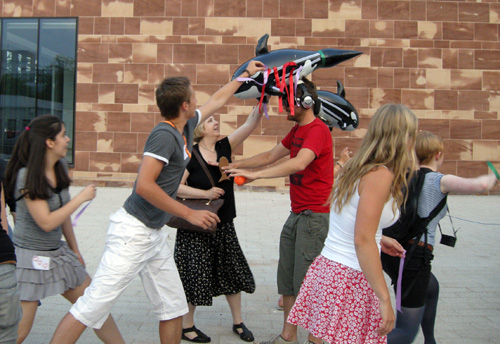
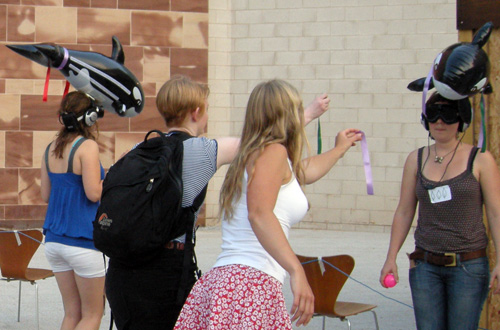
It was great to see the balloons bobbing around on the green and in front of the parade of shops. It was fun to see the teams playing jan-ken-pon to decide the next runner, but substituting diddle-diddle-dum lyrics so as to avoid the 50 point fine for speaking Japanese. It was satisfying to hear small groups of students with nothing to do standing around and chatting in English. It was worrying to hear that one girl hadn’t been seen for 25 minutes, but heart-warming to hear from the search party that she’d been found in the park with a gang of kids around her trying to help her solve her clue. We giggled to hear the story of people offering to help count dragon’s teeth. It did nothing less than warm my cockles to hear someone describe the hats as being magic, a comfort, and to thank me for making them wear them.

relocation of the Bournville factory, as explained through the medium of leaves

thinking hat

changeover

All three teams did really well and the rain mostly stayed away until we had finished playing. The final scores were in the region of 120 points (average 10 points per question) with only maybe 4 failed questions per team.

I finished off the day with a more formal presentation about the use of mechanisms and rule sets to instigate interactions with spaces; how presenting something as a game contrasts with presenting it as a piece of performance artwork; the importance of stories; the importance of magic vests/hats; the importance of silliness (and how it’s easier to be part of a large group doing silly things rather than being by yourself doing silly things) and how doing projects in public spaces confers ownership of that space to you (in the sense of responsibility and empathy, rather than of power).

Anyway, it looks like I may yet end up doing some social stuff with the group on Saturday: I may take the opportunity to quiz them on how the game has affected their perception of Bournville…

loudnoisesandflashinglights

Stuff to follow on from and slot into the Playmakers conversation here and here.

I originally named the Synapse the Synapse because I imagined the arduino-powered, instruction-delivering oojamaflip to be at the head of a chain of people, something a bit like a neuron.

synapse sketch

functions

I’ve just now discovered courtesy of wikipedia that:

The word “synapse” comes from “synaptein”, which Sir Charles Scott Sherrington and colleagues coined from the Greek “syn-” (”together”) and “haptein” (”to clasp”).

Which is even more apt; so if anyone asks, that’s my story and I’m sticking to it.

So right, the question is how to give as many members of the playmakers teams (usually about 15 people, I think) important jobs to do. (NB important does not necessarily equate to sensible.) Rather than thinking of the camera as a huge physical device, I see it more as a large mass of people having to move in unison. On the Ludocity forum I initially suggested remoting the power supply to the video camera so that several people had the responsibility to keep switches closed in order to keep the camera filming. This was an extreme example, and probably not one you’d actually want to do because the stakes are a bit high if someone breaks the circuit and the camera loses power. You’d have to stop play and get things set up to start recording again = too much of a handbrake.

So, back to the old staple of loud noises and flashy lights. Loud noises instantly draw attention to the players both from bystanders and from other teams they may be trying to sneak up on/away from. Flashy lights because if you’re watching playback on 3 screens simultaneously, you’re not going to be able to identify which camera the sound came from.

your players will look like criminals

At tonight’s fizzPOP I hacked together a bike light, an attack alarm and a couple of push-to-break switches to see if the approach looks like it’s got legs. Both switches have to be continuously held down or else lights will flash and noises will be noisy.

After the session the other hackers were kind enough to humour me and help give it a little test. It was raining, but fortunately we were in a building next to a railway viaduct, so we headed for that.

loud noises and flashy lights from nikkipugh on Vimeo.

Can confirm lights are bright enough and noises loud enough.

Prior to going outside, we’d had a really good discussion about the Playmakers project, possible roles of technology and what were appropriate roles of technology.

A really interesting idea that bubbled up was what would the scoring be like if you could use augmented reality software to recognise the presence of players from other teams and therefore automate durational scoring? We imagined ridiculously big It’s a Knockout style marker images being carried around the streets.

Could have some interesting implications for superimposing graphics over the videos during the playback too…

Anyway, back to loud noises and flashy lights. From the test we learned:

  • Switches need to be more tricksy: maybe tilt switches or something that rely on the position of whatever you’re carrying – push buttons as they are are too easy to hold shut.
  • Things will get interesting with upwards of about 5 people in a chain.
  • The camera person needs to be quite a way back from the loud noise and flashy light device…
  • … but I like the way the video shows the team doing stuff, having the camera pointed down the line like this.
  • Croc clips can’t be relied upon if you’re running around!

Synapse

Back in April I finally got to go to play at the Sandpit.

One of the games I played before dashing off to get the last train was Shrine – the 2nd iteration of the Playmakers project to crowd-source contributions towards developing a new pervasive game.

Did I mention the train journey home? Good. It was quite a long one and I had lots of thinking time to mull over what I thought of the game and how it might be improved.

I think the game’s been played several times now with varying rules that I’ve not really been keeping track of. Key components are (I think) 3 teams of about 15 players, each (teams, not the players) with a flip video camera on a large tripod and running around to film different objects/actions/people within a set time to score points. The teams then assemble together to watch all three videos being played back at the same time and some sort of scoring takes place.

BFI, May 2, Playtest #3b from Hide and Seek on Vimeo.

These are the main areas that have been identified as needing some thought (reproduced from the Ludocity forum):

  • So, the video playback – is it fun to watch, should it be more fun? How should people be filming? Is there some way to make the videos… prettier, and if so is that a desirable end, or should the focus be purely on making it easy to score?
  • One of the problems with the basic game is that it’s very open to one player grabbing the tripod and running off, and some of the players feeling peripheral or not having anything to do. Should there be more roles for specific players? Different jobs to do? The traitors were a step towards this, as were the encoded clues, but should it be clearer, more extensive? What should the different team members be doing?
  • How is the game introduced, how should the rules be explained? Should there be actors? Pieces of paper in envelopes? Skywriting (we can’t actually afford this)? Should it be part of the game, or clearly set apart from it?
  • So, there’s a tripod. There’s a video camera. There’s a brightly-coloured feather-duster. But maybe there should be something else… a mobile phone, ringing with extra tasks, or letting teams communicate with each other? Some sort of tiny computer doing… something? GPS tracker?
  • The game will be played at the H&S Weekender around the Southbank Centre, and it’d be nice if the basic game could work in a variety of locations, but what’s happening in the space? How far should people go, and what’s there when they get there? Is there a secret dance extravaganza that they need to find and film? A hot air balloon (this is another thing we can’t actually afford this)? Something happening, something installed, something participatory, something they need to create themselves – what’s there?
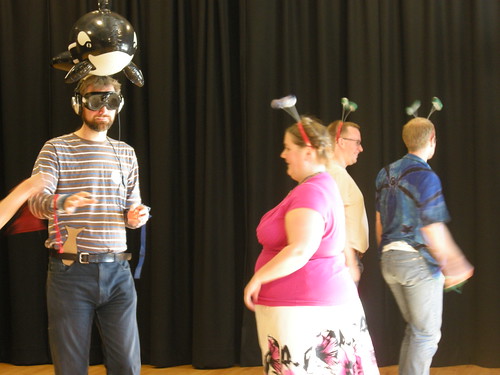
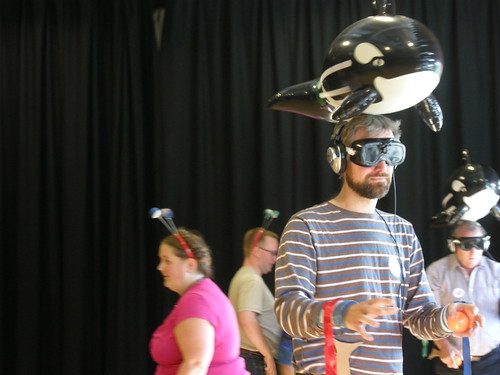
  • At the moment, there’s the tripods; there are sports bibs. That doesn’t have to be the case. Maybe there could be different costumes for different roles within a team; or maybe the people presenting the game need costumes, or someone running around the space as a target has a costume, or something else entirely. Maybe the tripod isn’t a tripod, but an enormous teddy-bear. Maybe it’s a balloon that’s gradually inflated over the course of the game. Maybe it’s a perambulator with a goldfish bowl inside, who knows?
  • One problem with the game as it stands is that there’s not that much of a feeling of good gameplay being rewarded. The balance of points for filming targets and opposing teams isn’t right; adding extra ways to get points (for example, by identifying traitors successfully) doesn’t necessarily work with the rest of the game. So, how should scoring work – how many seconds of filming another team’s tripod, for example, should be equal to successfully finding all the targets?
  • How should all these different components fit together?

I like those questions a lot. Seems to me it’s a basic arsenal of interrogation for any game designer to ask of any game they’re designing. Bing! Preserved here for future reference!

In this particular instance though, the two I’ve homed in on are how to make the video work (in terms of making it watchable and also making it scoreable) and also how to ensure that all team members have roles to play.

Meanwhile, I’ve recently made and used The Anticipator. Techy GPS thing hidden innabox in such a way that it becomes a prop for getting a group of people to work together as a team. Round 1 was with primary school children and now I’m thinking about how to apply this to BARG-related stuff.

So, something I want to explore that can easily be attached to a live project with real design criteria and real deadlines.

…I spent the weekend doing some rapid tinkering ahead of meeting up with some of the Hide&Seek folk at an event tonight…

I now have a working prototype for something I’m calling the Synapse. It’s basically a portable arduino-powered device that buzzes and flashes out a sequence of warnings and cues for players to do stuff.

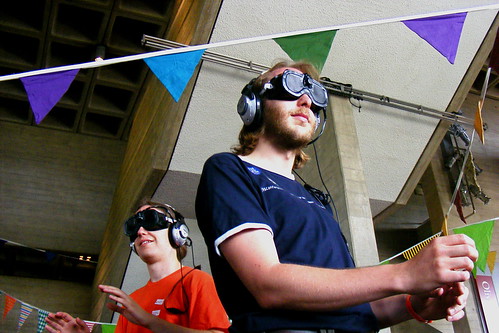
Because the timing is now independent of any filming taking place (when I played Shrine it was done off the flip’s counter: cunning, but caused a few problems) players can take their time to get into position and check the equipment is all working ok. The LEDs and buzzer also make it really easy to sync up multiple films.

The only thing left to do now is to figure out how to use it…

Here’s my first test:

Synapse test #1 from nikkipugh on Vimeo.

I was struggling before with matching up the concept of the film documentation and the style of game-play. They didn’t seem very compatible somehow and the end result was some meandering video that [during the scoring for the version I played in] wasn’t in step with those from the other teams and just wasn’t that interesting to watch[Disclaimer: I haven't particularly watched any of the video from the other games. They might be very different ...or that may underline my point...].

I had a bit of an epiphany when I changed the way I was looking at things and rather than seeing a game followed by a scoring phases that conveniently produced some film documentation too, saw it as teams competing to produce the video that would beat the other videos.

That and seeing the collated videos as a film that therefore needed moments of tension and conflict and suspense in order to keep the audience interested. (Humour’s a given in this situation, I reckon.)

So, each team has a task to do. It could be filming objects or actions; it could be finding things; it could be collecting objects. It’s the background action of putting balls in holes. (Collecting physical objects would make it a lot easier to score this aspect, rather than the durational stuff we were trying to do in Shrine.)

Interjecting into this are the unnecessaries – the tasks you have to complete when the Synapse gives you a very defined time limit in which to do them in. These are like jousting an invisible opponent – you either have to be the best imaginable or put your fate down to chance… Will it be rock paper scissors, will it be doing the best improvised dance routine or will it be waving a flag at a checkpoint?

The synchronised unnecessaries where each video component goes head-to-head with the others are what potentially start to make the videos into a film.

I have plans for how to develop the synapse as a way for making several people work together, but for now let’s just get some feedback on what we’ve got so far…

w i d e o p e n s p a c e

Edit 10th May: Scroll down to the comments to see links to documentation of the event.

w i d e o p e n s p a c e brought to you by BARG Saturday May 9th, 2pm – 7ish suggested donation: £3 per player

w i d e o p e n s p a c e is an afternoon of fun, games and picnics around the Curzon Street area of Birmingham. Come and explore the terrain and its possibilities with us. All are welcome although we ask that parents bringing children keep an especially close watch on them. We’re asking people to make a donation of at least £3 each to help fund future BARG events.

Sign up at http://is.gd/vqYz to let us know if you’re planning to join us.
A .pdf of this information is available for download here.

Programme:

Here are the games we’re planning to run. (But there will also be plenty of opportunities for you to invent your own!)

Hat Snap

(variant of a game designed by Krzysiek “Semp” Bielecki)
The first game runs between 2pm and 3pm, with sign-up in the Bullring shopping centre at the cube seats near Baguette du Monde and Café Rouge (the open-air bit between New Street and Saint Martin’s Square, [1] on the map, see below) between 2 and 2:20.

You will need to bring a digital camera or a camera phone and it will be to your advantage to not be carrying too much other stuff. If you’ve brought a big delicious picnic with you, you might want to sign up at the front of Curzon Street Station ([2] on the map) and leave your baggages with our stewards.

Players will rendezvous at the Curzon Street Station building at 2:40 to tally up the points and determine the winner ([2] on the map). Full instructions will be given to you when you sign up; it’s up to you to decide on your strategy…

The Lost Sport

(rediscovered by Jane McGonigal and Kiyash Monsef)
The Lost Sport of Olympia is believed to be a 2500-year-old game invented, and ultimately banned, by the Ancient Greeks.

At 3pm we will move to the Curzon Street car park (probably the bit at the back, between the skaters and the railway lines, [3] on the map) for a team game with no opposing team: listen carefully as your team-mates guide you around a labyrinth. Make sure you’re wearing shoes you can run in.

Picnic

(designed by you!)
Not a game, but still very enjoyable!

Bring some food and join us on the grass area in front of the station building between about 5 and 6 for a leisurely picnic ([4] on the map). Sharing of food and ideas encouraged!

Bocce Drift, Croquet and GPS Sketches

Grab a few friends and have play with these things that will be available after the carpark bit. The rules for Bocce Drift (designed by David Jimison and Jeff Crouse) are here: http://ludocity.org/wiki/Bocce_Drift and we encourage you to invent your own rules for croquet (bear in mind it’s a borrowed set though – please don’t damage it). As an additional challenge, we’re asking for people to bring along random (non-valuable/non-dangerous) spherical objects for some further games improvisation.

2 iPAQs will be available for you to use to record your movements around the area: what pictures can you make? After the event we’ll convert everyone’s tracks to a Google Earth file so we can see what people drew. (You’ll need to leave your credit card or driving licence as a deposit for the iPAQ.)

Human Snake

(designed by Minkette)
You’ve seen the game played on mobile phones, now it’s time to play it in real life. Conga around between 6:30 and 7 to collect the fruit before the other team gets it first.

The Weather

A game of chance.

In the event of bad weather, w i d e o p e n s p a c e will be cancelled. We will announce the final decision on whether it will go ahead or not by 11am on Saturday the 9th of May. The announcement will be made via http://twitter.com/pindec, http://twitter.com/genzaichi, here and http://bargbarg.ning.com/events/w-i-d-e-o-p-e-n-s-p-a-c-e so please be sure to check if the weather looks a bit dodgy.

In the event of good weather, please make sure you bring the appropriate hat/cream/parasol to stop yourself getting sunburnt – there’s not a lot of shade available around Curzon Street.

The Map

(Click to embiggen.)
wide open spaces

The Small Print

w i d e o p e n s p a c e is an exercise in exploring a part of the city that is currently something of a wasteground. We’ll be playing in unloved areas that may be littered with things like rubble and broken glass, so if you’re joining us we ask that you dress appropriately and be especially careful of your safety at all times. Play at your own risk, etc etc, but have fun and spare some time to look at the cityscape in a new way.

BARG is a Birmingham-based network for playful people who like to make and/or play interesting games.

A game for Curzon Street would…

the Curzon Street area

  • A game for Curzon Street would be designed for the Curzon Street area, and for the Curzon Street area only.
  • A game for Curzon Street would make reference to Curzon Street’s past. [wikipedia entry] [rail around Birmingham entry]
  • A game for Curzon Street would make full use of how Curzon Street is now.
  • A game for Curzon Street would make people explore.
  • A game for Curzon Street would make people interact.

The London & Birmingham Railway, Curzon Street Station, 1838

Curzon Street car park

I’d like there to be a game designed specifically for this part of Birmingham.

BARG will be hosting an afternoon of play and picnics in the Curzon Street area (image of the full area) on the afternoon of Saturday the 9th of May. We can playtest either complete games or partial mechanics …or make something up when we’re there.

Consider that a challenge.

Call and Return and the Ludogeographers

On the 19th of September, players of Call and Return will start to tackle a series of creative missions that will send them out across the city exploring places, materials and the way contemporary culture permeates through them.

The city in question could be Birmingham or Tokyo, Bristol or Kyoto, and as well as negotiating their immediate surrounding, players must also negotiate interactions with other people across different geographies, languages and time zones.

An avatar explores the streets of San Francisco

Call and Return is the second in the Emergent Game series: projects that investigate group dynamics, collaborative creativity and the use of digital technologies to adjust how we relate to public spaces.

Missions are not location-specific, so players can be based anywhere: all you need is access to an internet connection, a sense of humour and a soft toy to represent you in the game (we play anonymously).

Instructions on how to sign up can be found here:
http://ludogeography.org/projects/callandreturn/
(don’t worry, this is the most complicated bit of the process – it gets easier from here on in!)

To complement activities taking place on-line (once again most of the conversation will take place via twitter.com) there are opportunities to get involved in various events:

Monday 8th of September
Workshop at hanare, Kyoto
http://hanareproject.net/workshop_lecture/index.html

Saturday 13th of September
Workshop as part of the Dislocate08 festival, ZAIM, Yokohama
http://www.dis-locate.net/workshop2.htm

Then we pull together the contributions from the workshops and on-line conversations in a weekend of creative missions as part of a festival of pervasive games in Bristol:

Friday 19th – Sunday 21st September
igfest, Bristol
http://igfest.org/

Loki and Yohmoh explain emergent game to Simon at igfest

It doesn’t matter if you can’t make it in person to any of these events – remote players have an equally important role to contribute. Sign up now to join the conversation and influence the directions the game goes in. For a flavour of what it might evolve into, see the Emergent Game website for what happened last time.

Ludogeography

Call and Return is a project initiated by The Ludogeographic Society. The Ludogeographic Society grew from collaborations central to the development of the first Emergent Game earlier this year: Ana Benlloch, Stuart Tait and myself.

To coincide with Call and Return, we are also launching www.ludogeography.org where we will document the activities of the Society. Likewise for http://twitter.com/ludogeography: if you use Twitter follow @ludogeography for updates on what we are doing, or perhaps just subscribe to the RSS feed.

Call and Return is supported by:
Arts Council England
Dislocate 08
hanare project
igfest

Thanks also to Antonio Roberts and the igfest volunteers for helping to staff the Bristol activities.

Hide&Seek 4: Gype and etcetera

All the other stuff that happened as part of the Hide&Seek festival was great, but the highlights of the day for me were what happened after the festival had officially finished.

The hardcore gamers loitered around for half an hour or so, not yet ready to concede that it was time to wrap up and go home. A few people were constructing a board game from rules appropriated from different parts of the festival, the stewards were starting to take down the banners and one of the iglab Simons was pootling around on a little orange bike…

Then somebody suggested KerPlunk and half a dozen of us huddled in the corner playing with straws and marbles. One round of KerPlunk (Just for the record, Simon and I won!) was enough to bridge the transition and then suddenly everyone was properly back into game-playing mode and it was clear none of us would be going home just yet.

Gype

I also remember that it was we who invented the well-known and widespread national game of Gype. All sorts of variations and complications were invented in connection with Gype. There was Land Gype and Water Gype. I myself cut out and coloured pieces of cardboard of mysterious and significant shapes, the instruments of Table Gype; a game for the little ones. It was even duly settled what disease threatened the over-assiduous player; he tended to suffer from Gype’s Ear. My friends and I introduced allusions to the fashionable sport in our articles; Bentley successfully passed one through the Daily News and I through some other paper. Everything was in order and going forward; except the game itself, which has not yet been invented. Autobiography_(Chesterton)/Chapter_X

Simon had been proposing a motion that we played Gype since before KerPlunk and, after explaining a bit about the rules (not dissimilar to those of Mornington Crescent), that now took off.

I also had to take off at this point because I desperately needed to take on board more fluids. When I got back from the bar the game was in full swing with 2 pieces of A5 paper, three dice of a sort that I didn’t recognise and the counters from a chequers set.

I haven’t got any photos of this first round of Gype – I was too busy tending to my drink – but you’ll just have to take it from me that it was an awesome thing to watch. These were people who take playing very seriously indeed, given free reign to make it up as they went along. Dare I say there was an element of competition there too…?

Watching it, there was no way you could tell that it was being fabricated on the spot. At one point one of the players drew a distinction between Land Gype and Water Gype in such a matter-of-fact way that I had real difficulty in sorting out fact from fiction. Seriously: probably not until an hour or so later …and now I see the two different Gypes are mentioned in that quote above. Now I don’t know what to think!

I finished my drink and got re-absorbed into the group of players. Another strange position to be in as you try and dream up a creative move for your turn, but the landscape keeps shifting so much after the moves made by previous players that it becomes all but impossible to do anything but wait and then react spontaneously when it’s your go. I found out later, via Jane’s post, that this had been designated a game of Speed Gype. I’m not sure if this was just a follow on from the Speed KerPlunk we had been playing before, but it’s a really nice tweak to keep the pace up and get the creativity flowing nice and fast without too much analysis.

As it happens, I was just planning how I would see if I could score some points by throwing the dice at each of the three counters in the central triangle formation when Simon, the player before me, used a tablecloth move.

Our reaction was similar to that in the video and, to an enthusiastic chorus of “GYPE!” Simon was declared the winner.

Fort Gype

Turns out Speed Gype was just the warm-up.

We then moved over to a court that had been marked out on the floor earlier in the festival (possibly for freemasons) and Fort Gype began.

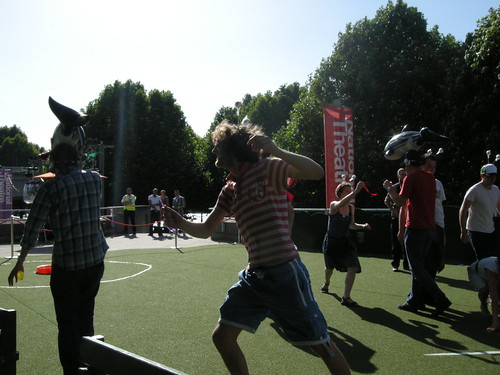
Fort Gype follows the same sort of rules as Speed Gype, but utilising the cool Southbank Centre squidgy furniture to (we assumed) build a fort. Spectators from the last game joined us as players so we were probably up to about 20 players now.

the Gype players await

The opening moves were fairly straightforward placements of the furniture, with the occasional “lock-in” move thrown in for good measure.

lock in

balance

placement

Things got more interesting once there were more things to respond to. [How about starting a game of Fort Gype with randomly rolling a few items onto the 'board' to kick-start this process?] I was about 10th to make a move and, with my lime green seat-like-thingy I opted for an ‘entrapment’ move with one arm pinned under the furniture. Seemed like a good idea at the time, but the way things worked out I had an increasingly restricted view of what was going on!

gype

From my not-so-much-of-a-vantage point I tried to take a photo every move. You can see the results here on this Flickr photoset.

raising the game

Gype upwards!

As the play progressed we started to build upwards and more and more people added themselves to the structure. I think this would be a really good aspect for Fort Gypers to investigate further: I mean, if you’ve got a bunch of people with squidgy furniture it’d be a shame not to incorporate more bodies, right?! OK, OK thinking like that blatantly goes against the fundamentals of Gype! Still, I would have liked to have played a few rounds to see how things got refined.

Eventually the inevitable happened and the tower collapsed: thereby signalling the end of the game. This was good because then we didn’t feel so bad when the member of Southbank staff came over and informed us how expensive the squidgy furniture was and, sorry to be the bad guy, but would we mind stopping abusing it please…? Fair enough!

collapse

The third bus

There was no escaping it: the festival had drawn to an end and it was time to relocate. After a lot of conferring the general plan seemed to be food and then more games. Several people stated the need for showers before anything else happened and so we arranged to meet an hour later in the middle of Westminster Bridge. By this stage we knew that locating food was not going to be a straightforward matter and would involve getting on the third bus and then, whilst on the bus, figuring out the rules that would allow us to then get off the bus…

I told you these were hardcore gamers.

The last train

Unfortunately for me, the last train back to Brum on a Sunday is horribly early so I had to say my farewells before everybody had even reconvened on the bridge.

Whilst the others got up to whatever banana-assisted adventures their journey took them on, I had my own trials awaiting me: “the train is to long, can you all move forward a carriage please”; delays in leaving Marylebone; the train in front hitting livestock…

Sat in the foyer of Banbury railway station waiting for the replacement coaches to arrive at 1am felt so incredibly desolate compared to the atmosphere I had left a few hours before. The stark difference in attitudes between the pissed-off travellers and the Stag-chasing gamers was huge.

I wanted to suggest a game of Gype or Werewolf, but thought I’d get lynched. For real.

Hide&Seek 3: and the rest

I’ve already written 2 posts about the now somewhat distant Hide&Seek Festival of social games but there’s still a shed-load of goodness to cover so I’m going to blitz it here and hopefully get most of the important bits into the annals.

I’m warning you now: it was a busy day…

Let’s try for a chronological approach so I don’t miss stuff (and also because that finishes somewhere around Fort Gype and that’s a damn good way to finish!).

Cruel 2 B Kind

I missed out on Cruel 2 B Kind due to Twitter flakiness, which was a pain in the bum but there you go. I arrived in the kill zone at 12 on the dot and strolled around a bit hoping to be the victim (or at least a witness) of an assassination by one of the following methods:

  • A: Serenade your victim pleasantly.
  • B: Compliment their eyes.
  • C: Mistake them for somebody famous (be nice, no famous serial killers or Jade Goody please).

It wasn’t to be though so, pausing to take in Volume, I made my way to the Southbank Centre.

Sleeveface

You know the silly seafront set-up where you put your face in a hole and take on someone else’s body? Well, sleevefacing is where you supply the body and a record sleeve provides the face…

I got coerced into this by one of the stewards (OK, OK, I asked him for his suggestion of what I should do first…) and although it took me a while, I did eventually get quite into it.

I was stood around for ages waiting for The Man With The Camera but it was interesting to watch others being arranged:

madonna

couple

This would be awesome with a greater variety of props (or pehaps the other extreme and no props at all). Check out the Flickr pool for some cool examples of some very pre-meditated sleevefaces. However, you have been warned: it’s very addictive…

I had my trusty brown anorak with me, so I opted for a bit of Tony Hancock:

tony hancock

There is a sleeveface website and I also believe I’ve seen some sleeveface-style billboards around town too…

And I Saw

Lists? Compiling lists of noticed things? Lists? Did somebody say lists? Noticing stuff?

Bit of a no-brainer really, of course I was going to wander over to this table and find out what was going on.

And I Saw… describes itself as being a bit like a treasure hunt. And I spy. The difference being that you play by SMS, some of the things you are seeking are mobile, new things are being added all the time and you yourself are being sought.

On joining the game you are given a large sticker with a unique code number on it. You are then sent out into the game zone to seek out other stickers. When you find them you have to text the number on that sticker to the And I Saw… phone number. Because you’ve already registered your number, some automagicery calculates who has seen the most items, which items have been seen the most and which players have been seen the most.

Inside the Southbank Centre was a good place to start because lots of people playing the indoor games were already stickered-up. I was about to head out for the outdoor area (between the London Eye and the OXO tower when I met Lionel Richie again and we got chatting.

We ended up walking together looking for stickers and having a really good discussion about the application of games in our respective fields of work (I think she worked in an adult training sort of context, but I can’t really remember now…) and analysing how And I Saw… was modifying our usual behaviour. This was particularly evident in her case because she was a Londoner and a frequent visitor to the Southbank area.

and i saw...

The things that really worked for me (luckily I have unlimited texts with my phone contract) were a) the way looking for a particular object/objects completely changed the way I engaged with my surroundings and b) the encounters we had with the other seekers playing the game. It was a really nice mechanism for going up to random strangers, sharing a quick exchange and then moving on. I also very much liked the way that most players were developing their own little rituals around what they did when they found a sticker. Most people had fallen into the routine of photographing each location, but others were taking it further and taking photos with mascot toys etc etc.

I only discovered the And I Saw… website fairly recently: turns out I was the 4th most seen player, but only saw a rather pathetic 20 items (compared to angelsk’s 60).

After an hour or so, Lionel and I happened to end up by The Eye as the Cruel 2 B Kind assassins had their end of game picnic. We hung out a bit, chatted, heard tales of trying to assassinate non-players, tales of mass team serenades and generally helped eat the chocolate cup-cakes before they melted in the sun (well, it would be rude not to…).

mscapes

I then had a bit of a gap before the start of The Lost Sport of Olympia and went off in search of padding.

I’ve been lusting over mscapes for a couple of years now, but not had a chance to try it out so, when I returned back to the hub in the Southbank Centre and saw that the mscapes table seemed up and running, I jumped at the chance to sample Duncan Speakman’s Always Something Somewhere Else.

Despite a few technical hiccups at the start, I can only reiterate what the people on the video at the previous link said: a beautifully haunting, in-your-own-world experience. I particularly remember the point at which the voice of the narrator invited me to find some stone and I reached out to place my hand on a pillar of the Thames-side architecture…

London-as-Tokyo

feet

I’d been keeping watch for Momus’ transposed tour, London-as-Tokyo all afternoon, so it was a tough call when I came across them part-way through Always Something Somewhere Else, but I did have to turn off the iPaq and listen to some beautifully wonky descriptions of wherever it was that we were.

Here’s a short extract of them taking about mobile phones and then going off on one about “chotto”.


London as Tokyo from nikkipugh on Vimeo.

Whilst Momus was holding forth confidently on a wide range of subjects it was worth taking a few moments to tune into the reactions of passers-by who weren’t aware of the context for London-as-Tokyo!

The Lost Sport of Olympia

It was as good as I had hoped. More here.

the lost sport of olympia

Stag Hunt

I had no idea (no pun/old joke intended) what this was about but the crowd that drifted back from the labyrinths just sort of evolved into the Stag Hunt crowd and I had no complaints… It turns out the game was massively oversubscribed, but we got around that by working in pairs.

pre Stag Hunt gathering

Stag Hunt rules

A sample ruleset for Stag Hunt is available on the Hide&Seek site or you can listen to/watch the rules as they were given to us on the day over on Vimeo. In brief: approach the stag with two other balloon-carrying team-mates and sweet-talk him into letting you tie one of the balloons onto his antlers. Team with the most balloons on antlers wins.

Once we’d organised ourselves into 4 teams there was a mad dash as, once we’d got a balloon per pair, we legged it outside to try and find the stag.

Purple Team

Stag Hunt


Stag Hunt from nikkipugh on Vimeo.

Getting the first balloon onto the stag’s antlers was fairly straightforward, it was after we’d returned to the Southbank Centre, collected a new balloon and started out to try and find the stag again that things got really interesting…

By this time the stag had moved further away and the initial crowd had dispersed so we genuinely had no idea where to look inside a large playing area (10 mins walk from the Southbank Centre in any direction …except for the river). We occasionally saw clusters of balloons moving around, but nothing that suggested they knew where the stag was either!

We began to ask passers-by (in an incredibly deadpan manner) if they had “seen a man wearing a morning suit and a large white stag mask that people were tying balloons to”. We had an interesting range of responses including: the who-are-these-loonies look; grins; detailed information of what direction they had just come from; and, winding us up with false sightings. This is what really made Stag Hunt for me – the leakage of the game out to include ‘non’-players.

Alas, no-one had seen the stag but we continued to scout around and managed to collect a few more team members before we eentually found the stag again.

Stag Hunt

Time was running out now so there was a frantic succession of attempts to win the stag’s favour as he made his way back down the waterfront towards the Southbank Centre.

Often they involved ruthlessly employing the services of a small, cute child.

The rules were now being much more strictly enforced so there was a leap-frogging effect as threesomes located themselves in the stag’s path, at 5 pace intervals, poised ready to put their flattery tactics into action. It was fab. People were getting really creative! We had serenades, human pyramids, human letter-forms spelling out S T A G (didn’t work) and all sorts. I have no idea what the non-playing public in the area thought must have thought all these nutters with balloons must have been doing. Hopefully there are a few tourists who now believe this is a traditional Sunday-afternoon pursuit…

Stag Hunt points count

Anyway, when it came to the count we (the purple team) lost out on first place by one single balloon…

Anyhoo, I can genuinely say I was thoroughly glad I had taken part. Stag hunt: hilarious, exciting, creative and just plain silly. I would love to try variants of this game that allowed for greater use of tactics in locating and tracking the stag as well as, as Jane asked, interfering with the balloons of other teams.

Things wound up with a great photo-opportunity with a business card that had been planted in someone’s bag (presumably as a trail-head into some new ARG):

triangles

Not going home yet

Stag Hunt was officially the last event of the festival, although there were still pockets of activity and board game construction going on inside the building. Mostly though there were lots of people who know that they should go home now, but also that they really didn’t want to.

I know I promised you Gype, but I’ve decided to put that in a 4th, post-festival post

In Deep End-Dance +1

The Grand Finally of Emergent Game

[warning: this post contains Ludens' speak]

Wow.

Saturday was the big ‘closing’ event for Emergent Game (again, we all seem to have trouble thinking of it in terms of being the end) and, as usual, my head’s full of stuff that I’m going to inflict on you as part of the process of sorting through it and pulling out threads. There are lots of photos to be shared and stories to be told, but I expect this will be done in a different place and in a different voice.

Here are some initial thoughts from the point of view of organising the event:

What is?

Partly through needing some distance and partly through commitments to other projects in the interim, there was quite a long gap between the NGA festival-related part of The Game (up until 20th of June) and the Grand Finally.

Though I didn’t have a lot of time for directly organising stuff, it did give me the opportunity to think a lot about more general things like what sort of an experience I wanted it to be. The event had been presented in terms of being a combination of the City Wide Treasure Hunt mission (coming from random descriptions in the festival literature) and the Ludens’ Tea Party mission – both big scorers within The Game and ideal ways to combine cabaret and collaboration.

As it began to take shape in my head though, I increasing lost sight of this and, especially after going to Hide&Seek last weekend, was thinking more in terms of the types of behaviours I wanted to encourage.

That sounds odd. What I mean is…

…that after much thinking I decided that the aim of the day was not to discover the location of some object or to solve a puzzle; it was to give people the opportunity to do things they wouldn’t normally do, within the framework of a larger context that added layers of excitement such as trying to remain anonymous when you knew there were other Ludens criss-crossing the same space at the same time.

Looking back at it now, I’m wondering if it’s enough to regard the larger context as being the day’s event, or whether you have to include all the play that came before it? Would the Grand Finally have been possible/as successful had there not have been the 2 month’s worth of conversation and interaction that built up the characters and narratives involved?

Certainly when I was planning who should do what, a lot of the missions were based on references to things that had developed out of the game. @egorbeaver was given a lot of tea party themed activities, @cross_triangle’s day was based on glyphs and @LeonHerring got to spend some time at the beach. With other players I knew who they were in real life and so was able to build in references to things outside of Emergent Game.

The other benefit to having been through all the missions and stuff beforehand was that I’d got a sense of what, for me at least, provided the buzz: knowing that you might find yourself at a drop-off point at the same time as another Ludens; having to work with your avatar in public locations; having to either explain to Sapiens what was going on or pretend that nothing out of the ordinary was going on and it’s perfectly normal to be taking photos of this soft toy in this shop thank you very much.

By the time it got to In Deep End-Dance day I knew that I wanted In Deep End-Dance Day +1 to be based around the following:

  • A Common starting point and a common end point (i.e. the pub!)
  • Going to parts of the city you probably hadn’t been to before
  • Interactions with Sapiens
  • Remote interactions with Ludens – i.e. transfers of information and objects
  • Possibility of accidental direct encounters with Ludens – i.e. crossing of paths

That and 2 things to follow up on after a barrage of phonecalls and texts to possibly friendly Sapiens were pretty much all I had to go on at the start of spending the day in town looking for ways to string it all together…

Interactions with Sapiens

In moments of optimism I had thought it might be nice to have Sapiens tweeting in tasks etc over the course of the event, however the degree of interaction from Sapiens up until this point had been, frankly, disappointing so I gave up on that idea.

In comparison, the support I had from random strangers as I wandered around town and made strange requests was phenomenal.

First stop was the Borders bookshop in the BullRing where a supervisor friend volunteered two front-of-store staff to be in on the Grand Finally. Thanks to them I was able to leave several mission packs in a couple of different locations.

richard and judy zone

travel table

Four of the Ludens and two watchers passed through this space in the first hour or so of the event – I’d like to see the cctv footage!

Pen Room typewriter

Likewise, assistance from the staff at the Pen Room really made a huge difference. I’d only had a glimpse of this place a few years ago and wasn’t disappointed on going back for a closer look. I strongly recommend you do the same.

stampts

In the 2nd of the two pen room rooms is was immediately apparent that this was somewhere to send not only cross_triangle, but also the stamptmeister Loki. A big thankyou to Malcolm both for his enthusiasm and his assistance in relaying contents of emails.

A meeting in a coffee shop then secured the assistance of Zebra Scraf Woman on the Fluxus boat trip …and also the name of a friend’s mum librarian …which led onto one of the players being shown some of the Central Library’s Shakespeare Collection.

The other big contribution came from the security staff at the Victoria Law Courts at the top of Corporation Street. This is a favourite hidden gem where I usually take visitors to the city. Once you’re past the x-ray machine you’re immediately in another world of 19th Century architecture. Check. It. Out. (information sheet available from the desk inside)

I checked to see if they’d be open to the public on Saturdays and at first it looked like they wouldn’t and that I’d have to come up with another idea. So I asked them if they could think of any alternative locations and that drew a blank. …and then suddenly I’m proudly being shown the portcullis over [under] the main entrance [can anyone confirm this is the only one still in use in the world?] and we’ve worked out a deal that if I send a player along first thing then they’ll probably still be there and everything will be OK. Love it – and what’s more it sounds liek they were conducting their own personal treasure hunts when LeonHerring turned up with Leon’s mission:

law courts

As the Grand Finally progressed we also had encounters with various unsuspecting members of the public including (but not restricted to) most of the staff of Borders, someone with a clipboard, the man with the cigar photographed with egorbeaver at a prominent Birmingham landmark, the person ad Hudsons who took temporary custody of the receipt for the mug that had the photo of the man with the cigar photographed with egorbeaver at a prominent Birmingham landmark printed on it and the patrons of the children’s library. Job done.

Timetabling

Some of the players had to get to certain places by certain times before Law Courts shut or boats set sail. The timetable looked like this: (click for larger)

timetable

Needless to say most people were late turning up for the start and a few coffees later quite a few things had to be jiggled. Didn’t seem to matter too much in the end, but lesson learned to leave more allowance for this sort of thing next time around.

Using Twitter


incoming tweets from nikkipugh on Vimeo.

Love it or hate it we relied on Twitter really heavily through all stages of Emergent Game. It’s caused us headaches on more than one occasion so I made sure everyone had my phone number before the Grand Finally began. Just as well really, because somewhere between Manchester and Brum egorbeaver discovered egorbeaver was suffering from the same PIN thing that had prevented me from playing Cruel 2 B Kind the weekend before.

So, for the first hour or two I was relaying instructions to egorbeaver by text. Luckily I did then manage to log onto egorbeaver’s account from the Grand Finally HQ in Coffee Lounge and get things working again later!

One thing I hadn’t really anticipated was the extent to which 7 people tweeting would eat up the battery life on our phones. We’ve talked about the benefits of using Twitter for a decentralised method of communication, but my phone gave out about 20 minutes before the end and we came really close to losing a few of the others too.

Next time around we’d have to consider either a) doing things over a shorter time-scale, b) doing things over a much longer timescale (i.e. you can go home and recharge between missions) or c) making more use of direct messages so that players only recieve tweets for them and not so much of the general chit chat. Hmmm, not sure if I’d want that or not…. I’m curious to find out more about egorbeaver’s experience of playing for a few hours with Twitter silence to see what this is like in comparison to having an awareness of what the other players are doing.

The other thing I like about public tweets is that they are then available as an archive of what happened in the way that direct messages are not.

Documentation and commentary

Puppet Mastering the Grand Finally was an intensely hectic experience. I didn’t get a chance to pause for the whole 3 and a half hours and only got the chance to go for a wee when Loki’s brain went bork and Loki joined me for a few minutes before going to collect the mug.

I’m definitely thinking in terms of this being a two-person job next time around. There certainly wasn’t any time available for live blogging or LudensShow tweeting for the benefit of any Sapiens.

I’m really glad that Alex and Vanessa agreed to join us as Ludens Stalkers and help document the event. I’ve now got some great images of various players at different points of the game and it seems like most of them were unaware they were being followed!

Although we heard a few tales in the pub afterwards, I’m really hoping the Ludens will take the time to write up their experiences so we can start to piece together what happened and, more importantly, what it was like to be in it.

The meet up

So, the guessing game is over! Now we know who they are! (Well, some of them, anyway.)

A bunch of Ludens in a pub eating beevapoo… who could have known that would have made me feel so happy! :)

avataris

One of the things several people commented on as the Ludens started to appear was how so many of them were women. Normally I’d pay as much attention to gender labels as I do to those for Art and Science (i.e. I try not to), but it does seem this is something significant. It would be interesting to find out who all the other players are to see if this trend is carried out across the whole Ludens population.

It’s interesting to look back now with hindsight and look at the different assumptions I made about whether Ludens were male or female. In my mind’s eye egorbeaver was male until I got the furball in that box and somehow the handwriting was female too. Oh, and the singing voice!


My favorit things from Egor Beaver on Vimeo.

Ditto for cross_triangle: female handwriting on the labels that accompanied the treasure. What the hell does female handwriting look like?!?! How do I have an opinion about what female handwriting looks like?!!?

It occurred to me this morning that what we had in the pub was a bunch of web-literate people talking about digital stuff …who mostly happened to be women – and it all felt very, very different to the one blogmeet I’ve been to.

Anyhow, it feels like it would be a heinous crime to reveal anyone’s identity, so I’m going to leave it there.

Lessons learned and a big thank you to all those to whom I owe thanks.

Was fun an much citements yesno?


Copyright and permissions:

General blog contents released under a Creative Commons by-nc-sa license. Artworks and other projects copyright Nicola Pugh 2003-2008, all rights reserved.
If in doubt, ask.
The theme used on this site started off life as Modern Clix, by Rodrigo Galindez.

RSS Feed.