June 12, 2011

Testimonials please

In which I ask for a few minutes of your time in return for the promise of more good things ahead…

In 2008 I was awarded support from Arts Council England to run workshops at the Dislocate symposium and at hanare project in Japan, and also to participate in the Almost Perfect co-production residency at the Banff New Media Institute in Canada.

My practice got nudged onto new tracks and cranked up a notch or five. Now with added locative media and things in the city.

When I got home I co-founded and co-ran the fizzPOP hackspace and the BARG games network, both of which involved running programmes of events and workshops alongside the other participatory stuff of my main practice. All this, bar indirectly via a few commissions, with no further support from public funds.

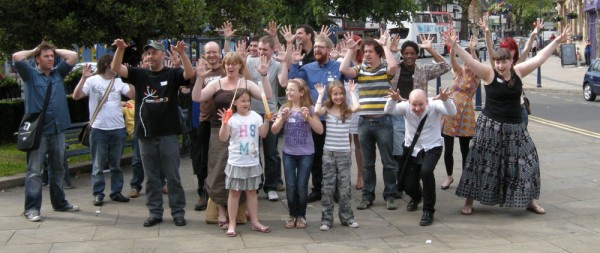
Hands up please if you've taken part in something I've organised...

Now, three years later, I am in the process of writing another application for Arts Council funding; again to support professional development activities in foreign parts: two weeks in New York City, a couple of visits to Netherlands and… two days in Newcastle…

In case you’re not familiar with the Grants for the Arts application form, there’s a section that asks for me to describe how the public (that’s you) engages with my work. Specifically:

Details about the people the activity will reach (for example, the audiences or people taking part), stating whether these people would not normally engage with the arts (see our information sheet ‘Public engagement’).

One of the four criteria against which my application will be assessed is “How the activity increases opportunities for the public to engage in arts activities.”

I could write this section, but it would carry a lot more weight (and give me valuable feedback on what I’m doing) if you could spare a few sentences to describe in your own words your experiences with the things that I (and various collaborators) have made happen. I really would be very grateful.

Here’s a quick reminder of some of my doings that you may have participated in over the last few years:

Colony prototyping, with Fierce at VIVID and The Edge
The Ministry of Rules, with The City Gallery at New Walk Museum and Art Gallery
Circuitbending 101 workshops, at Nottingham Hackspace and Meshed Media
Enter the Arena, with BARG at mac
Taste the Game, with BARG at mac
The Bloop/ Sonar Goggles, with Hide&Seek at Warwick Arts Centre and National Theatre
Location Aware, with Radiator
Market Pongs I, II or III, with BARG
Theremin Day workshops, with Mr Underwood and fizzPOP
Improbable Machine, with fizzPOP at The Lombard Method
Useless Machine workshop, with fizzPOP
Uncertain Eastside Walk and Talk event
fizzPOP Howduino, with fizzPOP, Howduino and Hello Digital
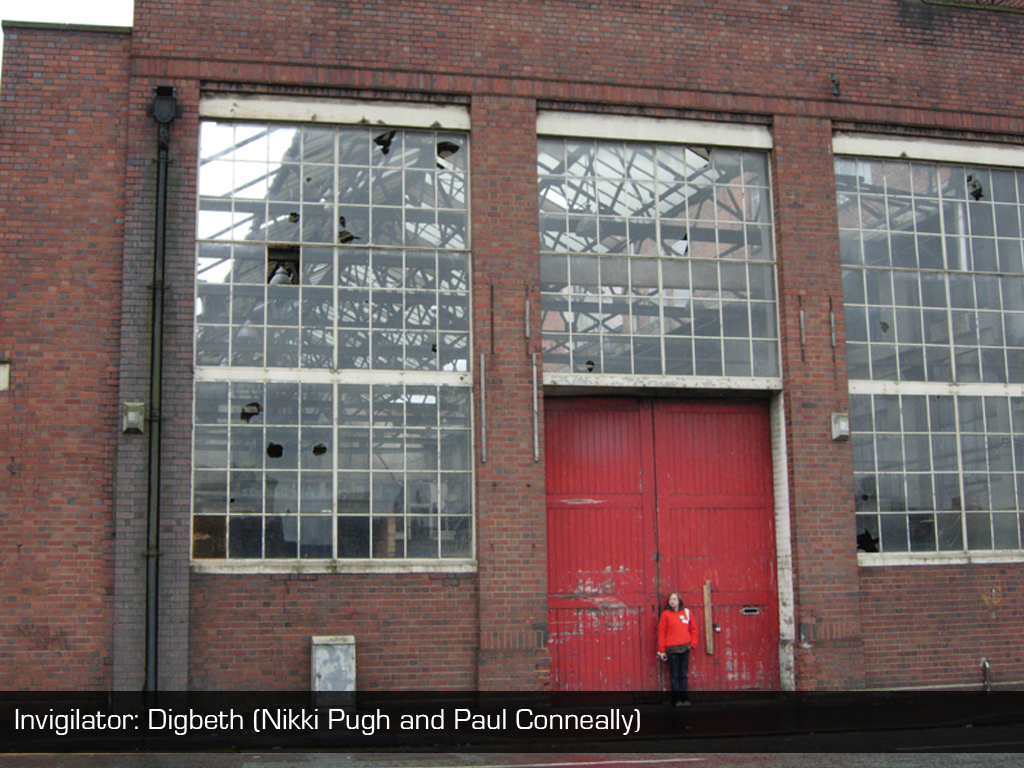
Invigilator: Malvern, with Paul Conneally and MECA
Person, Panther, Porcupine at Mozcamp
Emergent Game, with BARG at The Lamp Tavern and with Hide&Seek at the Royal Festival Hall
w i d e o p e n s p a c e, with BARG
fizzPOP hacksessions, any of them between April 2009 and October 2010
BARGmeets and events between January 2009 and October 2010

Looking at all those links, I guess there’s quite a large secondary audience consuming my work online, too!

If you add your testimonial to the comments below I can link to this page in my application, but if you’d prefer to contact me privately, you can do so via the contact form.

Thank you for taking part.

Colony Prototyping #2

Thursday came and saw us doing the second round of user-testing for Colony as part of the Platinum showcase.

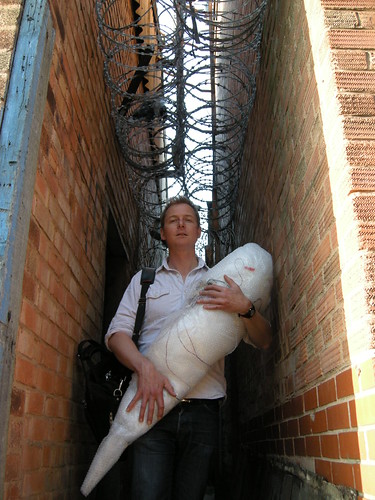
We walked, stood in smelly corners, manoeuvred in and out of fortified alleyways, got shouted at from cars and stared at from a variety of directions.

It was pretty great.

Moving on from the prototypes I had in March that simply vibrated at random, these prototypes were now loaded with code that made them responsive to their surroundings. Our task for the evening was to find out what that meant when you put that mathematical analysis of data a) into the hands of people and b) in to the streets.

The first group of participants set out to find out how all this works.

Another development since the initial testing was that this time there were two organisms. We’re getting incrementally closer to finding out what it might be like to have that colony of them.

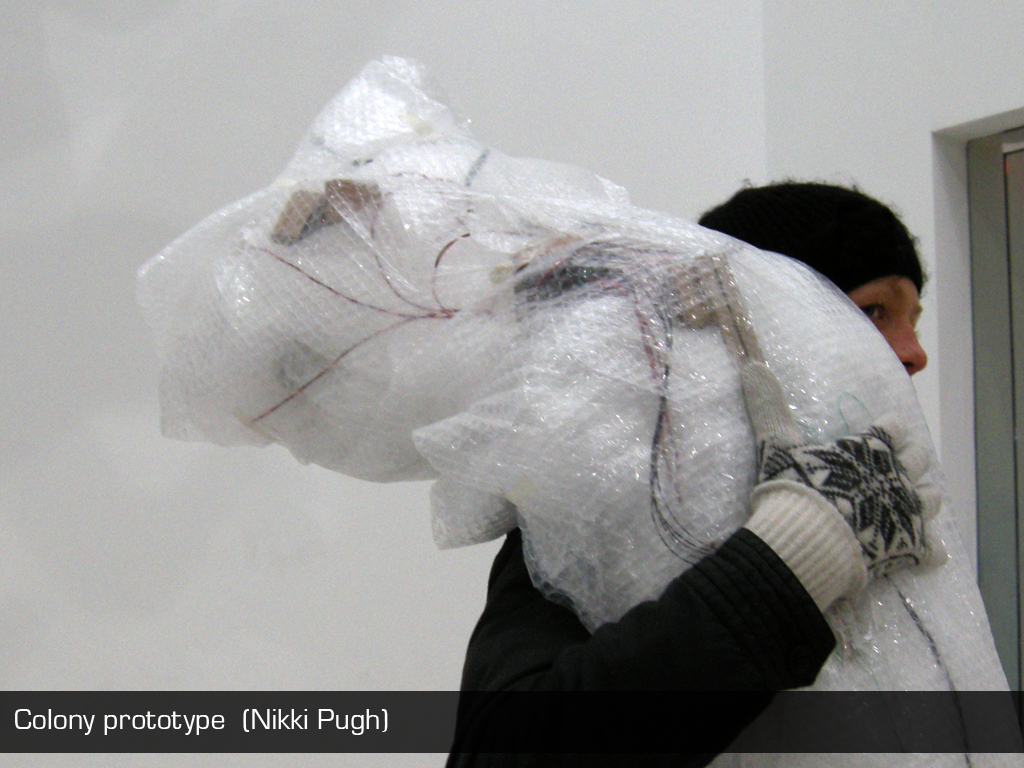
The protoshape I used in March was a “small human sized” pear/water-drop/fish/swaddled baby kind of thing. This had seemed to be an ideal blank canvas upon which to project empathy and from which to project emotions and desires.

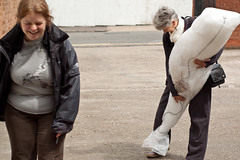
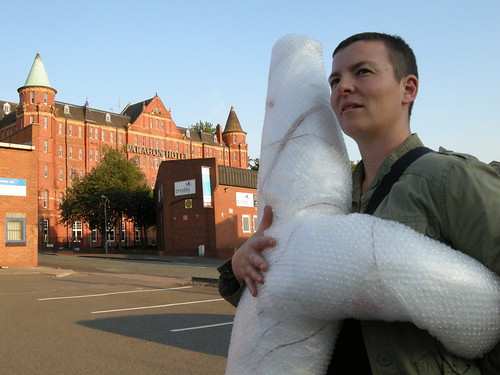
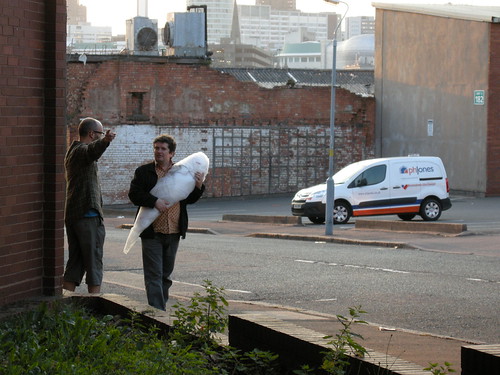
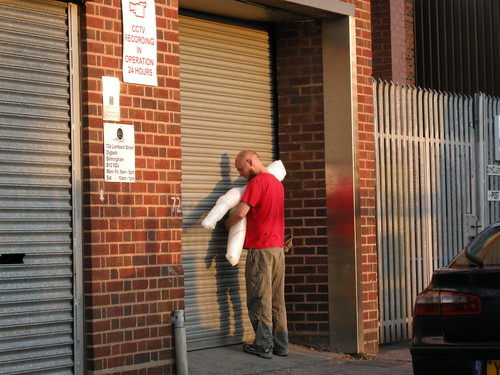
Grappling with the over-sized prototype (photo: Pete Ashton)

After a bit of a false start the weekend before, where I had made one that was too darn big, I remade it a lot smaller. And therefore a lot more huggable.

For the second of the two organisms I wanted to try something different, so I added an awkward limb/tentacle thing. Whereas with the drop-shaped blob the feedback vibration motors were very strategically placed along anticipated contact areas with the carrier’s body, the plan for this one was to make something less intuitive to hold and to see how people dealt with it.

A pause at the crossroads

Sash and shoulder; lock and load

Ant probes the streets of Highgate/Digbeth

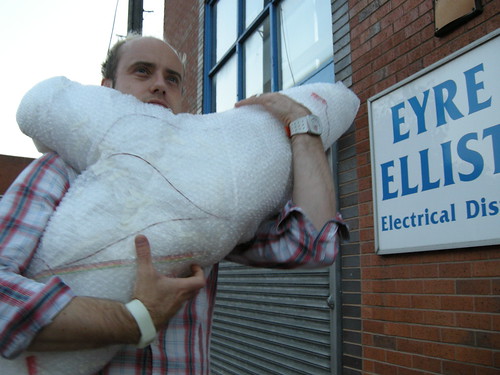
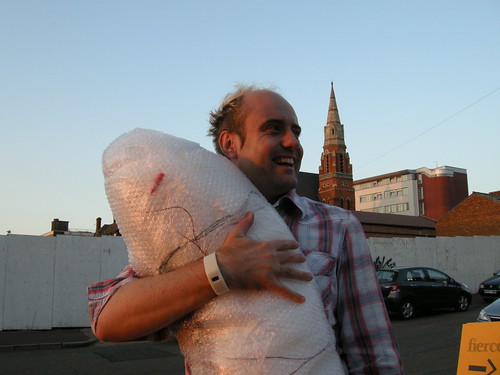
JV goes for the torso wrap

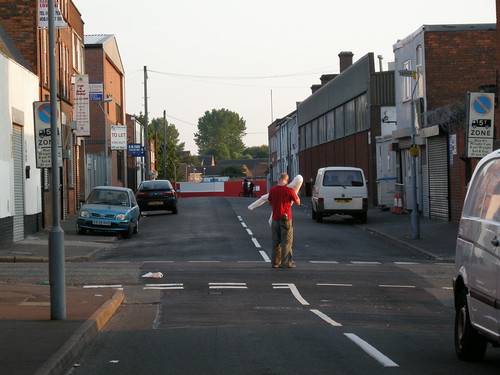
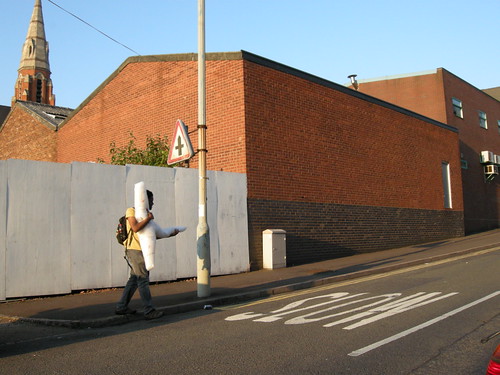
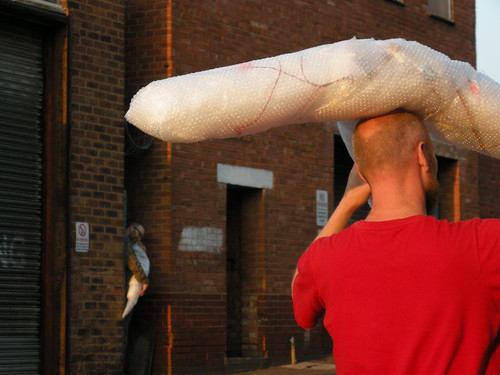
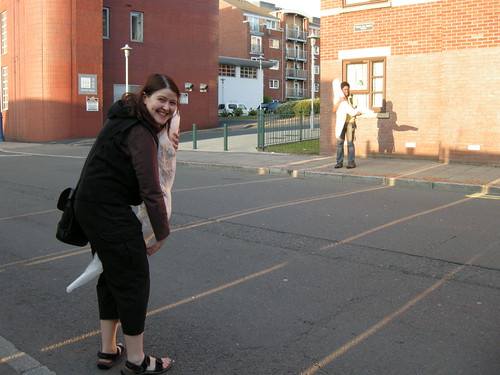
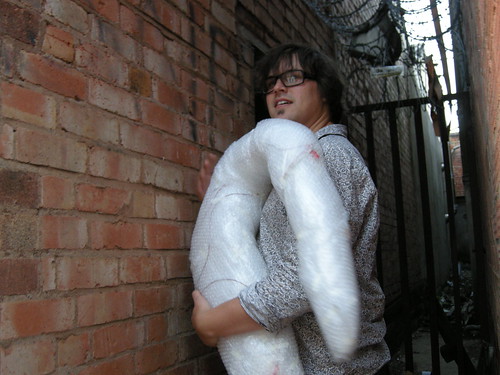
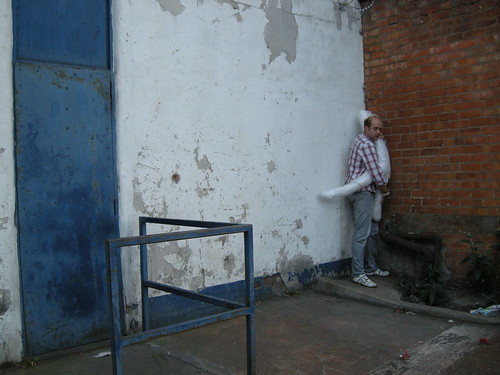
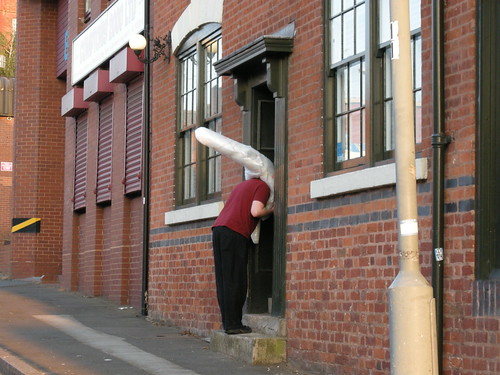
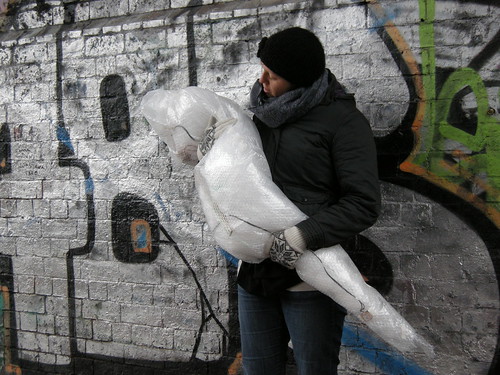
The photos above show a few of the many solutions people came up with: headwear, neckwear, waistwear and gripped in a variety of different manners. It seemed to me that people were much more inclined to experiment with different ways of holding this creature, whereas with the other … well, this next photo sums up the different modes of interaction very well, I feel:

One blob gets a hug, whilst the other is borne down the street atop of a head

That's not to say that the baby-shape didn't get experimented with too...

A few next steps were identified over the course of the evening:

  • People like data. I need data:
    Of some urgency is the need to log the changes in the data as the blobs are carried around. This is very important in terms of me being able to learn more about how this system works and how to tailor the different reactive responses, but people were also asking me a lot if they’d be able to see the traces of their walks.
  • Reactive responses:
    There’s a lot of experimenting to be done in order to devise the vocabulary of vibrations (and possibly other responses) that somehow convey a sense of rising distress as the creatures are carried through environments in which they are uncomfortable.
  • Reactive responses:
    With the current (no pun intended) set-up I’m limited to having a maximum of 2 vibrating pager motors switched on at any one time. Any more than this and there’s not enough power to drive them and nothing happens – I need to power the motors separately to the arduinos dealing with the data, but still have them controlled by the microcontrollers. I have been pointed towards Darlington transistors.
  • Shapes:
    I need to try more of them. More tentacles? Bigger? Smaller? Fatter? Flatter?

Ashley gets his first buzz as he begins his journey with new companion

As well as a selection of interesting interactions with some of the few other people on the streets at that time, I was very pleased at the way the colony organisms provided an impetus for the testers to interact with their surroundings. Ultimately, this is what the project’s all about.

I've no idea what they're talking about, but I'd like to think it's a discussion about the architectural qualities of the local urban environment :)

A reassuring pat on the back for an organism unhappy to find itself in a narrow alleyway with no clear view of the sky

A corner not normally stood in

Not only not enough sky, but a hefty amount of barbed wire between it and you - no wonder they're not happy

A few moments of paying attention to a rollershutter alcove

Many thanks to everyone who helped get the prototypes working in a technical sense, and to everyone who experimented with and offered feedback on how they worked in a practical sense. More photos can be found in this Flickr set.

Platinum at The Edge

Myself and the other artists from the current Platinum cohort will be presenting our various works in progress at a public event to be held at The Edge on the evening of Thursday 2nd of June.

The artists involved come from a diverse range of backgrounds, and the work on show will range from performance through to endurance; presentation through to exploration.

Rob Jones: My Piece

An exploration into personal fears. This work will involve sharing a series of experiences.

Nikki Pugh: Prototypes for Colony

A playful device that aims to gently nudge and augment people’s perceptions of the urban landscape.

Aleks Wojtulewicz: fr36ze

An exploration of the stimulatory effects of adrenaline. The physical act is militaristic.

Sarah Farmer: Cultural Amnesia: what we lost in the fire

A research-led investigation of the cultural history of the arts in Birmingham from the perspective of recent graduates.

Lucy Nicholls: In Preparation for Death

Researching the commodification of the ritual of funeral, while exploring death within its wider social and cultural meaning.

Mark Essen: Club Hot Zeus; BAD MUSIC

John Napier and CLUB HOT ZEUS present BAD MUSIC.

The first prototypes being tested around Digbeth. This time they'll vibrate in response to their surroundings!

I aim to have two prototype organisms there as part of the development of my work in progress Colony. I’ll give a short introductory presentation and there will be a limited number of slots available for you to take the prototypes out for an exploratory walk around the streets of Cheapside.

Do come along if you’re in the area. Free entry; cash bar; FaceBook event.

Making the Colony prototypes landscape aware

Another compilation of Tweets.

These last few weeks I’ve been giving the development of Colony an extra big push to get it as far along as possible ready for next week’s public event.

Having previously been able to get the tech working on a temporary breadboard set-up, the next stage was to solder everything onto a more robust base that can be used inside the organisms that get carried around. The next stage after that was to start carrying it around!

With the circuitry in a shoulder bag, one GPS receiver on my left shoulder and the other in a glove on my right hand with a vibrating motor, I made myself more location aware as I made the 3.75 mile walk to and from work yesterday and the day before.

The code generates a measure of difference between the two calculated positions and then buzzes out a code so I can feel the values as I walk.

Initial findings are: it’s great! Super-exciting to have that extra sense that no-one else is aware of, and you can see the trends in output as you move from one type of terrain to another.

I’ll be refining the code over the next few days and also getting the circuitry into an organism ready for carrying. Do come along to The Edge on Thursday to find out how I’ve got on.

What do you do that you consider to be a craft activity (or feels like it might be)?

I’ve increasingly been noticing parallels between the feeling of being absorbed in a soldering project and memories of working in more traditionally-accepted craft activities such as ceramics or silver-smithing.

Inviting ponderings on Twitter about the essence of craft turned into a really meaty discussion with lots of diverse examples and defining concepts being offered. It was important to me that this conversation was based on people’s personal experience rather than an abstracted argument.

Here’s the archived timeline:

Bat gloves in progress

Last Autumn I started playing around with Tony Messina’s Simple Bat Detector circuit. I made a few boards and got as far as sticking one of them in an mp3 player armband …before the local bat population went into hibernation!

After being in the park one evening recently with bats swooping low overhead, I decided it was time to dig out the circuits again and get them tested and used.

Over the winter I’ve only been able to test with the ultra-sonic rangefinder I use in my sonar goggles, so I knew the circuit works, but I needed to see if it worked with airborne moving targets!

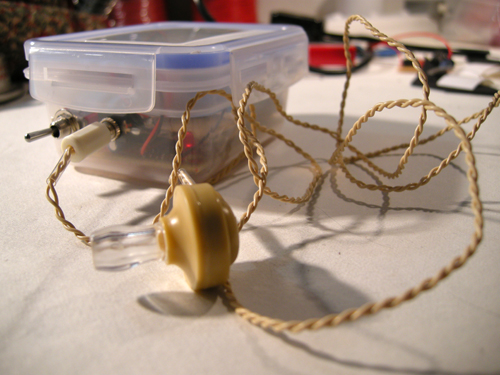
Simple bat detector

I rehoused the armband detector into something more sturdy and finally managed to coordinate with dusk and dry(ish) weather the other night to give it it’s first testing in the field.

It works!

I wandered around the park the other evening and found a bat flightpath that was conveniently located above a bench. I was able to use the detector to pick up a few clicks each time the bats zipped past. A really nice moment of making the invisible audible. If you know what I mean.

Bat gloves in progress

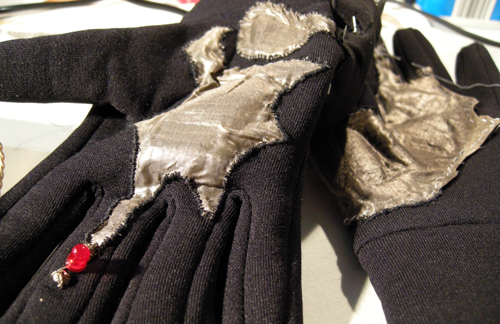
Meanwhile, however, I’m really unhappy with the crystal earpiece as the interface through which to experience this somewhat magical thing, so I’ve been working with some soft circuit techniques to develop some bat gloves.

There’s still a lot of sewing to do and, I expect, quite a lot of testing down at the park as well, but I’m really happy with the early experiments and how these transform the whole interaction.

That’s all I’m going to say for now…

Own This City – Pecha Kucha Night, Coventry

Last night I gave my first Pecha Kucha presentation at the lovely PK Coventry.

I’ve been meaning to do something like this for some time, as one of the aims I’ve set myself for this year is to do more public speaking. This is in order to give myself more practice at articulating the ideas around my work.

Here are the resulting slides and words for “Own This City”, in which I give an overview of some of the observations, ponderings and questions feeding into my newly-commenced project, Colony.

Own This City

Own This City is a section title I’ve shamelessly stolen from a section of New York Time Out, because I think it’s important.

Ownership towards – rather than over – spaces is part of a wider spectrum of interactions between people and place that I’m thinking about a lot at the moment, as I develop a new project called Colony.

Shinagawa Station by mdid on Flickr

Tokyo: population 36 million, and, it seems each of those people desperate to be somewhere different.

Here more than anywhere I’m aware of the city being just a backdrop to that perpetual process of being neither here nor there.

It’s like the background in a platform game – it moves as you move, but it’s not somewhere you will ever touch or be touched by.

Man on bench by Jay Morrison on Flickr

So, to what extent are we blinkered as we move around in our everyday life?
Maybe the first step towards owning our city is to stop and to be aware of it?
To slow down.
To simply spend time with a place.
To linger,
To be present.

17th Street Plaza opening by Jamison Wieser on Flickr

These people sit in a plaza made from space reclaimed back from the traffic.

I look at this photo and I wonder what sort of sense of ownership they are feeling after having fought for and won back this territory?

I wonder if observation of the city is enough, or does ownership also require being proactive?

As for my actions, I suspect they are more loan this city than own this city: temporary occupations. Passing moments that leave little or no trace on the city itself.

Within my practice I try to affect people’s perceptions of space, which is a slightly different thing to altering the space itself, but it can be just as vivid.

Recently I’ve been learning from the world of pervasive games.

I’ve learned a lot about the power of a silly hat, the power of brief moments of spectacle, the power of conspiracy and the power of doing daft things in public places.

I learned the thrill of knowing the secret life of a place…

…of knowing that these market stalls are really a wiff waff stadium

I learned that familiar things in unexpected places can make people pause and that these pauses can be turned into many different things.

I learned that after the running around and the laughter, serious conversations happen in the pub. Where can you pong? Where would you hide a stash of bats for those in the know?


The thing is, once you start playing in public places, you become aware of how much of the city is only pretending to be yours.

In such a case, I tend towards subversion and a little bit of risk.

Some of the people in this photo have dared to come to this shopping mall with no intention whatsoever of buying anything.

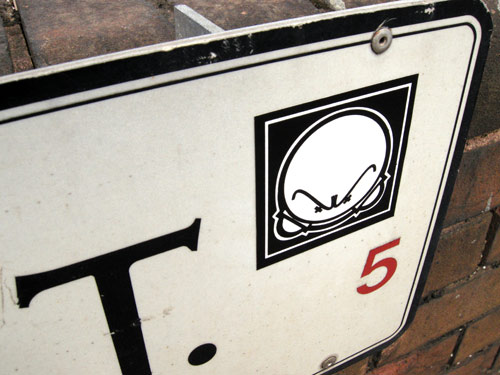
When Nicky Getgood reported there were half a dozen different ballhead stickers, and that there might only be one place in which you could find all of them together, suddenly we were seeing the little blighters everywhere!

Having a task or a framework radically pulls different elements of your surroundings in and out of focus.

Chaser Country by Kevan on Flickr

Kevan has had a slight, irrational fear of the steps at the back of the Royal Albert Hall, ever since he first encountered them during a chase game.

This is where it starts to get very interesting for me. The play may only be fleeting in terms of its presence on the streets, but its effects and resonances can stay with you for a long, long time

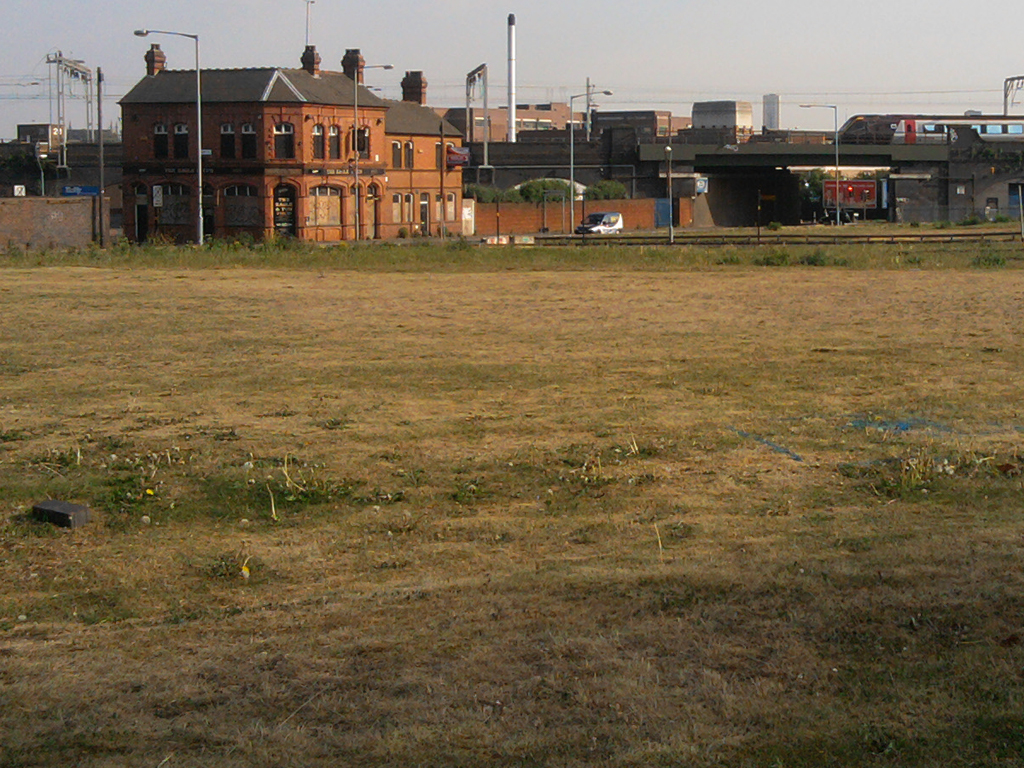
I first became aware of this whilst on a train about here. The wasteland in front is where we had once spent the afternoon playing and sharing a picnic. One afternoon.

This time though it was hosting men in hi-vis and some sort of massive drilling rig! It was a real gut-churning moment of “But it’s ours! They can’t do that! ”

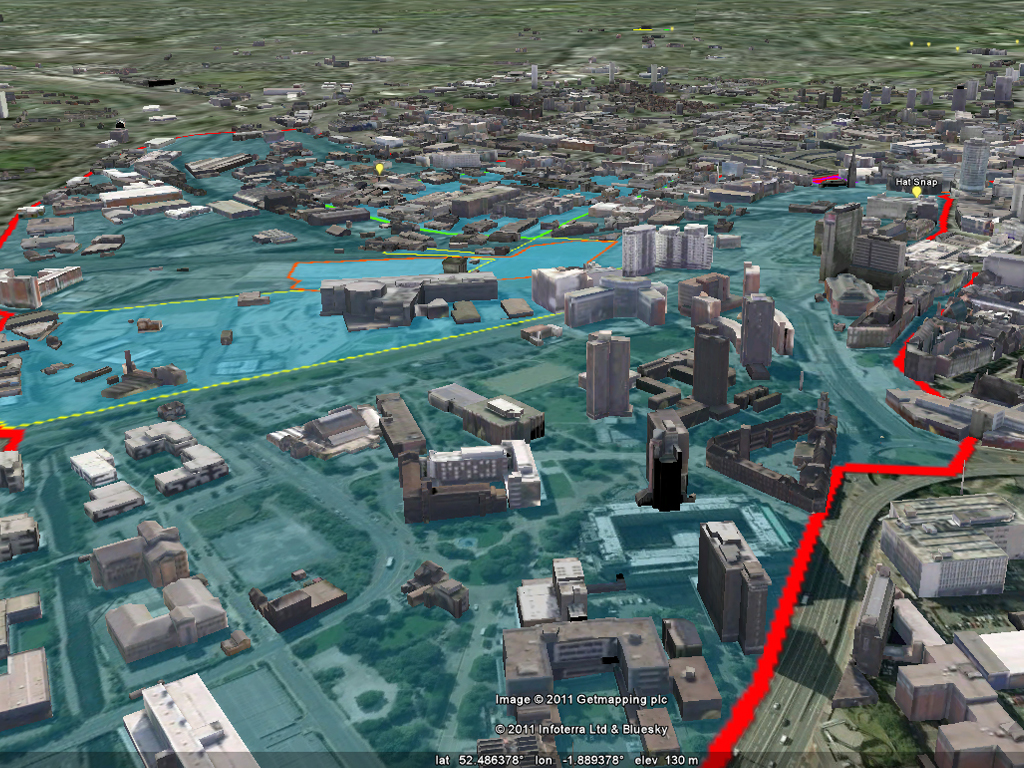
This got me thinking and I started compiling a map of all the places around Birmingham that I now feel I have some sort of ownership towards.

Actually, I got a bit carried away with some of these areas – this large one bounded in red, and the one inside it bounded in yellow. They should really just be a series of perimeters.

Here are the bits I actually claim as mine, and I claim them not through spectacle or subversion, but through quietly and mindfully walking the same journeys over and over again.

Through this process I am starting to gain an affinity for what are, frankly, pretty grotty bits of the city.

These grotty bits are also regeneration areas and I place myself within them as a sort of witness to change.

As I walk on a daily basis, changes on a micro scale reveal themselves:

Shifts in litter, new additions of graffiti, fresh coats of paint.

The same space can get occupied by construction workers, emo kids and office staff at different times of the day.

As I repeat the walks on an annual basis, changes on a macro scale are revealed as buildings are demolished, carparks assembled and the other type of ownership changes hands.

These are the big changes that have a habit of being made by stealth:
the ones where you can never quite remember what was there before…

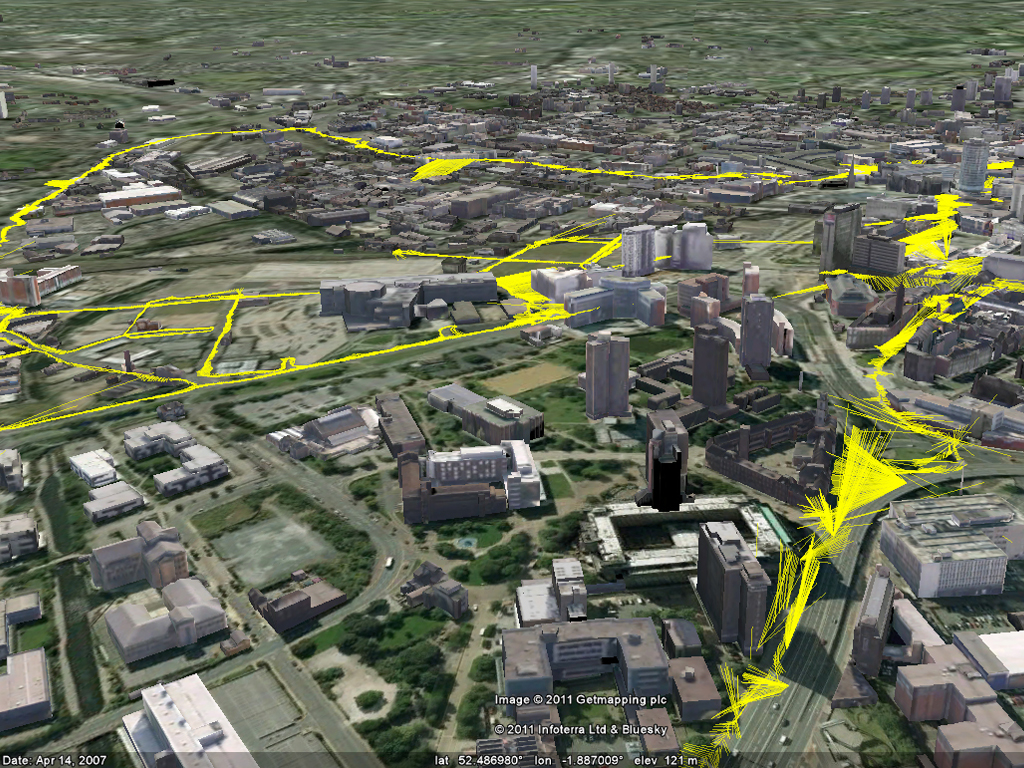
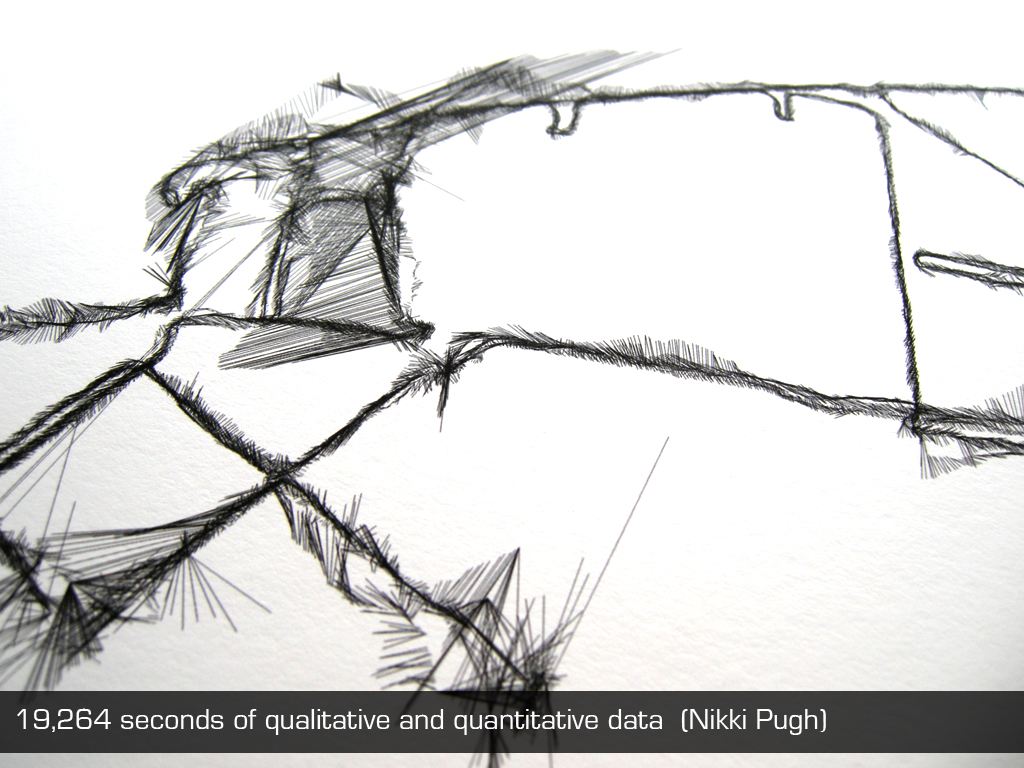
While I walk, I gather data that describes the landscape. In these drawings short lines indicate open space and longer lines indicate lumps of stuff.

Over the years I hope to capture something of the changes in the fabric of the city.
But when I’m walking I cannot pause to investigate or chat. It’s a solitary, introspective process.

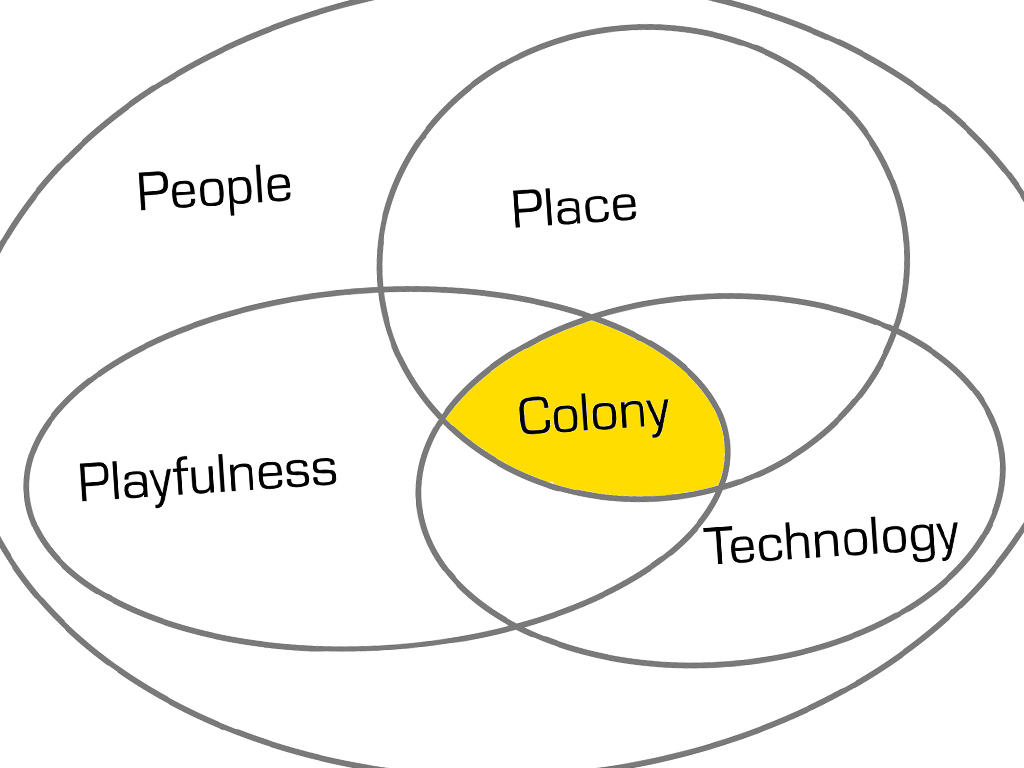
This is where I find myself now: at an intersection wanting to weave several threads together.

For Colony, I want to transform the process that I use to make those drawings into a real-time shared experience. I want the data to manifest itself as you walk through the city.

To do this, I’m having to make the move from closed-box electronics, to building the darn things myself – because I want to own my data in much the same way that I want to own my city.

I want to seed feelings of empathy amongst the participants, so the technology will eventually be housed within what will be some sort of landscape-aware organism that is carried around.

Maybe this organism does not like open spaces. Or maybe it starts to writhe around if it feels too enclosed.

A colony of these creatures will be transported by foot across the city. How will their guardians negotiate the different pushes and pulls acting on them?

  • Empathy
  • Stares
  • Camaraderie
  • Flocking
  • and the logistics of getting from A to B?

More questions!

How do these factors combine to affect how people will perceive the city in order to be able to navigate it?

What will be shifted into focus?

Will any of these effects be long-lasting?

What sort of desires will be projected onto the creatures,
and what sort of passport will these provide for passing into and maybe owning new parts of the city?

~~~

Many thanks to Janet, the gang and the other speakers for a really excellent evening and a great atmosphere.
Ups and downs

Along with many other freelancers, I’ve been using the bank holiday season to concentrate on getting some work done. One of the major tasks on hand at the moment is to further develop my Colony project ready for the Platinum sharing event.
My first attempt at reading two GPS datastreams into an Arduino microcontroller over serial ran into some strange issues, so I decided to investigate I2C just to make sure I didn’t spend an incredibly long time barking up the wrong tree trying to make the serial version work.

Well, it’s been a steep learning curve and I’m truly indebted to the likes of GB, Ben and Adrian, but I we have now got the basics of some code working!

My coffee table currently looks like this:

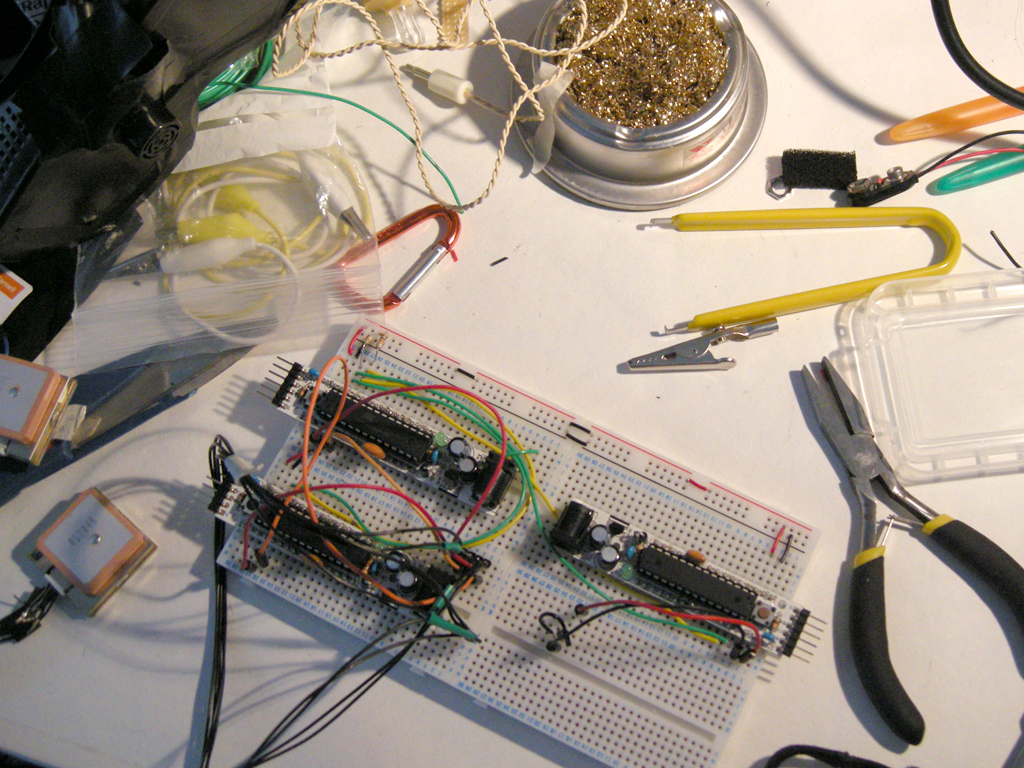
3 RBBB microcontrollers, 4 breadboards, 2 GPS modules and lots of wire

Each of the GPS modules has a slave Real Bare Bones Board reading its data and sending longitude and latitude values over to the master RBBB when requested. The master RBBB reassemble then does a quick comparison between the two values to give a measure of difference.

I left this set-up logging the difference between the two GPS positions whilst I went out for an hour or so, and this is what I returned to:

The measure of difference (y-axis) plotted against time (x-axis, very approximately in seconds)

The kit is on a table not particularly close to the window in my attic flat, so there’s GPS reception, but I wouldn’t expect it to be particularly stable. That said, the graph above struck me as being very regular somehow: not as random as I had expected.

I’m wondering if the peaks correspond to the ebb and flow of the satellites overhead. Is that likely?

edit:Scratch that; wrongheaded. What would affect one GPS module and not the other?

Pecha Kucha presentation coming up…

I’ll be presenting at the Coventry Pecha Kucha night coming up on the 10th of May (tickets available here).

I want to explore themes of affiliation with place; of different ways (relating to my practice) that feelings of responsibility, empathy, custodianship and connectedness can be fostered.

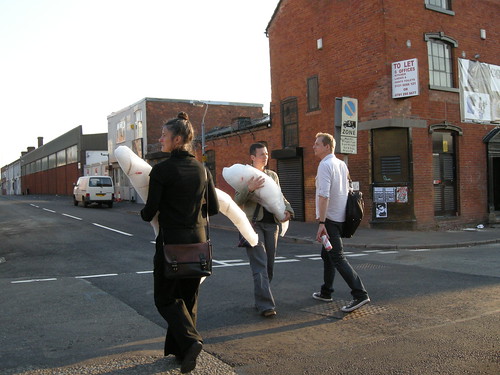
With the early form of a presentation entitled “Own This City” in mind, I took these two photos yesterday:

Let’s see if they make the final cut of 20 slides…

Tying together faint fragments

I recently made a “What others say” page for the nice things that had previously been on the (too busy) home page. I also wanted to include some of the descriptions of my work from the old Japanese language profile page …which meant I had to ask for help for an accurate translation.

With many thanks to the completely-unknown-to-me Claire Wilkinson, and the online intermediaries, I received these two translations of descriptions from two Japanese artists:

小さな欠片を見つけては集めていく。微かな断片を探しては繋いでいく。彼女はまるで解れた糸を紡いでいくように人と人を、街と街を、繋いでいきます。- こうあみ

Finding and collecting small fragments. She searches for faint fragments and ties them together. It is as if she is spinning threads which have become loose and frayed, from person to person, town to town, tying them.” – Ami Ko

彼女は人と人とのコミュニケーションを図るイギリスのアーティスト。様々な方法を駆使した表現で展開しています。自己の体験や記憶を他人と共有した時に起こる可能性や、そこから生まれる心のつながりについて思考しています。場と人と時間、この要素がそれぞれの境界を曖昧にすることで、つながりを持ちはじめます。そのつながりは、人と人との言語コミュニケーションを超越したコミュニケーションとなるのです。 – 井上 織衣

She is an English artist attempting interpersonal communication. Her expressions are developing making full use of various ways. She is thinking about times when her own experiences and recollections are held jointly with other people, and the possibilities arising and mental connections born from this. Places and people and times, by blurring the boundaries each of these constituent elements, connections begin to be held. These connections become a form of communication which stands above verbal communication between people.” – Orie Inoue

I love the image of wandering from town to town, tying fragments into new connecting threads. Also of blurring boundaries between places and people and times.

A special mention also to Minkette for her software translations and appreciation of the poetry found within:

@ Minkette will find a small piece collected. We are looking for a piece by connecting faint. And people like her who will spin a yarn like Reta, city and town, we are holding hands.


Copyright and permissions:

General blog contents released under a Creative Commons by-nc-sa license. Artworks and other projects copyright Nicola Pugh 2003-2026, all rights reserved.
If in doubt, ask.
The theme used on this WordPress-powered site started off life as Modern Clix, by Rodrigo Galindez.

RSS Feed.