Tinier GPS

After an enforced absence from the Margaret Street workshops, I’m bracing myself for a final push to get some serious making done in preparation for an exhibition coming up at the end of April.

Although I’ve not been able to get at the woodwork equipment, I’ve not been idle and have been working away at improving the code and GPS set-up that I’ll be using to animate the objects I’m producing.

I’d like to say I’ve built on the improvements I made whilst in New York, however it’s probably more accurate to say I’ve torn it all down and started again from scratch…

Here’s the kit I’ve been using up until now:

1 x Arduino clone (RBBB); 2 x bare bones Arduino clones; 2 x GPS receivers; OpenLog

Having initially tried and failed to satisfactorily read from the two GPS receivers via serial, I’d switched to using multiple Arduino units communicating over I2C. All built off the tutorials and examples made available at the wonderful Lady Ada site (and a lot of help from other generous people!).

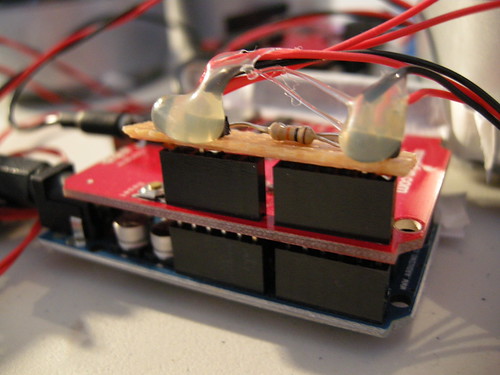
A year and a lot of learning later, I thought it would be worth a second attempt at a one-microcontroller set-up. Having used Mikal Hart’s TinyGPS library for the Chin Up Chapeau, that seemed a promising way to go. And here’s the result:

One RBBB Arduino clone alternating between reading two GPS receivers via TinyGPS and SoftwareSerial (also based on work by Mikal Hart, available with V1.0 of the Arduino IDE).

I’ve been testing it over recent weeks and the results are a very close match to the lines I was getting with the original original set-up using two PDAs and mscape.

A walk through the city centre earlier today (click for larger version)

It’s not all about cutting things out, though: I’ve also added in a transistor to control a solenoid. Tomorrow I plan to insert it all inside a large wooden drum and see what happens…

Phoenix playtesting sessions #2 & #3

Due to low turn-outs, these sessions were more testing than play, however we still had some very big smiles!

By Thursday I’d made some units that communicated with each other via XBee radios. They remain happy whilst still in range, but once separated you have a short grace period in which to link up again. After that an alarm goes off.

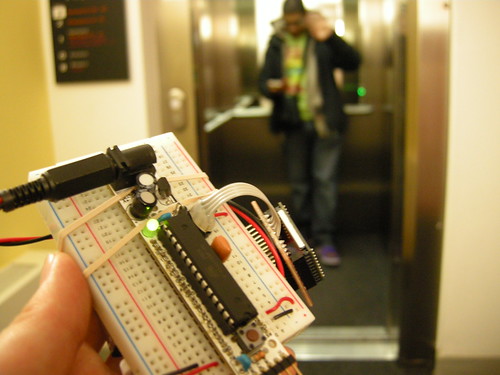
For the first of the two playtesting sessions it was the first time the units had been taken outside, so we wanted to get a feel for what sort of maximum range they have. Not until after having experimented with corridors and lifts, first.

Faraday Cage

Faraday Cage: third floor.

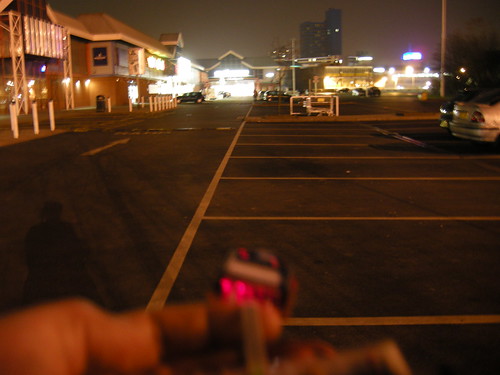
Maplin’s carpark wasn’t big enough, so we moved on to the ring road and then the St George’s retail park. You can just make out the person carrying the other unit in the distance…

Full range

Range-testing in the biggest carpark we could find...

For the last session we headed into the city centre and experimented with corners, pillars and mezzanines in various streets, theatres, shopping centres and multistorey carparks. I’m afraid I was so engrossed in what we were doing that I totally forgot to take any photos!

Next step is to expand this out to a group and start working with range information to see how that affects the coalescence of a group moving through the city.

Residency at Phoenix Square, Leicester – participants wanted

23/02/2012: Updated with this eventbrite link.

Next week I’ll be the third and final resident at Phoenix Square in the series that started with Engagement Party and The Institute for Boundary Interactions.

My blurb has yet to make its way onto the website, so here’s the skinny:

Colony

Over the next few months, a range of artists will be living, working and creating brand new artworks at Phoenix Square, taking inspiration from this unique cultural building and its surroundings…

Nikki Pugh is evolving technological creatures that affect the way you navigate the cityscape.

Nikki’s project ‘Colony‘ is an ongoing series of experiments in which she is developing a group of creatures that respond in real time to the landscape through which they are being carried.

Having already built prototypes that vibrate differently depending on whether they are in open or confined spaces, Nikki will be using radio communication and biofeedback to investigate aspects of flocking and interconnectedness.

Stay tuned for opportunities to become part of the colony and contribute to the play-testing in and around Phoenix Square.

Nikki Pugh is an artist who investigates issues around interaction: how we interact with spaces and landscapes; how we interact with each other; and how we interact with objects. Her practice is located somewhere in the intersection of people, place, playfulness and technology.

Basically the plan is to do a series of experiments involving radio communication and, I think, galvanic skin response readings. You probably know enough about me by now to know that this will mean going out into the streets and trying stuff out to see what happens.

Since I’m particularly interested in flocking and interconnectedness for this residency, that also means I’ll be needing to muster small groups of volunteers in order to try stuff out and see what happens.

If you’re up for spending some time next week exploring the streets of Leicester whilst carrying a small radio unit and with a few sensors attached to your fingers, you can sign up at this eventbrite page.

Thanks!

Making, tangents and edges // Making tangents and edges

After a bit of a delay, and then after a bit of an induction, I’ve at last been able to start on the making! Hurrah!

Still life with visor, nail gun and wood adhesive

I’ll be using my time at the Margaret Street campus through the AA2A programme to explore a tangent of the Colony project.

The two prototyping sessions I ran last year posed some very interesting questions about the experience of travelling through public space carrying landscape-reactive objects. Lots of interesting questions. Lots of interesting big questions.

In the absence of a big interesting residency in which to tackle these big interesting questions, I’ve decided to modularise my research and use some little interesting residencies to explore different avenues of research.

I want to feel that I am really exploring possibilities rather than just making the version of Colony that’s already in my head, so some of the things I’ll be investigating are tangents that may lead me away from the things we’ve previously said are the nice things.

This is how we find the edges (hopefully), and the edges are where the interesting things happen (inevitably).

In the previous two incarnations of Colony, the objects carried have been small, light and kind of cuddly. The vibrations in response to the GPS data were only perceptible to the person carrying the object.

What happens if the objects become large and weighty?
What happens if their reactions are audible to those nearby?
What happens if you are moving in a group with others also making noise?

Dust: tech write-up

Now we’re the other side of Dust and safe from dropping any major spoilers, here’s a quick overview of how the Dust Balls were put together.

Dust balls? Here’s an extract from the explanatory text Hannah’s published on her blog:

The Dust Balls are large fragments of the city. They are formed out of open source electronics, clay, hope and optimism. They begin by introducing themselves to the listeners, and instruct them to point the device in different directions in order to ‘pick up’ stories of individuals in the areas surrounding them. Depending on the timing and direction in which you are facing, different stories will be heard.

They are heavy, and designed to be listened to by two people at once – the weight and bulk of the object meaning that two are required to support it. The two people sharing each experience of overhearing the stories should be strangers.

Quite a design brief there, with some technologies I’d never worked with before (audio and direction-sensing). Fortunately I know where I am with clay!
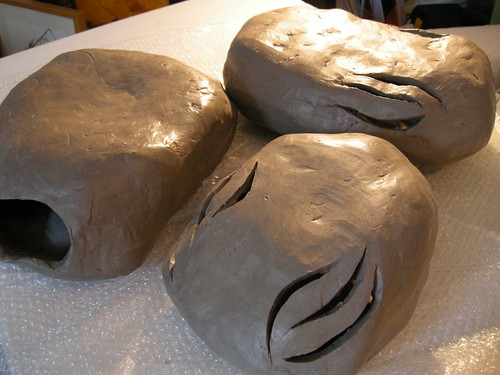
Fragments of the city

The finished Dust Balls

There’s a whole other post-worth of talk about the whys, wherefores and processes relating to the clay, but this post is about what went inside the Dust Balls.

Short answer: lots of electronics.
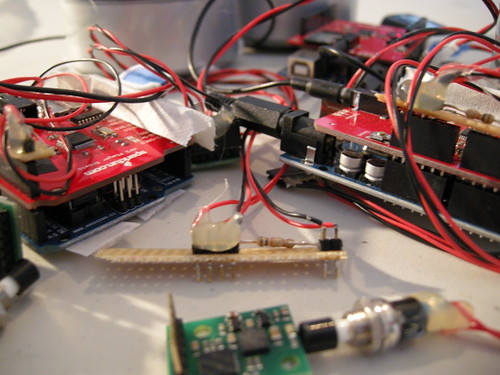
Dust bunny brains

Location, location, location

Once we’d decided to site the Dust event on top of the Vyse Street car park, I spent several hours up there over 3 or 4 visits after work. We didn’t have much in the way of lead-in, but this was time well spent getting to know the feel of the location and details such as how loud the ambient noise of the traffic below is, how busy the car park is at that time and generally getting to know the lie of the land.

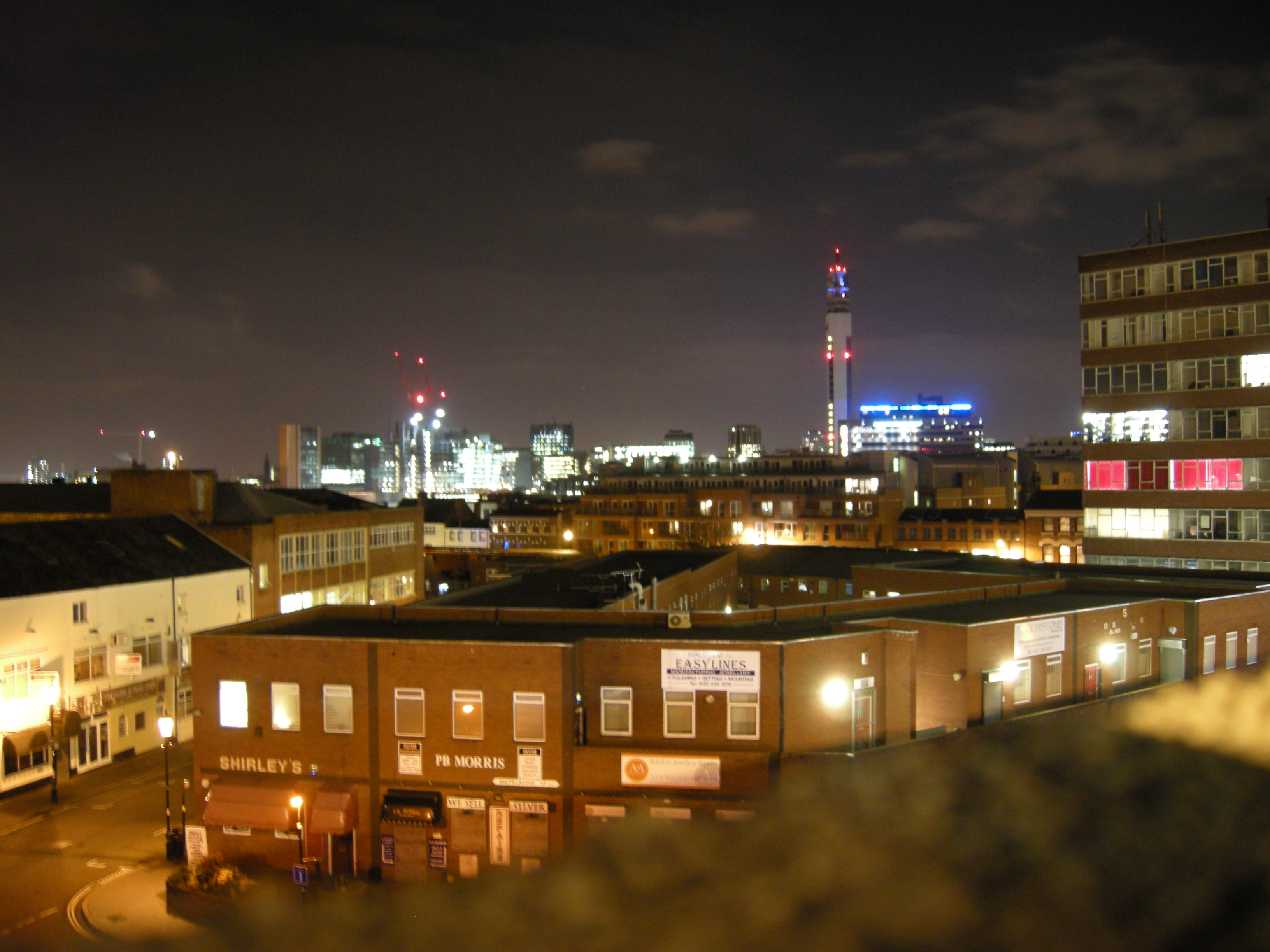
View from the top deck of the car park towards Snow Hill station and Colmore Square.

From here we were able to locate the 5 story threads that Hannah had written amalgamating objects and memories submitted by different contributors.

Thread 1: a visitor to Birmingham is reminded of being in love; Thread 2: a man feels like a boy as he listens to a recording of the grandfather he never met; Thread 3: an office-worker battling deadlines and spreadsheet puts a hand to the pocket containing one of his son's toys; Thread 4; a victim runs through the city streets at the feet of the tower blocks; Thread 5: a friend bearing a gift walks purposefully towards the hospital.

Working from a tracing from a fold-out A-Z map of Birmingham, I drew out the segments for each thread and used a protractor to get the bearings for the boundaries between threads. This working diagram was then orientated to North and taped to the table-top in preparation for testing the the next stages…
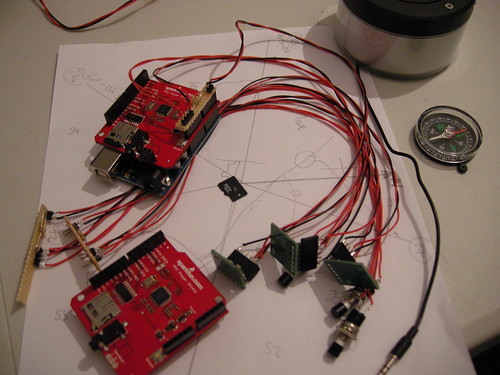
Locating story fragments

The compass module

After some research into different options, I decided to use this CMPS10 tilt-compensated compass module. The tilt compensation was important (since we couldn’t guarantee the Dust Balls would be held horizontally) but it was also selected because of the range of communication methods (serial, I2C, pwm) and the documentation and example code available. Given the lack of time and my lack of coding chops, this is the sort of bet-hedging that was required!
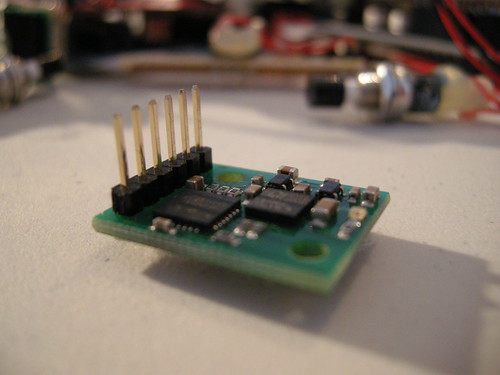
Compass module

It was easy enough to get the compass module working with an Arduino using the example code. I initially tried serial communication, but I couldn’t get this working via the NewSoftSerial library when I came to combine it with the mp3 shield.

The switch to I2C communication required the addition of a couple of pull-up resistors, which I made into a stripboard ‘shield’ that I could plug into the Arduino stack.
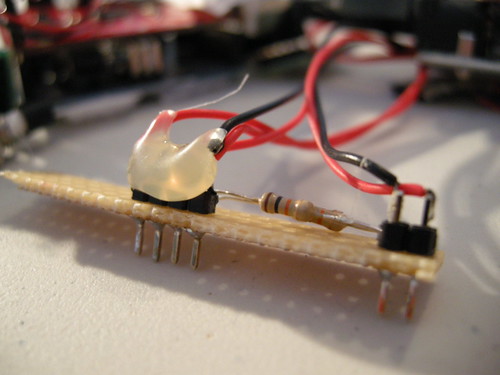
I2C and reset 'shield'

This made things a bit more robust for placing them inside the Dust Balls, as well as being a nice convenient modular approach.

I also added in a push-to-make switch between the ground and reset pins. This would allow me to place the the electronics at the back of the Dust Ball where they wouldn’t interfere so much with the compass readings, but to still have reasonable easy access to reset the kit between users.

mp3 shield

The remaining component of the set-up is the mp3 player shield. I used this one from SparkFun, and it worked, although I may well choose something different next time around…
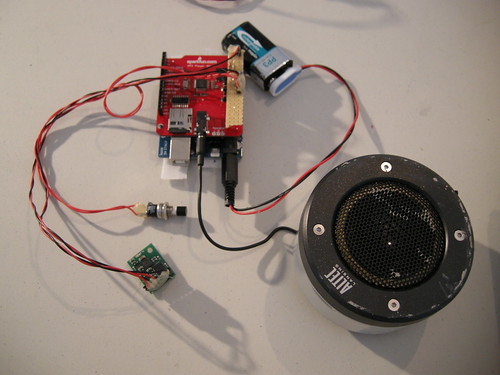
Dust bunny innards

The main thing to be aware of with this shield is the lack of a line out. There’s a headphone socket and somewhere to connect a speaker, but using an amplifier without also adding in protection against electrostatic discharge runs the risk of frying the audio chip. We’ve been lucky so far using portable speakers in the headphone socket, YMMV and you have been warned.

When using these shields you also need to be careful to install the SDFat library correctly (only the ‘SdFat’ folder from the zip file) and ensure you make the necessary changes to the Sd2PinMap.h file as documented in the mp3 player example.

The comments on the product page are well worth a read through too.

Anyway, I got it working eventually…

et enfin

The final stack looked like this:

Stack: Arduino, mp3 shield and I2C/reset gubbins

Arduino Uno, mp3 player shield and homebrew I2C/reset shield, also connected to the compass module and the portable speaker. All powered with a PP3 9 volt battery connected to the Arduino’s power jack.

I added in some hot melt glue to protect the soldered joints that were prone to flexing and breaking and also used black insulation tape to cover over some of the power LEDs (I didn’t want the Dust Balls to look like they were powered by Kryptonite!).

Strips of velcro were used to hold the components in place during use, whilst still leaving them removable when required.

The code takes its main functionality from the compass and mp3 player examples, with some logic to select which audio track to play depending on which direction you’re facing and what’s been played before.

As ever, there’s room for improvement, but hopefully there’s enough here to get you started with your own projects. There’s also a set of photos from the make on Flickr.

We will not be afraid to get our hands dirty.

We will make and share our own tools as appropriate.
We will collaborate.
We will be generous.
We will be porousexcerpt from the Splacist Manifesto 2.0
Mapping possibilities

Yesterday I took part in Spurse’s Mapping the Distributed Self workshop at the Guggenheim Lab: “Can we develop a different view of the self—a self that extends beyond our skin, out into the surrounding environment? One that is distributed and woven into the environment?”

At the moment everything’s reflecting back onto Splacism as we try and figure out what it is and what it might be.

Amongst a whirl of kitten carousels and collapsing wave functions, I’m now pondering the opportunities for working with digital tools and materials for creating new ways of perceiving our surroundings and encounters.

Assemblages; perspectives; co-composition; possible states; experimentation; meeting local conditions; mapping as fiction-making; disintegrating tales; the needs of the self.

Can we explore differently in order to reveal new possibilities?

Through the use of new tools, do we get a new world to interact with?

How do you arrive at the places that are not yet mapped?

Spaces for learning

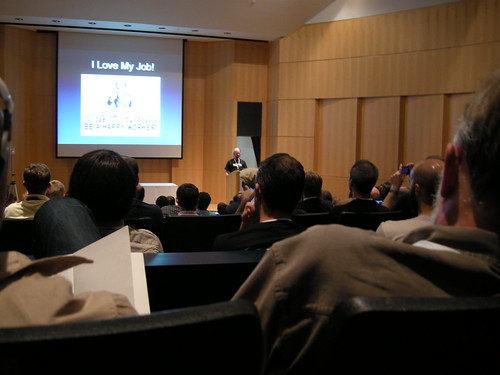
On Thursday I attended the Open Hardware Summit and listened to presentations that underlined the importance of different frameworks and approaches to allow innovation to happen. Here I also went to the Open Hardware in Education breakout session.

Mitch loves his job

Live Feeds FeedForward Fieldwork 7: Migrations and Immigrations—Mapping Movements and Power by spurse

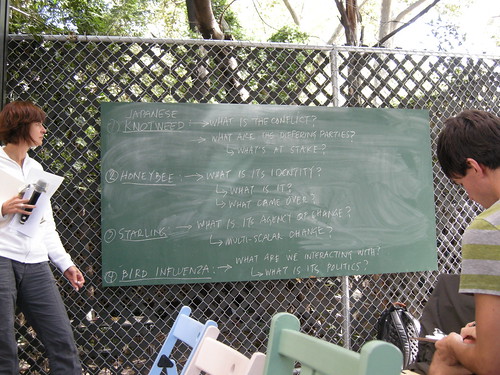
On Friday I returned to the Guggenheim Lab and joined Spurse and a group of strangers in co-constructing a tour of the local area in an attempt to answer a set of research questions linked to migration/agents of change.

I was in a group of 5 investigating the identity of the honey bee. I learned a lot as we first pooled our knowledge and then presented our contribution to a tour with the other groups.

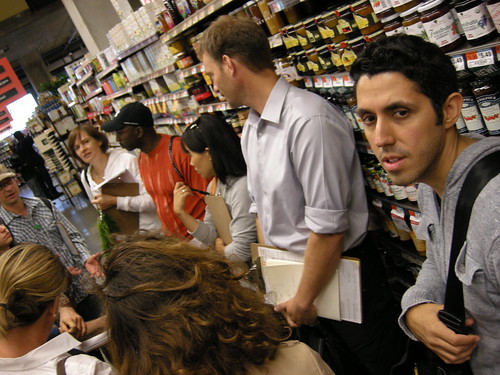
The tour makes a stop at the Wholefoods Market aisle selling honey and jam.

On Saturday and Sunday I was at the World Maker Faire. Apart from being surrounded by exhibits and hands-on workshops that exemplified the sort of discipline-linking, world-shifting creativity that we’d talked about elsewhere earlier in the week, I also went to several presentations.

Two in particular addressed this common thread of spaces for learning: Hackerspaces: Schools of the Future and DIY U: Designing Self Organized Education.

These, along with your own testimonials, are helping me to put into context what we achieved with fizzPOP (and to some extent BARG too) in terms of making alternative spaces for learning and the importance of that.

Hackerspaces: Schools of the Future

Hacker and Maker spaces provide passion-based education that many of us missed in traditional education systems. The learning which takes place in these spaces is intergenerational, transdisciplinary, and multi-intelligent. A panel of hackerspace founders will ask how these alternative education venues can be recognized as a legitimate route to certification, how they propagate knowledge across the culture, and how they avoid becoming dull and co-opted. With Mitch Altman (TV-B-Gone), Willow Brugh (Space Federation), Jimmie Rodgers (Bucketworks and The School Factory), James Carlson (Schoolfactory.org), and Jon Santiago (NYC Resistor)

.

The first thing to note was how chair James Carlson positioned his spaces as school factories (as in things that new models of schools would eventually come out of) and as ‘healthclubs for the brain’.

The panel talked in detail about their responses to mainstream education and how hackspaces were providing learning spaces that didn’t silo people according to age or discipline, but instead provided opportunities for people to learn about the things they wanted to learn about and opportunities for people to discover things they didn’t know they wanted to learn about.

We talked about meritocracies, do-ocracies and being able to share the joy of achievement. We talked about how sometimes the best teachers are those that have only just learned, not those that have been competent for 20 years. We talked about the importance of high tables and being able to ping around between different workspaces. We talked about the process of learning being important, not so much the content which is only a small part of the story. We talked about the inspiration that comes from being around other people who are doing. We talked about measuring growth and how we automatically know how we’re doing anyway – no need to add grades on top of that. We talked about how to teach failure. We talked about how many schools are stuck and how hackspaces can provide alternative spaces free from baggages of the roles people have fallen into within their usual learning environments.

DIY U: Designing Self Organized Education

How do we teach, learn, and credential each other outside the logic of traditional educational institutions?

We talked about universities as unyielding structures of education based on the concept of knowledge being scarce. We talked about communities of practice and how legitimate, peripheral participation can lead to being a master of a skill. We talked about how in this system, as soon as you have taken the first step in, you automatically have a responsibility to help those that come behind you. We talked again about content as a framework. We talked about education being the sum of content (what we learn) + socialisation (how we learn) + accreditation (which for many has become the why we learn). We talked about how “how to” searches are amongst the most popular on Google and YouTube – and how people are sharing their knowledge. We talked about tradeschool and investing some of your time and talent to get someone else’s. We talked about the social nature and value of exchange. We talked about how bartering for skills (rather than paying for them with money) also led to forming ongoing relationships with peers. We talked about how people are finding ways to make knowledge gained in the do-ocracy realm count towards credit in the traditional realm. We talked about different macro and micro scales of education. We talked about the risks of network-based learning. We talked about being committed to each other.

~~~

As I get more of the bigger picture that accompanies my own small experiences and experiments, I’m increasingly thinking I’d like to see a hackspace – and all that it entails and all that it might entail – being supported by something like the NESTA Digital R&D Fund. These are spaces that get people involved, that make innovation happen and that need to be explored and made sustainable. Can we make that happen?

Circuit Bending 101: the SoundNetwork edition

It’s with great pleasure that I’m now able to announce the third in the series of Circuit Bending 101 workshops.

11-6 on Saturday 9th of July.

This time, with much support from Adrian McEwen, Cheapjack and SoundNetwork, the bleepy noises will be emanating from the STATIC Trading Co. studios in Liverpool.

A dozen people, three projects to introduce you to the basics of circuit bending, all the tools and components you’ll need, a possible guest furby and definite cake. SoundNetwork have been kind enough to subsidise the ticket price, so all this for only £25. Quite frankly, that’s a bargain!

Full details are over on the Eventbrite page. And to whet your appetite there’s a bunch of photos and videos from the last workshop in this Flickr Set.

Tickets will be available from 11am next Friday (24th of June).

Sonar goggle sampler

I’m one of six artists currently taking part in Fierce‘s Platinum professional development programme. As part of the early doings we each ran a 30 minute workshop to introduce everyone else to an element of our practice.

Since I’ll be using Platinum to explore possibilities for applying elements of playfulness and interactive/responsive technology to my core interest of investigating interactions with spaces, part of my workshop included a chance to sample the sonar goggles I made for the game The Bloop last year. More on what the first part of the workshop entailed later…

Although I was on invigilator duty to make sure everything was running safely etc, I still managed to get in some observation and even take a few photos.

The goggles drew a lot of interest from the other people in that part of the arts centre, and a few people from outside our workshop also wanted to take part. Who am I to say no?!

What’s struck me most, looking back at the photos now, are the different hand and arm positions…

Total bizarre wonderfulness

I’ve always struggled with the “hacker” terminology, finding it quite limiting and a hurdle to explaining what hackspaces/hackerspaces are about to the various people I find myself having to explain what hackspaces/hackerspaces are about to. However, I’ve long been a fan of how Noisebridge presents itself. This extract from their wiki:

Noisebridge is a space for sharing, creation, collaboration, research, development, mentoring, and of course, learning. Noisebridge is also more than a physical space, it’s a community with roots extending around the world. […] We make stuff. So can you.

The definition is in terms of the verbs, not the tools that are used to realise the projects.

I’ve just come across this short introductory video to Noisebridge which I also find presses a lot of my buttons – loving the emphasis on creativity of all sorts: expressed in the space via the craft area, the darkroom, the kitchen, the gas cylinders in the background as Mitch talks, and the massive library! Check out the video below:


QUEST on KQED Public Media.

Note the importance of community. We always took this as our starting point for fizzPOP, but unfortunately we didn’t manage to get a cohesive group together last time. As you can probably tell, I would absolutely love it if Birmingham could support a Noisebridge equivalent, but ultimately it’s down to the community as to what happens.

Head on over to this recent thread on the fizzPOP discussion group where it seems momentum is gathering around fizzPOP 2.0. If you want to contribute, now would be a good time to do so.


Copyright and permissions:

General blog contents released under a Creative Commons by-nc-sa license. Artworks and other projects copyright Nicola Pugh 2003-2026, all rights reserved.
If in doubt, ask.
The theme used on this WordPress-powered site started off life as Modern Clix, by Rodrigo Galindez.

RSS Feed.