June 5, 2010

MECA 2009 book now available

In October of last year, Paul Conneally and myself were commissioned by Nathaniel Pitt and Malvern Exhibition of Contemporary Art (MECA) to conduct Invigilator: Malvern, 6th in the Invigilator series.
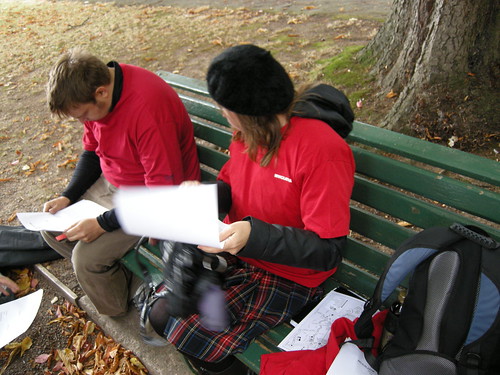
Invigilators prepare for Invigilator: Malvern

Invigilators prepare for Invigilator: Malvern

Invigilator: Malvern formed part of a programme of events taking place in and around empty shops in the centre of Malvern and a publication documenting the project is now available.

You can see a preview of the book below (Invigilator: Malvern is on pages 36-39).

The making of Location Aware

Last Friday I was in Nottingham making a new piece of work as part of the Territorial Play event organised by Trampoline.

Using the same dual-GPS process as for Uncertain Eastside, I selected a route that took me through a variety of different urban environments including narrow streets, open wasteland, alongside large buildings and around the foot of the castle.

Wasteland with desire lines

Wasteland with desire lines

Each circuit of the route (2.2 miles) took approximately 45 minutes to complete and started and finished at the Broadway Media Centre where the event was hosted.

We had a ‘project room’ that we were using as a base for various tech + mapping activities. After each circuit I returned here, processed the data and turned it into a .pdf file that my glamorous assistant Russell would take to the printers whilst I set out walking again.

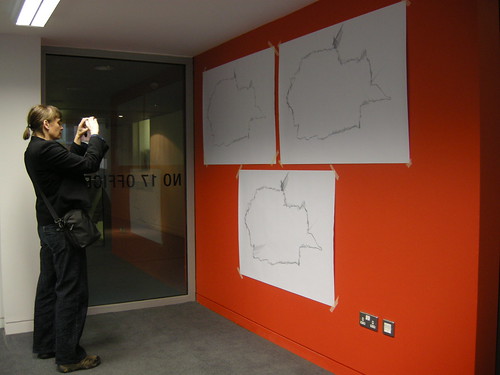
By the time I returned there would be a new print put up on the wall combining all the traces from all the previous walks.

Cumulative prints of the GPS traces

Cumulative prints of the GPS traces

I only had time for 3 circuits, but my shoes seemed to think that was plenty.

I’m really pleased with the results and had some great feedback and conversations with the other people at the event.

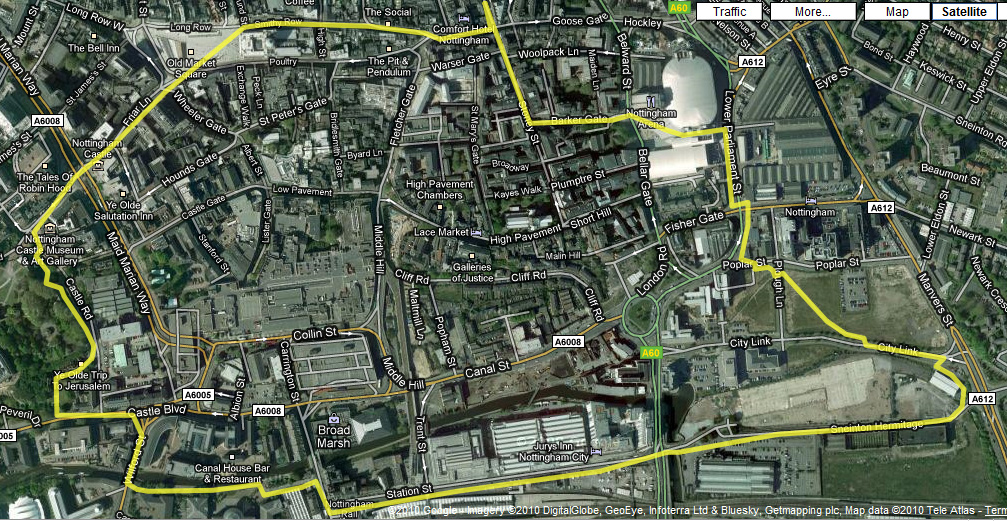
To share a little something of the resultant drawing – and how it relates to the landscape – I’ve added some details from the drawing to the Google Map of my route. Click on the yellow placemarkers to see the image and read the associated text.

Overview of the final route

Overview of the final route

Detail from the resultant drawing referenced to the part of the route it came from.

Detail from the resultant drawing referenced to the part of the route it came from.

So, head on over to the map: zoom in, zoom out, change views, click on things and have an explore!

Walking Route for Location Aware

I’m currently working on the route I will walk for my piece Location Aware at this Friday’s Territorial Play platform event in Nottingham.

The problem is, I don’t know Nottingham, so I’m crowd-sourcing some input on a route I’ve put together from Google Maps.

If you know Nottingham at all, then I’d be grateful for any feedback on this route (larger version here, or click though for zoom-able version on Google Maps):

My first proposed walking route - what do you think?

My first proposed walking route - what do you think?

I’m looking for the following qualities in the final route:

  • Safe for me to walk with a PDA visible in each hand.
  • Total walking length of about 45 mins (I think the current one is about an hour).
  • Passing through a range of different built environments and open spaces.
  • Starting and finishing at the Broadway Media Centre.
  • Some interesting places to see on the way. Several times during the course of the day!

I’ll be going to Nottingham on Thursday afternoon and will hopefully get a chance to investigate the route ahead of the first scheduled walk at 11am on Friday.

Prior to that though, if you can suggest any changes to make the route safer, more interesting or maybe just different, then I’d love to hear from you!

Location Aware at Territorial Play event in Nottingham

I’ll be in Nottingham this coming Friday and Saturday for the Territorial Play platform event and symposium as part of Tracing Mobility.

Detail from Uncertain Eastside - I will be using the same technique to explore Nottingham

Detail from Uncertain Eastside - I will be using the same technique to explore Nottingham

For Territorial play, Pugh will conduct a series of walks whilst carrying a satellite navigation device in each hand. Glitches in the technology and interference from the physical landscape result in anomalies in the data recorded by each device. As the journey is repeated and the resulting data overlaid, unique generative drawings are produced that reveal relationships between the fabric of the city and the behaviour of the technology.

My first walk will start at 11am and you are welcome to join me (free, there is a sign-up list at http://locationaware.eventbrite.com/), you can also join me on subsequent walks, through until the early evening, however these will be unscheduled.

The generated drawings will be on display at the Broadway Media Centre [Google map] and added to throughout the day as new layers of data are collected.

We need questions. We need answers.

I’m working on a massive Creative Partnerships project in a Leicestershire primary school with several other practitioners from various disciplines including, music, dance, architecture, story-telling, illustration and greenwood structures. Our brief: to make sure the staff can do what we do after we’ve gone.

We’re starting off on two threads of enquiry. One is to look at how we can encourage more imaginative play amongst the foundation level classes (3-5 years old) and the other is nominally working with years 3 and 4 (7-9 years). I say nominally, because actually I think we’ve discovered it’s more about exploring how the teachers can move away from teaching for a specific outcome and move more towards child-led learning where the outcome comes out of the process.

Last week this message was delivered in assembly:

The message delivered to the pupils last week

The message delivered to the pupils last week

On Friday the pupils worked with some of the practitioners on brainstorming their initial ideas and questions.

Tomorrow I will go in and liaise.

Today I am trying to plan the day without actually planning the day.

It’s counter-intuitive and a bit scary, but we need questions and then we need answers. In that order.

one thing leads to another

I’ve just started a 2-week residency with fizzPOP at independent artist studios The Lombard Method.

Over the bank holiday weekend we’ve been running a project – open to the public – to try and cobble together a Heath Robinson style chain reaction contraption to fill one of the studio spaces. Cardboard, gaffa tape, cake and random strokes of genius being the main ingredients.

For the main chunk of the residency I have a few projects that I am intending to work on. These include a second-by-second walk-through of the GPS data from Uncertain Eastside, building a Tannerin style instrument and circuit-bending a butterfly.

I fully expect that I might end up doing something completely different though!

chain reaction from nikkipugh on Vimeo.

Cast list for Milton

Milton – the pathogen-introducing game I’m making for a Coventry school – gets its first playing on Friday, so I’m in full-on production mode making the cards that determine the players’ roles.

Here’s a quick peek at the bacteria who will be trying to infect as many pathologists as possible:

List of bacteria from the game Milton

List of bacteria from the game Milton

Can the pathologists fight back?

Theremin Day

For the last month or so I’ve been helping Mr Underwood get the planning together for Theremin Day: an afternoon workshop building an optical theremin followed by an evening of film and performance, including a live set on theremin from Ms Hypnotique

Hard work, but what a great day!

The workshop had a great vibe, especially as the sounds of working optical theremin began to mingle with those of drilling and the occasional piano performance:

Listen!

Pretty much everyone got their noise boxes finished and working, with some great playing styles starting to emerge:

noise boxes from nikkipugh on Vimeo.

After the workshop we did a quick changeover and re-arranged The Edge ready for the evening performances. There was much packing away of soldering tools; construction of staging; testing of audio and visual equipment. It all stopped when Susi started to play on her theremin. What an amazing sound: so different to anything else. Everyone was transfixed!

Listen!

The evening event kicked off with a selection of short films exploring the historical, technical and fun sides of the theremin. This was then followed by a set from 8bit Pete and his Thingamagoops. This included a live mic off to the side of the stage where people could come up and contribute to the maelstrom of bleepy noises and flashy lights with the workshop-built theremin(s). [What is the plural?!]

Next up was Mr Underwood’s performance of Steve Reich’s Pendulum Music for optical theremin and torch. Brilliant. Pete Ashton has posted a nice video extract.

After that was the theremin set from Ms Hypnotique who performed a wide range of music for us. In her own words, the set list was described as: “Varese, Walter Carlos and forgotten scifi soundtracks”. She did an excellent job of interspersing the music with interesting explanations and anecdotes – entertaining and educational!

Here are my photos from the evening event followed by a couple of videos of Ms Hypnotique playing. The last video is how she ended the set. Perfect!

Ms Hypnotique performs from a visual score from nikkipugh on Vimeo.

Ms Hypnotique knows her audience from nikkipugh on Vimeo.

Thanks to everyone who supported and participated in the day.

circuitbent easy button

After Jimmie Rodgers described his use of it for circuit-bending workshops, I thought I’d investigate a simple hack of the Staples easy button.

Prototyping with a breadboard

Prototyping with a breadboard

I swapped out the clock(?) resistor on the circuitboard for a light dependent resistor and here are the results:

circuitbent easy button from nikkipugh on Vimeo.

Except, that’s not all the results!

There’s not a lot to this thing: you vary the amount of light getting to the light dependent resistor and it affects the speed at which the “that was easy” sample is played back. It’s highly addictive though. It’s just the right size and weight to go in your hand and there are so many different effects you can get from it. There’s even a noticeable change in behaviour depending on what time of day you play with it.

Not that I’ve been playing with it instead of getting on with some work, you understand…

Making Milton

I’ve been working with a school in Coventry to help them develop activities for their Year 8 Flexible Learning Day focusing on science and creative writing.

As a result of this I’ve been commissioned to design a game to teach and reinforce concepts and vocabulary relating to pathogens: how they spread and how we can protect ourselves against the nasty ones.

Game flow and card design

Game flow and card design

I’ve had the school’s permission to release the game’s rules under a creative commons license, and the basic description and mechanics are now up on the Ludocity website: http://ludocity.org/wiki/Milton.

I’m currently working on designing the cards that will be used in the game and making sure they also double up as instructional prompts for the players – expect that ruleset to develop! In the meantime, I’m also soliciting feedback in advance of the game’s first plays on April 30th.


Copyright and permissions:

General blog contents released under a Creative Commons by-nc-sa license. Artworks and other projects copyright Nicola Pugh 2003-2026, all rights reserved.
If in doubt, ask.
The theme used on this WordPress-powered site started off life as Modern Clix, by Rodrigo Galindez.

RSS Feed.