Audio clip: Adobe Flash Player (version 9 or above) is required to play this audio clip. Download the latest version here. You also need to have JavaScript enabled in your browser.
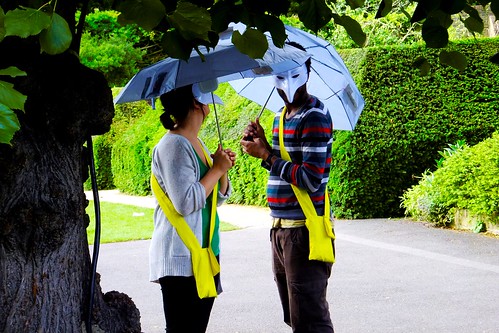
Having come across Curby/Kerby/Kirby a few times since then, I’m now prepared to concede that it is an actual real life childhood past time.
In fact, I quite fancy trying it.
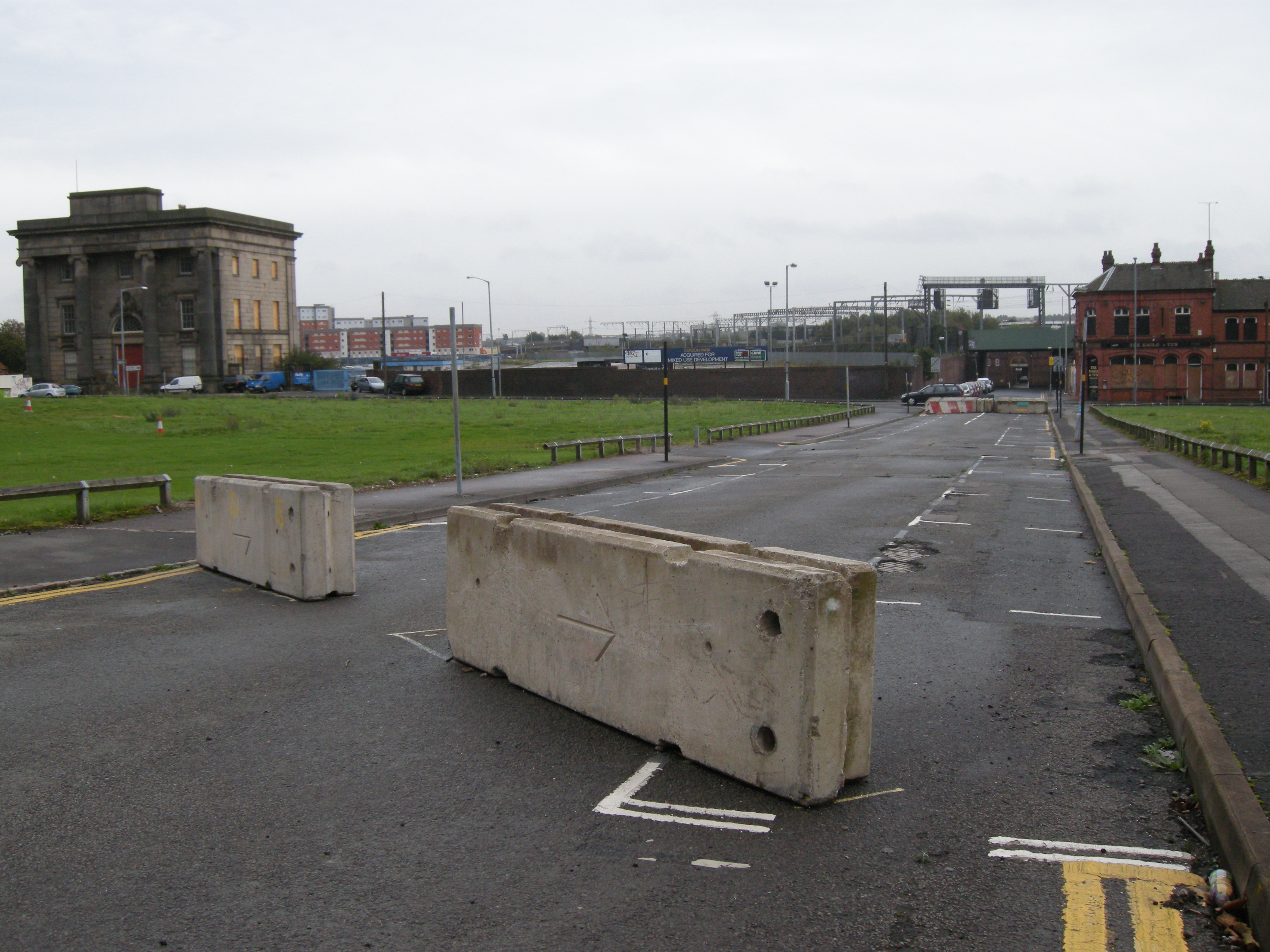
Banbury Street
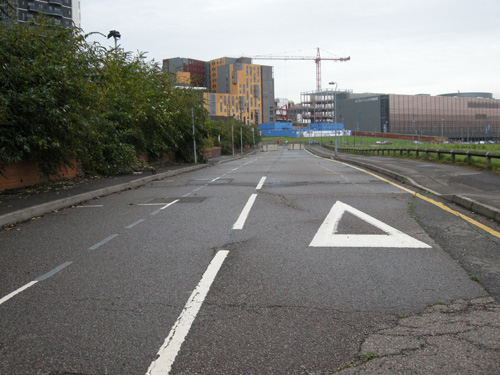
Bartholomew Street
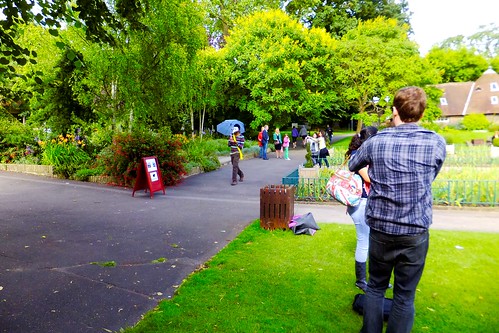
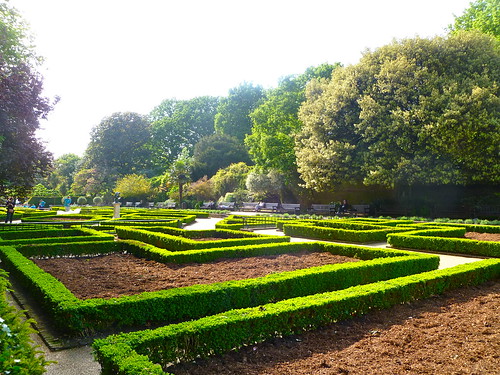
For the last three days I’ve been walking around the grid of streets around the Curzon Street area collecting data for a new piece of work. This walk took me along Banbury and Bartholomew Streets (pictured above).
As you can see, both are currently closed to traffic.
As I was walking past yesterday morning, a crane was lifting yet more of the concrete blocks into position at the lower end of Banbury Street. I’ve no idea what the plans are for these two roads or the grassland next to them, but I’ve felt a fondness for them since w i d e o p e n s p a c e [video] and would like to gather people there at least one more time before the diggers move in and we lose this little oasis.
Milton – the pathogen-introducing game I’m making for a Coventry school – gets its first playing on Friday, so I’m in full-on production mode making the cards that determine the players’ roles.
Here’s a quick peek at the bacteria who will be trying to infect as many pathologists as possible:
I’ve been working with a school in Coventry to help them develop activities for their Year 8 Flexible Learning Day focusing on science and creative writing.
As a result of this I’ve been commissioned to design a game to teach and reinforce concepts and vocabulary relating to pathogens: how they spread and how we can protect ourselves against the nasty ones.
Game flow and card design
I’ve had the school’s permission to release the game’s rules under a creative commons license, and the basic description and mechanics are now up on the Ludocity website: http://ludocity.org/wiki/Milton.
I’m currently working on designing the cards that will be used in the game and making sure they also double up as instructional prompts for the players – expect that ruleset to develop! In the meantime, I’m also soliciting feedback in advance of the game’s first plays on April 30th.
I was shocked when this lady ran into the room & said COME INTO THE HALL NOW- THIS IS TOP SECRET. We suddenly found out that our teachers were all agents named Agent squirrel, Agent pants, Agent ants & Agent elliephants. I enjoyed learning this misson it was interesting to see all our teachers undercover. I learnt how to break codes in the afternoon & we got two clues that tell us what is the answer to this mission & it carries on going and going until we find the last clue. I am excited but i am little bit nervous because we only have 3 days.
Agent CB
In the morning when Miss Yates had just taken the register agent N came in and she said EMERGENCY!!! COME TO THE HALL QUICK I was really excited but when we were walking in the corridors we had to make sure that we were undercover so we had to act normal and when we had got to the hall agent N told us that we were on a mission to find some clues to solve the mission.Then we had to go back to are classrooms and we had to solve some clues and we got some clues just in the time of 15 minutes and the first clue was , near a mans whos’s insides you could clearly see and we had to find a map and each class had part of the map and if we put it together it would make the whole map. Today I have learned that if we all work together as a team the mission would be done quicker because we only have 2 days left.
Agent AW
I have realy enjoyed day 1 of (Sssshhhhhh) code breaking I can not I repeat (can not) wait until tomorrow.
And I cant wait to see the map again because it realy I repeat (realy) looks like fun also I thought what we might have to do with the map cause it looks allot like a treasure map.So we might have to find another clue or something.
cant wait for tomorrow
see you, yours greatfully
L (byeeeeeeeeeeeeeeeeeeeeeeeeeeeeeeeeee)
Agent LJ
(All these examples were added to a forum on the school’s Virtual Learning Environment after school had finished.)
As a follow-on from the box with a secret knock in it, I’m preparing a 3-day immersive experience to develop active learning amongst 3 classes of 9/10 year-olds (Y5). This project is attached to the curriculum area of mathematics, but aims to address fundamental questions about attitudes to learning in general.
Constructing a map of the school grounds.
The plan is to solve a series of puzzles to incrementally build up a massive dot-to-dot overlaid on the school grounds, so I’ve just spent a couple of hours working from satellite imagery to construct an outline map over which we can place…
I’d be really interested in hearing more about who you consider your influences or precursors in installation art – I’m vaguely drawing up an enormous Flowchart Of Pervasive Games And Where They Come From And All That Sort Of Thing, which is obviously never going to be even slightly exhaustive but which might be fun to have around. I don’t have much from installation art there – any suggestions?
I was pretty rubbish for about the first 2 of my 3 years doing A-Level Art and Design, so I’m guessing this happened in about 1996/7, after a certain rollicking from Hillary regarding some lino prints got me thinking more about process and journey.
I got the train up from Southampton to London to Go And Look At Some Art. I think what I did was to rock up, find a newsagents, have a flick through Time Out and see what looked interesting. …and so I ended up in somewhere I think was probably Mile End.
This was a part of London I’d never been to before and it was all pretty scary. When I finally found the address given in Time Out, the building was big, not at all what I was expecting (like an old town house or civic building of some sort) and very locked looking. In fact, very boarded-up looking…
After a bit of hesitation and hopeful looking around for any indication at all that this might have been a gallery, I plucked up the courage to ring the buzzer indicated by a note attached to the door that might have been referring to the art I was seeking. When the door was opened, and the correct place had been confirmed, I was led inside and it became apparent that the building was well on its way to becoming derelict: I was guided around holes in the stairs and there were bare floorboards and bare wires.
A few storeys up, we came to a door with a small wooden chair placed next to it.
I was to go inside and be careful. The man would be waiting for me outside.
The dark room I stepped into was one of those where there would ordinarily have been 3 or 4 steps down from the door to floor level. However, the artist had constructed his own floor that began at door level and then cut through the room sloping both up and away towards the back of the room and also from left to right. The new floor was made of metal grill, so as my eyes became accustomed to the dark I could begin to make out the cables snaking across the original floor below, a couple of vertical columns piercing up through the grill from below and also some faint light associated with those columns.
I slowly made my way across the metal structure, all the while aware of my location in the middle of the room. Approaching and then looking down into one of the columns, it became apparent that there was a monitor at the bottom showing some video. I can’t remember much about the video, except my impression is that it was a blueish monochrome and the images might have been abstracted shots of human bodies. I don’t recall there being a narrative or a soundtrack (although there might have been sound).
…and that was it, really: a wonky floor and a few monitors you could look down on through rectangular tubes. I was in there for so long that the artist sat waiting outside was wondering whether he should come in and check on me!
When I did finally leave the room, I was invited to chat with the artist for a little while. I’m not sure if he and the other artists working in the building were squatting or not, but he was living – for the time being at least – in a small room not much bigger than the mattress on the floor and cooking from a primus type thing in the corner.
We talked for a bit and then I left to continue my day of art-looking.
I don’t remember anything else I saw that day.
I do, however, remember telling the story of seeing that installation over and over again when I got back to college. My tutors were concerned that I had put myself in danger, and in retrospect I probably had. Fortunately though, it had all worked out fine and for the last year of that A-Level my work was predominantly installation-based and so much the better for it.
***
So, an experience of installation art that had a big influence me. If we’re drawing lines from that day to my thoughts and doings with pervasive games now, it would be tempting to label them thus:
Following a scrap of tempting information into the unknown.
This year I’m working with Dean the Art Wizard and 20 ‘Gifted and Talented’ [a definition here] Year 10 pupils from King Edward VII Science and Sport College. The pupils will spend some time developing projects before going as small groups of Science Ambassadors into feeder schools and running activities with younger children. As part of National Science and Engineering Week in March, they will also host activities at King Edward’s as part of an open evening.
Yesterday Dean and I spent the whole day with the soon-to-be ambassadors: we introduced our practices and I did a presentation around the theme of materials selection in sport. Dr Lewis, the science teacher we are collaborating with wanted the project to use recycled (reused?) materials and to tie in with the Olympics, so we then presented the pupils with a pile of junk materials and the challenge to design a sport to take into the feeder schools as an activity.
We used an iterative process of first generating wild and exciting ideas and then over a few more passes eventually distilling these down into things that kept the kernel of what made the original ideas exciting, but were realistic for taking into primary schools and doing with a few classes of young children over a couple of hours.
We finished off by documenting the process and by starting to write up rule-sets for the new sports.
The Year 10 pupils will me a few more times to refine their projects and then Dean and I will accompany them into about 6 different schools to roll out their activities. I’ve no idea what to expect.
Generation of initial ideas
Introducing the new sport of hockegg
Principles of box jousting explained
Making prototypes
Making prototypes
CD and bubblewrap wheels are attached to a racing cart
I was asked if I would run some workshops as part of Mowmacre Hill Primary School’s Creative Learning Day – a day aimed at trialling a range of creative learning activities and developing the pupils’ role in the planning, reflection and evaluation stages of Creative Partnerships projects.
Working in mixed-age ‘research groups’, each consisting of 30 pupils, the children were exploring the following 5 areas of creativity:
Envisaging what might be
Questioning and challenging
Making connections and seeing relationships
Exploring ideas and keeping options open
Reflecting critically on ideas, actions and outcomes
So, I needed to provide an activity that would work with children aged 5-11 years old and would provide a framework for the areas of creativity. After some discussion with the Creative Agent (representative from Creative Partnerships) we decided to use a version of Emergent Game.
Given that at least 50% of the adults who play Emergent Game pay to keep hold of their avatars, I thought it would be prudent to change the format to one that didn’t involve soft toys!
A selection of mysterious liquids
Inspired by the workshop we did at hanare project in Japan last year, where we ran out of toys and one of the players used a glass of water instead, I decided to theme it around some mysterious liquids…
I was also keen to build on the immersive experience work I did earlier this year at Linden Primary School, and experiment with how key strategies from that might be scaled down into something much smaller. In this case, a workshop lasting about an hour.
Starting off in a room next door to where I had laid out the grids, I first introduced myself as a secret agent. I wasn’t allowed to tell them much about my job, other than that we were on the lookout for fresh talent to join my department in the years to come.
I gave them a description of the sort of people we were looking for:
People who can notice the smallest details.
People who can think the biggest ideas.
People who can tell the best stories.
People who can imagine the wildest dreams.
I then informed them we would be doing a series of missions as a sort of a job interview, and I would be watching to see who had the skills we were interested in.
We also wanted people who were good at team work, so I gave them 1 minute to get into pairs (preferably with someone from a different year). After that, I told them our missions would be based around investigating some mysterious liquids. The scientists in my department had no idea what these liquids were, so we needed the pupils to figure out what the stories might be so the scientists knew where to start with their research.
The mysterious liquids were all in a rucksack and the teams of special-agents-in-training did a lucky dip to get the one they would be investigating. Whilst the bag made its way towards the back of the group and after the initial exclamations of “its just water” had been heard, I reiterated the four skills, asking after each one if they thought “its just water” would be the sort of thing we were looking for. Generally, they thought not!
The Grid
With all the mysterious liquids distributed, we moved next door into the mission laboratory and gathered around the edge of the grid. Here I explained the first mission:
Profile:
What is the name of your liquid?
Where is it from?
What is the best thing it has ever done?
From this standing start, the children only had about 3 minutes to come up with the seeds of a back story for their mysterious liquids.
They did me proud with intergalactic waters of several different sorts; healing octopus blood; water from a river-and-washing-up-liquid accident; jelly from London that would make you powerful and water from Antarctica that looked innocent enough, but only the two agents working with it had the special eyesight to see what it really was…
It poisons you because a part of the moon has fallen into it...
Where some of the older kids were sniggering and wanting to say their mysterious liquids were urine, I called their bluff and demanded more details.
Frog wee/wii collected by a farmer over the course of one day
Next – to some embarrassment from aforementioned sniggering kids – was the reporting-back session, where each team told the rest of the group what they thought their mysterious liquid was. This gave me a chance to make sure everyone was entering into the spirit of things and identify the very few who were unable to see anything more than a bottle of water. It also meant that everyone could see what sort of standard was being set and what they had to match up to.
Next I unleashed the remaining missions: one asking them to write a postcard from their mysterious liquid to one of the other mysterious liquids; one asking them to design a creature that might live in the liquid, giving me information about what it looks like, how it moves and how it breathes; one asking about what it might have been used to wash clean; and one explaining where the liquid might (and might not) like to hang out in school.
The creature-designing mission was by far the most popular mission, but again the pupils did amazingly well, with most of them completing all four missions in something like 15 minutes.
We concluded with a second reporting back session lasting about 10 minutes in which each team was asked to share their best mission.
Here is a slideshow of some of the mission cards that were produced during the three workshops:
It was great for me to be able to run the game (although I never actually called it that in front of the pupils) 3 times back-to-back, because it meant I was able to try different formats and tweak things that weren’t quite working as well as I wanted.
In addition to this, the pupils were also involved in evaluating and reflecting on each workshop immediately after it finished. I wasn’t part of these sessions, but you get the gist of them from the evaluation sheets each child completed:
Did you...
At the end of the day there was a final session where the pupils were again asked for their thoughts on the different activities they had taken part in, this time feeding back verbally in response to questions such as: did you think the activity was better suited to any particular year groups; what did you enjoy about the activity; and what aspect of learning did they think it was relevant to.
I followed my last group into their final session and so was able to get a feel for how positively it had been received. I missed whether they thought it was suited towards a particular age group, which was a shame because I want to know how the youngest children got on with it.
There was potentially a large focus on writing during the game, and I wanted to check whether the working in pairs (and often with a teacher supporting them), coupled with the verbal reporting-back sessions, meant that they were still able to express their ideas in a way that wasn’t too daunting (more important to me than actually generating written documentation).
A really interesting thing that came out during this evaluation was how much the pupils were linking it to their maths and science lessons. It’s possible it could also have been influenced by us working in the science room, but they were mostly making an incredibly strong connection to the containers of liquid and their work on capacity etc!
Another piece of feedback I received, this time from a member of staff at lunch time, was the value of the reporting-back sessions in going towards developing some much-needed speaking and listening skills. This was really useful, because up until then I had been a little bit concerned about the pacing and whether this bit slowed things down too much.
Anyway, many lessons learned, and I’m confident that the Emergent Game framework can be successfully and interestingly adapted to use in different education contexts. Next challenges might be to explore how it might be harnessed to a specific set of learning objectives. It would also be good to get the pupils roaming around the school a bit and interacting with their surroundings. I’d also like to see what happens if we re-introduce the emergent aspect and ask the pupils to start generating their own missions…
My main area of enquiry is centred around interactions between people and place: often using tools and strategies from areas such as pervasive games and physical computing to set up frameworks for exploration.
General blog contents released under a Creative Commons
by-nc-sa license.
Artworks and other projects copyright Nicola Pugh 2003-2012, all rights reserved.
If in doubt, ask.
The theme used on this WordPress-powered site started off life as Modern Clix, by Rodrigo Galindez.