March 16, 2014

Getting started with Bikes and Bloomers

Hardcore Victorian velocipedestriennes. Source: http://sixday.org.uk/html/early_photos.html

I’m now a couple of days into joining the Bikes and Bloomers team at Goldsmiths College in their highly infectious quest to investigate the designs Victorian women developed in order to adapt very proper attire so it was functional – and still proper – whilst riding bicycles.

We’re talking the 1890s here: skirts were full length, corsets de rigueur and heaven forbid a limb should be identifiable.

Sociologist Kat Jungnickel and the team have been digging around in patent archives and have selected some interesting designs that they’re now starting to reconstruct from the descriptions and diagrams given.

One of the patents we’re focusing in on: an improved skirt available also as a cape for lady cyclists

It’s a wonderfully interdisciplinary project and the office table seems to mostly look something like this:

Technical drawings, fabric swatches, sticky notes, paper-clip-and-string proto-mechanisms, notebooks and yes, ahem, maybe the occasional snack. What’s not to like?

Whilst the others keep busy with adapting sewing pattern blocks, automating a 5’8″ wooden mannequin, lusting over reflective tweeds and figuring out what it all means with respect to mobilities and gendered bodies, I’ve been given the mission of developing a guided tour style cycle ride that incorporates relevant locations around central London and weaves together key themes from the research.

Yum.

Kat already has some nice ideas involving pocketses and my early research has brought up a lovely link to a professional cyclist sister-in-law to one of the patentees – it’s clear this is going to have to be an exercise in self-restraint as much as anything else.

We’re optimistic we can rein in our curiosity and excitements though: keep an eye out for a date for the ride sometime in April.

A Road Trip for Longbridge – dates announced

Austin Park, with Bournville College in the background.

I’ve been working with cultural planner Jenny Peevers to find a way to harness the Road Trip I’ve been developing as part of my Longbridge Public Art Project commission so that the conversations catalysed though it can be more effectively turned into actions.

As a result, we’ve linked two of the Road Trip events to two Supper Club meals that Jenny’s organised as part of a larger series.

Here’s how she describes the Supper Clubs:

…an exchange of food, stories and future possibilities. We bring the food, you bring the stories.

Through your stories we will map collective hopes and aspirations, getting more local voices heard as the new Longbridge grows.

So, on the 5th and 26th of April, you can spend the afternoon with me touring different corners of Longbridge and the surrounding areas looking for new angles on the theme of community, and then segue smoothly into a meal and some activities designed to identify what changes people would like to see taking place in Longbridge over the next few years.

Both events are free, but you will need to sign up in advance via these eventbrite pages (NB ticketing closes the Monday before each event so Jenny has time to prepare all the food!):

Road Trip + Supper Club combination, 5th of April, starting from Reaside Community Centre.

Road Trip + Supper Club combination, 26th of April, starting from Longbridge Methodist Church Hall.

For those of you who would like to take part in the Road Trip but not the Supper Club events, there is a Road Trip only taking place on the 29th of March. Sign up for your place on the minibus here.

Our conversation (although not necessarily the journey itself – check the sign-up pages for starting locations!) will start at Austin Park where the River Rea has been ‘realigned’ to look more natural. Our effect on our surroundings and our surroundings’ effect on us will be a recurring theme throughout the day.

Join us and add your feet and your voice.


These events are part of Longbridge Public Art Public (LPAP) conceived by EC Arts for and on behalf of Bournville College. For more information visit www.lpap.co.uk.

Tell me something about… Frankley Services and St Leonard’s Church

As part of my research for the A road trip for Longbridge guided tour, I’m keen to hear your stories, anecdotes and interesting facts about places on the route.

First up are two locations over Frankley way…

Frankley Services

Photo credit: Robert Soar

Apparently one of the oldest service stations of its kind (opened in 1966) Frankley Services must have seen some interesting things. Have you? Can you tell me about something that happened here?

St Leonard’s Church

St Leonard’s Church at Frankley – click through for location on Google maps…

A rural church a stone’s throw from Frankley Reservoir. I hear it’s really popular for weddings. Can you tell me anything about it, or perhaps describe why you chose to tie the knot there rather than anywhere else?


If you’ve got something to share, please add it to the comments for this blog post.

A road trip for Longbridge

As I mentioned recently, I’m one of a cohort of artists and other practitioners involved with the Longbridge Public Art Project (now with its own website).

Following those first explorations on foot, Colin Corke (vicar at St John the Baptist, former chaplain at the Longbridge car plant and general Austin/Rover aficionado) was kind enough to give me a motorised tour of the area.

We talked about communities, places to gather, places to get away to, landmarks, things that aren’t there and, yes, maybe a bit about cars too!

I found this a really eye-opening way to think about Longbridge and, as a result, I’ve decided that my main project for the residency will be to develop a guided tour taking in a selection of locations that relate to the themes of community, roots, travel and flows. A road trip for Longbridge.

I’m working with local residents and staff and students of Bournville College to pull together the content for the tour. See this post for my first request for stories about Frankley Services and/or St Leonard’s Church.

The draft route is currently weighing in at about 25 miles, so I think I’ll be researching mini-bus hire in the near future too!

Bees in a Tin line-up announced!

It is with very great pleasure that we’ve just announced the details for Bees in a Tin, an event I’ve co-curated with Hannah Nicklin and Jen Southern.

Bees in a Tin will feature talks and workshops from key makers and thinkers from around the country as well as two panel sessions for audience questions. If you’re interested in the spaces where the arts, science, technology, and games crash into one another, apologise, and then buy each other a drink: then this is for you.

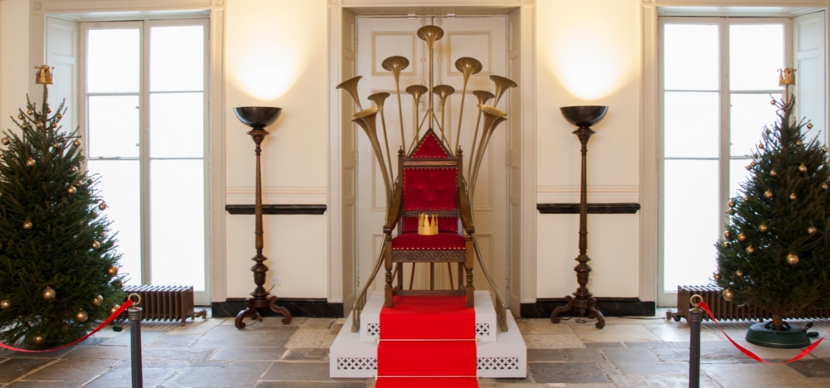
The talking throne made by East London Kinetics

Even if we do say so ourselves, the line-up is outstanding, with contributions from

  • Dr. Rebekka Kill
  • Kate Andrew
  • Holly Gramazio
  • Hamish MacPherson
  • Stuart Nolan
  • Nigel Reid
  • Tim Wright
  • Pete Ashton
  • Katie Day
  • Alice O’Connor
  • Gareth Briggs
  • Henry Cooke

You can find out more about them all and what they’ll be talking/doing about on the Many & Varied website.

We’re also very excited to have a keynote commission from Sarah Angliss:

According to Sarah, the stage is a tricky place to deploy a machine with an unusual interface. Your audience may be encountering the interface for the first time. They’ll have to grasp its function as the music unfolds, even though they can only see and hear it in action, rather than get their own hands on it. These days, musicians often have to face the challenge of laptop-based interfaces, where so much of the function is embedded in invisible, intangible code. As Sarah talks about these issues and her experience with unusual machines on stage, she looks at the importance of ‘coupling’ – in particular, the audience’s sense of cause and effect between a musician’s actions and sound. What are we gaining – or losing – by loosening this coupling? Does it matter if the audience have no intuitive sense of the musician’s influence on the music? And how can we deploy coupling to turn any gig into an unforgettable event – one which could never be replaced simply by listening to recorded music at home.

Tickets are only £4.50. Buy some.

Of sweat and shops: a project in Longbridge

I’m just getting started on a commission from E-C Arts as one of the cohort of artists contributing to their public art project in response to the regeneration in Longbridge, Birmingham.

This area has begun to see regenerational changes in the wake of the collapse of MG Rover and the demolition of most of the car manufacturing plant that previously dominated the landscape.

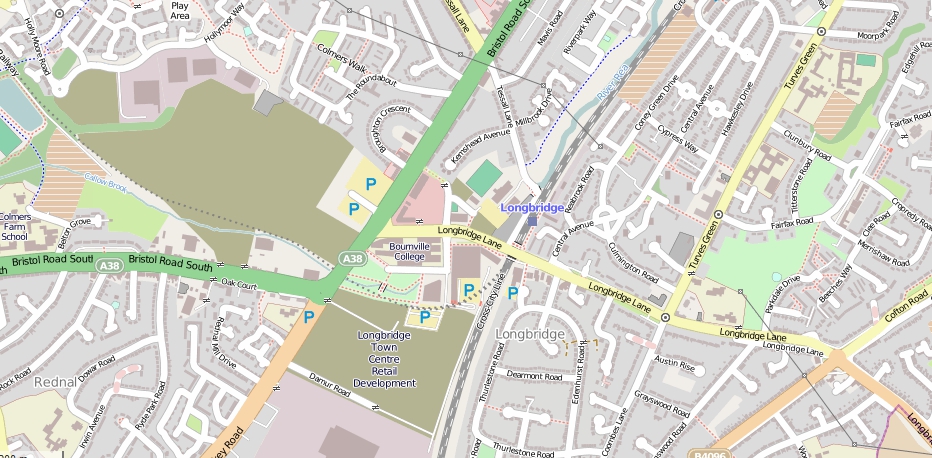
Map of a small section of Longbridge – the brown bits are mostly that colour in real life as former factory land waits to be built on

My brief is to investigate movement in and around the area so naturally I started off by going for a walk…

I mostly only have prior experience of the area from driving through it on the A38 (the big green road in the map above) so I took the opportunity to explore off to the East and experience different types of landscapes.

After being involved in the BMW Guggenheim Lab project in New York a few years ago, I’ve become increasingly interested in aspects of urbanism and, in particular, the ways in which design and planning decisions impact back on our experience of a place.

So the following day I returned wearing this:

A simple skin conductance meter, with GPS and logging modules

This is a device that measures Galvanic Skin Response:

A change in the ability of the skin to conduct electricity, caused by an emotional stimulus, such as fright.
source

If you experience a strong emotion such as fear, pain, curiosity or joy, this has an effect on micro amounts of sweat your skin produces and this can be measured by its effect on conductivity.

Those two velcro straps around my fingers are holding tin-foil electrodes against my skin. When I feel, for example, pain, this increases the amount of sweat on my skin and this means that electricity can move more easily between the two contacts. This difference can be detected by the small circuit and this in turn is logged by a small computer chip (an Arduino).

I’m interested in how this effect varies as a move around a place, so I also added in a GPS module so I can log my position. I’ve never done this myself before, but I once took part in a bio-mapping workshop led by Christian Nold where he did much the same thing, so I thought it might give some interesting results.

On Sunday I walked for a couple of hours, seeking different types of space: the residential area of Austin Village and the tower blocks; busy roads and junctions, road crossings, car parks and a small section of cycle path.

As I walked I tried to pay attention to being wherever I was. You know how, quite often we filter out a lot of what’s going on around us as we move between A and B? Well I tried not to do that.

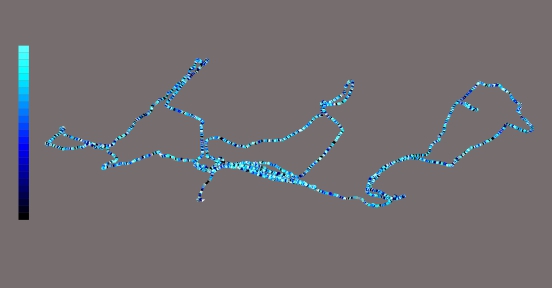
When I got home I mapped the data according to the GPS co-ordinates and colour-coded it according to the Galvanic Skin Response (GSR) data. Lighter colours relate to greater skin conductance. Triangles show the direction of movement.

There’s a lot of ‘noise’ because of the nature of the equipment and also because my hand wasn’t being held entirely still, but here’s the bit where I was walking around Austin Village and decided to explore down an alleyway (the spur to the right). Halfway down the alleyway a man came out of a side gate to unload his car, causing me to startle.

Walking from the top of the image, feeling quite relaxed, then turning left (right as you look at the image) down an unknown alleyway

Here is an overview of all of the data:

Galvanic Skin Response and GPS data combined into a map

Can you guess at what types of space I was walking through at each point, and how I was feeling in response to my immediate environment?

Declaration of intent: collaborations, brokerage, weird shit and ecosystems

This is still shifting around a bit too much to go on the Many & Varied website as something concrete, so putting it here more as thinkings-in-progress…

~~~~~

For a long time now I’ve found myself having conversations with people about how we’d like things to be different; about what’s missing in the Midlands; about how we often seem to meet up Elsewhere, because that’s where the stuff that feeds our practices is.

A few weeks ago I gathered together some of the people I’d been having these conversations with and we sat down and asked the question “so are we going to do something about it?”.

The team was selected on the basis of being proactive folks having a wide range of skills and backgrounds, here’s who was present:

David Checkley – Involved with festival style events and performances (such as Shambala and ProjectXPresents); Senior Teaching Technician, School of Electronic, Electrical and Computer Engineering, University of Birmingham; has helped several arts spaces across Birmingham get set up with electrics and lights etc.

Katie Day // @otherwayworks – Artistic Director at theatre company The Other Way Works; produced the Theatre Sandbox scheme for iShed, working with six regional venues to commission six new projects that explored the use of pervasive media in live performance.

Alyson Fielding // @alysonf – Managing Director of Pyuda, (storytelling, digital content, play); currently doing work for the Government Digital Service team; leads sessions for TeenTech; also working on various artistic/cultural projects.

Nikki Pugh // @nikkipugh – Me. Artist working at the intersection of people, place, playfulness and technology; founder of Many & Varied; co-founder of Birmingham’s first hackspace fizzPOP and mover and shaker for events there for a few years.

Antonio Roberts // @hellocatfoodArtist, curator and VJ; another fizzPOP co-founder, mover and shaker; runs events like Bring Your Own Beamer and GLI.TC/H.

Kim Wall // @kimble4 – Herder of bytes, electrons, photons and cats. Actively involved with Many & Varied, co-creator of Fun Factories and interactive igloos.

So between us we had a lot of angles covered, but we quickly identified that our concerns were similar. I’ll add the notes I made from the meeting to the bottom of this post, but the executive summary is that some or all of us will be working together to put things in place for a Midlands-based interdisciplinary hub of some sort. As the next iteration of Many & Varied we’ll be designing and delivering a programme of research, events and activities that move us a few steps further along that path.

We’re developing that programme now and identifying the research questions we want to address through it. If you’re thinking along similar lines or have thoughts/resources to contribute, then please get in touch.

Summary of meeting on 24th of November 2013

The challenges:
– Birmingham (and the wider West Midlands region) is missing a FACT- or a Watershed-like institution to champion and facilitate interesting interdisciplinary works [do we want to use the ‘D’ word? is it healthy?]
– Finding places to make (physical) stuff is difficult
– Finding people to collaborate with is difficult
– Intermediate layers of administrators can suck up disproportional amounts of the limited funding available to artists
– Birmingham often feels like it doesn’t ‘get’ interdisciplinarity, with newer artforms lacking support and people being judged on day jobs and academic background (or lack thereof)
– It’s difficult to find/make space in which to play/learn/explore

Ideal ecosystem:
Space and facilities for making things
– Fun and inclusive
– Where weird shit can happen
– Embraces interdisciplinarity (including in same person)

Space and facilities for meeting people (may not be the same physical space as above)
– Talking as a currency (also see PM Studio’s contract of interruptibility)
– Co-working/hot-desking options
– Events that bring people together
– Facilitates serendipity and bringing together potential collaborators

Admin component
– Optional – can access the hub without buying into training etc
– Advocates for interesting stuff, showcasing good projects
– Brokers for funding
– Initiates projects that give purpose to collaborations
– Approachable at the start of a project to fast-track linking up with people and resources
– Promotes collaborations (cf contracting for services) and the skills required for this

Short-term aims:
– To develop a community of interesting people
– To develop a culture of open, interdisciplinary events
– To get in place what we can in terms of community and infrastructure, so that we can hit the ground running when we get to the stage where we need to ask for support and money/membership etc
– To begin to identify sources of income and strategies for sustainability

Short-term actions:
– Sort out a programme of events that bring people together and explore initial questions about what might or might not work
– Get clued up on what else is going on the the region
– JFDI

Bees in a Tin – call for unusual interfaces

I’ve been running the Many & Varied programme of events over at The Public, and as the last in that series (relocated to Birmingham, because The Public has now ceased to be) we’re gathering as many interesting and exciting people as we possibly can together in the same room at the same time.

The event is called Bees in a Tin and the call for proposals is here: http://manyandvaried.org.uk/bees_in_a_tin_-_call_for_stuff/ (deadline January the 8th). Follow that link for full details and the application form.

So, if you make unusual interfaces for the world around you, get thinking about how you can use that day. Also have a think about who you’d like in that room with you and spread the word!

29 Not-Quite-Random Walks Around Tokyo

I’ve been a bit slow in posting this one, but the audio and slides of the talk I did for Pecha Kucha Night Coventry in October has been put on the main PK website:

The explosion during slide 13 is courtesy of the party poppers left behind by an earlier speaker, Laura Elliot!

Follow @PKN_Coventry on Twitter to keep up-to-date with what’s happening with future events.

GPS Orchestra with the Digital Producers Lab

I’ve spent the last week running GPS Orchestra as an ongoing element woven through iShed’s brilliant Digital Producers Lab (a development programme for 12 producers working across Wales).

As a counterpoint to the programme of presentations and discussion settings led by some great speakers, GPS Orchestra was intended as a practical set of tasks to introduce working with GPS, electronics and the Arduino platform.

Starting with a ‘site visit’ out into Millennium Square, the producers were tasked with observing the space and thinking about how they’d like to nudge the atmosphere and/or behaviours they noticed.

That was the easy bit! What followed was a steep-learning-curved introduction to coding and prototyping to get them to the point where they could control motors and LEDs through live GPS data according to the movement of the contraptions they were to make.

Layering up the skills through the week, it was very heartwarming to hear that by Wednesday quite a few of the group were already planning to purchase Arduino bits and pieces to continue tinkering with after the lab!

By Friday lunch time – after only about 5 or 6 hours on their projects – they had made some amazing things:

  • Something that responded to the number of satellites it could see – initially intended to be rolled along the floor, but ended up getting lots of hugs.
  • Happbee – a wounded bee whose recuperation could be assisted if you carried him fast through the air as if he was flying.
  • The musical box – a small box that had the power to make you dance (or at least move differently).
  • The Digital Harp / y Delyn digidol – plays when you walk towards Wales and plays more the closer to are to the homelands.

It wasn’t an easy challenge by any means, but I was really impressed with the outcomes (not just the things they made). A lovely group of people and a very inspiring week overall. Thanks to everyone who contributed.

My photos from the week are at http://www.flickr.com/photos/nikki_pugh/sets/72157637471578064/, and below are a collection of Tweets relating to the sessions:


Copyright and permissions:

General blog contents released under a Creative Commons by-nc-sa license. Artworks and other projects copyright Nicola Pugh 2003-2026, all rights reserved.
If in doubt, ask.
The theme used on this WordPress-powered site started off life as Modern Clix, by Rodrigo Galindez.

RSS Feed.