November 9, 2014

Colony presentation at Pecha Kucha Coventry

Here’s a words-and-pictures version of the presentation I did for Pecha Kucha Coventry on the 30th of September…

~~~~~

2010. I’m working with GPS data and walking around Birmingham, on the cusp of starting to try and weave together thoughts about public space, DIY tech, playfulness and the ways in which combining these can change our relationships with the places where we live.

By November I’m starting to get the headpictures – the fleeting images of a half-seen thing that compel you to make the thing so that you can get the rest of the detail.
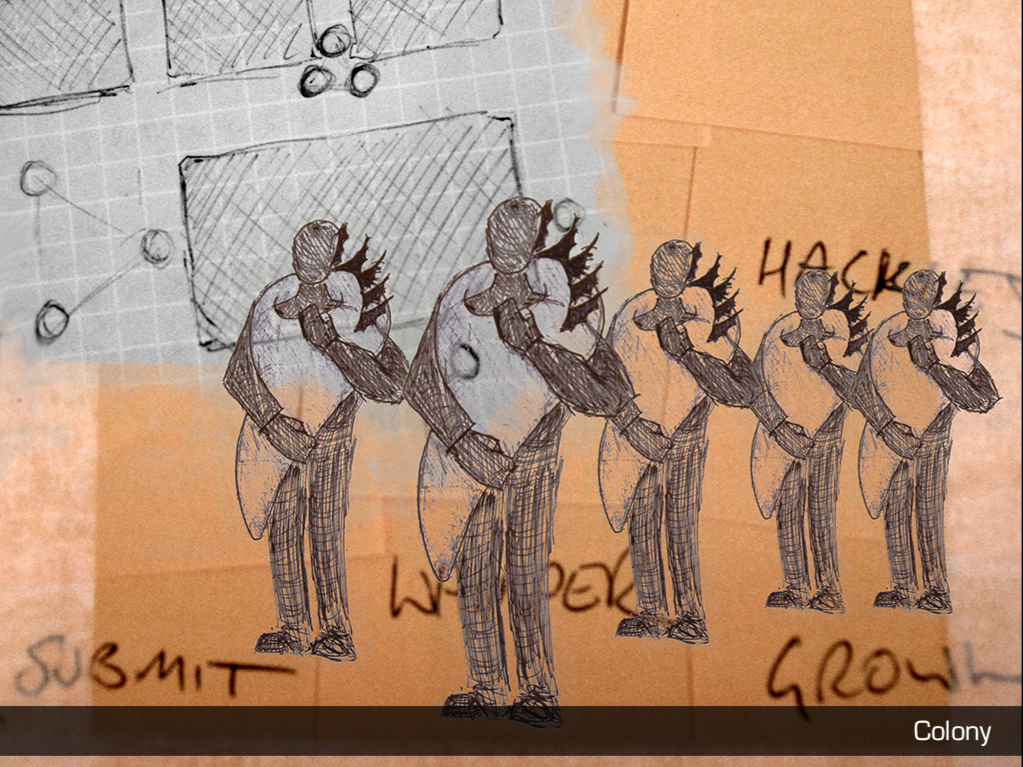
In my mind’s eye I could see small groups of people carrying creatures that would give them some sort of extended awareness of the built environment around them. I wanted to know how this group would affect – and be affected by – the city as it moved through it.

This project became Colony, And this is a whistlestop tour of what happened next…

I wanted the communication between the person and the creature to mainly be through touch. We’re so used to interacting with things through screens, but I wanted to leave sight free for everything else in the world, not looking down at this thing.

The first prototype had a long contact interface across the person’s body.
Here’s an abridged description from Holly Gramazio:

It has half a dozen different types of vibration (a central shake, for example, and a long ripple that moves from the narrowest end of the bundle to the widest).

It decides when to vibrate – and what sort of vibration to make – entirely at random.

The first thing we noticed was that was that holding the bundle gives you an immense feeling of entitlement.

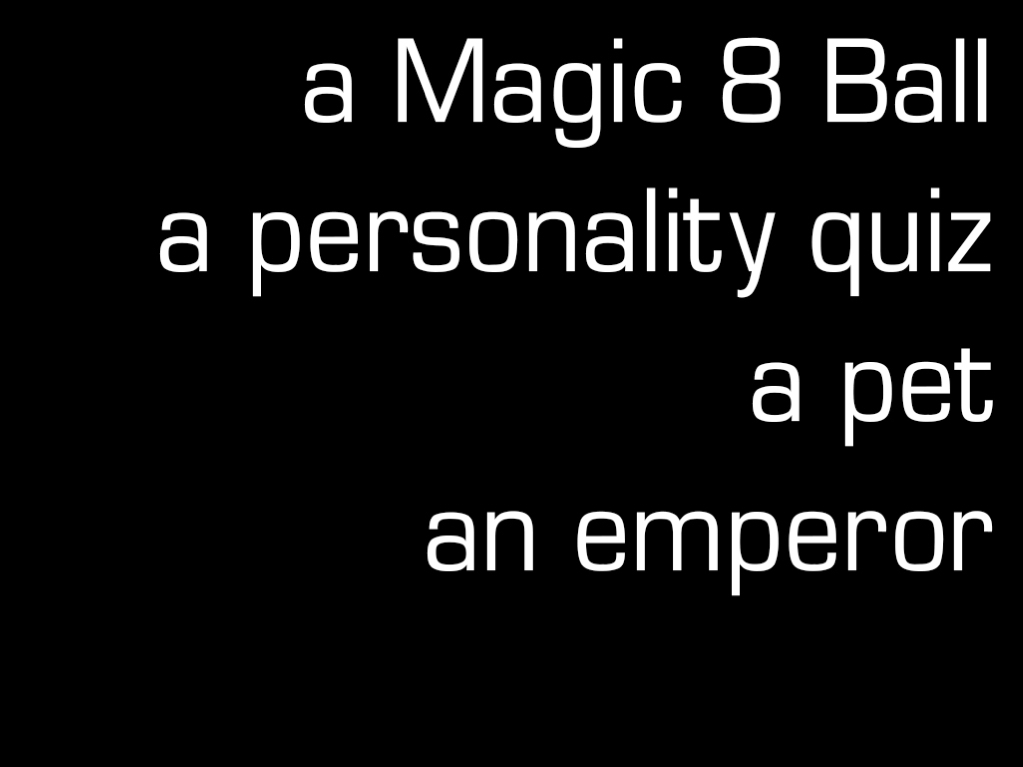
It’s a cross between a Magic 8 Ball, a personality quiz, a pet, and an emperor.

Out of that first proof of concept we saw how readily people would invest the random vibrations with personality and intent. It also gave us permission to explore the secret corners of Birmingham.

The next iteration had vibrations that were linked to the built-up-ness of the immediate surroundings – this led us into more corners and alleyways.
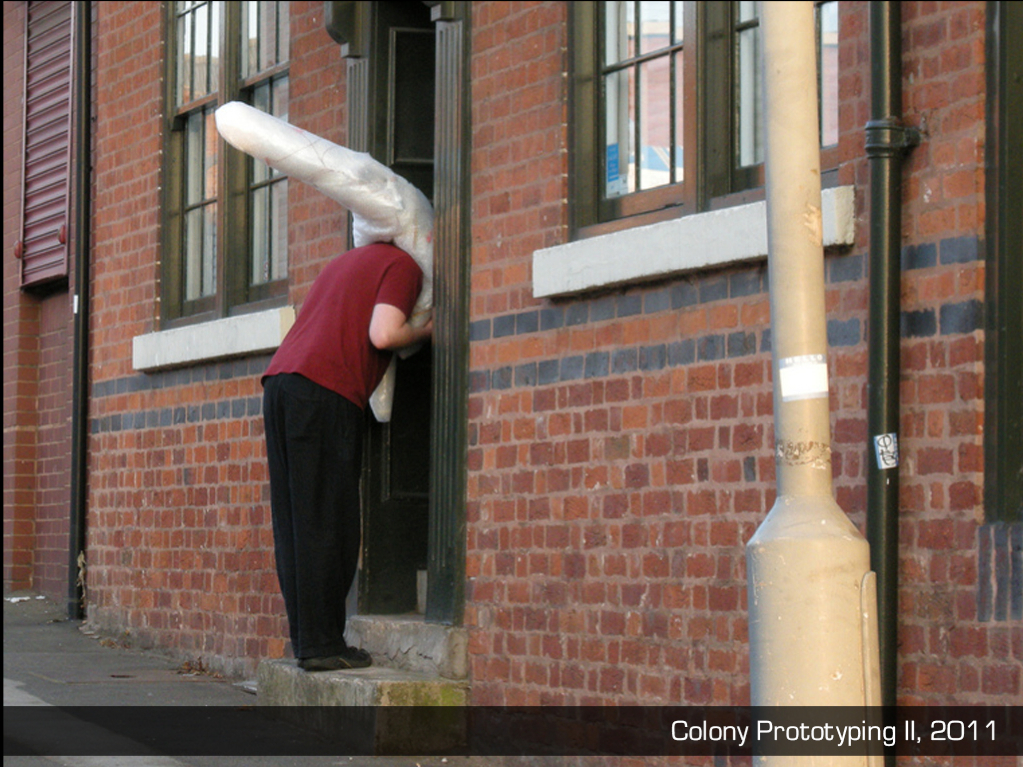
What we also got from this location-aware version was an excuse not just to go to different places, but to interact with those places in non-usual ways.

We all agreed there was something very nice in the soft, warm, light, secretive cuddliness of the creatures.

So there was really only one direction to go in next!

Big, heavy and cumbersome, I made three of these wooden drums that tapped at different intensities depending on whether you were out in the open or not.

With consumer electronics constantly striving for smaller and sleeker, it was interesting to see the effects of a mobile device you have to work hard at. Really hard at.

The residency those were made through also presented some chewy problems regarding how to exhibit these objects. I usually use galleries as hubs for activity, so exhibiting actual things isn’t something I do a lot of.

When I see the objects as being only half of the constructed assemblage, how do I usefully represent them after the experience and when the person half is not there?
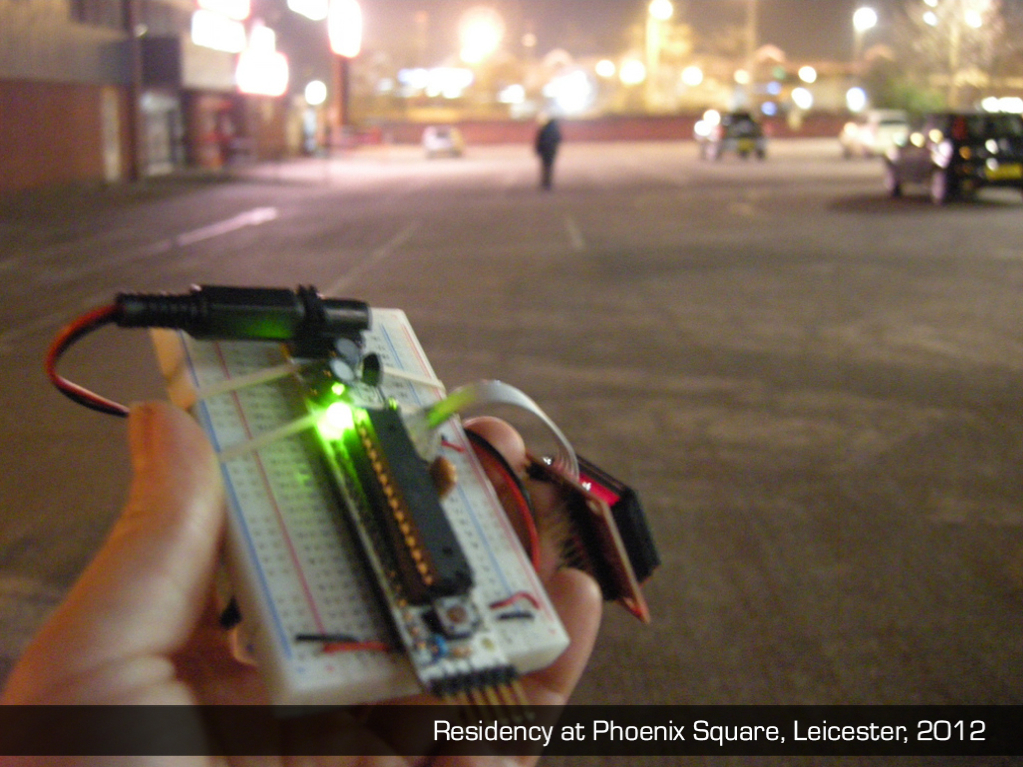
Another residency. This time with a few days to think a bit about the Colony as linked individuals.

I did some experiments with these little radio units and playing around a bit in carparks at night to find out when they stop being able to communicate with each other.

Later, I built on this to make Landscape-reactive sashes. Here the members of the proto-colony are wearing these yellow sashes that have a radio and a vibration motor in them. There’s a central node who is analysing the GPS data and sending out the vibration instructions to all the sashes.

Become separated from the group and your sash goes still.
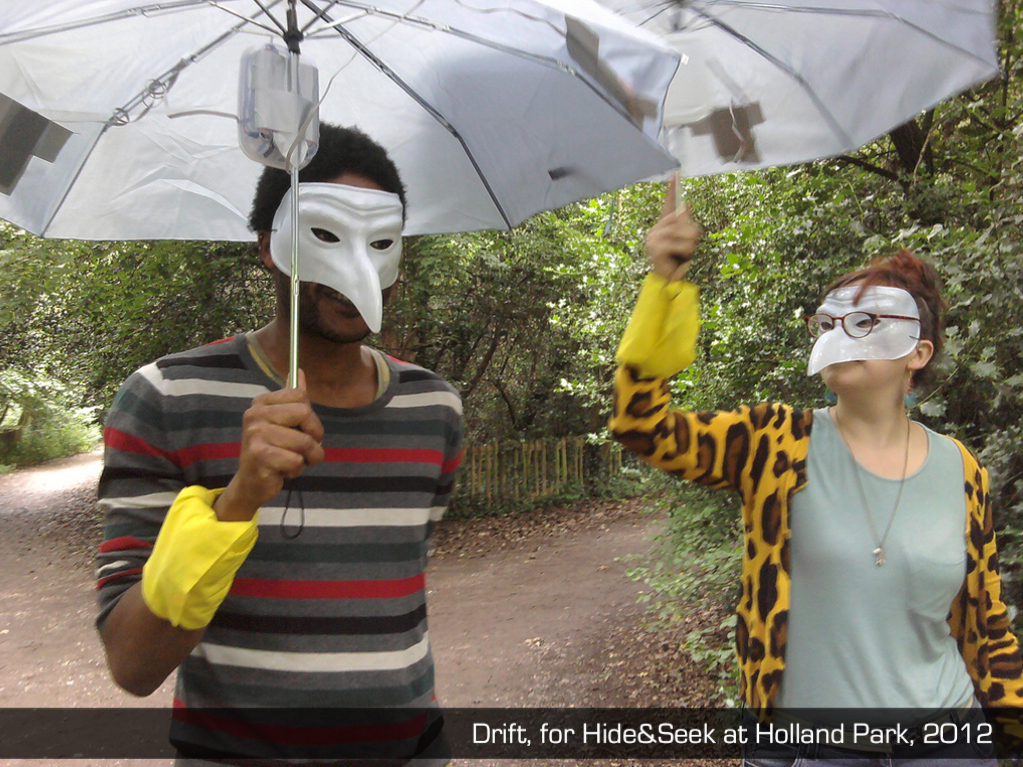
With Drift, I wanted to find out if it was possible to ‘read’ – to interpret – the vibrations from the sashes.

Given a choice of 3 possible broadcasters – these magnificent creatures – could you deduce which one it was from thinking about the different places where they were stood?
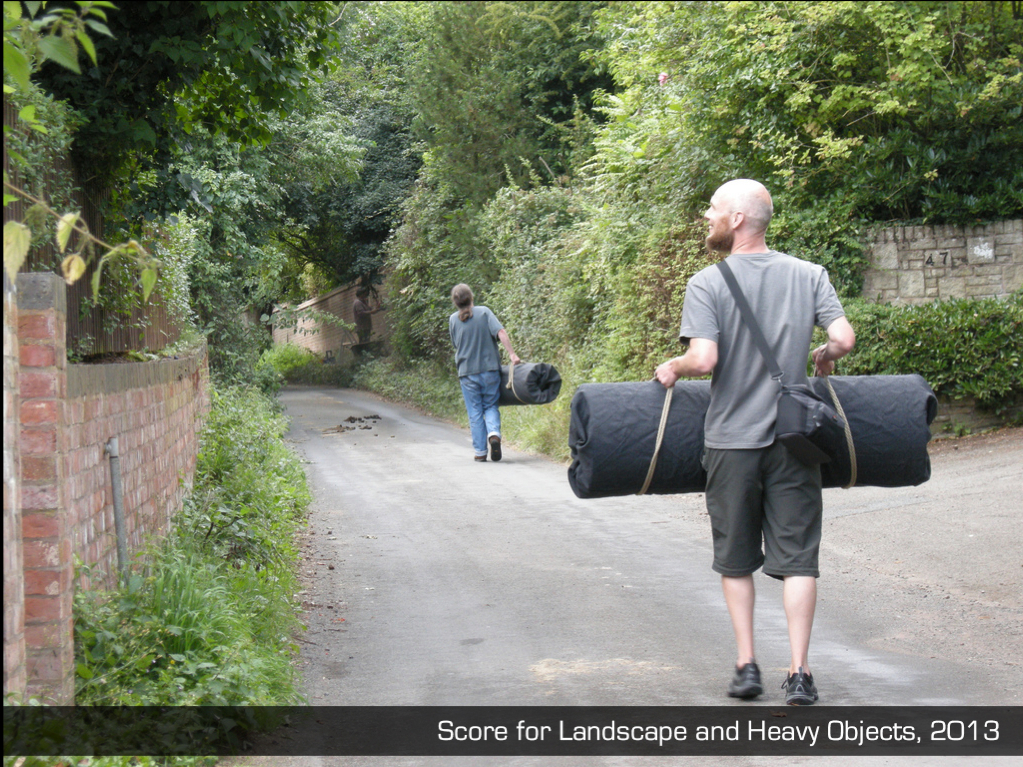
Last year the heavy objects came out again. This is David and Sam from the wonderful If Wet… walking them around rural Worcestershire after I challenged them to use them as musical instruments.

All three of us walked for something like an hour, and I’m fairly sure they saw them more as instruments of torture rather than as a way of sonifying the landscape.
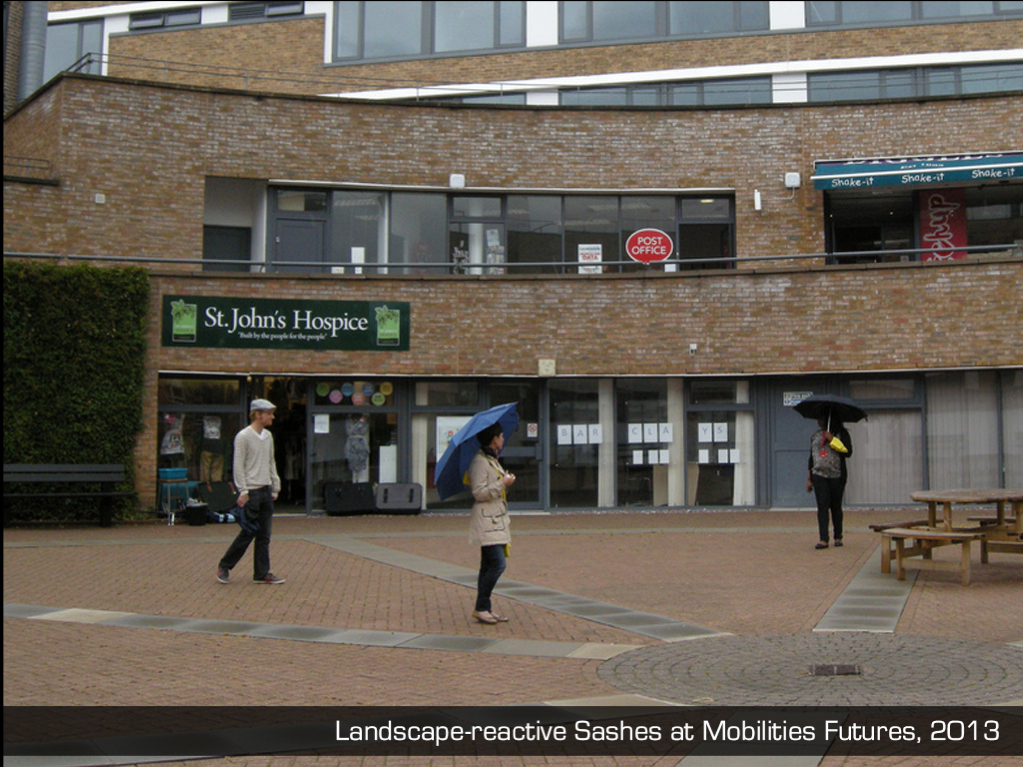
Then I was invited to present a workshop as part of the Global Conference On Mobility Futures at Lancaster University. These are the sashes being walked around a drizzly campus.

Mobilities Studies is a youngish area of research that explores the movement of people, ideas and things, as well as the broader social implications of those movements.

Although the weather was uninspiring I’m getting a lot out of Mobilities Studies as a way of thinking about my work.
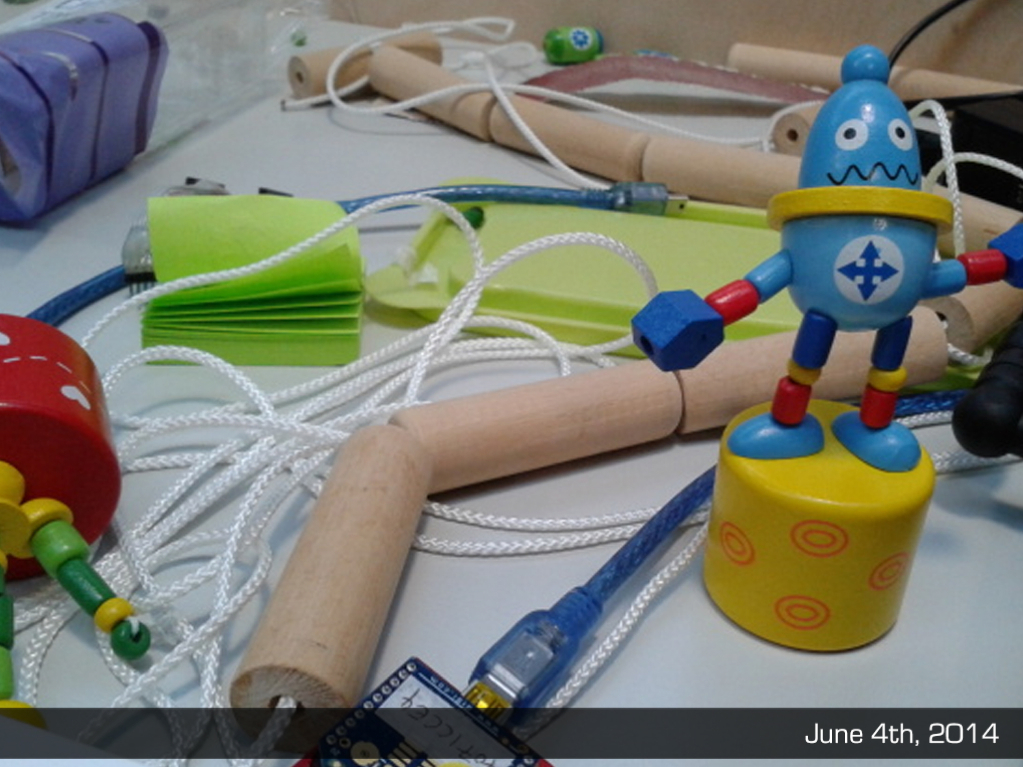
This Summer I got an Arts Council grant and finally a chance to dedicate a bigger chunk of time to developing the creatures. Priorities were 1) investigating how to design the bodies so they could communicate the creature’s emotional state, and 2) building in an awareness of the Colony as a whole.

The latter was beyond my skills, so I delegated that to Tarim, who actually knows how to do computer programming. The former started here with bits of string, post-it notes and dissecting pushpuppets for scientific purposes.

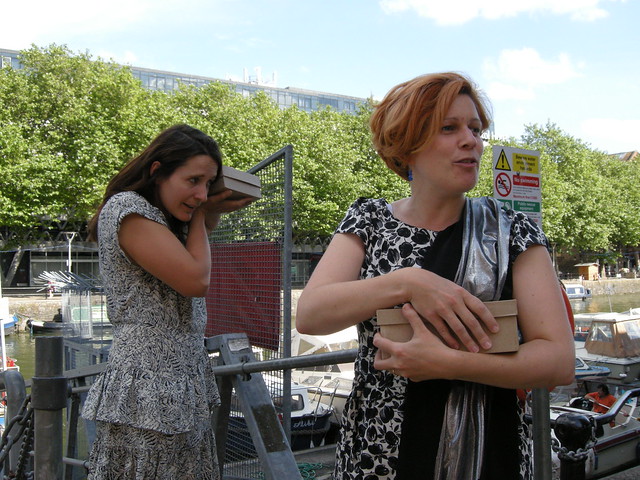
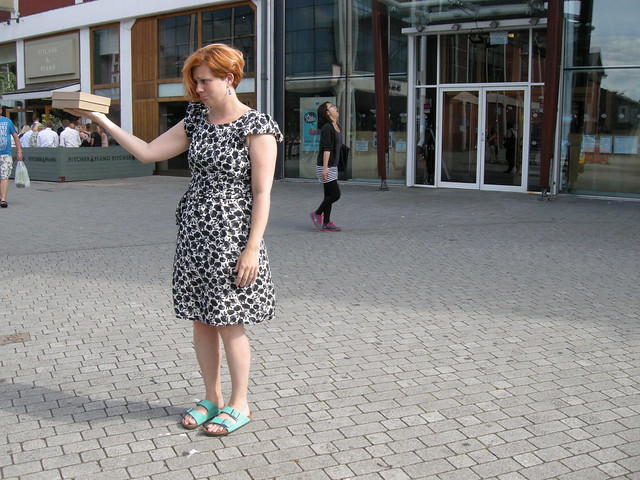
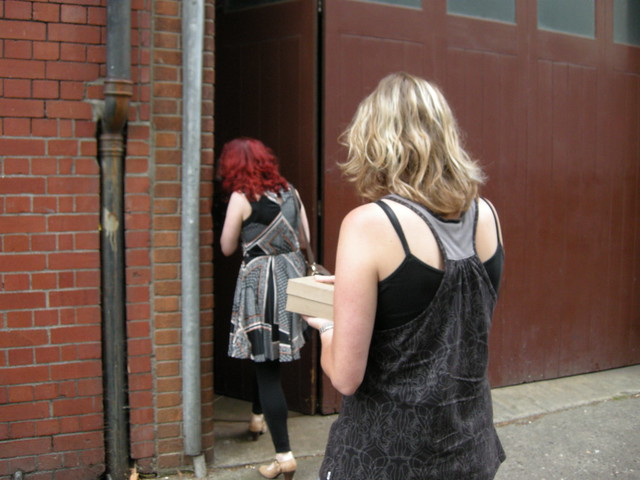
The next step was a heartbeat inside cardboard boxes. Even that had the power to make people feel empathy towards the thing and curiosity towards their surroundings.

Over a total of about 35 days we’ve gone from that, to 3 of these.
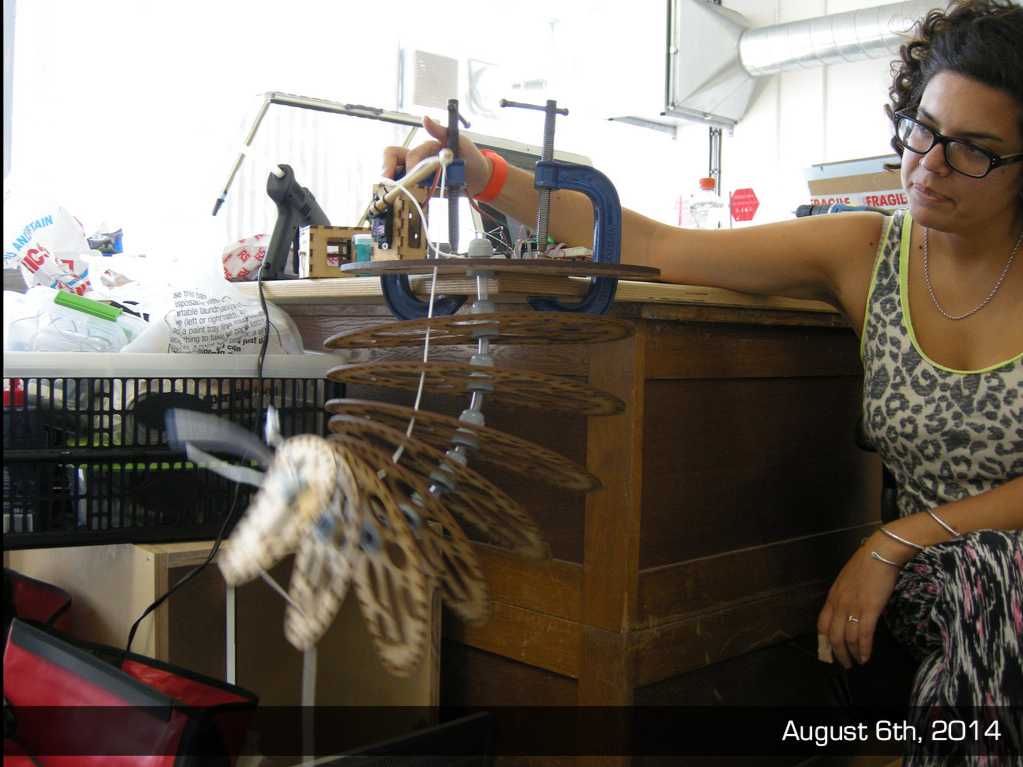
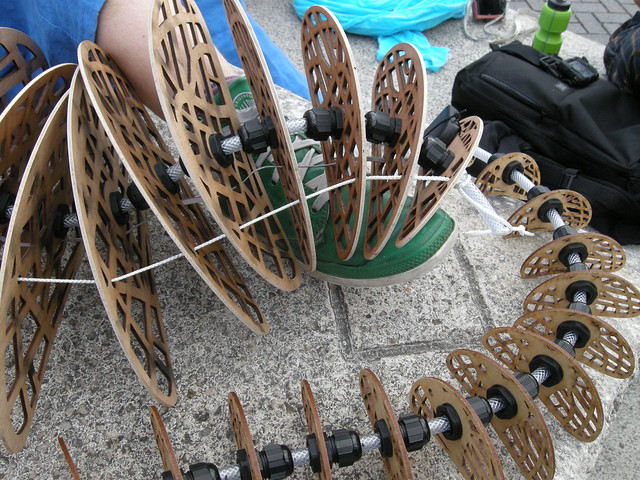
I spent 9 days working with Sarah Barnes at the laser cutting facility at UWE. Here we built many, many iterations of hearts and spines and brackets and levers.

With physical manifestations to play with, we could figure out the mechanics and also the intricacies of how it all related back to the human body in motion.
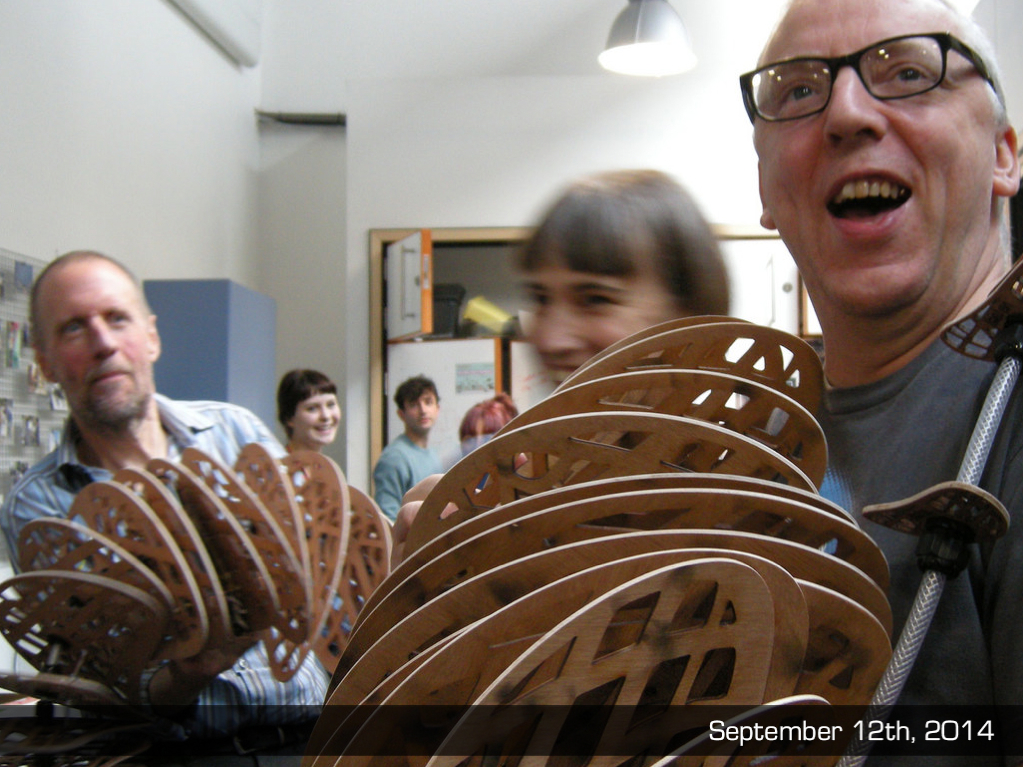
We were confident we were onto a winner with this design, and this was confirmed when we put the creatures into the arms of a small group of playtesters.

Humans of course being the part of the system that it’s hardest to design for.

I’m starting to understand about how to manage the getting-to-know-eachother stage where empathy is formed, the Colony is bonded and a shared language is developed.
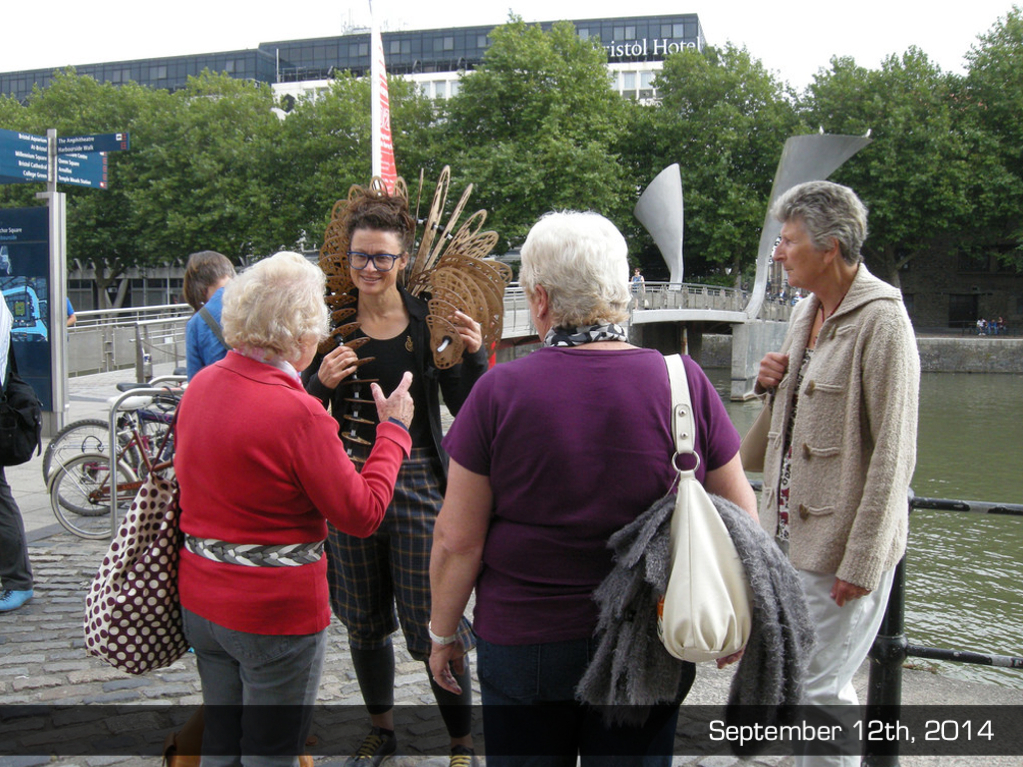
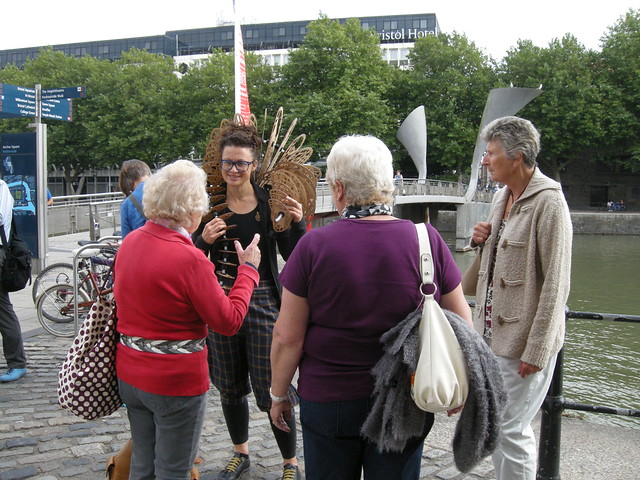
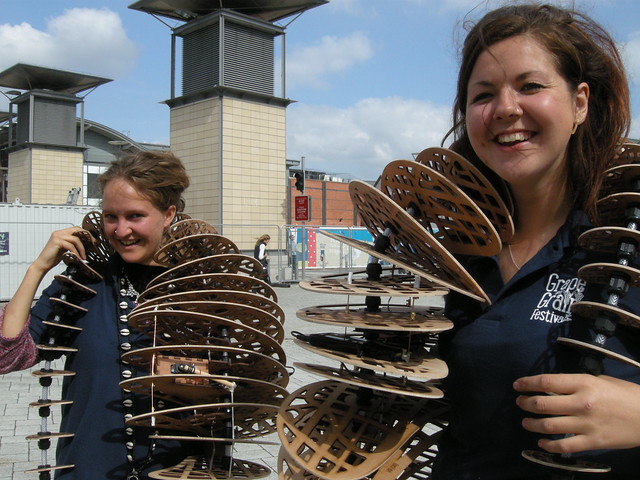
I was hoping the Colony would provide something of a spectacle, making other people nearby curious about what was going on. I wasn’t prepared for quite how many people came up to us and wanted to touch, wear and talk about the creatures.

I love that these things make a space for stranger: stranger interactions.

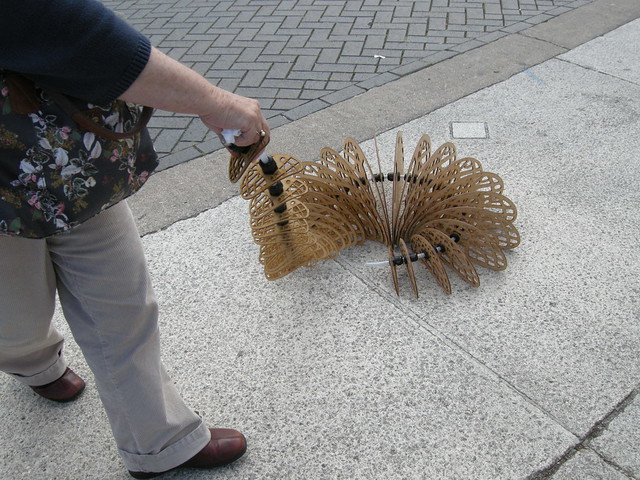
And then there was all the unexpected stuff too: one woman spent ages drawing with one of the creatures by dragging it around by one end.

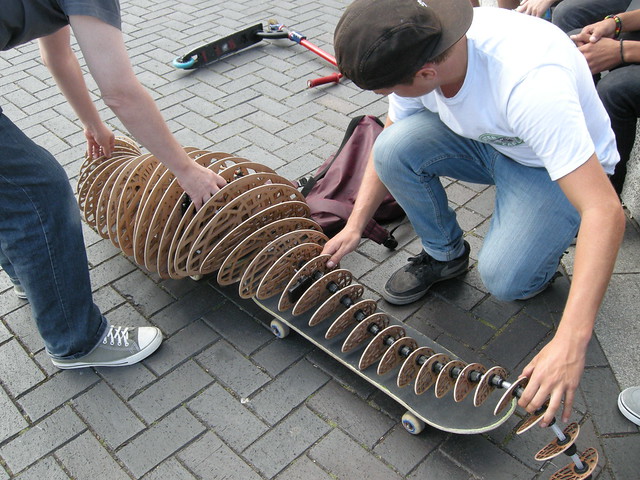
We can also confirm they’re unexpectedly good at skateboarding and that they do not like being dangled over deep water.
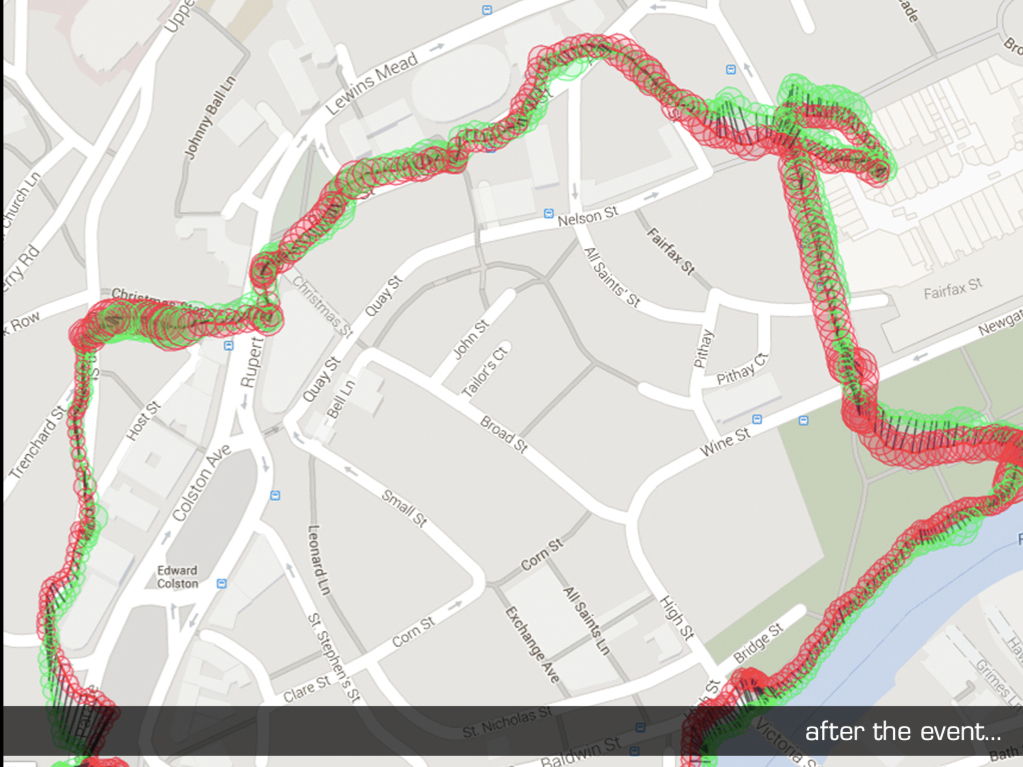
I think it’s important for people to have a framework for sitting down and sharing their stories and experiences after walking with these things. I’ve also been working with David Haylock to map the data collected by the creatures, so we have a visual reference for when different things happened and a starting point for thinking about why they happened.

~~~~~

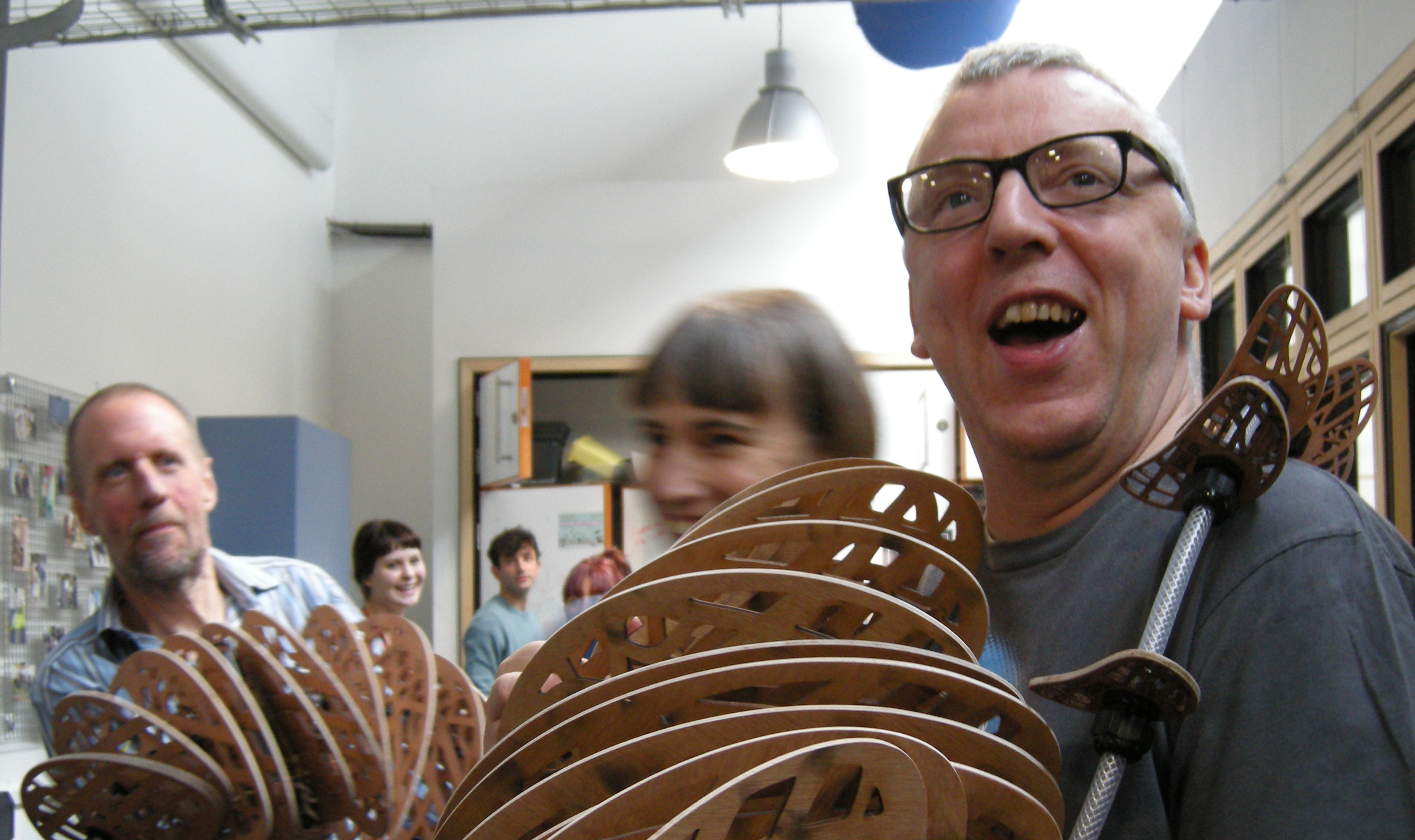
I didn’t really have a snappy closing line, so instead I invited the evening’s organiser, Janet, to come up and meet the critter I’d bought with me
Colony residency: final push

Only 5 more days of the residency at the PM Studio left; I’d better squeeze in another update!

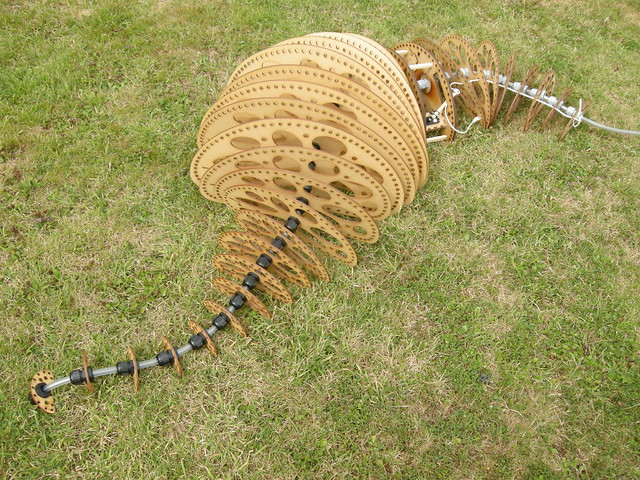
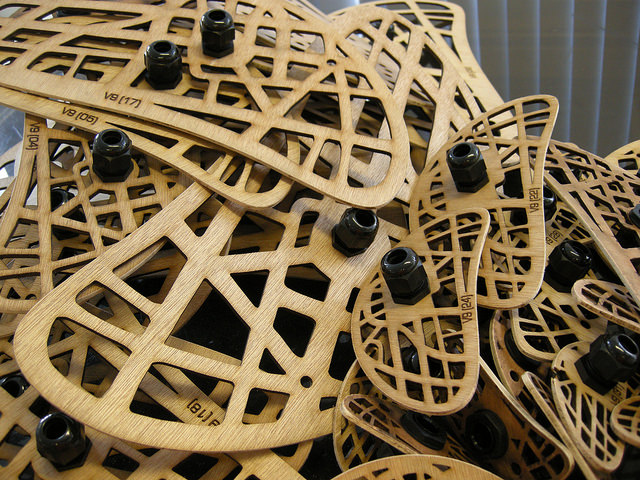
After the first wave of lasering and constructing with Sarah Barnes, there was just enough time to refine the design of the creatures and squeak out enough cuts to make 3 creatures out of plywood (a lot nicer material to work with and handle compared to the MDF I had been using for the previous prototypes).

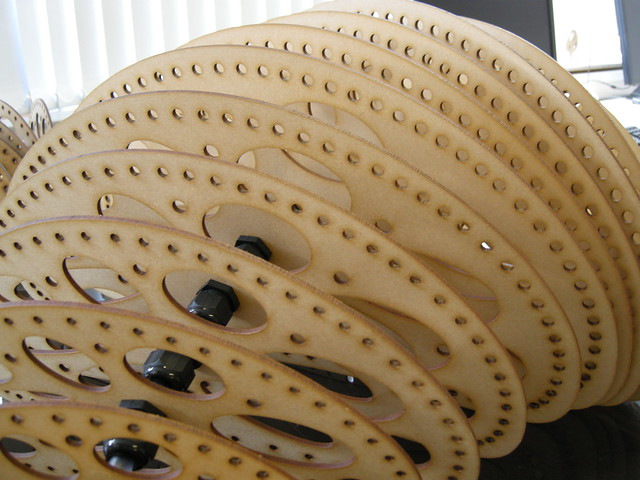
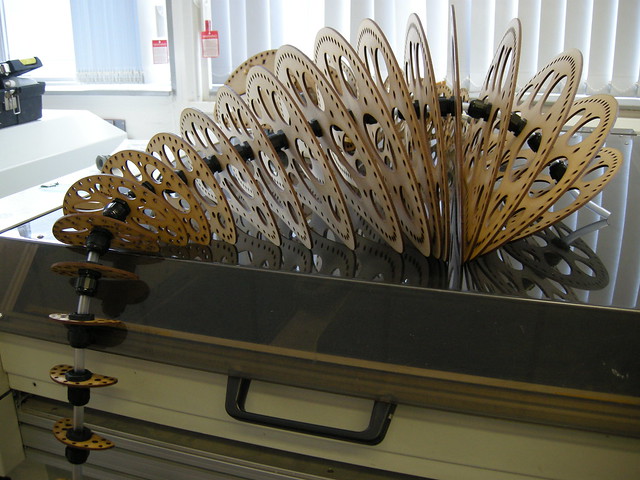
Cabourg stack waiting to be assembled

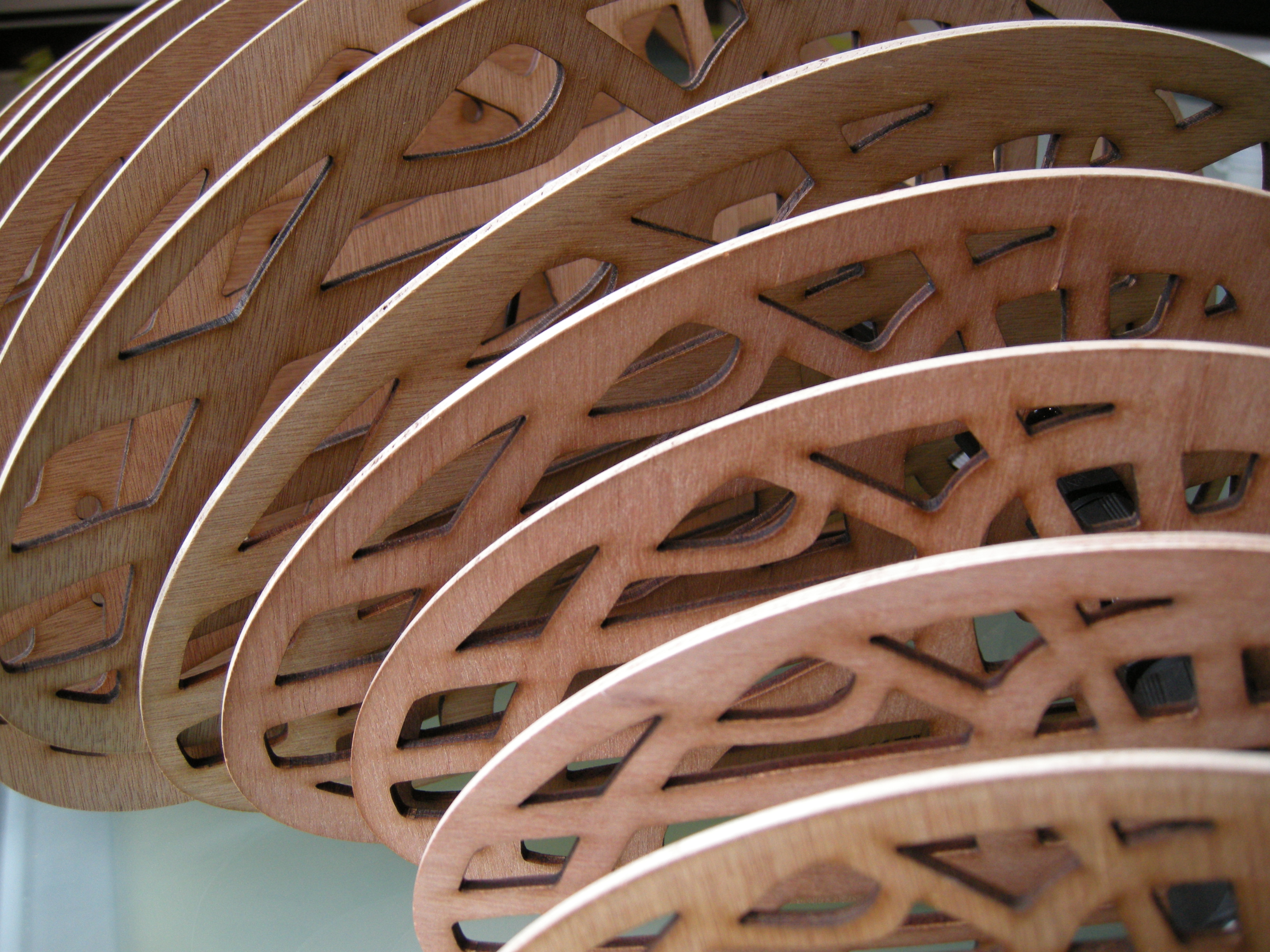
Version 9 of the spine has vertebrae that echo the street layout of Cabourg: a French seaside resort and influence in Marcel Proust’s In Search of Lost Time. I like this as an allusion to the multi-path error phenomena from which the creatures’ movement is derived.

Speaking of their movement, it was a very nice moment when we got this tail moving:

It had been tense moments up until that point because as well as the change in vertebrae material I’d also changed the hose I was using for the ‘spinal column’ and tweaked the positioning of the hole used for the driver cord.

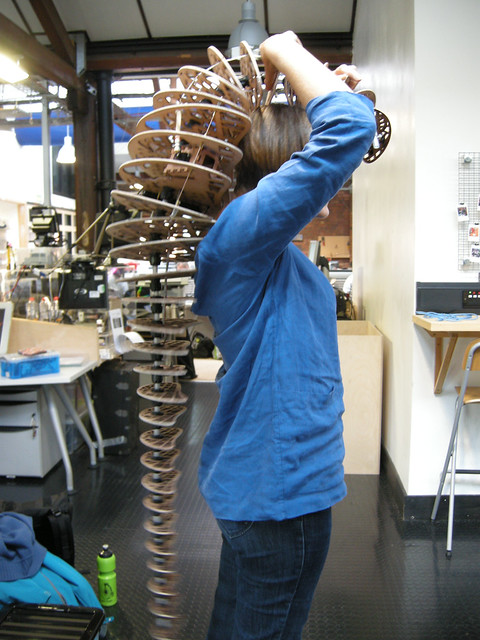
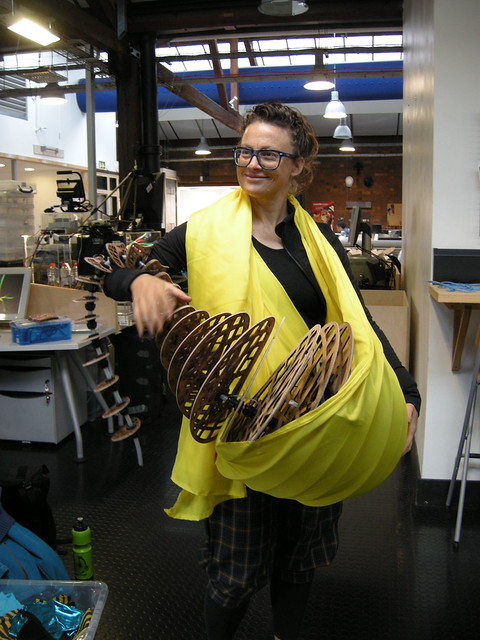
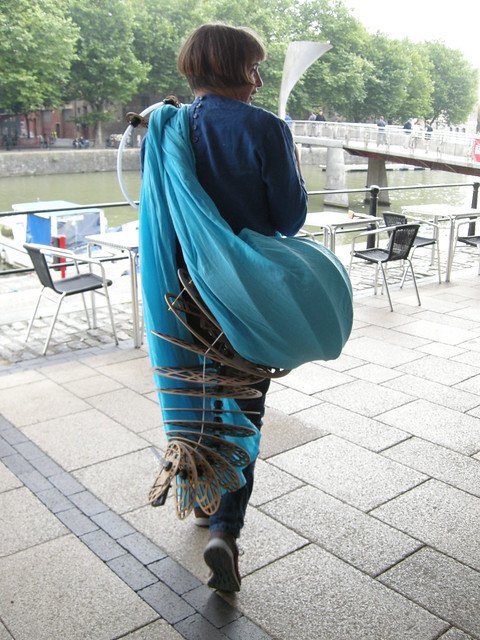
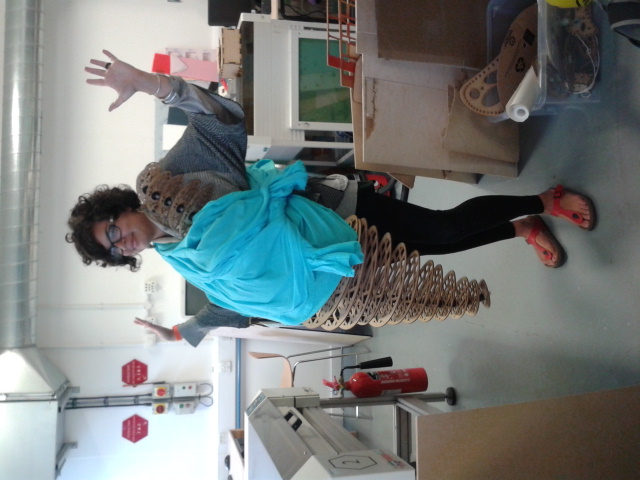
Alongside changes in the overall dimensions, we now had a structure that was a lot lighter and more manageable to carry. It would still be a bit of a weight to carry for any length of time, though, and since I want people to be able to use their hands for sensing movement rather than gripping and carrying, we also did a few experiments with binding the creatures to their guardian:

Hands free!

The process of wrapping up yourself and a creature in a long length of fabric is an interesting one and I think it has a lot of potential for symbolic beginnings and fostering empathy.

Once the 9 days of laser cutting were over (gosh we came a long way in that short amount of time!), it was time to return to the Pervasive Media Studio and tackle the code and electronics once again.

Wait! No! What am I saying?! Once the 9 days of laser cutting were over, it was time to spend a couple of days sanding the edges of all the vertebrae in order to remove the burnt wood and to make them smooth to the touch. The result was well worth it, though.

Sanded plywood vertebrae – much more touchable

After another couple of days soldering electronic circuits, the creatures were ready for assembly with GPS units, batteries, Arduino and the servos that control the articulated tail section. This isn’t yet the final set-up I want to use, but I had a group of playtesters arriving in Bristol the next day and I wanted to get something up and running so that they could have something landscape-reactive to try out.

The night before the playtesting I lay the freshly-assembled creatures out on a convenient table in the Studio and it was borderline unnerving to see them twitching away and generally just sort of quietly owning the place. Y’know, in a good way. In a very good way.

“Colony creatures are having a quick run-through of their presentation for next week’s Lunchtime Talk at @PMStudioUK”

Have we got space for another close-up of some curves? Yes. Yes, I think we might…

…And then play testing was upon us!

I’d invited a crack squad of playful people who I believed would ask me some challenging questions and push my assumptions about what I thought I’d made: Jen Southern, Stuart Nolan, David Morton, Kat Jungnickel, Sam Underwood and Laura Kriefman. I wasn’t disappointed! Much to consider, interrogate and experiment with.

The playtesters get acquainted with the creatures

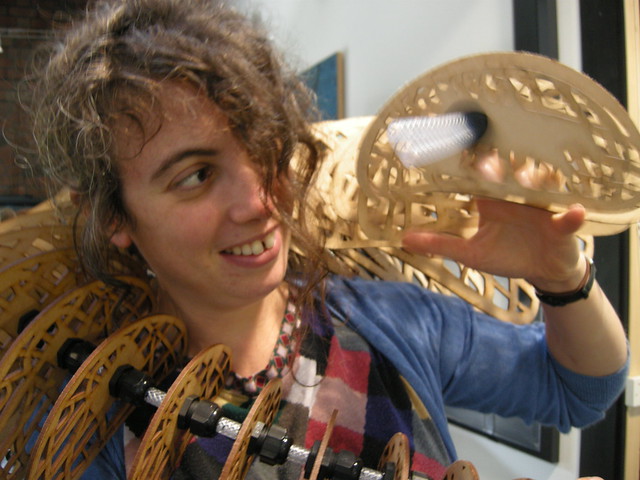
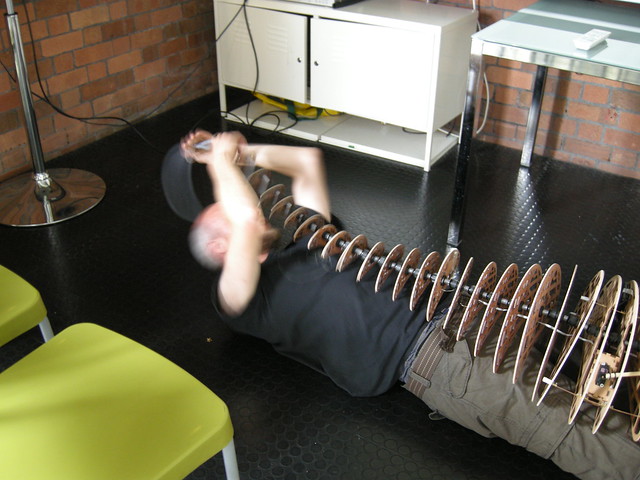
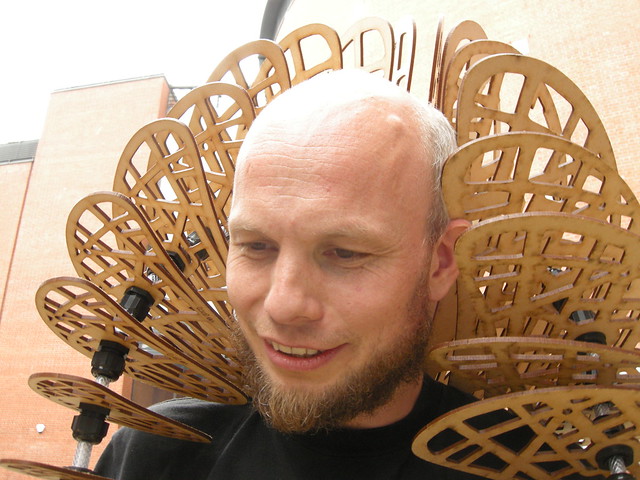
In the few hours we had we didn’t focus on the landscape-reactiveness of the creatures so much, but there was a lot of exploration of how their forms related to the people carrying them. Here are just a few examples:

Colony Playtesting 12/09/2014

Colony Playtesting 12/09/2014

Colony Playtesting 12/09/2014

Colony Playtesting 12/09/2014

Colony Playtesting 12/09/2014

Colony Playtesting 12/09/2014

Colony Playtesting 12/09/2014

The other discovery was that the creatures were a MASSIVE invitation for strangers to approach us, ask what they were and, often, pose for photos with them. This process had started even before we’d left the studio, and once outside they continued to pique the curiosity of young and old alike:

Colony Playtesting 12/09/2014

Colony Playtesting 12/09/2014

Colony Playtesting 12/09/2014

Colony Playtesting 12/09/2014

A set of my photos and videos from the day is on Flickr.

This was all very satisfying and followed on nicely from my Lunchtime Talk at the Studio last year where I talked about how I see the things I make as permission givers and invitations for triangulation. Yup, I’m very pleased with that.

This Friday I’ll be giving another Lunchtime Talk at the Studio and, fingers crossed, by then we should be in a position to also try out some of the flocking aspects that Tarim has been working on.

Exciting!

Colony residency: iterations and combinations

The current Colony residency at the Pervasive Media Studio has a chunk of time for laser cutting in the middle. That’s where I am now: learning to use the laser cutter; improving my understanding of the physics and mechanics I want to harness to make the creatures move; and – what’s really interesting – getting new insights into the whole undertaking through having physical objects to interact with.

For this bit I also have Sarah Barnes to interact with, which is feeding in lots of other lovely references and observations!

Using the laser cutter we’ve been able to quickly cycle through several iterations of different elements to the creature structures.

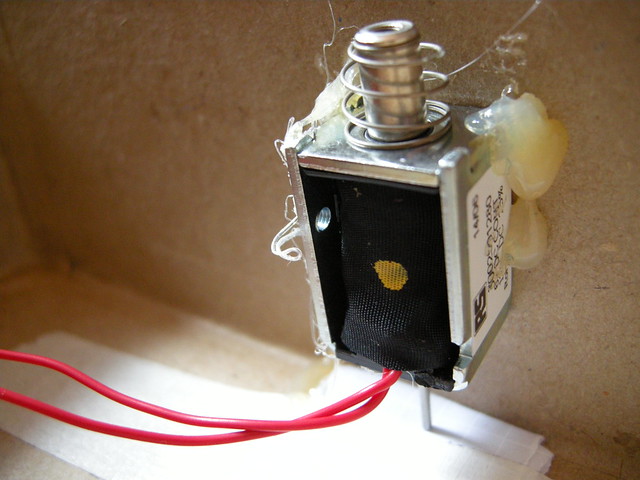
The heartbeat – which will be used to indicate panic levels – was, two weeks ago, a solenoid glue-gunned to a cardboard box. In 6 days’ worth of laser cutting it’s gone from

heartbeat v00

heartbeat v00: solenoid glued to a cardboard box

via

first attempt at a solenoid mount: it looks so clunky now!

and

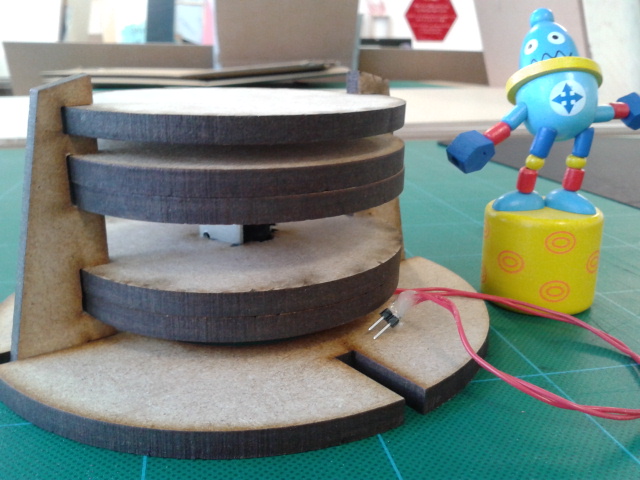
heartbeat v01: a much more lightweight structure, pressing rather than tapping

to this much smaller and lighter design:

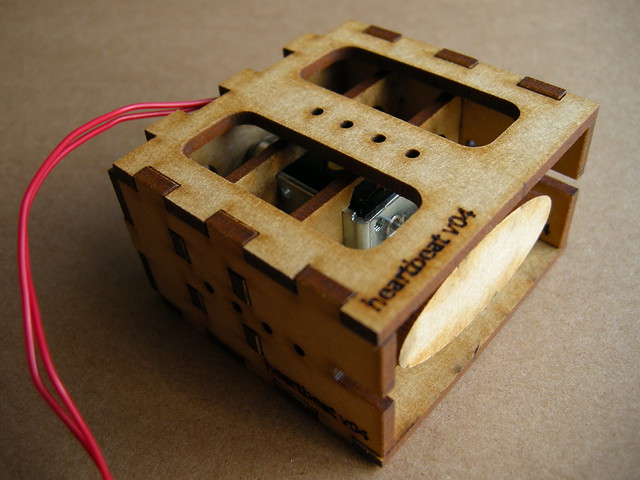
heartbeat v04

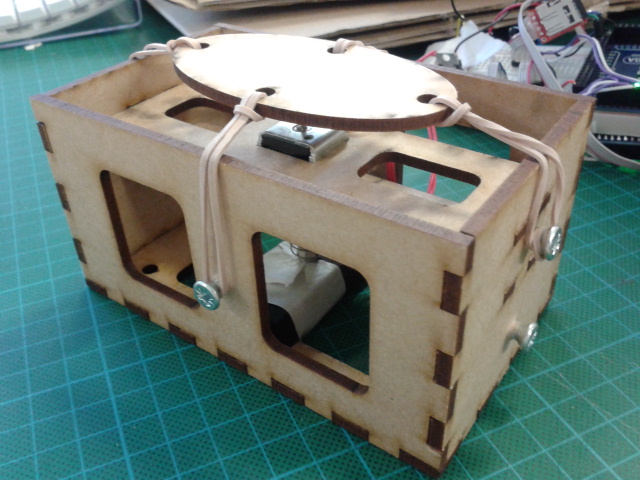
heartbeat v04: scaled-down framework suitable – I hope! – for attaching to spine vertebrae.

The last week has been all about the spine, though. On Wednesday we attached a ‘tail’ to a servo and were able to see the combination articulating by themselves for the first time (prior to this it had been me tugging on a string).

After spending Thursday morning wrestling with how to skin the structure, we eventually decided that perhaps we didn’t need to and I embarked on preparing the files for a ‘body’ section that would be constructed in the same way as the tail. No laser cutting got done that day.

… but a lot got done on Friday, resulting in this little beauty!

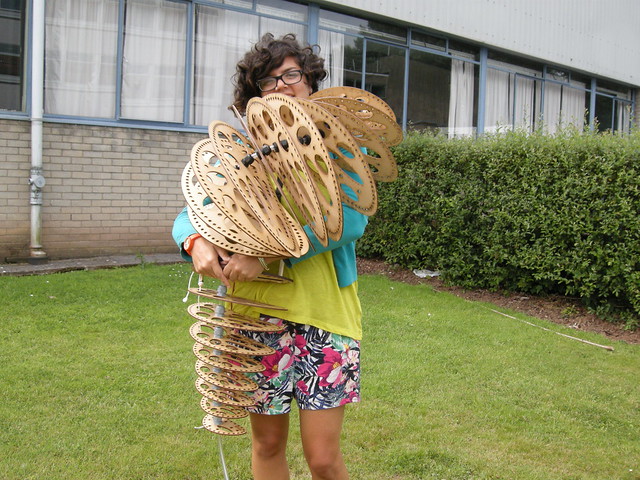
Well, I say ‘little’, but it is kind of huge:

The new torso section joined onto the articulating tail

I have a few concerns about weight, and the consequences of this when the creatures are carried around for a significant amount of time, but the large size of the skeleton is proving to be very interesting in terms of how you relate it to your own body as you wrap it around yourself. It’s very similar to a process of stepping into a role and almost ritualistic as you become one with the structure. We’re now thinking that using a fabric poncho or sling tactic will work well for supporting some of the weight and also bonding you even more to the creature for which you will be a guardian.

Our little forays outside to take photos are also highlighting the creatures’ potential for catalysing stranger:stranger interactions as, even on a deserted summer campus, this one has already initiated conversations with several people who stop to ask questions as they pass by!

I’m really happy with the way all this is evolving: there’s a satisfying balance between proof of concept that I’ve been holding in my imagination for several years, mixed in with delightful little discoveries of the unexpected.

Colony residency: mid-way-ish

I’m currently a little more than half way through my Arts Council funded residency at the Pervasive Media Studio developing my ongoing project Colony.

A lot has happened in 21 days, so here’s a whistle-stop tour of what’s been achieved…

Android phones reporting to a central database

Way back in the first week of July (it seems like such an incredibly long time ago now!), we (Creative Technologist David Haylock and I) were thinking that we were going to build a system where Android smartphones uploaded their positions – and the status of the creatures they were housed in – to a central database. It seemed like a good idea at the time, but a few issues with hardware and a timely dollop of sense-talking from Tarim made us revert back to the logging-to-memory-card system I had been using before.

This freed David up to work on some mapping visualisations, whilst I worked on reformatting the Arduino code into a library-based structure. This has so far evolved from looking like:

openFrameworks based plot of data points

…to looking like this:

Google map based visualisation

This visualisation of the data will be a key tool for supporting post-journey discussion and understanding of what happened. It has already been something of an eye-opener for us as we start to be able to see links between the paths walked, the calculated latitude/longitude coordinates and other data such as Horizontal Dilution Of Precision.

Visualisation showing circles scaled to value of HDOP

A Work in Progress event on the 17th of July saw us experimenting outside with some heartbeats in boxes – carry the boxes into surroundings that are too built up and the heart would beat faster in a panicked state.

Checking to see if being by the harbourside helped

Keep it panicked for too long, and the heartbeat would stop.

Dead

A nudge of threshold values and a quick play testing excursion the next day saw more exploration of different spaces that would otherwise have been ignored.

Secret storage

Last week and this, I’m mostly based in the laser suite at UWE, collaborating with Sarah Barnes on the production of the articulated structures that will be the basis of the animated objects that participants will be carrying around the city.

Working our way through several iterations, we now have some promising looking mechanisms for the heartbeat and for a moving tail.

Next steps are to start combining these into a single construction and to start sending it out into the world to find out what affordances this assemblage might have. We’ve still got a few sheets of spangly lycra to experiment with, too!

More photos and videos can be found here:
https://www.flickr.com/photos/nikki_pugh/sets/72157645784475769/
https://www.flickr.com/photos/nikki_pugh/sets/72157645687684097/
https://www.flickr.com/photos/nikki_pugh/sets/72157646221072651/

Colony residency at the Pervasive Media Studio

I’m very happy indeed to be able to announce the start of a residency at the Pervasive Media Studio, Bristol, where I shall be developing my ongoing project Colony.

The residency will be for about a month – mostly taking part in July and August – and leads on from the Place Interfaces lunchtime talk I did for them a while back and conversations sprung from the GPS Orchestra workshop I ran.

An early prototype for a Colony creature

An early prototype for a Colony creature

There’s more information on the PM Studio’s project page, but in short I’m developing some landscape-reactive ‘creatures’ and am interested how use of these affects our experience of navigating cities.

I’ve just finished an introductory 3 days in the Studio which I used to suss out my approach for the main chunk of time next month. It was also a good chance to revisit my original aims for the project (first conceived back in 2011) with a few years’ more experience under my belt. This process involved a lot of post-it notes and a few push-puppets.

I’m not sure how the push-puppets felt about this.

Doing a bit of research into how pack animals signal to each other

Doing a bit of research into how pack animals signal to each other


A push-puppet robot about to reveal its secrets…


These limbs were a red herring


Now we know!


Reassembled components = more learning


Having successfully dissected and reconfigured one of the push puppets, I wanted to see if this approach to applying and releasing rigidity could be scaled up to the sort of size that the creatures I’m making will be. (I’m investigating body tension as a simple way of communicating distress.)

Drilling axial holes in dowel with a lathe


After a morning drilling and sanding dowel on a convenient lathe, I was able to experiment with much larger components and start to see how different surfaces and gravity start to play against each other.

I suspect dowel’s going to be too heavy for my purposes, so I think I’ll try beads next.

Meanwhile I’ve also started investigating use of XBee radios to network all the creatures within the colony so they exchange information with each other.

Lots of pages like this in my notebook as I think that through:

Lines of communication

Lines of communication


Protocode


Here’s what my desk ended up looking like:

Traces of thinking, learning and doing


I think that’s as good a representation of the process as any!

A few more photos from the last few days can be found on Flickr.

Many thanks to the Pervasive Media Studio community who have already moved my thinking on a lot, and also to Arts Council England who are supporting this residency through their Grants for the Arts programme.

Coming up: being a bit whooshy with the National Trust

Next week I’m going to start a short stint working with a couple of digital producers based at the National Trust’s Croome Court property in Worcestershire.

It’s a pretty amazing place with gorgeous sweeping Capability Brown landscaping and a house with many stories to tell. (Click for larger versions of the photos below.)

I’ll be helping Clare Harris and Ashleigh Moore as part of their 4-year mission to investigate new approaches to the Croome visitor experience.

They’re currently working on a time-travelling adventure mission for families and I’ll be helping them with prototyping and trying out some ideas. My brief: “a bit whooshy with the right amount of peril”.

I’m looking forward to it!

A Road Trip for Longbridge (cycle version)

The ford across the River Rea

Saturday 17th of May, 11am-4:00ish, free

What is it?

Radical psychoanalysts; a medieval corn mill; a stairless Paradise; and more hairdressing salons than you can shake a freshly-cut daffodil at.

A Road Trip for Longbridge starts and finishes with the regeneration works on Longbridge Lane but in between goes on a journey to a variety of locations in Hollymoor, Frankley, Rubery and Rednal that pose questions about ideas – and ideals – about the places we want to live in.

Part guided tour and part guided conversation, it is an invitation for you to share your stories about your experiences of community and the changes in the area.

Booking is not entirely necessary, but there’s a sign-up form here which would help Cycle South Brum immensely.

Where/when does it start and finish?

The tour starts and finishes at Austin Park – behind the new Bournville College building on Longbridge Lane. Go into the shared space area as if you were going to Sainsbury’s, then turn right in front of the hotel and pub. We’ll be the ones with the bikes in the corner!

Meeting point for the main ride at Austin Park

Please make sure you’re ready for a prompt 11am start. There are loos in the nearby Sainsbury’s supermarket if you need them beforehand.

There will also be a feeder ride for people who would prefer to start from Northfield. Meet Cycle South Brum at the multi use games area in the middle of Victoria Common. This group will leave at 10:30, so please make sure you are there and ready to depart by then.

Feeder ride from Northfield meets in the middle of Victoria Common for a prompt 10:30 departure

Is it far? Is it fast? Will I be able to keep up?

The route is about 10 miles long in total, but there are several stopping points, so you’ll not need to cycle more than a few miles at a time.

We’ll go at the pace of the slowest rider, waiting for everyone to catch up after uphill sections etc. We’ll also have a ‘Tail End Charlie’ whose job it will be to stay at the back of the group and make sure no-one gets left behind.

If you find you need to walk up a hill, that’s totally fine.

Will we be cycling on busy roads?

Yes. Although some of our route is on off-road cycle paths and National Cycle Route 5, the majority of the tour will be along roads – sometimes busy ones.

Because of this the tour is not suitable for children or for very novice riders. You don’t have to be a pro road racer with all the kit, but we do request that everyone taking part should be comfortable cycling on the road in amongst other traffic.

Will we stop for lunch? Do I need to bring anything with me?

There’ll be a lunch and toilet break at the Hollymoor Centre café. Please bring a lock so you can leave your bike outside and some money.

It would also be wise to bring some water to drink as we’re cycling around and of course clothing etc suitable to the weather (waterproof layers or sun protection, depending on which way it goes!).

There’s a chance for another loo break later in the day at Rubery.

Can I borrow a bike?

Cycle South Brum have a few cycles available for hire. You will need to arrange this with them in advance.

Will the tour still take place if it’s raining?

Yes …up to a point. If it’s drizzly we’ll still ride. If the weather’s shockingly bad we’ve pencilled in the next Saturday (24th of May) as a Plan B. Cancellation notices will be posted here.

I really want to take part, but I can’t do the bike ride. Is there an alternative?

Yes! We’re also running a minibus version of the Road Trip on Saturday the 26th of April. Places are limited, so you need to sign up here.
No, sorry, all the places for the minibus version have been taken!

I have another question!

Use the contact form and we’ll do our best to help.


Go get yourself signed up!


This event is supported by Cycle South Brum. Check out their website for information about bike hire, events and training.


These events are part of Longbridge Public Art Public (LPAP) conceived by EC Arts for and on behalf of Bournville College. For more information visit www.lpap.co.uk.

A Road Trip for Longbridge

Radical psychoanalysts; a medieval corn mill; a stairless Paradise; and more hairdressing salons than you can shake a freshly-cut daffodil at.

A Road Trip for Longbridge starts and finishes with the regeneration works on Longbridge Lane but in between goes on a journey to a variety of locations in Hollymoor, Frankley, Rubery and Rednal that pose questions about ideas – and ideals – about the places we want to live in.

Part guided tour and part guided conversation, it is an invitation for you to share your stories about your experiences of community and the changes in the area.

A Road Trip for Longbridge is available in two flavours: minibus and pedal-powered. Both events are free and start and finish at Austin Park (behind the new Bournville College building).

Minibus version, 26th of April, 2pm-4:30ish

Places are strictly limited, more details and sign up at
http://longbridgeroadtrip.eventbrite.com/

Also on the 26th of April there’s a Supper Club (includes a free meal) event 6-8pm at Longbridge Methodist church hall. Reserve your place here before the 21st of April.

Pedal-powered version, 17th of May, 11am-4:00ish

Run in partnership with Cycle South Brum. Sign up here. Bring a bike and meet us at Austin Park at 11 (or at Northfield Eco Centre at 10:30).


These events are part of Longbridge Public Art Public (LPAP) conceived by EC Arts for and on behalf of Bournville College. For more information visit www.lpap.co.uk.

(re)form follows function – presentation at PKN Coventry

If you’ve been anywhere within earshot of me for the last couple of weeks you’ll know that I’m currently on a placement with the Bikes and Bloomers research group at Goldsmiths, and very excited I am about it too.

I’m particularly excited about their emphasis on the use of stuff to understand stuff, and also how we can get messy and inventive in our communication of our new understandings.

It was in this spirit that I gave this presentation for Pecha Kucha Night, Coventry.

Unfortunately their usual videographer was unable to make it to the event, so this is the footage I got from my compact camera propped up on a makeshift tripod made from an empty glass and some mobile devices… Exposure and sound are suboptimal, but I’ve added captions which you can switch on (recommended), by clicking on the [CC] button. Full screen’s probably also a good idea.

(re)form follows function from nikkipugh on Vimeo.

Free Longbridge Art Service

Yesterday I joined forces with Hannah Hull to provide a special, for-one-day-only, free public art service for Longbridge as part of our commission for EC Arts.

We struck out down the Bristol Road and found a parade of shops that seem to have been passed by by all the regeneration efforts several hundred metres away and decided it would be nice to give them some attention.

We went into several of the shops introducing our art service and offering to provide creative services, be it drawing, painting, sculpture, performance or socially-engaged interventions.

After more or less discussion, some of the shopkeepers came to the conclusion that they were not in need of our services. We asked them to fill in an entry in our receipt book to certify that “no art is required today”.

For some, this was because they saw no need for any additional art in their life, or because they did not feel qualified to be able to make the decision themselves, instead asking us to return when other family members would be present.

For others, this was because they were more than capable of being self-sufficient in their art requirements. As soon as we introduced ourselves to the staff in the tattoo studio, one man immediately dashed out to a back room and returned with these paintings that he had done:

Next to him was sat a young woman sketching out a Jack-Nicholson-as-the-Joker portrait for what we think was going to be a calavera sugar skull.

We were quite envious of her pro pencil kit and putty rubber.

Of the 8 shops we visited, we ended up being commissioned for art services from 3 of them, and we had such an interesting conversation with a woman in a 4th that we were moved to make an uncommissioned artwork for her:

Next time you’re in a shop in Longbridge, have a think about the person serving you and wonder if they’re really a secret artist.

Of the official commissions we received, there was a strong signage theme. The man in the electronic cigarette shop is unhappy with his boring black front door and wants to paint it up so it’s more catchy.

We measured the door and then sketched out a few different approaches he might consider. Unfortunately we didn’t have much in the way of paint with us, but what we were able to do was set up a potential link with a student at Bournville College who’s interested in doing some graffiti-style work. We all thought this could be a nice pairing!

The man in the tool hire shop requested some designs for a mural on his outer side wall in a style not entirely dissimilar to the signs that could be seen around the shop counter. With added tool-based word play.

We suggested that this might be a bit sexist and sketched up a few variants on the theme that were more encompassing of other types of relationships and gender identity.

Perhaps our most successful commission was completed for Mandy in the convenience store. After a bit of a chat we discovered that she was quite frustrated at always having to direct customers towards the bread. Finding the milk often seems to be problematic too, but we really liked the signs she’d made for the fridges and so we decided to concentrate our efforts on bread wayfinding.

After checking how the sign could be hung from the ceiling, Hannah used her stencilling skills to put together a rather eye-catching three-tier bread sign.

We’re rather pleased with the results – here’s the sign being installed:

Hannah also took this rather nice portrait shot of our happy customer:

Bread, sign, portrait. Photo: Hannah Hull

All commissions were documented via report sheets detailing client details (name, age, ethnicity); description of art services provided; duration of art service; venue of art service and whether the art service made people happy.

We had a 100% success rate with that last one.

Art service recipients will also be entered into a free prize draw – more on that later…


These events are part of Longbridge Public Art Public (LPAP) conceived by EC Arts for and on behalf of Bournville College. For more information visit www.lpap.co.uk.


Copyright and permissions:

General blog contents released under a Creative Commons by-nc-sa license. Artworks and other projects copyright Nicola Pugh 2003-2026, all rights reserved.
If in doubt, ask.
The theme used on this WordPress-powered site started off life as Modern Clix, by Rodrigo Galindez.

RSS Feed.