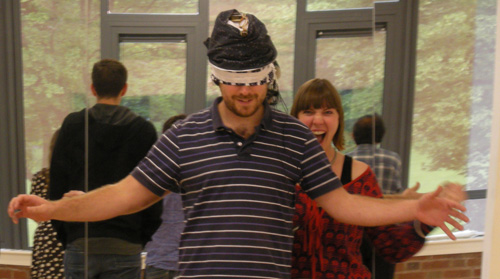
Ant trying out the sonar goggles at fizzPOP yesterday. He said he had very good spatial awareness and could tell where he was in the room, this video was a little experiment with his awareness of where I was.
(If you listen carefully you can hear the different beep patterns the goggles make depending on how close things are to them.)
Following on from last week’s pervasive games lab, some or all of Hide&Seek, Fierce and/or Screen West Midlands awarded me a grant to develop the sonar stuff into a game to be played at the Sandpit event at Warwick Arts Centre this Saturday. (Not quite sure who to thank, but thanks!)
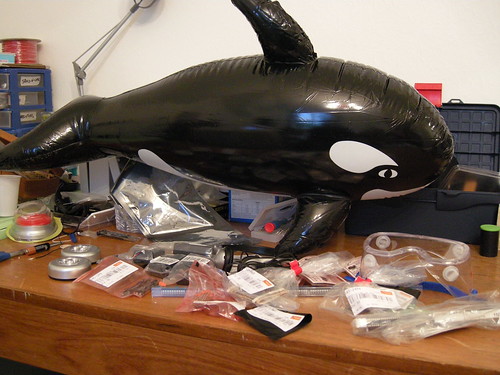
So, it’s been full steam ahead to turn the whale hat prototype into something that will survive a game. Several games. Maybe some of them outdoors in the British summer…
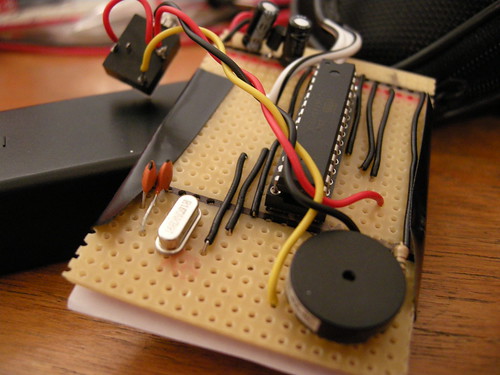
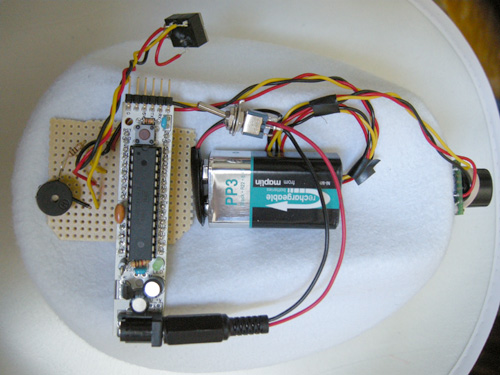
For various practical and arty reasons, the hat has been replaced by goggles. For financial and logistical reasons, the ArduinoRBBB I used in the prototype has also been replaced by a bare bones equivalent on stripboard.
Here’s the finished circuit, the goggles and the first unit being user tested…
There’s still a lot of soldering, spraying and sticking to be done to get ready for the weekend, but several people have used the googles now and I’m really pleased with the result. Join me at Warwick Arts Centre from 6pm this Saturday to experience the game – which is undergoing a similar evolutionary process!
At yesterday’s game lab (a team effort from Fierce, Screen West Midlands and Hide&Seek) I finally got a chance to try out the whale hat I’ve been making. By which I mean I got other people to try it out!
Andy gets to be whale for the first version of the game, unaware that krill Laura is trapped between him and the mirrored wall behind!
The whale hat was conceived in response to Hide&Seek’s call for games relating to the theme of ‘international‘. I wanted to develop a game based around the idea of epic whale migrations, where the person playing the whale navigates around the game space using echolocation.
The electronics that power the whale hat.
Using a sonar range-finder commonly used in robotics, I hooked it up to a RBBB running Arduino code that generates different patterns of beeps depending on how close objects are in front of the hat-wearer: a continuous loop of 4 beeps when there’s something within 50cm; 3 beeps when there’s something within 1m, 2 beeps, 1.5 metres etc
During the game lab I first got a chance to try out the experience of wearing the hat (complete with headphones and blindfold) and then I roped in the other attendees to help me try out some simple game mechanics. The sorts of things I had written down in my notes as things to explore were “finding objects”, “avoiding objects”, “detecting stationary objects” and ” detecting moving objects”.
Kind of a slow-moving version of the arcade game space invaders: the whale (in the hat) can move from side to side and has to try and ‘catch’ the krill (other players) who are approaching steadily.
If I were to try this again, I might try and set the krill off on their journeys with bigger intervals between. As it was though, this was a beautiful visual spectacle with the gradual advance of the krill contrasting nicely with the clumsier movements of the whale!
This time the krill remained stationary and the whale had to move around trying to locate them.
We talked about what might be motivating the krill (we found ourselves using many phrases we hadn’t anticipated using that day!) and also identified that we kind of needed to justify the sonar more. For example, it would have been possible for the whale to have caught the krill just by walking up and down and waving their arms around at random. We also toyed with the idea of limiting the number of grabs per game.
Although the krill aren’t doing much during the game, I love how you can see all the different emotions they’re (silently) going through!
Trying to give the krill a role that couldn’t be performed equally well by a chair. Now the krill are allowed one step per click and have to gather as many plankton (small pieces of paper) as possible whilst avoiding being caught by the whale.
A shift from object detection to object avoidance. Now we’re justifying the sonar and it’s starting to feel more game-like!
The whale has to avoid the er, the whatever they are. The other players are probably no longer krill, but in the absence of any other term we ended up calling them nuclear krill to signify that they were something not very nice.
The whale’s objective is to get from one end of the playing area to the other.
The nuclear krill are trying to block the whale’s progress. They are allowed one step per clap (approximately every ten seconds) and can move across the playing area, but not up and down it.
We also tried a variant of this where the nuclear krill could only move across, until the whale had passed them, at which point they became locked in to a ‘vertical’ line and could then only move up and down. This change was made to try and prevent redundant nuclear krill. Bad things happen when nuclear krill get bored…
If I can get to the stage where I can build a few more whale hats then the next thing I want to try is having multiple whales. We discussed how having one whale trying to get from A to B at the same time as another whale trying to get from B to A would make things more of a challenge for the nuclear krill and would also reduce the problem of redundancy.
So…
Overall I’m happy with the experience of being the whale (another one of those unanticipated phrases!). I like the combination of vulnerability with the almost super-hero power of being able to see by sound.
I love the spectacle of the game as seen by an audience. All of the versions we tried worked well at this and I think slowness and silence could be a really nice contrast within a busy event environment where this could eventually end up.
That leaves the krill. How can I make life for the krill more interesting?
Another post relating to Phase 1 of delivery of an Agent N project designed to inspire creative writing and foster curiosity amongst a group of Y3 and Y4 pupils.
Whilst the pupils were winding up the training camp with a piece of reflexive writing, I took the opportunity to take a couple of them outside for a bit of feedback on the goings-on of the previous two days.
Rather than shoving a microphone in their face, I used some binaural microphones that look like earphones and just wore them around my neck. I’m repeating most things they say because I wasn’t sure if the mic was picking them up or not!
Last week I spent the first 2 of what will be approximately 6 days working with the Year 3 and 4 classes at Bredon Hancock’s Endowed First School in rural Worcestershire.
My brief was initially to “inspire their children and staff to write with imagination, creativity, enthusiasm and confidence”, but this has since (I think in part as a result of conversations at my interview, which I did in role as Agent N) been expanded out to also try and foster a spirit of creativity, experimentation and enquiring minds in a more general sense. Staff and pupils.
I’ve worked on several Agent N projects up until now: immersive experiences taking place over 3-5 days in which the pupils have an overarching challenge to work on and, as a part of this, investigate different areas of the curriculum. Whilst I’ve had enormously positive feedback on the effects of these, I think there’s still plenty of scope for improvement, so with this project I have changed the structure to explore ways in which to hand some of the authorship back to the children. This has resulted in the delivery being split up into sections. Last week was the first of those sections: a 2-day special agent training camp.
Relinquishing some of the design decisions started well in advance of the delivery time in school when I recruited a friend – 8-year-old Agent M – to help me prepare a video for the trainees to respond to.
The message from Agent A requesting that we look at the top secret footage
I wanted a video of an operative in action. The action involved had to be exciting and intriguing, but not so prescribed that the the pupils in school couldn’t come up with a large range of different interpretations. I had a few locations in mind, but the filming was done as part of a weekend away with friends, so even those decisions had to be flexible.
Here’s the result after some basic prompts for Agent M to run with plus a bit of video editing:
I’ve never seen 40 children sat with such rapt attention before!
We played the video a few more times, pausing in places to give the trainee agents a chance to write down any important details or questions in their special agent notepads.
After a bit of discussion to get a general idea of what they thought was going on, the children were asked to write up their reports for Agent A.
A trainee agent prepares their report...
Here are a few excerpts (spellings etc corrected):
In the film there was a girl disguised as a young child. At the start the girl was at an airport. At a machine she got some tickets. The code was AQZP. After she caught a plane and got dropped off at a wood. Why did she feel the tree?
The lady typed in AQZP. She walked up to a plane netting and stopped. The man walked to the plane. The lady ran to a tree and found a bag with a book in it. It might have been a clue. She ran to a farm track and stopped and ran a bit more and stopped again then suddenly pointed at a farm house. She ran down to a beach and crouched down to touch the sand. She was concentrating on the texture of the sand. Then she ran to a castle on a hill. I think she might be an agent on a mission.
She was wearing black and she looked like she was on a top secret mission. She typed into the computer AQZP which looked like a code. She thought carefully about what she was doing as if the time was running out. She recorded stuff in her notepad. She thought carefully about stuff she found and used it to help her. She looked around carefully in case anyone watched. She looks as if the time was running out and she had to go with the flow. She was just guessing and running. She wrote something into the sand. She felt the tree as if the tree had put it there.
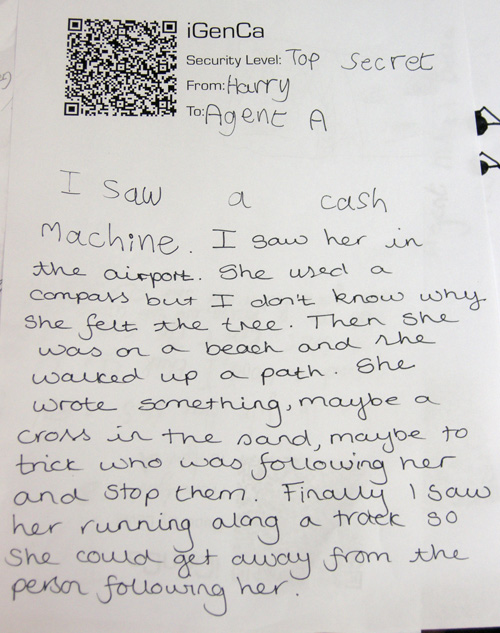
Agent Harry's report on the video
On the DVD I think that there was a girl in an airport and she went there. A cash machine or ticket machine and then she looked at the plane and went to a woodland when a plane went overhead. I don’t think she wanted to be seen because she was sneaking. She picked up a bag and ran to the beach and made a sign in the sand. It was something like this [picture of an arrow]. She was disguised as an old gran. She had glasses like this [picture of glasses].
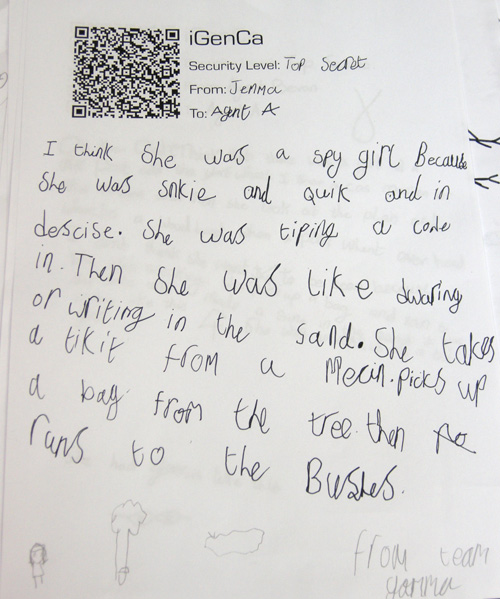
Agent Jemma's report
I think that the code at the beginning was that she was ordering some clues to find where she needs to go next. Next thing she was taking facts about the airport. Trying to get the right plane. Missed the plane. I think that she was undercover because she has glasses and a hoody.
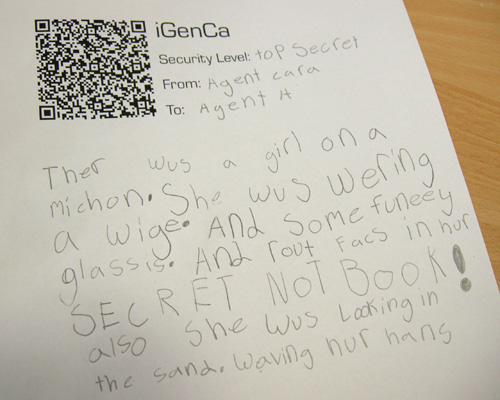
I saw some dead drops that the agent was finding. It was an agent on a mission I think or she was finding information. An agent was on a computer on Flybe. In the corner of the screen I saw a word that was WHSmiths. The agent at the end was a bad agent finding clues about the good agent. I can’t work out why the agent at the end was feeling a tree and feeling the sand. The agent was writing the code AQZP to get permission.
The report from Agent Cara
Ideas from these reports and from other pieces of writing generated over the training camp will be used in the next phase of delivery…
I’m working on a massive Creative Partnerships project in a Leicestershire primary school with several other practitioners from various disciplines including, music, dance, architecture, story-telling, illustration and greenwood structures. Our brief: to make sure the staff can do what we do after we’ve gone.
We’re starting off on two threads of enquiry. One is to look at how we can encourage more imaginative play amongst the foundation level classes (3-5 years old) and the other is nominally working with years 3 and 4 (7-9 years). I say nominally, because actually I think we’ve discovered it’s more about exploring how the teachers can move away from teaching for a specific outcome and move more towards child-led learning where the outcome comes out of the process.
Last week this message was delivered in assembly:
The message delivered to the pupils last week
On Friday the pupils worked with some of the practitioners on brainstorming their initial ideas and questions.
Tomorrow I will go in and liaise.
Today I am trying to plan the day without actually planning the day.
It’s counter-intuitive and a bit scary, but we need questions and then we need answers. In that order.
Milton – the pathogen-introducing game I’m making for a Coventry school – gets its first playing on Friday, so I’m in full-on production mode making the cards that determine the players’ roles.
Here’s a quick peek at the bacteria who will be trying to infect as many pathologists as possible:
For the last month or so I’ve been helping Mr Underwood get the planning together for Theremin Day: an afternoon workshop building an optical theremin followed by an evening of film and performance, including a live set on theremin from Ms Hypnotique
Hard work, but what a great day!
The workshop had a great vibe, especially as the sounds of working optical theremin began to mingle with those of drilling and the occasional piano performance:
Pretty much everyone got their noise boxes finished and working, with some great playing styles starting to emerge:
After the workshop we did a quick changeover and re-arranged The Edge ready for the evening performances. There was much packing away of soldering tools; construction of staging; testing of audio and visual equipment. It all stopped when Susi started to play on her theremin. What an amazing sound: so different to anything else. Everyone was transfixed!
The evening event kicked off with a selection of short films exploring the historical, technical and fun sides of the theremin. This was then followed by a set from 8bit Pete and his Thingamagoops. This included a live mic off to the side of the stage where people could come up and contribute to the maelstrom of bleepy noises and flashy lights with the workshop-built theremin(s). [What is the plural?!]
After that was the theremin set from Ms Hypnotique who performed a wide range of music for us. In her own words, the set list was described as: “Varese, Walter Carlos and forgotten scifi soundtracks”. She did an excellent job of interspersing the music with interesting explanations and anecdotes – entertaining and educational!
Here are my photos from the evening event followed by a couple of videos of Ms Hypnotique playing. The last video is how she ended the set. Perfect!
There’s not a lot to this thing: you vary the amount of light getting to the light dependent resistor and it affects the speed at which the “that was easy” sample is played back. It’s highly addictive though. It’s just the right size and weight to go in your hand and there are so many different effects you can get from it. There’s even a noticeable change in behaviour depending on what time of day you play with it.
Not that I’ve been playing with it instead of getting on with some work, you understand…
I’ve been working with a school in Coventry to help them develop activities for their Year 8 Flexible Learning Day focusing on science and creative writing.
As a result of this I’ve been commissioned to design a game to teach and reinforce concepts and vocabulary relating to pathogens: how they spread and how we can protect ourselves against the nasty ones.
Game flow and card design
I’ve had the school’s permission to release the game’s rules under a creative commons license, and the basic description and mechanics are now up on the Ludocity website: http://ludocity.org/wiki/Milton.
I’m currently working on designing the cards that will be used in the game and making sure they also double up as instructional prompts for the players – expect that ruleset to develop! In the meantime, I’m also soliciting feedback in advance of the game’s first plays on April 30th.
My main area of enquiry is centred around interactions between people and place: often using tools and strategies from areas such as pervasive games and physical computing to set up frameworks for exploration.
If you'd like to commission me or collaborate with me, please get in touch via the contact page.
General blog contents released under a Creative Commons
by-nc-sa license.
Artworks and other projects copyright Nicola Pugh 2003-2026, all rights reserved.
If in doubt, ask.
The theme used on this WordPress-powered site started off life as Modern Clix, by Rodrigo Galindez.