Just a quick note to say that, although things may seem a little quiet around here in terms of my own personal projects, many exciting things are happening over at fizzPOP (the hackerspace I’ve been co-running with Antonio Roberts.)
If you’re interested in collaborative learning or creative use of technology, then you should check it out:
We meet on a fortnightly basis at The Edge for our informal hacksessions at which you can just pop in, have a mooch and/or work on a project (we can always find stuff for you to get involved with if you’re a beginner).
This year we’ve also been ramping up the volume with a programme of workshops and events. The next of these will be Theremin Day as organised by Sam Underwood (also featuring in the video above!).
This is an opportunity to see one of the nation’s most renowned Theremin players. She has trained with Lydia Kavina, the grand-niece of Leon Theremin, and performs in many genres from classical to surf-rock to industrial. She has given numerous performances and recordings for artists including Bob Moog, Damien Hirst and TV appearances include “James May’s 20th Century” and “New Paul O’Grady Show”. In 2009 she performed on the fourth plinth, Trafalgar Square, as part of Anthony Gormley’s “One and Other” project and in April 2010 she will perform at Ether Fest at Royal Festival Hall in a 20-piece Theremin orchestra.
Mr. Underwood & Friends
Yes, me! I’ll be doing a super rare performance of Steve Reich’s Pendulum Music, using four torches and four Optical Theremins (of the same kind made in the afternoon workshop). The performance will be in darkness and will peak in a cacophony of squealing sound.
Pete Ashton
Pete will be wowing us with his Thingamagoop (see video below) and some 8-bit sounds. He will also be collaborating with Ms Hypnotique and myself in an improv session.
In May fizzPOP will be in residence at independent artist studios The Lombard Method for an intense two weeks of workshops and making of stuff, 1st – 16th of May. Stand by for more details of how you can get involved with making contraptions and contributing to blinky light extravaganzas!
There’s loads more in the pipeline too, with the British Science Festival in September, exciting partnerships with Aston University Eng Soc, robots, Arduinos and dorkbotbrum. No surprise then that we’ll be moving to weekly hacksessions after Easter in order to try and fit in everything that we want to do!
It’s proved to be very popular, so it’s time to take it out of its prototyping stage and into something a bit more robust.
The version I’ve been using so far runs off a Real Bare Bones Board mounted on a breadboard. It’s OK, but I need to keep checking it all the time to make sure the wires haven’t come out. Not ideal if you’ve got a dozen young children clamouring around to try and guess the hidden knock!
I could move it to perfboard or something similar, but I suspect I’m going to be making several of these in the future, so I’m using it as a project to learn a bit about making Printed Circuit Boards (PCBs).
I then combined this with the power supply from this ITP tutorial on breadboarding an Arduino. And finally added all the switches and gubbins from the original circuit.
Freestanding ATMEGA with additional project circuitry
It worked!
…and was a nice bit of learning too – I feel all empowered now!
Putting it all together. With arrows.
Having ascertained that it wasn’t all going to go fizz or POP, the next stage is to start arranging all the bits into a nice PCB layout.
…And for me to profusely thank Dr Sugden and the Eng Soc students at Aston University who are proving to be top notch fizzPOP collaborators and walked me through this afternoon’s learning. Much appreciated.
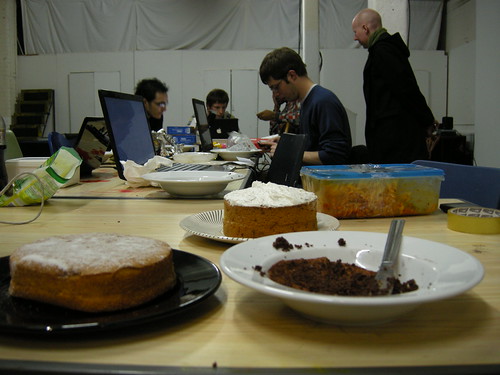
Last night at our fizzPOP hack session we celebrated the group’s first birthday.
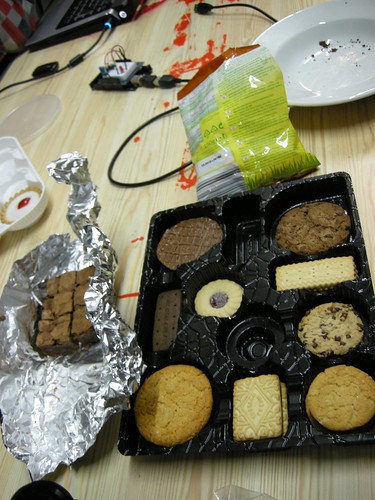
Chocolate brownies, jammie dodgers, humidity sensor LED candle.
fizzPOP (so named as a reference to the Lunar Society) came into being just as I returned form a residency at the Banff New Media Institute and was pondering how on earth I was going to develop my skills and practice in a city with an apparent lack of peer group.
I’ve been heavily involved in the organisation of the hackspace (working with Antonio Roberts and others) since the early days and seen it grow from laptop-orientated meetings in pubs through to regular practical sessions held at The Edge. I’m happy to be able to report that I’ve learned loads and am constantly meeting new people who provide skills and ideas that feed into my work (and play!).
There are big plans for our second year – look out for more in the way of events and workshops, as well as continuing to develop the hacksessions that form the core of what fizzPOP is about.
Cake.
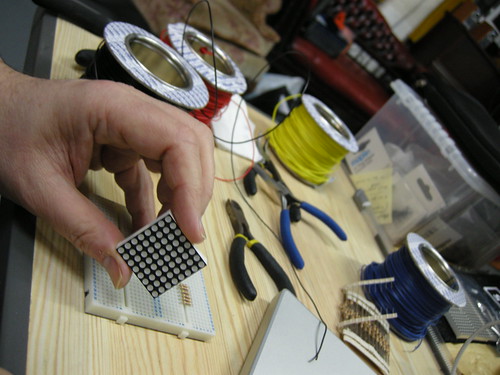
LED matrix: GB contemplates colour mixing, simple graphics and very small numbers.
As a follow-on from the box with a secret knock in it, I’m preparing a 3-day immersive experience to develop active learning amongst 3 classes of 9/10 year-olds (Y5). This project is attached to the curriculum area of mathematics, but aims to address fundamental questions about attitudes to learning in general.
Constructing a map of the school grounds.
The plan is to solve a series of puzzles to incrementally build up a massive dot-to-dot overlaid on the school grounds, so I’ve just spent a couple of hours working from satellite imagery to construct an outline map over which we can place…
In the second of my two interviews this week, I was invited by Whitmore Park Primary School in Coventry to help them look at ways to develop their children’s skills as active learners in mathematics.
With only a day and a half’s notice for the interview – which required me to design and deliver a ten minute activity with a group of pupils – the only sensible thing to do was not only to figure out the content of the activity, but also to embark on constructing a technological doohickie, the workings of which I had no prior experience in! Well, it’s all good learning, isn’t it?!
The things I wanted to achieve through the activity were:
To have the activity pupil-led as much as the restrictions in time would allow.
To use a medium that highlighted a ‘special’ technical skill that I could contribute to the mix – ie something not likely to already be available or in use within the school.
Something that felt to me like it was a genuine activity, and not too much like ‘maths dressed up’.
Something with a bit of ‘wow’ to it.
Riffing of something I had referenced in my application, I decided to do something based on code-breaking, but I wanted this to involve a physical object – one that would respond when the code had been broken. This, I felt, would give me a chance to make something using my hack/electronics skills which, whilst not being up to much in the grand scheme of things, should be adequate enough to impress a 9 year old…
After much searching of Instructables and Hackaday looking for the right combination of inspiration and cold, hard instruction, I decided to work with a system for recognising sequences of knocks in order to open a box. For this I am deeply indebted to Steve Hoefer’s detailed documentation of his Arduino-based Secret Knock Detecting Door Lock, which I only modified slightly to take into account the resources I had available.
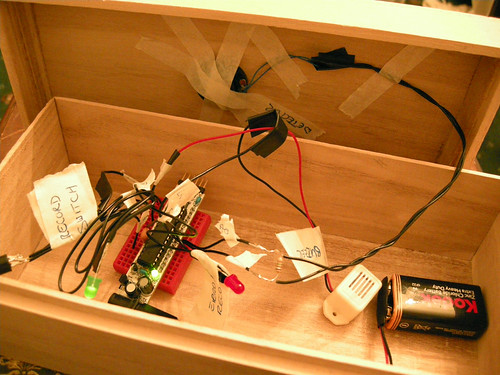
Secret knock box gubbins: components labelled up to facilitate explaining what they were for, free ends of wires labelled up so that they could quickly be replaced in the right row of the breadboard if they accidentally came out...
Since it was only a ten minute activity, I decided to leave the components on the breadboard, rather than permanently soldering them up. It was also for this reason that I was reluctant to drill holes in the box I had acquisitioned to use as the casing. The downside of this being that there wasn’t really much in the way of a feedback mechanism, because the LEDs were not visible. As a compromise, I fitted a buzzer in the place of the door-knob opening motor so that the box would buzz when the correct knock was given. I also implied a lock through the way that I introduced the box and handled it in front of the children.
When it was time for the kids to go into action, I reverted to the now familiar Agent N role and gave them an introduction that indicated that they were a specially selected team of code-breakers and we’d been given a mission to investigate this box.
I had some vague knowledge about such things, but I certainly didn’t hold any answers. After telling them they needed to find the secret knock, I handed them two folders containing stuff that might be clues and asked to “please tell me what you think”… I encouraged the children to help eachother out, and also to offer lots of different ideas and hypotheses.
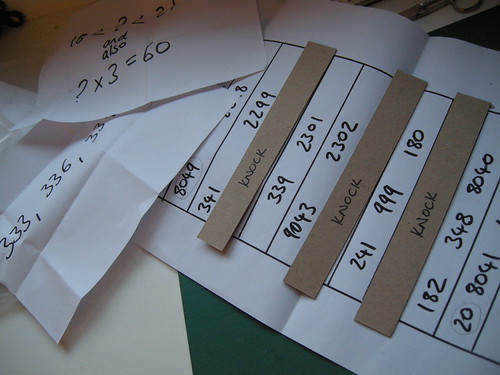
A selection of clues from which the children successfully built up and interpreted a diagram of the secret knock's rythmn.
From there I nudged and guided, seeking to let the pupils make the connections between the different clues wherever possible. We just managed to open the box in time!
The session was a bit slower and lower energy than I had imagined it would be. On reflection I think this was as much to do with nerves and shyness on the part of the pupils (I was the first artist they were interviewing) as much as anything in my control. Certainly the three children who had previously accompanied me on a tour of the school seemed more relaxed and outgoing than the others who had only just met me. The nice moment was when the Deputy Head came back to the room and asked what they had done. The description they gave, with no input from me, was spot-on and showed a sophisticated understanding of the principles involved.
Given the opportunity, I would love to expand this into a much longer activity in which we could solve the initial code, investigate how the box works and then – because obviously the code was too easy – reprogramme it with another knock and get the children to invent ways of codifying that information in an even more fiendishly difficult manner…
So far my 2010 has been very focussed on schools and learning as I first spent a week responding to the second wave of Creative Partnership calls for this academic year and then attending interviews as a result.
Roughly half of the interviews I am invited to involve having to deliver a short activity (10-20 minutes) to a small group of the children. Considering my whole approach to projects is based on collaboration and a particular process aimed at responding to each individual context, it’s quite strange to find myself being judged on solo delivery of something workshoppy to a group I’ve not had any previous contact with!
I’d like to think that with my cross-disciplinary background one of my main selling points is that with pupil-led projects I’m pretty well equipped to be able to bring in practical skills that relate to wherever we end up. This too makes it tricky to decide on just one activity to represent me, because I’m not working from a starting point of offering a particular medium in response to a brief. Again all about the process.
Anyhoo, irony of the situation aside, these activities can be very interesting in their own right.
On Monday I was in a school that was looking for someone to help facilitate Year 5 (9-10 years old) in designing and making their “Museum of Water”. I was really interested in this call because of the way it had been presented as very pupil-led and also because, through my work with pervasive games and hackerspaces, I’ve been involved in various conversations coming from museum professionals that resonate strongly with those of schools. We all want meaningful interactions.
15 minutes isn’t really enough time for introductions and then anything much in the way of making, so I decided to aim for something much more feasible …like a paradigm shift!
I wanted the school to see their museum-to-be not as a collection of objects, or of documentation of learning objectives, but as a process. People go into the museum and the museum has some sort of effect on them such that the people leaving the museum are slightly different to when they went in. Otherwise, what’s the point?
I started the session in my favourite manner – by getting things wrong.
Hi, my name’s Nikki and I do all sorts of creative stuff. I’m here because I saw your advert for someone to help you make a Museum of Water.
Well, I thought that was really very easy, so I just went ahead and made it for you. [places 2 litre lemonade bottle partially filled with water on table]
Can I have my £3000, please?
[Silence]
Oh, hang on!
[Places bottle on top of cardboard box pedestal]
[Silence accompanied by glances]
What’s wrong? Can I have my money please?
From this starting point, we were able to have a conversation where the pupils explained to me that, even if I labelled the water, just to have a bottle of water on display wasn’t good enough – they wanted a museum that was interactive and taught people interesting things. They weren’t very impressed with my offering at all.
My next move was to invite everyone down to the other end of the room where I had cleared some floorspace. Within the context of what they had just told me, I introduced the idea that I wanted them to think of their museum as an experience machine. I wasn’t interested in what was inside it right now, but I wanted to think of who went in, and what we wanted them to be like when they left.
Quick profiles of incoming and outgoing museum visitors
Two of the children lay down on some large pieces of paper and struck appropriate poses whilst we drew around them. First of all we gathered around the outgoing visitor and noted and sketched our thoughts about what we wanted people to be doing and feeling after visiting our museum. I was really impressed at the contributions made in what I think was less than 5 minutes.
At one point I announced I was going to write down the obvious and added “happy”. This triggered a conversation about whether we would ever want people to leave the museum feeling sad. Yes they said: there were some very serious things relating to the topic of water and they might want people to be moved by these. When I asked for an example, one boy said that sometimes people drown in water. We agreed it would be important to teach people how to be safe.
With very little time left, we quickly added some thoughts to the picture of the incoming visitor. These were very illuminating in terms of how they perceived museums. Or how they thought museums were perceived – anyway, a very stark difference to the very positive picture they had painted in the previous two activities!
And that was the end of the session ..or it was supposed to be: it took a bit of effort to get the children to stop adding to the picture!
A few pupils helped me take photos of the drawings before I departed (I left the originals with the school – along with the bottle of water, for which I kindly waived the £3000 fee). Below is a slideshow of some of the images…
They’ve set themselves some very high standards in light of what appears to be a somewhat challenging target audience – I hope they can realise them.
I’ve been threatening to use time over the Christmas holidays to get to grips with Scratch, a programming environment aimed at young people. I’ve been curious about it for a year or so and have recently had some conversations with people who have practical experience of using it in schools that has inspired me to actually get on and investigate it.
Coding blocks in Scratch
I’m thinking that to start off with I’m likely to apply it to animation-themed projects – you just don’t see briefs asking for people to come in and teach kids how to code! Shame that: beyond systematic approaches, applying mathematical concepts etc etc, I think there’s something particularly valuable in the process of debugging that can be applied to wider things. Fits in with my thoughts about protovation and creativity.
Anyway, as ever with these freestyle learning things, it can be a bit tricky to conjure up mini-projects to provide an impetus. Fortunately though I’ve had a huffing duck to work with and then an escaped bull went for a wander around Balsall Heath.
Balsall Heath, bull and the Shouty Lady
I lived in Balsall Heath last year, so I kind of got a bit distracted by the backgrounds and distilling some key landmarks into simple graphic form, rather than designing a game, as was the original intention. Still, there was a lot to be learned in just getting the background tiles to scroll as the bull works its way up Moseley/Alcester Road. [Addendum: This whole thing probably won’t mean anything to you if you don’t know the area. If that’s the case, here’s a link to the Google Street View to give you a toehold.]
Moseley baths
After some wrangling as to whether I was going to make it a shoot-em-up in the style of the real-life story, I eventually decided that that wasn’t a route I wanted to go down (well, it is Christmas!) so the hazard comes in the form of the Shouty Lady.
One of my overall impressions of living in Balsall Heath was that there always seemed to be people shouting in the streets. Not increased-volume-so-my-mate-over-there-can-hear-me shouting, but full-on screechy argument shouting at the person stood right by them, or perhaps now walking on the other side of the road. After a few months I began to recognise that, more often than not, it was the same woman doing the shouting…
So, in the Balsall Bull ‘game’ the Shouty Lady will appear at random intervals and potentially scupper your overall aim of getting to the curry house.
Scratch isn’t set up for embedding per se, but I’ve put Balsall Bull on a separate page so you can have a play if you’d like to. If you don’t see it on the page, you’ll need to download and install Java to be able to run the applet thingy.
To play Balsall Bull, use the arrow keys to guide the bull along the road, click the green flag in the top right corner if it goes sqiffy and, above all else, beware the Shouty Lady.
I seem to have already covered most of the stuff I was originally going to write about in this concluding post, so instead I’m just going to put down a few thoughts responding to this report by Agent Muhammad:
Security Level: 1 To: Agent A From: Agent Muhammad Message:
During the last 2 days I have learnt that being an Agent is hard but fun. We have completed the humming path. Then we tried to call Scats to our planet but he didn’t come. The next day Scats came to our planet. He said he was from Northsaxon. All of us thought he was fake. After we did some activities with Scats. First I went into 3BG cloakroom and worked out how shadows are big and small and how they have come to life. Then we tried to make the spiders work which Scats brought to our planet. They were solar power spiders so first I put a torch near the spider but it didn’t move. Then I put a big light and it did move. After we put transparent, translucent and opaque material near the spider
I love the way that “All of us thought he was fake.” is plonked in the middle there, but doesn’t affect how much he was absorbed into proceedings.
Other than a couple of children asking me if Skatz “was real”, I witnessed very little in the way of scepticism in the the story we were weaving. …but that’s not to say I think they believed it was all true.
I mentioned the use of slightly shonky, unrealistic-looking props in an earlier post. I think it’s important to signal that projects like these are something to play along with, that they’re not real. This offers protection from things that might otherwise be scary, but also opens up an ‘anything goes’ approach to responses that don’t necessarily have to be correct in order to be good.
I have these videos in mind when I say this (an earlier post):
The aim is to create a situation where the pupils are allowed to be wrong and where they are encouraged to frequently review their ideas and adapt them in response to new developments. Also where they are not afraid to be wrong and are therefore more free to suggest imaginative, innovative ideas. This is very much my interpretation of promoting creativity, especially within education, where I feel it is desperately needed.
In wow projects I like to set things up so that the characters and teachers don’t have a definitive right answer, so the children are free to follow their own trains of thought. I’m curious as to how this looks from the outside though.
I don’t really feel I have enough facts to be able to comment on whether the children actually were traumatised, and if so, to what extent, but the articles serve to highlight something we talked about a lot with both the Pod in the Quad and the Song for Skatz projects: what will the parents think? What happens when excited kids go home and recount their tales of adventure?
For an immersive experience, one of the powerful techniques at our disposal is that of disruption: allowing the school day/week to start off as usual and then to disrupt it by suddenly steering it off into the project narrative. How do you balance this against forewarning parents and guardians that something unusual will be happening?
One possible solution is to wrap it up in the process of getting permissions for the all-important project documentation. Ideally, permissions need to be established near the start of the planning stages, so maybe this allows enough of a buffer zone between the paperwork going out and the project delivery starting? I’ve also wondered about the possibility of making the parents complicit in the project too, after all, why should the experience be confined to the school grounds and the school day?
My observation session right at the start of the project planning was done in character: I spent about an hour moving among the pupils during an IT session, introducing myself to them individually as someone doing an investigation and asking them a) if they’d seen anything unusual happen in school recently and b) what what the most unusual thing they could imagine happening in school? I left them with a request that if they did see anything unusual in the future, that they should let me know about it. What if some of the pupils had received a letter from me at their homes? Maybe something along the lines of “Thanks for saying you would help, we’ve found out that something is about to happen, please keep your eyes peeled and ask your teacher to phone us if you see something we should know about.”
I love the idea that the project could leak out of the usual school boundaries, and also that a call from a pupil could kick-start the main action, but how do you work with parents to steer the child’s response to the receipt of the letter? It would necessitate a lot more time (and therefore money), but I’d like to think the returns would be high!
I know this is the sort of technique I’d go for if I was designing a game, but maybe it’s different in education? Is it?
So, I suppose my closing thought is a question: where do we go from here?
I’m liking this circuit-bending stuff. It’s making me do things I don’t want to do.
The particular comfort zone edges I’ve noticed are:
Restraining myself from immediately unscrewing the back and tinkering with the innards without having properly explored what the ‘normal’ behaviour is first. I must make more of an effort to document this too.
Choosing the 3 or 4 bends from several that I’ll try and work with. This is usually a balance between the “awesome!” and the practicality of getting wires and soldering irons where they need to get to. I ‘lost’ a really nice bend in the hippo – the behaviour changed when I soldered the switch wires onto the board. I’m starting to get into the habit of making audio recordings of the initial noodling noises.
[audio:http://npugh.co.uk/media/hippo.mp3]
Revising the previous decisions, based on what switches you can accommodate in the shell.
Making the first incision. Usually my electric drill is hilariously large compared to the toy I’m working on: one of these days the toy’s just going to disintegrate. It’s also a very definite point of no return.
I’m slowly getting better at drilling holes a few sizes too slow and then taking them up to size with a file. Neater results, but there’s still room for a lot more improvement. I’ve also started thinking a bit more about the feel of the switches – adding in rubber o-rings to cushion body contact points etc.
Similarly for the first solder, but given extra edge by the memory of all the circuit boards I’ve managed to kill in the past.
I’ve circuit-bent a few toys now, all with similar push-to-make switches and body contacts. An important edge is coming up where I’ll have to learn new stuff. With the hippo bend I made myself repurpose the existing switches. It’s a bit of a bodge, but it was worth the brain-wracking to come up with a (hopefully more than temporary) solution that a) works and b) is satisfying in the way that it looks and touches.
I just wanted to say that the fizzPOP hackerspace is increasingly becoming the communal, collaborative production space for unpredictable creative things that I was hoping for when I left art school.
Actually, come to think about it, in many ways it’s quite like what I hoped art school would be.
My main area of enquiry is centred around interactions between people and place: often using tools and strategies from areas such as pervasive games and physical computing to set up frameworks for exploration.
If you'd like to commission me or collaborate with me, please get in touch via the contact page.
General blog contents released under a Creative Commons
by-nc-sa license.
Artworks and other projects copyright Nicola Pugh 2003-2026, all rights reserved.
If in doubt, ask.
The theme used on this WordPress-powered site started off life as Modern Clix, by Rodrigo Galindez.