How to Wow: Day 4

5th in a series of posts describing and reflecting on the experience of delivering a ‘wow project’.
How to Wow: Introduction
How to Wow: Day 1
How to Wow: Day 2
How to Wow: Day 3
How to Wow: Day 4
How to Wow: Closing thoughts

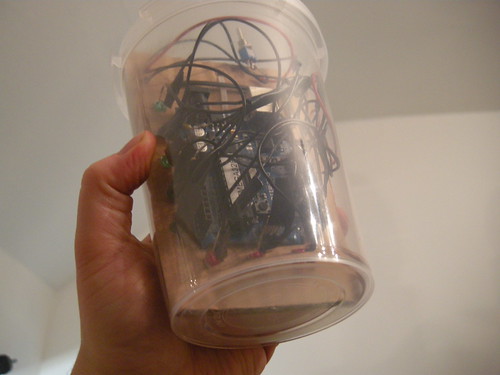
Thursday morning was spilt into 4 sessions, each about 30 minutes long. Our original plan was to stream the special agents into an upper and a lower ability group, but that didn’t happen in the end (I think mainly because it hadn’t happened the previous afternoon either) so we just kept to the two normal class groups.

The main aim for the day was to produce the song for Skatz to take back to Nednil with him, so the special agents worked to develop the light and shadow vocabulary further, and produced a dictionary of relevant “wow words”. The groups also collaborated to write a verse each and to compose an instrumental section for the song.

dictionary

song lyrics

Skatz

We also did some more work to reinforce the activities from the previous day.

Translucent objects

noon

Again, I was in a predominantly support role, but this was a much better situation compared to the previous day: Skatz was leading the musical side of things and the teachers were leading the vocabulary-based stuff. As it should be.

As well as being able to spend 1-on-1 time with any special agents who were struggling, I concentrated on documenting the activities. I generally try to give myself a character where it’s perfectly logical for them to always be carrying a camera and taking photos of what’s going on, and this project was no exception.

As well as my stills camera (which I also used to record the video) I also had a digital voice recorder. Things can get a bit side-tracked of you start using things like this to do ad hoc interviews etc during activities – everybody wants a go! – so what I did was to use a pair of binaural microphones (they look like earphones) and pretend that they were ear pieces and that I was listening out in case Agents A or E (Emma, the Creative partnerships agent) tried to contact me.

(Incidentally, I nearly got caught out a couple of times on the Monday, so from the Tuesday I carried a collection of spare batteries, mics and empty memory cards around with me in a camera bag clipped to my belt. I’d also been making quite a big deal of using my notepad to write down everything that we did and found out. This went in the kit bag too, as well as a spare pen!)

Here is a sample of audio taken from first thing in the morning using the binaural mics. (They were looking at their messages to Agent A again.) There’s a lot of background noise and echo, but they do well considering we’re talking in quite hushed voices. Another thing to bear in mind is that audio’s a useful tool because it frees you up from some of the issues of publishing childrens’ photos when it comes to publicising a project.

The downside of all these photos (about 450 on my camera over the 4 days) and all the ambient recording, is the sheer quantity of material produced. It could be a great way for teachers to monitor understanding etc, but realistically I think I’m the only one who trawls through it after the project has finished. Question: is there any merit in making going through the documentation an integral part of the project?

(Just as a guide, it will generally take me at least a day (usually unpaid) to put together something half-way-decent as an overview of what the project was about. How much longer would it take to include evaluation of what’s been documented and does that add enough value to warrant the time spent on it?)

As well as the general as-it-happens documentation, we also had the very specific need to document the song that was the main outcome of the project. This was quite nerve-wracking because, although Skatz had bought a voice recorder too, it was playing up and we couldn’t get it to work. That put the burden of responsibility onto mine and the set-up of the afternoon was that it was a one-shot-only chance to get it recorded correctly. A bit daunting, to say the least, but it worked and I was able to convert it and email a link to the teachers overnight so that they could play it in assembly the next morning.

The afternoon was orientated around Skatz’s farewell. The special agents spent some time rehearsing the song they had written and also a sheet of wow words for Skatz to take home with him. The way the sessions worked out led to an interesting situation where one of the teachers who was not confident with teaching music had to lead her class in rehearsing their instrumental section whilst Skatz was working with the other group. She was quite daunted by the prospect, but had seen Skatz working with her class previously and so was able to use the same techniques that he had used. I don’t now how this has affected her confidence long-term, but this sort of thing is a really simple, basic illustration of good stuff that can come out of these types of projects where teaching is split between visiting professionals and the teachers.

Then it was time for the grand finale…

The original plan (have I used that phrase quite a lot?) was to go back out onto the playground and do another big humming path to open up the inter-dimensional tear that Skatz travelled through, but this idea got rained off. Instead, we gathered in the hall and shut the doors and drew the curtains as before.

There was a round of thank-yous and goodbyes and presentations and then we sang the finished song:

[audio:http://www.npugh.co.uk/media/WOW.mp3]

Bring us words to wake up the light,
We can’t go on living in the night.
We need knowledge of the shadows and the sun,
Without help, our world is done.
Help us make and sing our song,
To bring us light and right the wrong.
One last thing we have to tell,
Only wow words break the spell, only wow words break the spell.

Feed the spiders, feed the spiders,
Find out what they need to wake.
They need light, a powerful light:
Energy to help defeat the night.
Feed the spiders, feed the spiders,
Find out more for us to take.
Our experiments show transparent,
Not translucent is what’s right.

Bring us words to wake up the light,
We can’t go on living in the night.
We need knowledge of the shadows and the sun,
Without help, our world is done.
Help us make and sing our song,
To bring us light and right the wrong.
One last thing we have to tell,
Only wow words break the spell, only wow words break the spell.

[dark instrumental]

In the morning, when the sun rise,
Long dark shadows casts to the West.
Then at Midday sun is highest,
Shadows short beneath our feet.
In the evening when the sun sets,
Long dark shadows spread to the East.
Measuring the shadows’ length,
Tells us when to wake and sleep.

Bring us words to wake up the light,
We can’t go on living in the night.
We need knowledge of the shadows and the sun,
Without help, our world is done.
Help us make and sing our song,
To bring us light and right the wrong.
One last thing we have to tell,
Only wow words break the spell, only wow words break the spell.

[light instrumental]

Opaque objects block the light,
Forming shadows dark as night
When the object is translucent,
That’s when shadows start to fade.
When the object is transparent,
It forms a shadow light and bright.
Twisting turning round the object,
Means a stretched out shadow’s made.

Bring us words to wake up the light,
We can’t go on living in the night.
We need knowledge of the shadows and the sun,
Without help, our world is done.
Help us make and sing our song,
To bring us light and right the wrong.
One last thing we have to tell,
Only wow words break the spell, only wow words break the spell.

farewell ceremony

After the song, we had to somehow dispose of Skatz: something we’d wrestled with all through the project. We felt it was important to have the illusion of him being transported back to his dimension, rather than just going out through the school gate and walking down the road. After allowing the special agents to play freely for a few minutes with the mystery objects/glow sticks from their investigation packs, we gathered them into 2 lines and got them to wear their blindfolds whilst Skatz performed a ceremony that involved him walking up and down the rows beating out a rhythm on a cymbal.

During this process Skatz secretly passed the cymbal to me and crept out of the hall (us having carefully padded the frame at lunch time so it wouldn’t make any noise). Once Skatz was out of the building I dropped the cymbal and we turned the lights on as everybody took their blindfolds off.

The special agents, on discovering Skatz was no longer in the room, all immediately rushed over to the storeroom in the corner where a load of furniture and sports equipment was kept. They were utterly convinced he was in there, despite me having seen that at least half of them were peeking out from underneath their blindfolds as I walked around. Interestingly, not one single child spoke up to say that it had been me on the cymbal. We did a bit of “what happened?” and “where do you think he’s gone?” hunting around and entertaining theories, before gathering everyone together to wrap up.

It was at this point that I realised we had serious misjudged this part of the project.

We had been so intent on making sure the effect was convincing, that we had almost completely omitted to take into consideration the affect it would have on the emotions of the children we were working with. They were all really sad and subdued and it took a lot of work from myself and the teachers to put a positive spin on it and to bring the energy levels back up. Some weeks later when the CP agent went back to the school to get feedback from the pupils, the overwhelming first reaction was that they were hurt that Skatz had left without saying goodbye.

The reality was that we did quite a lot of the goodbye and thank you stuff, it’s just that Skatz had used a little I’ll-sing-you-another-song-after-this-thing-with-the-cymbal sleight of hand to try and discourage peeking and that by far outweighed all the other stuff.

How to wrap up the delivery part of the next project I work on is something I will need to give a lot more thought to. In the Pod in the Quad project, a goodbye was used as a prompt for a golden time session with Paul Conneally discussing themes of saying goodbye, and I think we should probably have included an aspect of this in the Song for Skatz project.

I got lots of hugs from the special agents as they left the room, and then I sorted out some of the remaining equipment, wrote a thank-you-and-I-got-back-safely-and-all-the-lights-came-back letter from Skatz and then that was it. Skatz had gone straight to a gig in Bristol and the teachers were busy with meetings etc. I think I needed a different goodbye too!

I think I’ll leave the issue of evaluation and feedback for the next post…

What we learned

  • We spent a lot of time correcting the pupils from saying “small” shadows for when objects were far away from the light source before we realised that they were just trying to express the concept of faint.
  • Artists leading activities is good, teachers leading activities is good; teachers being able to observe how artists lead activities can be very good.
  • Have a range of methods of documenting – both in terms of media and in terms of ambient vs interview styles.
  • When glow sticks are bent too much and crack open they don’t half make a mess and it is human nature to peek out of the gap at the bottom of a blindfold!
  • Please do consider relaxing the tightness of the narrative in exchange for a more gentle/discussed goodbye.

5th in a series of posts describing and reflecting on the experience of delivering a ‘wow project’.
How to Wow: Introduction
How to Wow: Day 1
How to Wow: Day 2
How to Wow: Day 3
How to Wow: Day 4
How to Wow: Closing thoughts

How to Wow: Day 3

4th in a series of posts describing and reflecting on the experience of delivering a ‘wow project’.
How to Wow: Introduction
How to Wow: Day 1
How to Wow: Day 2
How to Wow: Day 3
How to Wow: Day 4
How to Wow: Closing thoughts

This was our riskiest day, both in terms of having to get various logistics right and also in terms of not knowing how the special agents would react.

I started the day by saying I didn’t know what else we were supposed to do next and maybe it would be good if the special agents could write a report to Agent A (my boss) explaining what they had done so far and what they thought we should do next.

report

It’s always good to have little snapshots of how people are interpreting what’s going on, but this was basically a distraction to allow Skatz to get into position at the far end of the playing field that both classrooms look out onto. At the pre-arranged time the blinds went up and a message came over from the other classroom that there was a stranger outside.

A Song for Skatz: a stranger arrives from nikkipugh on Vimeo.

I love that this was our massive “look kid! Skatz has arrived” moment and the over-riding priority for some of them is still to show me something they’ve written that they’re proud of!

Other things that happened in the video:
at 0:51 some of the special agents have realised they can get a better view of what’s going on if their teacher lets them go in through the other door.
at 1:03 you can catch a glimpse of Agent P, one of the special agents who always liked a bit of extra responsibility, returning from his mini-mission of being sent to find the headmaster and tell him what was going on.
at 1:30 we have the headmaster’s pronouncement that the stranger looks friendly, so we know everything’s going to be OK!
1:52 Skatz and I had worked out as part of the back-story that because he came from a place that had been dark for a very long time, the practical way of greeting people was to touch them on the head.

After Skatz had greeted everybody, been fetched something to drink, been offered somewhere to sit down and had done some comedy “what’s this do?” clomping around with the printer and interactive whiteboard stuff, he settled down to describe his journey and explain about what life was like on his planet. [I had to obscure some of the faces on this video – hence the blurriness.]

A song for Skatz: Skatz introduces himself from nikkipugh on Vimeo.

As I mentioned before, we’d used the project wiki to build up a fairly comprehensive list of details concerning Skatz’s background, what life was like for him and how/why he had travelled to the school. Watch that video again and be impressed at how the whole thing doesn’t get de-railed by Agent Alex asking Skatz how come he has a watch. (Full credit to Skatz for that!)

Watch again and note how at that point the conversation changes from being information being delivered by Skatz to being information being imparted by the special agents. It was beautifully surreal when they spontaneously started chanting out the months of the year and days of the week. Priceless.

We told Skatz about the song that had come through in the message and we asked if he could sing us the bit that had got garbled at the end. This is when we found out that the reason Skatz had come to the school was because they minstrels on his planet had forgotten the end of the song. They use to sing a song that had all the information about light and shadows in it and they would sing it every morning. When they stopped, that’s when the sunlight disappeared. Skatz needed our help to re-write the song so he could take the knowledge back to his planet.

Skatz told us he’d only got 2 sleeps’ worth of time before the inter-dimensional tear opened up again and he had to go back to his planet…

After the special agents had had the initial 20-30 minutes talking to Skatz we split up into 4 groups again and rotated around 4 different activities. We only had a couple of hours in which to get some practical experience of the learning objectives before we then focused on developing the vocabulary associated with them.

Here’s a quick outline of the 4 activities and the learning objectives associated with them. Int he planning sages these had been grouped together around themes and a general approach and then the exact nature of the activity put together once Skatz had joined the team and the overall narrative had been formed.

Feed the Spiders

  • Recognise that light comes from a variety of sources
  • Shadows are formed when the light is blocked
  • Compare shadows
  • Use knowledge of materials to predict shadows
  • Opaque objects do not let light through; transparent objects let a lot of light through

opaque

semi-transparent

Skatz had bought 2 spiders with him, but they had been asleep ever since the light diappeared. The special agents had to find out what made them wake up (they were solar-powered, needing a very strong light source). After waking them up, the special agents had to investigate what affect leaves made from different materials (opaque, transparent, semi-transparent) had on them.

What shape are shadows?

  • Shadows are formed when the light is blocked
  • Shadows are similar in shape to the objects forming them
  • Compare shadows from different objects
  • Use knowledge of materials to predict shadows

shadows

So he wouldn’t get scared when they suddenly appeared again when the light came back, the special agents needed to be able to explain to Skatz about how shadows are made and why they sometimes look scary.

We took lamps into one of the cloakrooms and made outlines of everyday objects. By moving the cut-outs closer and further away to the lamps we made the shadows get bigger and more faint and smaller and more dark. When we turned the cut-outs at an angle they made distorted, scary shapes we could use to tell stories.

Can we tell the time with shadows?

  • Shadows can be used to tell the approximate time of day
  • The sun is the main source of daylight
  • The sun appears highest in the sky at midday
  • The sun appears to move/the apparent movement of the sun is caused by the earth rotating on its axis
  • When the sun is behind, the shadow is in front
  • Describe a fair test
  • Measure length
  • Compare shadows

shadow lengths

Apart from needing to know when two sleeps’ time is up, if Skatz is the only person in his world with a watch, he will have to teach the other people how to tell the time using shadows.

The special agents used the torches from their investigation packs to model the movement of the sun around an object and work out the relationship between the position of the sun and the position and length of the shadow.

Skatz

interview

The fourth activity was spending time with Skatz to find out more about his life and his job as a minstrel. The special agents were encouraged to ask questions and make use of the notepads from their investigation packs.

How do we turn this knowledge into a song?

vocabulary

songs

The afternoon was split into two sessions with each class spending half their time on collating and understanding vocabulary related to the morning’s activities and the other half of their time working with Skatz to understand how songs are built.

What we learned

  • The write-a-message-to-Agent-A-and-please-don’t-look-out-of-the-window exercise highlighted some interesting contrasts in expectations in how polished written work – any written work – should be. (cf drawing and mark-making.)
  • Don’t assume any particular type of reaction to a situation.
  • Things get interesting if you put the pupils in the position of being the expert.
  • They will notice even the tiniest of details. Example: the battery inside Skatz’s guitar. Be prepared to improvise!
  • Given the chance, I would organise the morning activities differently:
    1. I think most of the staff involved only saw the notes I prepared on the morning in question. As a result, they were not very confident with the material. This was compounded by them also having requested that the staff travel around the activities with the same group all the time, therefore having to deliver 4 activities from scratch rather than repeating just one and being able to develop it.
    2. That we were solely relying on the notes I had written the week before to communicate what people had to do was a problem – this is why we ideally needed some sort of final training session with all the staff together.
    3. The lack of confidence of the staff in delivering the activities meant that I had to take on a floating role (moving from activity to activity checking that everything was ok) rather than playing a more active role in delivering. Not good.
    4. An alternative to this would have been to have brought in another person to co-deliver, but we didn’t have the budget for this either.
    5. After the day’s delivery, feedback from the teachers was that they wanted more time spent on the activities. This again relates to the points above and things not being slick enough to have really used the allotted time effectively, but also prompts the question of why this had not been broached during the planning stages – again, the importance of having open channels of communication such that everyone involved participates in the planning and things like this can be caught ahead of time.
  • For some of the activities we’d planned on doing them outside (especially the telling the time with shadows one). The weather was rainy though so we couldn’t. A lot of what we did had to be double-planned for different weather conditions.
  • If the staff do feel they need to revisit the practical side of the activities, I’m curious to know if they will use the same activities (solar-powered spiders in drain pipes etc – they still have all the equipment) or whether they will revert to whatever they would have used previously…
  • Within a limited amount of time, how do you balance expectations of covering the curriculum vs all the other stuff (narrative etc) that turns the project into a wow project?
  • Re telling the time with shadows: We discovered that text books typically illustrate this with diagrams that start with the sun rising on the left hand side and coming down on the right, presumably as a result of us reading in a left-to-right direction. In this topic though, teachers also have to talk about the sun rising in the East and we conventionally depict this as being on the right-hand arm of a compass cross. Confusing.
  • Anagrams and reversals are a fun way of naming distant planets and far off lands. Skatz came from a town called Nednil; the special agents studied at Linden.

4th in a series of posts describing and reflecting on the experience of delivering a ‘wow project’.
How to Wow: Introduction
How to Wow: Day 1
How to Wow: Day 2
How to Wow: Day 3
How to Wow: Day 4
How to Wow: Closing thoughts

How to Wow: Day 2

3rd in a series of posts describing and reflecting on the experience of delivering a ‘wow project’.
How to Wow: Introduction
How to Wow: Day 1
How to Wow: Day 2
How to Wow: Day 3
How to Wow: Day 4
How to Wow: Closing thoughts

Day 2 was when the project delivery really got going. First thing in the morning I called another emergency meeting in the hall (curtain drawn and doors shut so we could talk in private). We discussed the results from using The Anticipator the previous day and what we thought it meant. Then things got serious…

I’d received another message from my boss. It looked like this was going to be a massive mission and I wasn’t sure I could do it by myself. I wanted to ask the pupils for help, but the new message was not just Top Secret but Super Top Secret – which meant only special agents were allowed to read it. As it happens, the pupils all wanted to become special agents, so we did a bit of training to make sure they were healthy, could do sums and could follow instructions (skills they identified as being necessary for the job) and then issued everyone with an investigation pack.

Each pack contained:

  • a notepad
  • a pen (don’t buy cheap ones that don’t work)
  • a pencil (do buy ones that are pre-sharpened)
  • a strip of black cloth
  • a small torch (battery inserted, spare batteries on standby in the staff room)
  • an unidentified object (maybe it would come in useful later)
  • a name badge (a sticky label – unfortunately it would take a few weeks to get ones with a photo and barcode like mine printed up for them. We’d sort them out if the investigation went on for a long time…)

Now I could read them the message: scientists had discovered that there were planets in distant dimensions that were suddenly going dark. My next instruction was to find out what would happen on Earth if the sunlight disappeared so we could be prepared in case it happened here.

discussion time

We split the class into 4 groups and spent the remaining 10-15 minutes before break discussing the implications of living in a world with no light. The key themes we tried to steer the conversation around were:

  • the sun is our main source of light
  • examples of other sources of light
  • what we use light for
  • plants need light and we need plants for food

At the end of the session I sent a pupil to the office to see if any more messages had arrived. There were, but we weren’t quite sure what to make of them: there were a few swirly diagrams and also some information about a travelling minstrel called Skatz who put information into his songs.

We had the beginning of one of his songs, but then the transmission must have got garbled or something because the rest of it was missing:

Bring us words to wake up the light
We can’t go on living in the night
We need knowledge of the shadows and the sun
Without help, our world is done
Help us make and sing our song
To bring us light and right the wrong
One last thing we have to tell
Only Wow words break the spell

Feed the spiders, feed the spiders, find out what they need to wake
They need …
Feed the spiders, feed the spiders, find out more for us to take
They need …

It took me most of break time to carry the board with the map on it back to the investigation table in the corridor the other side of the playground. I got completely mobbed by swarms of special agents full of enthusiastic questions and ideas! (most frequently heard question: “Can we keep what’s in our boxes?”!)

After break the special agents worked on some activities that the teachers had devised. We figured out that the black cloths could be used as blindfolds and we tried to do some everyday activities – like going to get our coats – whilst we couldn’t see. We also went outside and and tried to make some of our other senses work harder.

A Song for Skatz: What would it be like if the light disappeared here too? from nikkipugh on Vimeo.

When we returned inside we found out that I’d received more messages. Skatz needed to come to the school and we had to send the message to call him over from wherever he was! The messages said we were to use a ‘humming path’, so we looked again at the swirly diagrams and realised that’s what they were for.

humming path questions

The humming paths were actually the Lost Sport labyrinths lifted from the Find the Lost Ring ARG – thanks to Jane for permission to use them! In the planning meetings we’d been talking about getting the pupils to do stuff blindfolded and then we jumped to talking about needing to do some sort of ceremony to call the hero over from his world. Bing! It was great to be able to say “well actually, that already exists!”. The experience of completing the labyrinths as a team and trying to improve your times also meshed really well with some of the personal skills we wanted to develop in the children too.

drawing a humming path

It probably took about 30-45 minutes during lunchtime and registration for me to chalk out 4 small labyrinths around the centre of the Anticipator activity levels we had mapped the previous day. Then, after registration, we all gathered on the playground to work out what to do with them.

We knew that Skatz was a type of musician, so we used the funnel shape of the humming path to beam the sound of us humming out to him and lead him to the right place. We used our new blindfold skills too.

I’d not had a chance to properly go through what we were aiming for with all 4 members of staff, so really they didn’t have that much more information than the special agents. It was really interesting to go around the 4 groups and see the different interpretations on how the humming paths should work. My first responses tended towards “no, you don’t do it like that; do it like this” but I eventually realised that this wasn’t the Lost Sport, this was something different, and so it was ok for it to be, well, different. The important thing was that each group made significant progress with whatever style they had devised, and we actually started getting some comparably fast times emerging out of what was initially quite shambolic. (Let’s just say Team Wellington are not under any immediate threat!) :)

Interestingly these fast times pretty much vanished when we gathered all of the groups together onto one humming path to do a 4-runs-back-to-back-special-amplified-broadcast to Skatz. I wonder if that was just the shift in location, or the sudden appearance of an audience?

The original plan was to spend time with the 4 small groups getting the basic technique right on small labyrinths and then to gather everyone together on a central medium-sized one for the grand finale ceremonious one to send the message across the dimensions. It became obvious that this was too ambitious, so we improvised by letting the special agents spend time decorating their group’s humming path with welcome messages and pictures of things related to light.

humming path

humming path

That brought us to the end of the school day. There was lots of speculation on how long it would take for our message to reach Skatz and then how long it would take Skatz to travel to us: 5 minutes? 2 weeks? A year?

Several of the special agents said they would keep humming at home that night to try and make it happen quicker.

Things we learned:

  • It’s surprisingly easy to stand in front of 60 people and make-believe about distant planets with strange things happening on them.
  • It’s surprisingly easy to make 60 people make-believe with you: during the whole project there were very few challenges from the pupils about whether things were real or not. Those that did come were sort of half-hearted. I don’t think that they thought it was genuine, but that they were very willing to suspend disbelief.
  • Giving each pupil an investigation pack is really powerful.
  • Giving each pupil a name badge was really powerful and really useful. The name badges were only sticky labels with their names written on them, but the pupils were wearing them with lots of pride. It also helped me reinforce their new responsibilities by being able to instantly refer to them by name. I underlined this by always referring to them as Agent [name]. As well as helping me know who was who on an individual level, it was an instant identifier for who was in the know and who wasn’t. This was a top secret mission and I had to handle queries coming from children outside the year group slightly differently to those who were part of the project.
  • Be aware of name badges when you are publishing documentation after the project.
  • Using the messages coming from my superiors worked absolutely brilliantly as a plot device. They were also a visual clue that something important was about to be revealed; they added an air of official business; and it it was useful in cutting down the amount of back-story we had to come up with – it gave a valid reason for me not to know the answer to some questions.
  • You really have got to be flexible and adapt your plans/expectations according to circumstances. Appreciate what is happening rather than worrying about what isn’t.
  • This improvisation can be unnerving if you’re not used to it!
  • Some of the adaptation comes from the teaching staff responding to what’s happening in the project and offering suggestions for activities. I would suggest these inputs be used and encouraged – don’t forget the overall aim is to do education differently. Giving staff space to try things out within the ‘safe’ environment of a Creative Partnerships style project (cf doing it on their own) is really important in my view. Obviously it would be best if this sort of input comes about during the planning stages, but sometimes maybe things don’t click until you actually start to experience what’s happening and how it fits together. This is not the place to be precious your ideas as an artist.
  • If you’re going to use the Lost Sport labyrinths in a project you need to practice constructing the markings and running them beforehand. Based on his experiences of using the labyrinths in his school, Tom had advised me to make the track widths larger, but based on young kids running with us at the practice BARG event I hadn’t thought this was necessary (also probably influenced by not wanting to measure out another rope!). I should have listened to Tom. It’s not that you have to make the tracks wider for the child running them, but that the children forming the walls will tend to stand right on the wall lines, rather than just behind with their toes up the the line like adults do. This makes the tracks very narrow, so widening the space between the chalk markings would compensate for this.
  • School secretaries are brilliant – they won’t just hold your primed messages in the office for you, but they’ll get you an envelope and write “Super Top Secret” on it too!

shadows

3rd in a series of posts describing and reflecting on the experience of delivering a ‘wow project’.
How to Wow: Introduction
How to Wow: Day 1
How to Wow: Day 2
How to Wow: Day 3
How to Wow: Day 4
How to Wow: Closing thoughts

How to Wow: Day 1

2nd in a series of posts describing and reflecting on the experience of delivering a ‘wow project’.
How to Wow: Introduction
How to Wow: Day 1
How to Wow: Day 2
How to Wow: Day 3
How to Wow: Day 4
How to Wow: Closing thoughts

This was the rabbit hole to the project: an introductory day to set the narrative off, rather than one to tick of learning objectives. The day began as normal, except Agent N (me) could periodically be seen walking around with a camera and looking a bit concerned…

We used the first hour of the day for me to set up an investigation table in the corridor between the two Y3 classrooms I’d be working with and for the two class teachers to do some exercises with the pupils to find out what they already knew about light and shadow (so we could have a marker for how effective the project had been). Towards the end of the first period I called an emergency meeting in the hall where I introduced myself as Agent N and explained that I was a secret agent that had been sent to do some important research at the school.

And so it begins...

I asked the pupils if they had seen anything unusual, and whether they had any idea what was going on. The main aims of this session were to:

  • Introduce my character
  • Set the tone of something awesome about to happen (whilst reassuring the children that everything was safe)
  • Make the children complicit and put them in a position of responsibility by asking for their opinions and their help
  • Observe their response to gauge how much they were buying into the story
  • Assess what their expectations were and to see if they could be accommodated within the following days of the project.

We gave the pupils very little information other than a very superficial back-story to who I was and establishing that I would be working with them throughout the course of the day in small groups to use a particular piece of equipment to scan the school grounds for signs of impending Very Exciting Things.

Using the Anticipator

I spent the rest of the day working with the pupils in groups of 5, for about 15 minutes per group whilst the rest of the pupils continued with their normal lessons. I’d designed an activity that required the children to work together as a team – each with specific responsibilities – to do a very specific task (go to 5 locations marked on the map and count how many LEDs were lit up on The Anticipator. Working with them in small groups allowed me to listen to each child’s thoughts on what was happening and to deal with any concerns they might have (I think only one actually expressed any concern over what might be about to happen).

The teamwork was exemplary, no really, it was, and they were very absorbed by the story: it was excellent to see them noticing the tiniest details around them and accommodating them into the narratives they started constructing. My job was mainly to ask open-ended prompt questions.

A Song for Skatz: using The Anticipator from nikkipugh on Vimeo.

So, there we have the first examples of the malleability that I mentioned in the previous post: I’d deliberately set Agent N up as a person who didn’t have all the answers …which meant she couldn’t tell people they were wrong. Which meant each child could potentially be right. There was space to accommodate 60 different versions of what was happening.

Speculative ideas were discussed, analysed and then commented on how probable the pupils thought they were.

The Anticipator was designed to elicit an inspirational response. It functioned, but didn’t look like it should. Most of the children started off with comments like “That’s not real”, or “It’s made from cardboard, it can’t work …can it?”. 10 minutes later I was being told things like “My Dad’s got one of them” and “Yeah, they’re really expensive, thay cost £400!”. Using shonky props (cf ones that strive to look realistic) is a great way to signal that this is imaginative play.

investigation table

At the end of the emergency meeting in the morning, I indicated to the children that I’d set up an investigation table and on it there was a map and some post it notes. I told them that since I was going to be very busy investigating outside all day that if they wanted to leave anything for me they should put it on the table. I also asked them to write down anything they thought might be important and stick it on the map for me.

The photo above was taken at lunch time – table and map already covered with thoughts about what I might have been sent to investigate, things spotted in the playground that might be important and a pile of clues.

This table was to be a hive of activity throughout the rest of the project – and that was with me doing not a lot more than pin up some of the messages that came though from my superiors. There were always clusters of children around it at break and lunch times, adding objects and words. Often I’d be called over to listen to them describing what they had found and what they thought it signified.

Adding to the investigation table

Shortly after taking the above photo, I was beckoned into the nearby staff room where an astonished teacher told me that the boy working away in his free time to add research to the investigation table was someone it was usually very difficult to engage…

On Day 2 we really turned up the intensity.

2nd in a series of posts describing and reflecting on the experience of delivering a ‘wow project’.
How to Wow: Introduction
How to Wow: Day 1
How to Wow: Day 2
How to Wow: Day 3
How to Wow: Day 4
How to Wow: Closing thoughts

How to Wow: introduction

1st in a series of posts describing and reflecting on the experience of delivering a ‘wow project’.
How to Wow: Introduction
How to Wow: Day 1
How to Wow: Day 2
How to Wow: Day 3
How to Wow: Day 4
How to Wow: Closing thoughts

Over the last year or two I’ve worked on several projects in schools. Two of these were “wow!” projects. I love wow projects – they have the potential to be everything I’m passionate about regarding learning and developing. They’re difficult to get right though, and even more difficult to pitch to schools without being able to point at precedents. I learned a huge amount from the first wow project I worked on (Pod in the Quad, lead artist Anne-Marie Culhane), and I built directly and extensively onto that experience when I delivered the second project.

That I’ve not come across projects like this outside of Creative Partnerships in Leicester (now part of The Mighty Creatives?) leads me to suspect (I hope I’m wrong) that this type of project is still quite rare.

Because I so strongly believe in the merits of this type of project and I want to be able to get better at designing them, (and I want more opportunities to work on them too) I’m going to publish a series of posts outlining how I approached the more recent of the two projects I worked on.

The intention of these posts is not to say “this is how it should be done”, but rather to say “this is what we tried; this is what we learned from it; what should we change next time around?”. Writing things down forces me to analyse them more thoroughly and through publishing the documentation it opens up the possibility of dialogue, constructive criticism and, hopefully, allows others to initiate their own projects with the advantage of being able to learn from the mistakes – and triumphs – of others.

Wow projects are great – but there’s still plenty of room to make them better. There’s a little invisible question mark at the end of the “how to wow” title…

What is a “wow project”?

Who knows?! “Wow project” is a term that’s evolved out of the groups of people I’ve been working with. I’m not sure where it originated from and I think we’re probably still in the process of finding out what it can mean. Here are a few adjectives that I think are key:

  • Immersive – you’re in it, it takes over
  • Challenging – you will be outside your comfort zone. You will step up; you will learn; you will grow.
  • Awesome – it will be beyond your expectations. It will give you things that could not have been planned.
  • Inspiring – there will be spaces left for you to fill in in imagination technicolour.
  • Pervasive – it will seep out of the classroom and reach beyond lesson times
  • Malleable – it will mean different things to different people; also, you will need to plan and contingency plan… and then adjust those plans on the fly in response to what is presented to you.

Here’s a link to the initial project brief I received for the project I’ll be outlining in this series: WOW! A Song for Skatz.

In my application, and with reference to the previous “Pod in the Quad” project, I declared an intended agenda that focused on inspiration and malleability:

In particular I’d be looking for strategies that leave enough unknowns that a) there is space for the details to come alive in each child’s imagination, thus making the experience very vivid and b) there are no ‘wrong’ answers.

We will revisit these ideas, and look at how we used unknowns and spaces, later in the series.

The planning stages

I was lead artist on the project and therefore responsible for the artistic side of the project management. The Creative Partnerships (CP) representative (Creative Agent) managed the budgeting and a lot of the liaison with the school in general.

There was a half-day meeting between myself, the main teacher contact, the school’s CP link person and the Creative Agent. We explored lots of ideas and got a better idea of what was wanted from the project. I think we left that meeting with no particularly fixed ideas of what the project would be like, but understandings of who people were, what might be involved in a wow project, and, importantly, having found out that the main teacher I’d be working with had loads of ideas and enthusiasm of her own but had never had the opportunity to put them into use on a creative project at the school. As she gave me a tour of the school, I remember telling her that in my ideal world my job would be to be a back-seat driver, steering the school staff to design and deliver their own project.

I really dislike the idea that artists might be expected to come into schools, deliver a project independently of the school staff and independently of that particular school’s context, finish the project and then disappear off again as life at the school goes back to being exactly the way it was. (It was far from happening in this case, but I have experienced it elsewhere.) I much prefer a collaborative style of working and conversation is a critical part of that.

It can be tricky to manage effective conversation in school projects when there are very limited budgets and therefore timescales. It’s the channels of communication that are open outside of the planning meetings that can make really raise the project’s level up a few notches – wow project or otherwise.

With school projects where there are, as a minimum, 3 distinct parties that need to keep in touch, email and phone can sometimes get unwieldy. For this project I set up a free wiki so that everyone could easily find the most recent version of timetables and lesson plans etc, whilst also being able to edit them.

There were some promising responses when I first introduced it, but in this case it turned out to only be myself and the other creative practitioner that really used it to any great extent. It was invaluable for quickly mapping out Skatz’s backstory and brainstorming questions the pupils might ask and that we needed to have answers for. Had the circumstances worked out, I think it would also have been very useful for discussing and getting feedback on the proposed timetables I was producing for the delivery days too.

Use of a wiki to centralise the planning is definitely something I’d try again (so long as the others involved were reasonably happy with online things), but I think I might also try and provide a training session by way of an introduction and demonstration on how it works. Training sessions rely on having everyone present at the same time though, and this is not always possible in school contexts.

For this project we worked very closely with one of the two class teachers, but had minimal contact with the other whose class would also be involved in the project and no contact with either of the teaching assistants until the project began. I feel this was a mistake and I would recommend to include all staff in the planning stages to some extent. Even if they are not actively involved in the decision-making, wow projects are a lot about ownership and that goes for the staff as well as the pupils. Wow projects are also pretty bewildering things to have thrown at you if you don’t know what’s coming.

We had enough budget for 3 planning days with the school and another 2 for me working at home. I think the project needed another day with the school, which I would have used to make sure all the staff were trained up and confident with the activities they had to deliver (more to come on that later). I estimate I also spent at least 5 days planning the project and gathering/preparing props.

How do schools feel if more of the project budget is spent on planning compared to delivery? I’m used to things being that way around, but what are the expectations of the teachers?

Wow projects are lessons and theatre and improvisation all rolled into one. Each aspect must be planned in relation to learning objectives, contingencies, wet weather alternatives and curve balls the pupils might throw at it. They need a lot of planning.

Balance this with the need for open-ended conversation: a lot of the content for the project (1 day partial, 3 days full delivery) did not come together until the 3rd planning meeting, and then it changed significantly after Skatz came onboard and sessions were tweaked to make best use of his skills. This is also the point where it became apparent what narrative was best to hang everything together on.

Suggested process flow:

(from the point the lead artist comes onboard, through to beginning delivery)

→ introductions and scope
→ tour of school
→ class observation (remember to do this in the style of the character you will play during the project – I took a notebook with me and asked pupils if they’d seen anything strange in school recently…)
→ developing ideas
→ refining content
→ identify other creative practitioners
→ recruit other creative practitioners
→ further adjust and develop ideas in response to (and in partnership with) the new team
→ train and thoroughly prepare the team

All this may take longer than expected and you may have to be flexible with your planned dates for delivery. Better to postpone a project like this and get it right, than to hurry it and not do all that planning justice.

Summary:

  • Wow projects are hard work, but completely worth it.
  • Don’t underestimate the amount of planning required.
  • Don’t rush.
  • Establish effective frameworks for communication and collaboration.

The next 4 posts in this series will look at each of the delivery days in turn and then I shall finish off with one more about what happens after the delivery.

1st in a series of posts describing and reflecting on the experience of delivering a ‘wow project’.
How to Wow: Introduction
How to Wow: Day 1
How to Wow: Day 2
How to Wow: Day 3
How to Wow: Day 4
How to Wow: Closing thoughts

Pieces of Eight

Earlier this year I worked with Linden Primary School in Leicester to take over their timetable for a few days in order to create an immersive experience to develop Y3 pupils’ scientific vocabulary around the theme of light and shadows.

An under-informed Agent N appeared on the Monday, having received information to do as much research as possible at the school because something amazing was going to happen (we just didn’t know what). By Thursday, the pupils had successfully scanned the school grounds for signs of activity; been inducted as secret agents; used humming paths to guide a travelling minstrel called Skatz across from another dimension; investigated light and shadow to find some good wow words; used the wow words to compose a song for Skatz to use to return sunlight to his home planet; and performed a farewell ceremony to send Skatz safely back home. (see below for photos)

A day or so ago I had an email telling me that this and other Creative Partnership projects in the region are presenting their work at the City Gallery in Leicester.

…there will be an exhibition sharing the Creative Partnerships work of the eight schools that the City Gallery has been working with.

The exhibition is entitled ‘Pieces of Eight’ is at The City Gallery and runs from 7th – 11th July 2009.

There is a drinks reception on Thursday 9th July from 6.00 – 8.00pm and a celebration event for pupils and parents on Saturday 11th July 1.00 – 5.00pm.

I’ve not been able to find out any more details, but I’m going to try and get across to Leicester tomorrow night for the reception. I’m looking forward to seeing what happened in the other schools and it would be great to see you there too. Hopefully it’ll also be an opportunity to get some feedback from the schools on the success of these sorts of projects.

In the meantime, here’s a song that’ll get stuck in your head, stuck in your head, stuck in your head

[audio:http://www.npugh.co.uk/media/WOW.mp3]

The Anticipator

feed the spiders

one of the humming paths

Skatz

farewell

loudnoisesandflashinglights

Stuff to follow on from and slot into the Playmakers conversation here and here.

I originally named the Synapse the Synapse because I imagined the arduino-powered, instruction-delivering oojamaflip to be at the head of a chain of people, something a bit like a neuron.

synapse sketch

functions

I’ve just now discovered courtesy of wikipedia that:

The word “synapse” comes from “synaptein”, which Sir Charles Scott Sherrington and colleagues coined from the Greek “syn-” (“together”) and “haptein” (“to clasp”).

Which is even more apt; so if anyone asks, that’s my story and I’m sticking to it.

So right, the question is how to give as many members of the playmakers teams (usually about 15 people, I think) important jobs to do. (NB important does not necessarily equate to sensible.) Rather than thinking of the camera as a huge physical device, I see it more as a large mass of people having to move in unison. On the Ludocity forum I initially suggested remoting the power supply to the video camera so that several people had the responsibility to keep switches closed in order to keep the camera filming. This was an extreme example, and probably not one you’d actually want to do because the stakes are a bit high if someone breaks the circuit and the camera loses power. You’d have to stop play and get things set up to start recording again = too much of a handbrake.

So, back to the old staple of loud noises and flashy lights. Loud noises instantly draw attention to the players both from bystanders and from other teams they may be trying to sneak up on/away from. Flashy lights because if you’re watching playback on 3 screens simultaneously, you’re not going to be able to identify which camera the sound came from.

your players will look like criminals

At tonight’s fizzPOP I hacked together a bike light, an attack alarm and a couple of push-to-break switches to see if the approach looks like it’s got legs. Both switches have to be continuously held down or else lights will flash and noises will be noisy.

After the session the other hackers were kind enough to humour me and help give it a little test. It was raining, but fortunately we were in a building next to a railway viaduct, so we headed for that.

loud noises and flashy lights from nikkipugh on Vimeo.

Can confirm lights are bright enough and noises loud enough.

Prior to going outside, we’d had a really good discussion about the Playmakers project, possible roles of technology and what were appropriate roles of technology.

A really interesting idea that bubbled up was what would the scoring be like if you could use augmented reality software to recognise the presence of players from other teams and therefore automate durational scoring? We imagined ridiculously big It’s a Knockout style marker images being carried around the streets.

Could have some interesting implications for superimposing graphics over the videos during the playback too…

Anyway, back to loud noises and flashy lights. From the test we learned:

  • Switches need to be more tricksy: maybe tilt switches or something that rely on the position of whatever you’re carrying – push buttons as they are are too easy to hold shut.
  • Things will get interesting with upwards of about 5 people in a chain.
  • The camera person needs to be quite a way back from the loud noise and flashy light device…
  • … but I like the way the video shows the team doing stuff, having the camera pointed down the line like this.
  • Croc clips can’t be relied upon if you’re running around!

Synapse

Back in April I finally got to go to play at the Sandpit.

One of the games I played before dashing off to get the last train was Shrine – the 2nd iteration of the Playmakers project to crowd-source contributions towards developing a new pervasive game.

Did I mention the train journey home? Good. It was quite a long one and I had lots of thinking time to mull over what I thought of the game and how it might be improved.

I think the game’s been played several times now with varying rules that I’ve not really been keeping track of. Key components are (I think) 3 teams of about 15 players, each (teams, not the players) with a flip video camera on a large tripod and running around to film different objects/actions/people within a set time to score points. The teams then assemble together to watch all three videos being played back at the same time and some sort of scoring takes place.

BFI, May 2, Playtest #3b from Hide and Seek on Vimeo.

These are the main areas that have been identified as needing some thought (reproduced from the Ludocity forum):

  • So, the video playback – is it fun to watch, should it be more fun? How should people be filming? Is there some way to make the videos… prettier, and if so is that a desirable end, or should the focus be purely on making it easy to score?
  • One of the problems with the basic game is that it’s very open to one player grabbing the tripod and running off, and some of the players feeling peripheral or not having anything to do. Should there be more roles for specific players? Different jobs to do? The traitors were a step towards this, as were the encoded clues, but should it be clearer, more extensive? What should the different team members be doing?
  • How is the game introduced, how should the rules be explained? Should there be actors? Pieces of paper in envelopes? Skywriting (we can’t actually afford this)? Should it be part of the game, or clearly set apart from it?
  • So, there’s a tripod. There’s a video camera. There’s a brightly-coloured feather-duster. But maybe there should be something else… a mobile phone, ringing with extra tasks, or letting teams communicate with each other? Some sort of tiny computer doing… something? GPS tracker?
  • The game will be played at the H&S Weekender around the Southbank Centre, and it’d be nice if the basic game could work in a variety of locations, but what’s happening in the space? How far should people go, and what’s there when they get there? Is there a secret dance extravaganza that they need to find and film? A hot air balloon (this is another thing we can’t actually afford this)? Something happening, something installed, something participatory, something they need to create themselves – what’s there?
  • At the moment, there’s the tripods; there are sports bibs. That doesn’t have to be the case. Maybe there could be different costumes for different roles within a team; or maybe the people presenting the game need costumes, or someone running around the space as a target has a costume, or something else entirely. Maybe the tripod isn’t a tripod, but an enormous teddy-bear. Maybe it’s a balloon that’s gradually inflated over the course of the game. Maybe it’s a perambulator with a goldfish bowl inside, who knows?
  • One problem with the game as it stands is that there’s not that much of a feeling of good gameplay being rewarded. The balance of points for filming targets and opposing teams isn’t right; adding extra ways to get points (for example, by identifying traitors successfully) doesn’t necessarily work with the rest of the game. So, how should scoring work – how many seconds of filming another team’s tripod, for example, should be equal to successfully finding all the targets?
  • How should all these different components fit together?

I like those questions a lot. Seems to me it’s a basic arsenal of interrogation for any game designer to ask of any game they’re designing. Bing! Preserved here for future reference!

In this particular instance though, the two I’ve homed in on are how to make the video work (in terms of making it watchable and also making it scoreable) and also how to ensure that all team members have roles to play.

Meanwhile, I’ve recently made and used The Anticipator. Techy GPS thing hidden innabox in such a way that it becomes a prop for getting a group of people to work together as a team. Round 1 was with primary school children and now I’m thinking about how to apply this to BARG-related stuff.

So, something I want to explore that can easily be attached to a live project with real design criteria and real deadlines.

…I spent the weekend doing some rapid tinkering ahead of meeting up with some of the Hide&Seek folk at an event tonight…

I now have a working prototype for something I’m calling the Synapse. It’s basically a portable arduino-powered device that buzzes and flashes out a sequence of warnings and cues for players to do stuff.

Because the timing is now independent of any filming taking place (when I played Shrine it was done off the flip’s counter: cunning, but caused a few problems) players can take their time to get into position and check the equipment is all working ok. The LEDs and buzzer also make it really easy to sync up multiple films.

The only thing left to do now is to figure out how to use it…

Here’s my first test:

Synapse test #1 from nikkipugh on Vimeo.

I was struggling before with matching up the concept of the film documentation and the style of game-play. They didn’t seem very compatible somehow and the end result was some meandering video that [during the scoring for the version I played in] wasn’t in step with those from the other teams and just wasn’t that interesting to watch[Disclaimer: I haven’t particularly watched any of the video from the other games. They might be very different …or that may underline my point…].

I had a bit of an epiphany when I changed the way I was looking at things and rather than seeing a game followed by a scoring phases that conveniently produced some film documentation too, saw it as teams competing to produce the video that would beat the other videos.

That and seeing the collated videos as a film that therefore needed moments of tension and conflict and suspense in order to keep the audience interested. (Humour’s a given in this situation, I reckon.)

So, each team has a task to do. It could be filming objects or actions; it could be finding things; it could be collecting objects. It’s the background action of putting balls in holes. (Collecting physical objects would make it a lot easier to score this aspect, rather than the durational stuff we were trying to do in Shrine.)

Interjecting into this are the unnecessaries – the tasks you have to complete when the Synapse gives you a very defined time limit in which to do them in. These are like jousting an invisible opponent – you either have to be the best imaginable or put your fate down to chance… Will it be rock paper scissors, will it be doing the best improvised dance routine or will it be waving a flag at a checkpoint?

The synchronised unnecessaries where each video component goes head-to-head with the others are what potentially start to make the videos into a film.

I have plans for how to develop the synapse as a way for making several people work together, but for now let’s just get some feedback on what we’ve got so far…

Babington 5, 4, 3, 2, 1!

It’s taken a while, but I now finally get to say “we did this!” and link to the blog and video from a school project I worked on earlier this year. I’ll let them speak for themselves.

Babington 5, 4, 3, 2, 1! from ignitescience on Vimeo.

Round up

It’s been a busy couple of weeks, here’s why:

w i d e o p e n s p a c e

w i d e o p e n s p a c e from BARG on Vimeo.

A fab afternoon with a great crowd of people. Heather wrote a nice summary of the first section and Nicky Getgood did a great job of capturing the non-games aspect of the afternoon which was to explore, and temporarily reclaim, some neglected urban spaces.

A song for Skatz

I spent 4 days being a secret agent at Linden Primary School.

We investigated, we hypothesised, we made a humming labyrinth, we transported a minstrel over from a parallel dimension where planets were losing their sunlight, and we helped him write a song that contained all the knowledge about light and shadows that they needed to bring the the sun back.

[audio:http://www.npugh.co.uk/media/WOW.mp3]

An excellent project where I was able to draw on a lot of the theory from game design in order to make an immersive experience that each of the 60 pupils could engage with in different ways. I hope to be able to write more about this once I know more about the permissions situation.

Rhubarb Radio

On the 17th of May I was a guest on Steadman and Grimes’ Sunday Social show on Rhubarb Radio. We talked about BARG and the w i d e o p e n s p a c e event. I’ve written the first of two posts on the BARG website that include the audio and a selection of links and further information relating to the things we talked about.

BARG website

barg.org.uk

Now BARG has been running for a few months and we’ve got a feel for what shape it is, pindec and I spent a lot of time last week coding up a website to cater for the different aspects of the network’s activity. Here’s the result: http://barg.org.uk/. We’ve loads more events planned and we’ll be using the website to put out all the details when the times come, so subscribe to the news feed, or make sure you join the mailing list if you want to get information by email.

Post Digital

Mudlark heralded their transfer to Birmingham and their arrival at Fazeley Studios by organising a “day of talks from inspirational friends and allies”.

Post Digital brought together an interesting collection of view-points and practices, to which I added a deliberately lo-fi potted history indicating how I had arrived at a practice where I hack up cardboard and masking-tape interfaces for GPS units.

I ended my presentation by asking what sort of post-digital spaces a pro-am sort of someone like myself might be prodding in a few years’ time…

Howduino

howduino

A brilliant event. I wrote about it on the fizzPOP website.


Copyright and permissions:

General blog contents released under a Creative Commons by-nc-sa license. Artworks and other projects copyright Nicola Pugh 2003-2026, all rights reserved.
If in doubt, ask.
The theme used on this WordPress-powered site started off life as Modern Clix, by Rodrigo Galindez.

RSS Feed.