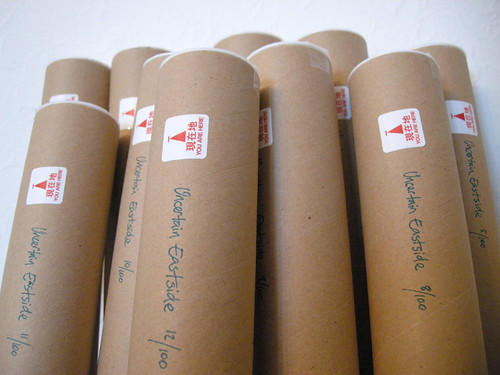
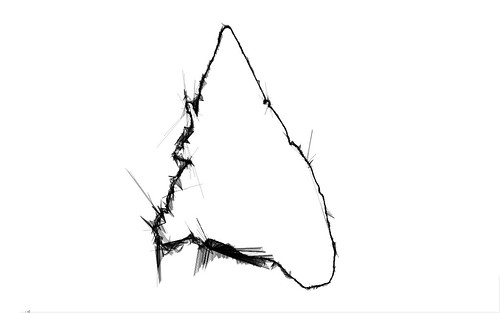
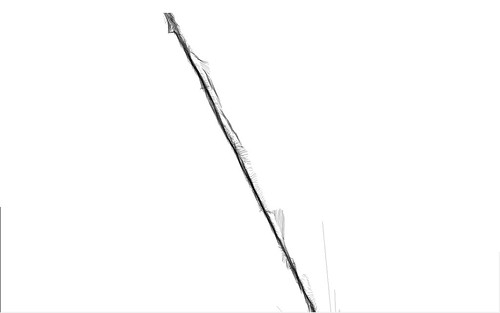
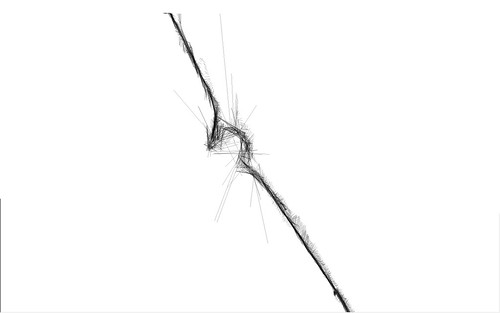
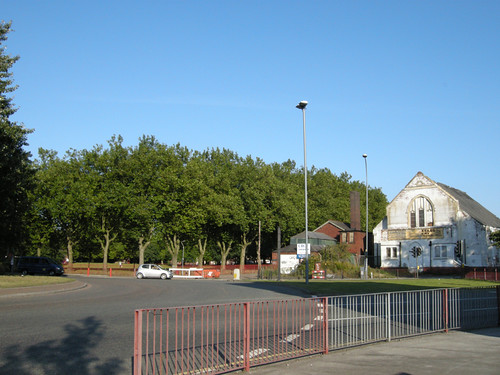
For those of you wanting to make sure you get your Uncertain Eastside limited edition prints in time for Christmas, please be aware that the Royal Mail’s advertised last posting day for 1st Class is the 21st December.
Uncertain Eastside prints tubed up and ready to go
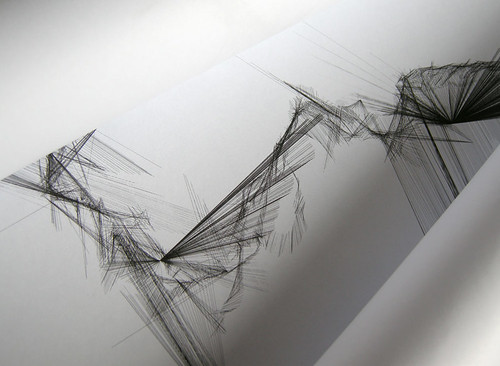
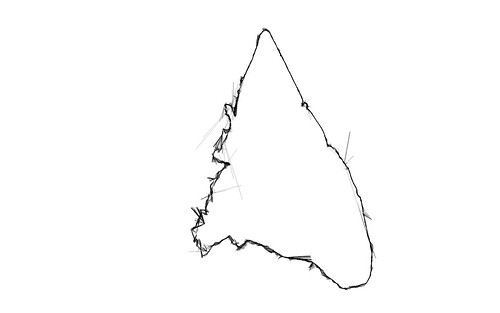
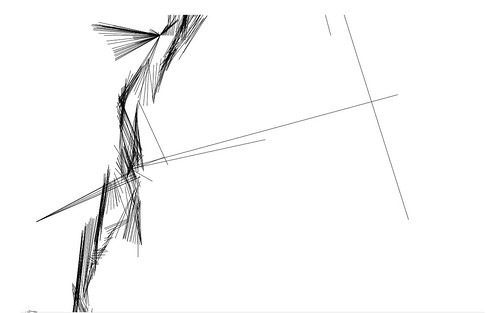
Detail from Uncertain Eastside print (B series: 6 overlaid circuits)
I was asked if I would run some workshops as part of Mowmacre Hill Primary School’s Creative Learning Day – a day aimed at trialling a range of creative learning activities and developing the pupils’ role in the planning, reflection and evaluation stages of Creative Partnerships projects.
Working in mixed-age ‘research groups’, each consisting of 30 pupils, the children were exploring the following 5 areas of creativity:
Envisaging what might be
Questioning and challenging
Making connections and seeing relationships
Exploring ideas and keeping options open
Reflecting critically on ideas, actions and outcomes
So, I needed to provide an activity that would work with children aged 5-11 years old and would provide a framework for the areas of creativity. After some discussion with the Creative Agent (representative from Creative Partnerships) we decided to use a version of Emergent Game.
Given that at least 50% of the adults who play Emergent Game pay to keep hold of their avatars, I thought it would be prudent to change the format to one that didn’t involve soft toys!
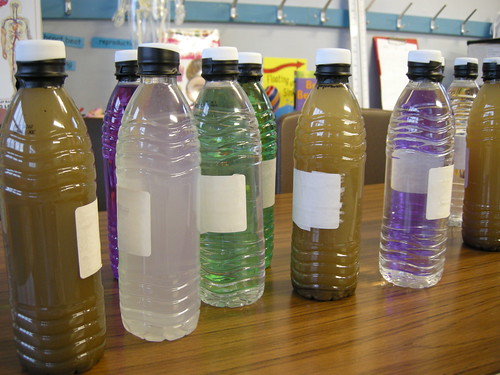
A selection of mysterious liquids
Inspired by the workshop we did at hanare project in Japan last year, where we ran out of toys and one of the players used a glass of water instead, I decided to theme it around some mysterious liquids…
I was also keen to build on the immersive experience work I did earlier this year at Linden Primary School, and experiment with how key strategies from that might be scaled down into something much smaller. In this case, a workshop lasting about an hour.
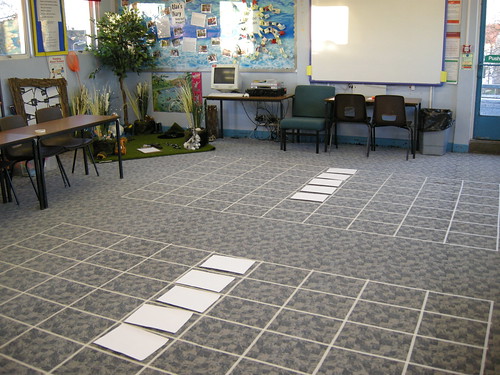
Starting off in a room next door to where I had laid out the grids, I first introduced myself as a secret agent. I wasn’t allowed to tell them much about my job, other than that we were on the lookout for fresh talent to join my department in the years to come.
I gave them a description of the sort of people we were looking for:
People who can notice the smallest details.
People who can think the biggest ideas.
People who can tell the best stories.
People who can imagine the wildest dreams.
I then informed them we would be doing a series of missions as a sort of a job interview, and I would be watching to see who had the skills we were interested in.
We also wanted people who were good at team work, so I gave them 1 minute to get into pairs (preferably with someone from a different year). After that, I told them our missions would be based around investigating some mysterious liquids. The scientists in my department had no idea what these liquids were, so we needed the pupils to figure out what the stories might be so the scientists knew where to start with their research.
The mysterious liquids were all in a rucksack and the teams of special-agents-in-training did a lucky dip to get the one they would be investigating. Whilst the bag made its way towards the back of the group and after the initial exclamations of “its just water” had been heard, I reiterated the four skills, asking after each one if they thought “its just water” would be the sort of thing we were looking for. Generally, they thought not!
The Grid
With all the mysterious liquids distributed, we moved next door into the mission laboratory and gathered around the edge of the grid. Here I explained the first mission:
Profile:
What is the name of your liquid?
Where is it from?
What is the best thing it has ever done?
From this standing start, the children only had about 3 minutes to come up with the seeds of a back story for their mysterious liquids.
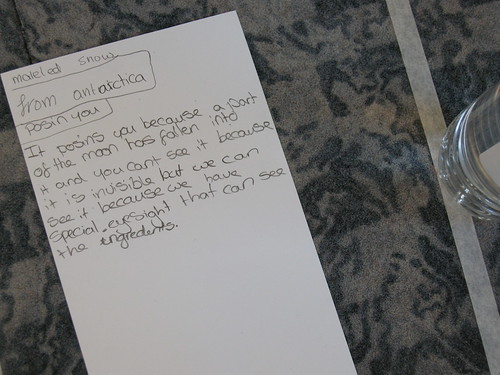
They did me proud with intergalactic waters of several different sorts; healing octopus blood; water from a river-and-washing-up-liquid accident; jelly from London that would make you powerful and water from Antarctica that looked innocent enough, but only the two agents working with it had the special eyesight to see what it really was…
It poisons you because a part of the moon has fallen into it...
Where some of the older kids were sniggering and wanting to say their mysterious liquids were urine, I called their bluff and demanded more details.
Frog wee/wii collected by a farmer over the course of one day
Next – to some embarrassment from aforementioned sniggering kids – was the reporting-back session, where each team told the rest of the group what they thought their mysterious liquid was. This gave me a chance to make sure everyone was entering into the spirit of things and identify the very few who were unable to see anything more than a bottle of water. It also meant that everyone could see what sort of standard was being set and what they had to match up to.
Next I unleashed the remaining missions: one asking them to write a postcard from their mysterious liquid to one of the other mysterious liquids; one asking them to design a creature that might live in the liquid, giving me information about what it looks like, how it moves and how it breathes; one asking about what it might have been used to wash clean; and one explaining where the liquid might (and might not) like to hang out in school.
The creature-designing mission was by far the most popular mission, but again the pupils did amazingly well, with most of them completing all four missions in something like 15 minutes.
We concluded with a second reporting back session lasting about 10 minutes in which each team was asked to share their best mission.
Here is a slideshow of some of the mission cards that were produced during the three workshops:
It was great for me to be able to run the game (although I never actually called it that in front of the pupils) 3 times back-to-back, because it meant I was able to try different formats and tweak things that weren’t quite working as well as I wanted.
In addition to this, the pupils were also involved in evaluating and reflecting on each workshop immediately after it finished. I wasn’t part of these sessions, but you get the gist of them from the evaluation sheets each child completed:
Did you...
At the end of the day there was a final session where the pupils were again asked for their thoughts on the different activities they had taken part in, this time feeding back verbally in response to questions such as: did you think the activity was better suited to any particular year groups; what did you enjoy about the activity; and what aspect of learning did they think it was relevant to.
I followed my last group into their final session and so was able to get a feel for how positively it had been received. I missed whether they thought it was suited towards a particular age group, which was a shame because I want to know how the youngest children got on with it.
There was potentially a large focus on writing during the game, and I wanted to check whether the working in pairs (and often with a teacher supporting them), coupled with the verbal reporting-back sessions, meant that they were still able to express their ideas in a way that wasn’t too daunting (more important to me than actually generating written documentation).
A really interesting thing that came out during this evaluation was how much the pupils were linking it to their maths and science lessons. It’s possible it could also have been influenced by us working in the science room, but they were mostly making an incredibly strong connection to the containers of liquid and their work on capacity etc!
Another piece of feedback I received, this time from a member of staff at lunch time, was the value of the reporting-back sessions in going towards developing some much-needed speaking and listening skills. This was really useful, because up until then I had been a little bit concerned about the pacing and whether this bit slowed things down too much.
Anyway, many lessons learned, and I’m confident that the Emergent Game framework can be successfully and interestingly adapted to use in different education contexts. Next challenges might be to explore how it might be harnessed to a specific set of learning objectives. It would also be good to get the pupils roaming around the school a bit and interacting with their surroundings. I’d also like to see what happens if we re-introduce the emergent aspect and ask the pupils to start generating their own missions…
Following on from the artist-led spaces podcast, there have been various other fizzPOP-centred events and conversations recently.
[Quick recap: fizzPOP is a hackerspace I’m involved with; hackerspaces being a place where people from all sorts of backgrounds can work on projects that typically involve varying degrees of programming, electronics, craft and/or jiggery-pokery.]
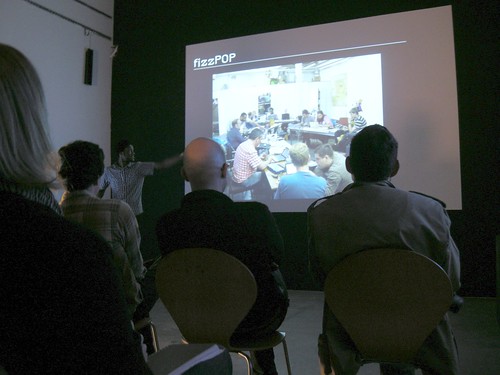
Antonio Roberts presenting at Eastside Projects
On Thursday 19th of November, Antonio Roberts gave a presentation to the Eastside Projects associate members. In the short time available he gave a very good, comprehensive, whistle-stop tour of how the hackerspace came about, what we do there and what our aims for the future might be.
The bit that has stuck with me most though, was when someone in the audience asked what kit we hoped might furnish a more established fizzPOP with. Antonio’s response included the usual basic toolkit of soldering irons etc etc, but then for his ambitious one-day-we’d-like-to-have item he went on to mention web servers. That would never have even occurred to me!
Now, Antonio comes from a graphics/code sort of a background, and I come from more of a maker/sculptural background. If I’d have been asked the same question, I would have answered with something along the lines of a laser cutter or a rep rap for rapid prototyping of physical objects. My point is not that one or other of these answers is right or wrong, just that it was a timely, healthy reminder that fizzPOP plays host to a really diverse range of people and that, if we asked 20 people that question, we’d quite likely get 20 different answers!
Right from the beginning we’ve said that the community is our number one priority and as fizzPOP grows it will be interesting to see what shape things settle down into.
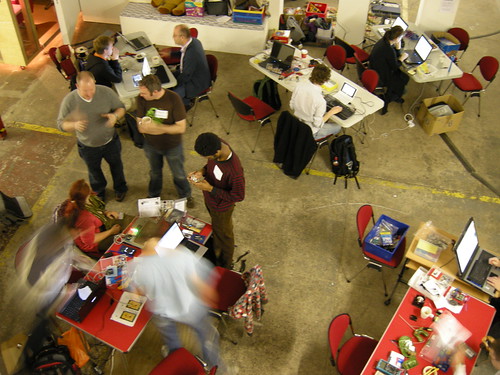
drone's eye view (we wish) of a small part of the fizzPOP Howduino event in full swing
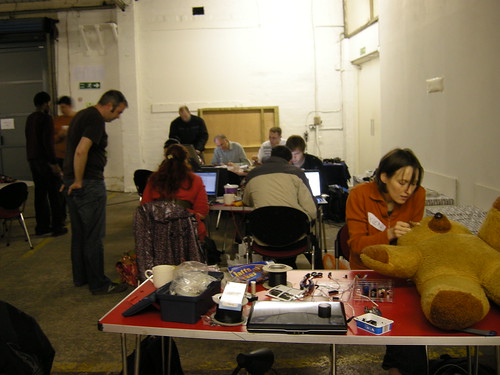
On Saturday the 21st of November, fizzPOP and Howduino joined forces to host a day-long hacking event at VIVID as part of the Hello Digital fringe events programme. This is something we’ve been itching to do for some time since our regular Wednesday evening haunt, The Edge, can only hold about 15-20 people and we’re only there for a couple of hours in the evening once a fortnight.
Saturday was intense and involved about 40 people, whatever stuff they bought with them and lots and lots of ideas. It was amazing to see how all these ingredients got circulated around over the course of the day. We certainly filled the space!
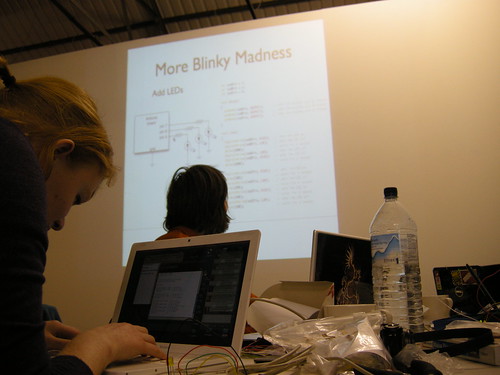
Marie and Helen blink like mad
fizzPOP regular GB did a sterling job of compiling and delivering beginners’ workshops introducing people to the basics of the Arduino platform.
This led to messages such as “Woo Hoo! I’ve downloaded a program onto the board & successfully have an LED winking @ me! :) Thanks 2 the wonderfully patient Howduino team” [@IonaMakiola] and “My first ardunio (technically a freeduino) http://twitpic.com/qct4g Never been so proud of turning on a light on before” [@TigersHungry] being posted on Twitter. TigersHungry has also written a fuller account of her learning experience on her blog.
At the other end of the skills spectrum, we also had two proficient hackers teaming up to work on projects together. Arvydas and Stewart could be seen running around the gallery space testing the autonomous robot car they’d programmed to recognise and avoid obstacles in its path. Check it out in this video avoiding even a pencil-sized object!
Evil Ted gets patched up after having LEDs inserted behind his eyes and an Arduino implanted in his head
Nicky Getgood and her mum popped in for a bit and were moderately baffled by the whole thing. When, whilst being interviewed by 6-year-olds the following Monday I described the “inventors’ club” my friends and I had set up, their eyes sparkled with excitement!
I’ve indicated as much before, but it’s worth saying again: I love fizzPOP as a space where I can go to learn things, to teach things, to be exposed to new ideas and to just try things out without risk of ridicule if it all goes horribly wrong.
Evidently other people feel the same way: several people clocked up round journeys of about 200 miles to attend the Howduino event (Bath, London, Milton Keynes, Hertfordshire and, of course, Adrian and Thom coming from Liverpool). Others came from Leamington and near Banbury, as well as a more local Birmingham contingent being present.
Despite going from strength to strength at the moment, fizzPOP will be going a bit quiet over the coming months due to the combined effects of heating costs for the warehouse space we hold our hack sessions in and a Christmas break. We’re looking to hold at least one more hack session before we go – add your name and preferred day to this poll.
Though we may become quiet in practical terms, behind the scenes we’re also beginning to think about how we can develop fizzPOP’s activities and give it a more stable base from which it can operate. We’ve seen that the demand for this sort of a space exists, and we know we won’t be able to hold our hack sessions at The Edge indefinitely, because at some stage it will need to be reclaimed as a studio and exhibition space.
If you know of anything you think we should be aware of – be it a potential advocate, source of funding to help us get started up, or some bricks and mortar that are available, please get in touch.
Also, if you have any spare web servers or rapid prototyping machines…
Last weekend I was at South Hill Park’s Digital Media Centre for one of their courses.
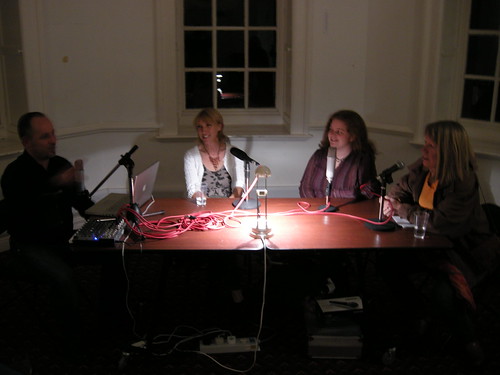
Martin Franklin, the DMC manager, has been following the development of the fizzPOP hackerspace I’m involved in organising and invited me to take part in a Gene Pool meeting and podcast whilst I was around. So, on Sunday evening I joined Martin, co-host Janet and Julie Hoyle from the Ochre Print Studio to talk about our experiences of setting up artist-led spaces and “artists doing it for themselves; doing naughty things without funders”.
From left: Martin Franklin, Julie Hoyle, me, Janet Curley Cannon
You can download the final podcast, or listen to it here:
The Uncertain Eastside limited editions prints are now officially available to purchase!
All the prints are A0 (841mm × 1189mm), signed, unframed and come in protective cardboard tubes – you will look after them now, won’t you?
The first batch of prints, rolled up, labelled and ready to go.
There are 2 different series available: A and B.
Series A:
Detail from a Series A print: Digbeth Deritend and Coventry Road.
A set of 3 individual prints, each of one of the double-circuits of the Eastside regeneration area. Limited edition of 10, £50 per set.
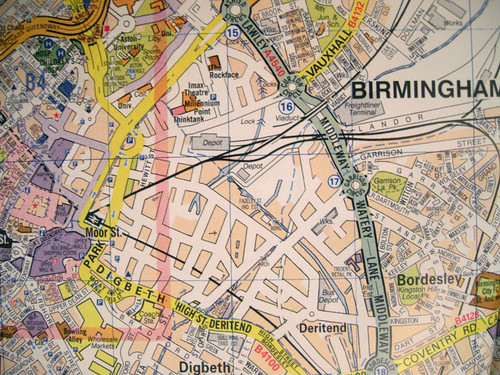
I walked around Birmingham’s Eastside regeneration area in pairs of 90 minute circuits – the two walks in each pair happening one straight after the other. These prints make the traces of each walk visible.
Series B:
Detail from a Series B print: Moat Lane and the Bullring markets area.
The traces of all 6 circuits overlaid. Limited edition of 100, £15 each.
These prints show the cumulative traces of all 6 circuits overlaid on top of each other. It becomes a lot harder to pick out the individual circuits, but instead it makes the patterns of glitches visible and you can see how the physical landscape of the city affects the different parts of the drawings.
How to order
These prints are available through my online shop The Invisible Hand. Simply send me a message via the order form telling me which items you would like to purchase and I will then contact you back with confirmation and postage/delivery information etc.
The wikipedia article that @MuseumNext links to includes a list of 19 steps to creating good open source software. My response to this was that I was excited by the prospect of a similar list for open museums.
We rattled off 19 steps that, for the most part, swapped in museum terminology for the software design terms. When I first started writing this post on Tuesday afternoon, it was with the intention of digging a bit deeper to check that what we had here wasn’t just some diverting wordplay. I thought I’d supplement each step with references to things that were discussed at the MuseumNext event and it would nicely serve as a redux for Suzanne and others who weren’t able to attend.
Anyway, it didn’t quite work out like that. We really did cover a lot of stuff at the event and most of it was brainstorming in small groups – so even the attendees only have a small part of the overall picture of what happened there.
I gave up on this post for a bit, but I’ve not managed to bring myself to delete it. The thing is, these steps are just too relevant to my work and I feel I need them in the system (equivalent of pinning them up on the wall by a desk) as a reminder as to what’s important for a meaningful participatory approach. So, I’m going to press the publish button after all…
Apologies to Suzanne that this isn’t the nice summary we had both hoped for, but also an invitation for people to chip in with their thoughts. Maybe we can yet use these 19 steps as a framework about which to curate awesome/vital/important things. The comments are yours…
1. Every good project starts by scratching an individual’s personal itch.
Over the day and a half of MuseumNext I met a lot of people who are very passionate about a whole range of different things. We know this is the driving force behind good projects.
We also saw examples of projects that scratched itchy participants: for example Advice: Give it, Get it, Flip it, Fuck it and the Living Library. Maybe a combination of the two is the driving force behind great projects?
2. Good curators know what to write. Great ones know what to rewrite (and reuse).
@MuseumNext included the caveat “works if you say everyone is a curator”.
I’m going to reference the original essay “it’s almost always easier to start from a good partial solution than from nothing at all.”
After Nina‘s presentation on the Friday morning, someone asked where was a good place to find out more about awesome projects – Nina’s blog being an obvious place to start.
I’ve done nothing much more than dip my toes into the world of museum/exhibition design, but I’m aware of a number of people in that area blogging and reporting back on inspiring projects. There also needs to be a place where we can celebrate and openly discuss our failures too (there may be such a place already, either online, or in the form of face-to-face exchanges such as MuseumNext) so we can learn from our, and others’, mistakes. I tried to do this with my How to Wow series of posts and I know it’s not necessarily easy, but it reaps its rewards later down the line.
In our group discussing the Exhibition Gaming wild idea, we kept coming back to the belief that institutions starting to work with games-based projects should think in terms of a programme of games-based projects to give the institution an opportunity to learn and develop.
We also commented that our sessions had generated a lot of questions and that it would be unrealistic to try and answer them all in one project. Choose a few key questions, design for those, then incorporate the successes into the next project.
3. Plan to throw one away; you will, anyhow.
Again, from the text of the original essay: “starting over with the right idea is usually more effective than trying to salvage a mess”. [reference]
I’m using the work “projects” rather than “exhibitions”. “Project” seems to imply more of an evolutional development to me. Maybe there’s an exhibition along the way (I’m resisting saying “at the end”)? Maybe that exhibition has changed form a couple of times?
4. If you have the right attitude, interesting problems will find you.
How often do the audience get to nominate the project?
5. When you lose interest in a project, your last duty to it is to hand it off to a competent successor.
I’m curious. How long do museum projects last for? Long enough to sometimes need to find a successor for them?
I also can’t help but think that there’s something in the notion that curators are handing over a participatory project to the audience and that a) the audience/participants should therefore be fully equipped with the skills and resources to get the most from the project and b) the curator should see themselves as only being the first in a line of custodians.
Throughout the MuseumNext event there seemed to me to be a recurring theme of institutions having to learn how to relinquish control.
6. Treating your participants as co-developers is your least-hassle route to rapid project improvement and effective debugging.
I particularly like participants-as-co-developers as a method of giving co-ownership to the project.
7. Release early, release often. And listen to your participants.
This, to me, implies testing. In my role as game designer, that equals play-testing. I’m learning to play-test components, rather than build it up into a nearly finished whole before I test it. Testing unrefined bits of things makes it easier to throw stuff out. See the section of the “Cooperation and Engagement: What can board games teach us?” video below from about 8 minutes in for an example:
“If you try to polish a prototype too early, you become married to it, and you don’t want to make changes…”
8. Given a large enough beta-tester and co-developer base, almost every problem will be characterized quickly and the fix obvious to someone.
This reminds me of tales told by Alternate Reality Game designers who spend ages devising the most fiendish puzzles imaginable, only to watch as the players’ hive mind strips it bare in 20 minutes!
9. Smart platforms and dumb content works a lot better than the other way around.
The original “smart data structures and dumb code works a lot better than the other way around” reminded me of Nina’s diagrams from her presentation:
Institution as content provider ...or as platform provider?
10. If you treat your participants as if they’re your most valuable resource, they will respond by becoming your most valuable resource.
&
11. The next best thing to having good ideas is recognizing good ideas from your participants. Sometimes the latter is better.
I’m not sure I can add anything more to those two. Maybe the typewriter for comments is a nice illustration of valuing your participants.
12. Often, the most striking and innovative solutions come from realizing that your concept of the problem was wrong.
*nods*
13. Perfection (in design) is achieved not when there is nothing more to add, but rather when there is nothing more to take away.
Can you substitute the word “communication” for “design”? What are the implications for that?
14. Any tool should be useful in the expected way, but a truly great tool lends itself to uses you never expected.
This is how smart platforms enable users to steer around dumb content.
It’s also one of the key reasons that I work in the way that I do – it’s so much more interesting to set something in motion and then allow participants to take it somewhere you never dreamed of. Be flexible and responsive when this happens.
15. When designing entry points to the project/exhibition, make it only as difficult as it needs to be. Never throw away feedback
(Original: When writing gateway software of any kind, take pains to disturb the data stream as little as possible—and never throw away information unless the recipient forces you to!)
I used some creative license in interpreting this one – mostly riffing off the idea of gateways…
In our games group we talked a bit about providing multiple entry points into a project. Nina also talked about offering multiple engagement points and not focusing solely on creators.
Rather than saying to make entry points as easy as possible though, I think there are cases for providing either a grain of sand to needle at what might otherwise be a no-thought-required entry (fairly literal example, the Would you go to Mars doorway to the Facing Mars exhibition), or to make entry a challenge or a thrill (Ref: Another Exclusivity Paradox: Secret Gardens, Hidden Museums). Thus making entry points just difficult enough and no harder than that.
16. When your institution’s/sector’s language is impenetrable to your audience, change your language. However, don’t patronise.
I’m mostly thinking of a comment made by someone in our group who flagged up that there was often a language barrier between institutions and that terms could have very different meanings to different organisations. I might also be thinking of grumblings in response to this post about the Ashmolean in Oxford.
17. Leave secrets to be discovered for those willing to search for them. Reward curiosity.
18. To solve an interesting problem, start by finding a problem that is interesting to you.
Motivation, motivation, motivation.
19. Provided the development coordinator has a communications medium at least as good as the participants/audience, and knows how to lead without coercion, many heads are inevitably better than one.
Use the communications medium that’s most natural to your intended audience.
Have you got anything more you’d like to add? What thoughts do these spark off for you?
a two day workshop event … for museum professionals who are interested in innovative new ways to energize audiences and create more engaging experiences for museum and gallery visitors.
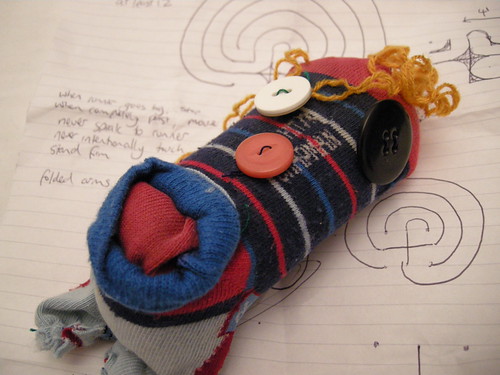
We made sock aliens; constructed quilt panels from Action man clothes; killed virtual spiders; and made Frisbees out of milk bottles (of the plastic variety).
It wasn’t long though before we were down to the serious business of the 7 Wild Ideas that had been submitted to the conference as the case-studies we would work on.
I joined the Exhibition Gaming team in response to Daniela Bauer’s vision of museum visitors being pawns in a game. Unlike some of the other Wild Ideas that were very much linked to specific contexts faced by particular institutions, Daniela was approaching this as a Psychology researcher and so our discussion was in general terms rather than attached to a particular location or design brief.
That didn’t stop it from being very in-depth though.
I first came across some of the awesome participatory work being done by museums via people from the sector involved in games such as Superstruct and Signtific Lab. Although I’ve as yet had no direct experience of working with museums, the discussions I’m reading coming from this direction have definitely inspired and influenced my thinking regarding participation. I therefore attended MuseumNext expecting to be out of place – in a good way – and expecting to learn loads.
I was and I did! Hurrah!
I’m fairly sure we didn’t answer any of Daniela’s initial questions, but in exploring them we came up with about 20 new questions. These questions were quite wide-ranging, but also with a significant amount of overlap. We were originally trying to work towards a framework for designing a museum-based game, but I think what we may have ended up with was more like a framework for institutions to start putting together a design brief for a potential game.
Collaboratively-made sock alien
The second day of MuseumNext started off with a very interesting presentation from Nina about participatory museums, after which we had two un-conference sessions. Incentivised by the prospect of being able to take a sock alien home (he needs a name, btw) I had offered to run a practical Lost Sport of Olympia session.
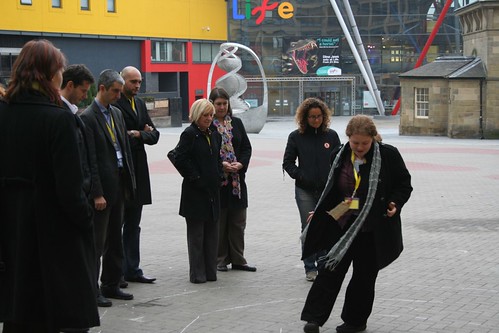
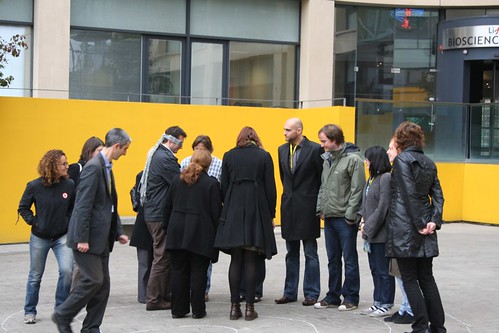
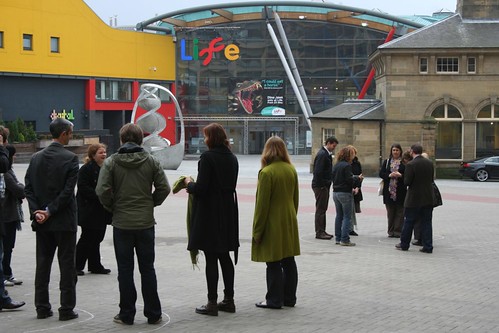
Although the people in our Wild Idea group had some great ideas about doing interesting stuff in interesting places, not many of them seemed to have had any experience of being on the receiving, playing end of such things. I thought the best thing I could offer was to give them a chance to actually feel what it’s like to be in a group of strangers doing something a bit odd in a public place. I asked for chalk and permission to temporarily deface the forecourt of the Centre for Life and got both.
So, I missed the first of the un-conference sessions because I was outside figuring out how to draw a couple of labyrinths without the usual marked-out length of string. Fortunately the ground was paved with bricks so I was able to use a combination of counting them and using my shoes to measure out radii.
It was well worth the effort – a good group of people decided to brave both the weather and the public gaze to come outside and play for the second un-conference session.
Action shot of me explaining how it works (photo from MuseumNext on Flickr)
A brave volunteer gives it a go (photo from MuseumNext on Flickr)
Things get competitive as we split up into two teams. (Photo from MuseumNext on Flickr)
After the un-conference sessions wrapped up, we reconvened our Wild Idea groups. Daniela had identified three parties that she wanted to investigate their motivations for getting involved in museum gaming: the institution, the audience and the urban gamers (there was a little confusion over this, but I think she meant the game designers, rather than players already in pervasive/urban gaming communities). It was really useful to examine these three groups and see where their motivations overlapped and where they differed.
After that we returned to our big list of questions and, working in threes, we tried to answer a few each. Again, I learned loads from this.
I’ve been working with game mechanics both in my own work (for example, Emergent Game and the Bournville scavenger hunt) and also through BARG for a year or two now, and I’m keen to start applying some of my skills to some issue-led contexts. I want problems to try and address!
I gained a lot through speaking with museum (and psychology!) professionals of all sorts and it has really helped me to better appreciate the sorts of issues institutions might be trying to address through the use of games and playful experiences. Also what the main concerns they may have in doing this and where likely pitfalls may be.
A massive thank you to all the MuseumNext team and all the participants: I have a feeling that the effects of this one will be reverberating around for quite some time to come.
Sadie Plant invited me to contribute to her presentation on ‘psychogeography and the city’ as part of the Performance Fictions symposium held at the Electric Cinema yesterday.
‘Performance Fictions’ is the fourth event in art-writing-research network created by researchers from BCU, Goldsmiths, Reading University and University of the Arts London. Article Press, BCU, will publish the papers and contributions from the various events in Spring 2010, to be distributed by Central Books. The volumes will constitute series one of Article Press’s art-writing-research publications.
After Sadie explored Birmingham’s historical rootlessness and uncertainty of place – its location at and function as, a junction – I gave a 10-minute presentation about the Uncertain Eastside work in progress. Below is a transcript with images.
___
When I graduated from BIAD about 3 years ago, it was to emerge into a lot of talk about plans for a brand new cultural quarter covering a chunk of one side of the city. I was concerned and confused by the apparent desire to suddenly plonk a fully-formed artist-led space into position amongst the warehouses.
Detail from THE ANTI-TALENT ZONE
My response was to wipe the streets of the designated area free of their existing names. And to add one.
The politics of regeneration is beyond the scope of today’s presentation, and I have little patience for it anyway, but I want to take the opportunity to use this image to show you how closely the borders of the City Council’s Eastside regeneration area are linked to the major traffic routes in and around the city.
In green, as we go up the left hand side is the ring road, going up, just out of shot to the roundabout where it meets the A38 on its way to spaghetti junction. Coming down via Corporation Street, the pedestrian routes of Hight Street and the Bullring area, and the across Digbeth Deritend back to the ring road. The criss-cross of roads and pathways are again being used to define parts of Birmingham.
In 2006 this was mostly all unknown territory to me. By 2009 it was still mostly unknown territory, but now with small incursions around Digbeth and Curzon Street. When I decided I wanted to return to some of the questions raised by the area’s regeneration, it was apparent that my first step should not to be to research it in an academic manner, and subject myself to all the spin, but to get out there and experience it directly.
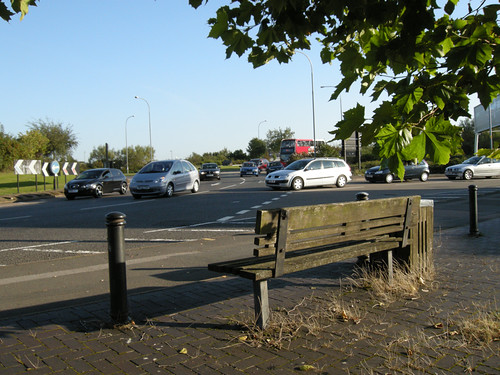
Bench on roundabout on Coventry Road
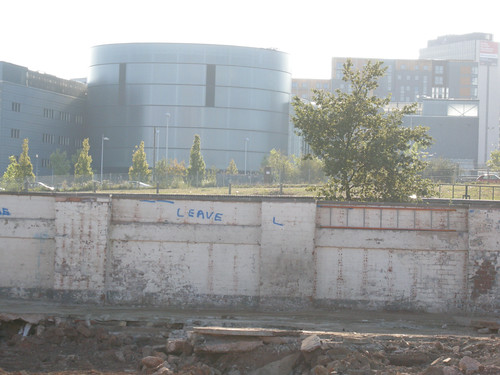
Construction site with sort-of graffiti
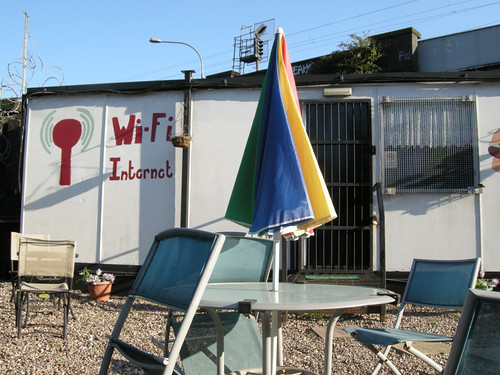
Greasy spoon internet café
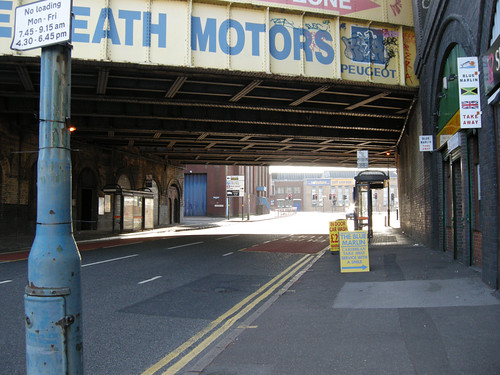
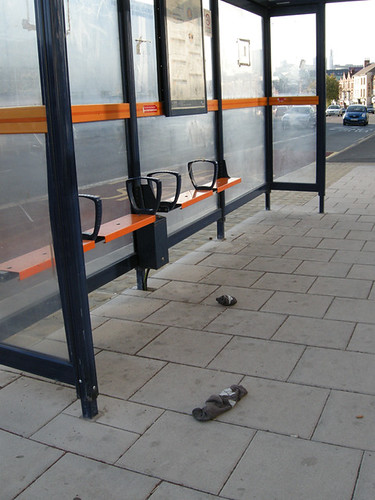
Shops and bus stops under the railway lines
Socks
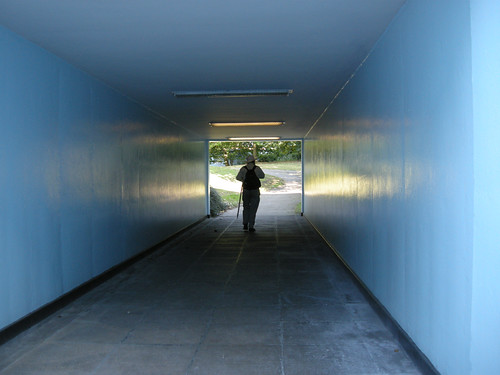
Subway rambler
I’ve spent the last month and a half repeatedly walking around the perimeter that defines Eastside, paying attention to how these spaces are being used at different times and by different groups of people. I’ve also been wrestling with how I might fit into the picture.
I wanted to document the process of walking this line, so on each 90-minute circuit I took with me 2 satnav GPS devices that I have programmed to log my position once every second. Rather than doing a straight-forward trace of my journey though, I was interested to see how the cityscape affected my position as seen by the machines.
GPS drawing from two laps around Eastside
Detail from previous slide
Each of these lines joins my position as determined by the machine in my left hand to my position as determined by the machine in my right hand. The longer the line, the more they disagree.
Despite what we are led to believe, GPS is actually pretty flaky. All sorts of things can affect its accuracy. There may be 3 rather than 8 satellites overhead at that particular time; my body may be blocking the satellite signal; and large buildings and areas of concrete can bounce the signals around. All these affect the perceived position.
Errors and glitches
Errors and glitches
Looking at the results from any one walk I can see a whole host of different glitches and errors. To be honest, they’re what make GPS an interesting thing for me to work with.
Composite drawing from 6 laps around Eastside
Through overlaying the traces of several laps, however, you can start to filter out the anomalies … or at least start to read which of them are caused by the fabric of the city-scape.
Here’s the cumulative result after 6 laps…
Stood near the base of the Rotunda
This detail is from the area at the base of the rotunda, at the edge of the Bullring shopping centre. The long, haphazard lines caused by the tall, closely-packed buildings.
Ring road
By contrast, the comparatively open space of the ring road gives shorter, much more uniform lines, occasionally buffeted around by a large warehouse building.
Ashted Circus
Here is Ashted Circus, where I momentarily loose contact with the satellite signals as I go through some underpasses.
The Other Side
Whilst walking with the satnavs I was given glimpses of other sorts of errors – biases towards the car, roads I couldn’t cross, residential areas the other side of seemingly impassable road boundaries.
Beautiful scary
Sunken oases inside the rings of roundabouts – beautiful but also possibly harbouring great danger.
However, due to restraints in using the GPS logging, I could only observe these in passing. I had to keep moving at a steady pace. I could speculate, but never investigate.
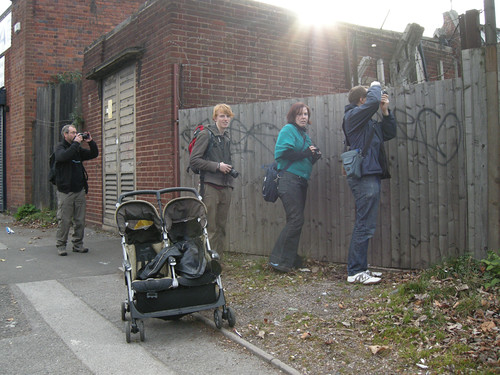
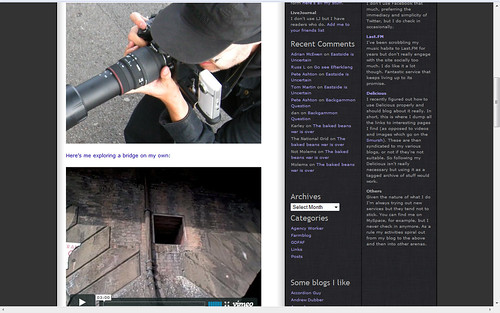
Participants document a building in Digbeth
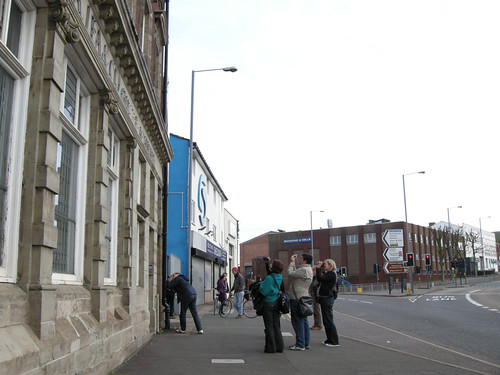
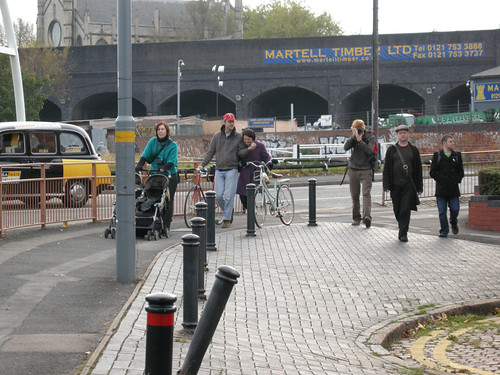
So, last Sunday I invited others to join me for an investigative walk. Nominally following the route around the edge of Eastside, but allowed the freedom to drift from it to explore things that caught our eye.
Walk
Look
Touch
Climb
Dare
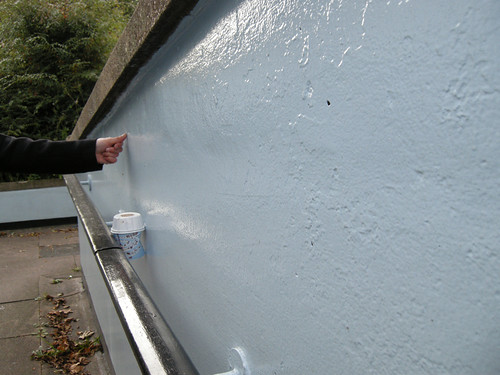
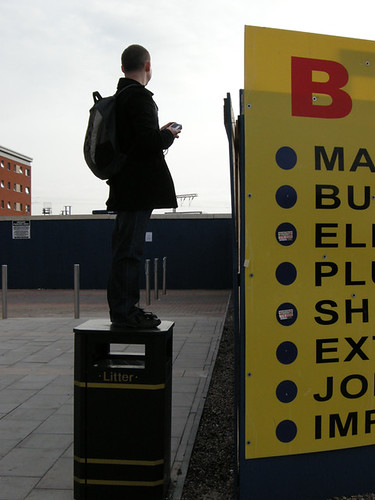
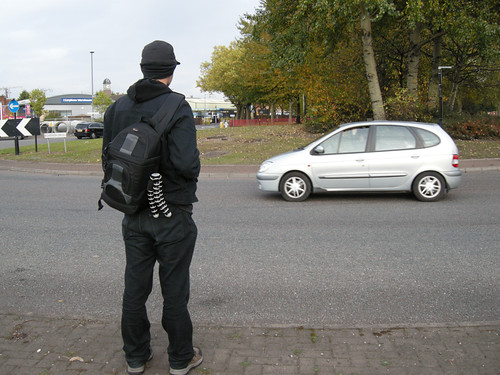
We walked, we explored, we looked at stuff, we touched stuff, we climbed on stuff and we dared to cross to the in-between places.
Blog post on Digbeth is Good, http://digbeth.org/2009/10/a-walk-around-uncertain-eastside/
Pete Ashton's blog post, http://peteashton.com/2009/10/eastside_is_uncertain/
People are now starting to post their photos from the day online, and their accounts of what happened are starting to appear on blogs where the stories and viewpoints overlap. We also exchanged stories between us whilst we were walking along the route. In situ. It’s my feeling that we needed the 3.5 hours of walking to get to the point where we could gather around the ‘map’ at the pub and have an in-depth conversation about what it signifies. I find this happens a lot – that you need the group performance before you can get to the meaty discussion.
I guess that in terms of this symposium, we’re talking more about performed narratives, rather than performed fictions per se, but I’m expecting the edges to blur somewhat, especially as we move into the phase where we compile the accompanying publication of thus chapter of the project.
After unfurling some of the stories, we will gather some of the images taken by the participants into a publication with the aim of making a document to record this face of Birmingham before it reinvents itself again.
___
From here, Sadie speculated that this sort of drift along a route defined by roadways, exploring the details, progress logged by satnav devices, might be psychogeography 21st Century style.
My main area of enquiry is centred around interactions between people and place: often using tools and strategies from areas such as pervasive games and physical computing to set up frameworks for exploration.
If you'd like to commission me or collaborate with me, please get in touch via the contact page.
General blog contents released under a Creative Commons
by-nc-sa license.
Artworks and other projects copyright Nicola Pugh 2003-2026, all rights reserved.
If in doubt, ask.
The theme used on this WordPress-powered site started off life as Modern Clix, by Rodrigo Galindez.