November 28, 2010

Five from a walk in the snow

  • Green eyes against black fur, peering out from overhanging foliage.
  • The lingering trail of a joint smoked as he crosses the playing fields.
  • Shouting at strangers to enjoy the echo.
  • Absent roast lunch.
  • Frozen textures underfoot whilst walking on the verge.

On making things

I came across this short documentary this morning:

We Make Things. from Ryan Varga on Vimeo.

Here are my resonant points:

  • Technology as the tools we use to communicate with other people.
  • Making technology accessible is: looking at something, knowing it, understanding it, taking it apart, putting it back together, remaking something new.
  • Understanding the technology as having come from somewhere: as having an origin, as being made.
  • I do a lot of work with technology, but I’m not actually interested in technology – I’m interested in people.
  • Technologies of various kinds have the power to change our relationship to the world, to other people.
  • Not having to allocate technology to an expert. Community is the biggest thing that’s motivating. The tools themselves are boring.
  • Development practice in some ways is as meaningful politically as protest and voting.
  • The maker movement is portrayed as something that’s new, but it’s not: it’s a return to knowing how things work.
  • We’ve been through this era where things got kind of abstracted and sealed off, where we weren’t looking at them. [The technology inside things.]
  • It’s very hard for people to connect with a mentor – with a master, if you will – and the information share from generation to generation …we’ve let technology get in between that.
  • The separation of language and action. When we describe something linguistically, it’s very easy for us to form what that thing is and it doesn’t necessarily resist us very much. When we make something, the thing we make doesn’t always do what we want it to do.
  • When we’re doing critical making we’re not doing craft. We use making, not to come up with some kind of object for display, and not to come up with some kind of product to be sold, but as one way of guiding a shared experience. So we make together, and we think together, and we talk together…
  • The MakerBot is something that’s like, even though it’s digital, it’s kind of pulling us back to that to that time before the Industrial Revolution where people truly took time to figure out how things were made and what they were made from.
  • Objects with no traces of their production process are the wrong goal.We need to figure out ways to see the traces.
  • The great revolution: it’s not going to be people actually doing, it’s going to be that people understand what people that do, do

Those ideas around traces of the making process and understanding the origins of technology were in my head as I walked around Eastside this afternoon collecting data for Uncertain Eastside.

Blood. Sweat. Tears. Data.

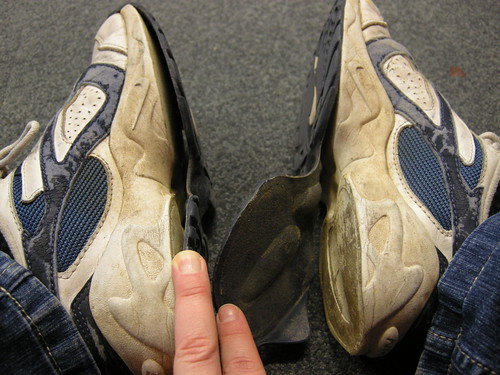
It’s important to the work, and to me, that the two GPS units are carried around the city by hand, and that I push myself physically to do this (I do two circuits back-to-back, 7 and a bit miles). That those screens of numbers, of data, have an origin in human toil.

broken shoes

Disintegrating shoes (after a day gathering data around Nottingham)

update: And then, as if to prove the point, I processed the data from the day’s walking and got this, so I’ll have to do it again:

:( That's 7.32 miles I'll be walking again next week, then... #badGPSday

Creative Partnerships and starting as you mean to go on

There are currently a wave of Creative Partnerships calls being circulated and, since this is where I earn most of my income, that means I’m currently writing a lot of Creative Partnership proposals and attending interviews etc.

A quick scan down the list of projects that I’m interested in reveals phrases such as:

  • “working closely with the staff and children”
  • “committed to collaborating with our staff”
  • “a programme of staff development”
  • “a project partner who will support them”
  • “facilitate our shared generation of a project”
  • “to work with Year One pupils (aged 5 – 6 years) and their teacher to help them”
  • “work alongside staff and children to plan, model, deliver and share skills”

All good stuff, and what you might expect from a programme called Creative Partnerships. The proposals I submit typically include the following sentences in the opening paragraph

My work is intrinsically cross-disciplinary and I’m also a serial collaborator. My philosophy towards collaborations is that they should ideally enable both parties to work in ways that they would not have been able to do if they were working independently. I’m interested in processes of challenge and development for everyone involved.

and it’s not unusual to see something like

I aim to make my design process as transparent as possible so that elements of it can be applied to later projects. My skills and enthusiasms complement yours – when we work together (rather than me delivering at you) that’s when things start to be really successful. I can bring enthusiasm, sensitivity, strategies for engaging pupils, adventures, a can-do attitude, experience of what has worked well in the past, making skills, gadgets and cunning devices; I’ll be looking to you to bring knowledge of curriculum content, awareness of the pupils’ abilities, constructive criticism, and a willingness to give things a go.

as a closing paragraph.

I’ve done enough projects now that I can clearly identify the active participation of the teaching staff as one of the – if not the – most important factors in determining the long-term success of a project. Those things I say I’m looking for staff to contribute are there for very specific reasons, both to underline what I expect from them and what I am unable to contribute.

So, by the time I am invited to interview, both parties have been very explicit in setting out expectations of collaboration, partnership and co-delivery.

Why, then, is the next step invariably

  • “deliver a 30 minute taster workshop to 6 of our year 5 pupils!”
  • “a short exercise (20 mins) with a group of Y3/4 which the interview panel will observe”
  • “deliver an activity for a group of children”
  • “work with a group of 10 pupils from Year 3 for 20 minutes to introduce them to your practice”
  • “work with a Yr 2 class of 29 children. […]a creative exemplar workshop session, that can last up to 40 mins.”

?

Turning up at a school I’ve never been to before, working with a group of children I have never met before and whose abilities I have no indication of, to deliver an activity that somehow responds to a pressing need within the school, but which I only know through maybe a few sentences as part of the published call for practitioners. No knowledge of the space, no knowledge of the people, minimal knowledge of the context, superficial knowledge of the curriculum and only guesses at where the children are in relation to it. Worst of all: no conversation and no collaboration. I have to prepare and deliver these sessions in isolation.

Apart from the obvious grumbles about having to prepare and deliver a lot of work without getting paid, I seriously question the relevance of interview workshops in this format. Certainly I don’t feel they reflect upon my practice or my approach to working in schools.

In addition to this, if I’m proposing an Agent N project in which I appear suddenly and initiate a several-day-long adventure, it’s difficult to frame popping in for a 20-min activity in the context of whatever that story may turn out to be. My main hooks and strategies only work properly within the context of that immersive experience and I have to be really careful not to damage that ahead of time.

So, how can we better address the needs of the school in selecting the right person to work with them on their project, and the needs of the creative practitioner in communicating their skills and approaches?

Fundamentally, I think the interview needs to establish whether the working relationships are likely to succeed.

From my perspective, Mowmacre Hill Primary School – a school I’ve worked for twice now [1, 2] and have a lot of respect for their approach – have come the closest to tackling recruitment in a sensible and constructive manner.

Candidates were invited to the school where we were interviewed, a few at a time, by the school council. Actually, we got a pretty intensive grilling! The children knew their agenda and what they wanted, and the questions they asked were searching and perceptive. I believe the questions were also prepared independently of the teachers. Being interviewed with a few other practitioners at the same time meant that we could bounce ideas off each other and also that the conversation could run for a significant length of time. Teachers were present to basically chair the conversation: making sure everyone got a chance to speak and to fill in extra details where needed.

The next stage in the (paid) half day was a workshop activity, but one working with a pair of teachers: three or four practitioners spent an hour or so ‘planning’^1 some initial ideas in response to the brief. This gave us a chance to really find out what was behind and under the brief as laid out in the tender document.

In the case of the thread of the project relating to the Foundation classes, this process actually established the brief in the first place – talking through the general context, identifying the concerns the teacher had and then exploring everyone’s responses. By the end of that session we were set to go with a project to do. We felt confident that we were going to affect some long-lasting changes. (This was in contrast to the way the meeting with the Y3 and Y4 teachers panned out, where we ended up with a project about and, for me, the feeling that the affects would be short-lived.)

I find this an interesting idea to go with Sally Fort’s comment that “[schools] don’t actually know what they need until the other end of the project in my experience”. Might it be nice if more schools felt that they could go into a project accepting/embracing that they don’t actually know what they need^2? (This is as much a comment on CP paperwork as it is on attitudes of school staff.)

What changes would you make to tendering processes for artists and other practitioners working in schools? How would you get a collaboration off to a good start? Can you represent your practice in 20 minutes from cold? How useful are interview activities in helping you identify the people you want to work with?

The comments are yours, I’m interested in getting some different viewpoints on this.

__


1: I’ve put ‘planning’ in inverted commas there because I think it’s dangerous to regard this as actual planning, but rather getting to know each other and getting a feel for the project in general. Sound planning comes later once people have had a chance to digest conversations and establish relationships to the point where people are comfortable to challenge suggestions as they are put forward and speak up about concerns. …another blog post sometime, perhaps…

2: I remember very clearly getting a rollicking in about 1996 from my A-Level art teacher about having too fixed ideas about what outcomes were going to be and being blind to the interesting stuff that crops up along the way. I generally consider that ideas at the start of a project are likely to be wrong ideas. Also, creating is, after all, about arriving at something new and that implies a journey of some sort without knowing exactly where you’re going to end up until you get there.

Circuit Bending 101 with Nottinghack

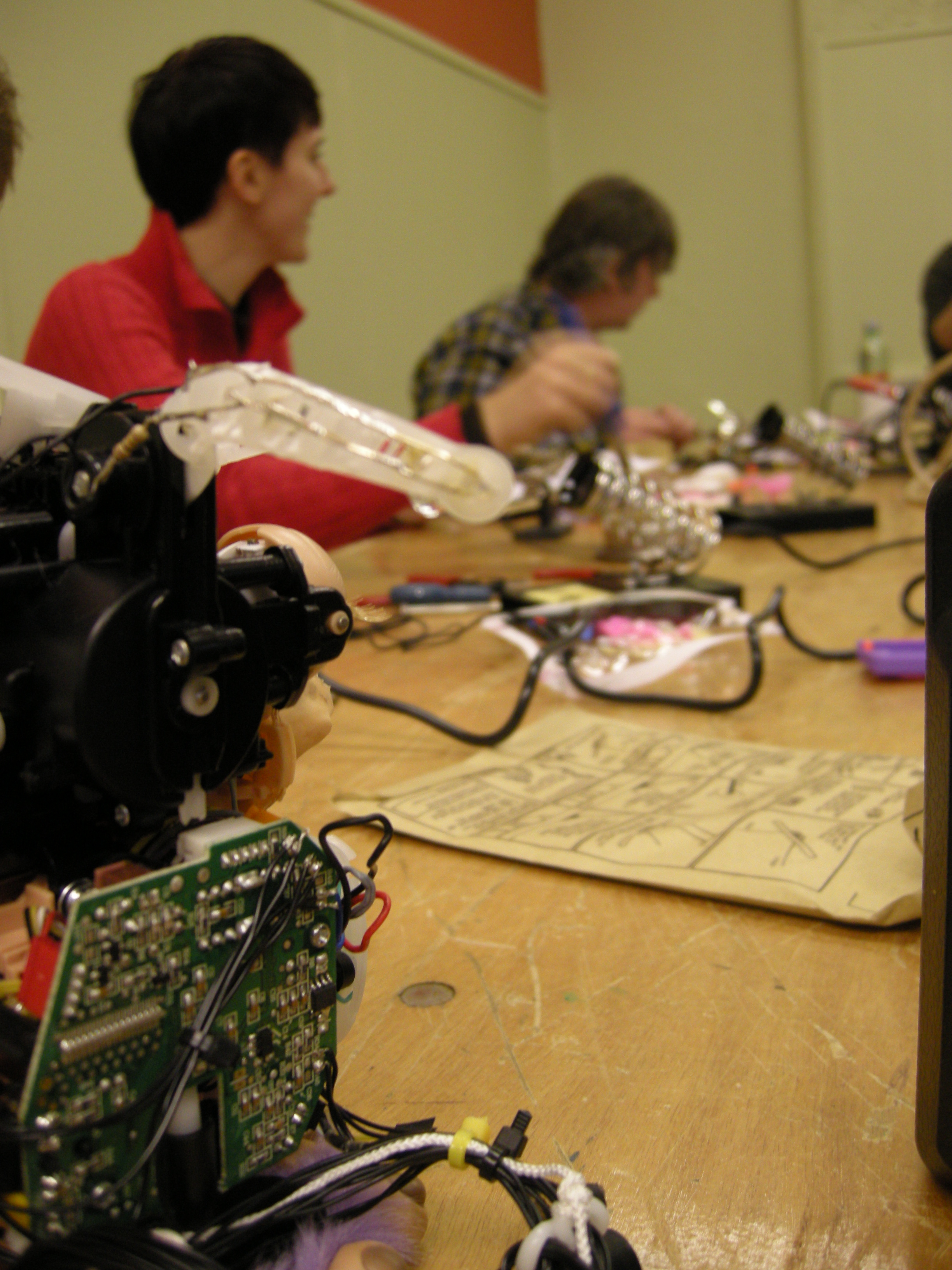
Many thanks to those who came along to the first of my Circuit Bending 101 workshops, and extra thanks to Nottinghack‘s Dom for hosting us.

Circuit Bending 101 hosted by Nottinghack

Circuit Bending 101 hosted by Nottinghack

After a quick soldering re-cap (selections from my ‘Soldering for 8-year-olds’ bit at Theremin Day) we started on the first project – making a music player controlled with light.

Here’s a recording of everyone trying out the toy as it was intended to sound:

Listen!

…and here’s the new, improved version an hour or so later:

Listen!

light and sound! from nikkipugh on Vimeo.

Several hours later we had eaten all the snacks, had a good laugh, discussed the difficulties of bomb-making [Theatrical-Fake-Bomb-Units, that is), worked our way through all three projects and arrived at this aural treat expertly performed by The Nottingham Hackspace Unharmonic Orchestra. A thing of beauty!

Listen!

Marvellous!

Next up is more of the same in Birmingham on the 27th of November, this time hosted by Chris Unitt at Meshed Media. Although it’s still a good few weeks away, places are already nearly all gone (only three left as I write this!). Head on over to the booking page to buy your ticket so you can join in the fun!

Not sure what was happening at the other end of the room, but it seemed to have everyone's attention...

Not sure what was happening at the other end of the room, but it seemed to have everyone's attention...

A room full of bent circuits

All I can do is show people how to wire them up - I can't control what happens after that...

All I can do is show people how to wire them up - I can't control what happens after that...

For several days now I’ve been saying what I’m really looking forward to with the Circuit Bending 101 workshops I’m running is the bit at the end where everyone will have a selection of tinkered-with electronic toys and the noise starts to issue forth.

For Saturday’s workshop in Nottingham there will be up to 12 participants. That’s up to 36 bleepy things! Hurrah!

Just as an experiment I thought I’d try and simulate what that might possibly sound like and recorded twelve individual segments of audio of about a minute in length.

I promise I was fully intending to try and combine these together in a vaguely musical manner, however when I imported all the audio and pressed play just to hear what I was starting with, I decided to leave things how they were.

I’ll leave you to speculate as to why…

Listen!

So, there’s the challenge, can we make that sound any better when we have everyone jamming together after the workshop, or is that already perfection?!

Blinking bats

A second slice of LED-based Halloween goodness.

Blinking bats from nikkipugh on Vimeo.

These bats will be part of my attire for later today, but they’re really quite pleasing just by themselves!

A really simple build using an Arduino-based Real Bare Bones Board, some cardboard, some insulation tape some wire and 14 LEDs.

Here’s the code:

/*
blinking bats
nikki pugh 30th October, 2010
Attribution-NonCommercial-ShareAlike Creative Commons
Powers LED eyes for a colony of bats, blinking them in a random sequence at random intervals
http://npugh.co.uk/blog/blinking_bats/

LED pairs with 330ohm resistors in series, connected between the output pins and ground.
*/

int colonySize = 7; // How many bats do you have?

//control pins for each bat

int bat1 = 2; // bat1
int bat2 = 3; // bat 2
int bat3 = 4; // bat 3
int bat4 = 5; // bat 4
int bat5 = 6; // bat 5
int bat6 = 7; // bat 6
int bat7 = 8; // bat 7
int bat8 = 9; // bat 8
int bat9 = 10; // bat 9
int bat10 = 11; // bat 10
int bat11 = 12; // bat 11

int gap = 3; // gap before selecting next bat to blink
int colony[] = {bat1, bat2, bat3, bat4, bat5, bat6, bat7, bat8, bat9, bat10, bat11}; // Put bat IDs into an array
int batSelect = 1; // your bat selection variable - used for selecting a bat ID from the above array
int blinker = bat1; // the bat selected to blink
int i = 0; // counter for start-up blinks

void setup() {

randomSeed (analogRead (0)); //read from the (unused) analogue pin to get a value to seed the "pseudo-random number generator"

pinMode(bat1, OUTPUT); // set pins to be outputs
pinMode(bat2, OUTPUT);
pinMode(bat3, OUTPUT);
pinMode(bat4, OUTPUT);
pinMode(bat5, OUTPUT);
pinMode(bat6, OUTPUT);
pinMode(bat7, OUTPUT);
pinMode(bat8, OUTPUT);
pinMode(bat9, OUTPUT);
pinMode(bat10, OUTPUT);
pinMode(bat11, OUTPUT);

}

void loop() {

for (i = 0; i< 3; i ++) { //blink all bats' eyes at start-up digitalWrite(bat1, HIGH); digitalWrite(bat2, HIGH); digitalWrite(bat3, HIGH); digitalWrite(bat4, HIGH); digitalWrite(bat5, HIGH); digitalWrite(bat6, HIGH); digitalWrite(bat7, HIGH); digitalWrite(bat8, HIGH); digitalWrite(bat9, HIGH); digitalWrite(bat10, HIGH); digitalWrite(bat11, HIGH); delay (200); digitalWrite(bat1, LOW); digitalWrite(bat2, LOW); digitalWrite(bat3, LOW); digitalWrite(bat4, LOW); digitalWrite(bat5, LOW); digitalWrite(bat6, LOW); digitalWrite(bat7, LOW); digitalWrite(bat8, LOW); digitalWrite(bat9, LOW); digitalWrite(bat10, LOW); digitalWrite(bat11, LOW); delay (200); } digitalWrite(bat1, HIGH); //all eyes back on again digitalWrite(bat2, HIGH); digitalWrite(bat3, HIGH); digitalWrite(bat4, HIGH); digitalWrite(bat5, HIGH); digitalWrite(bat6, HIGH); digitalWrite(bat7, HIGH); digitalWrite(bat8, HIGH); digitalWrite(bat9, HIGH); digitalWrite(bat10, HIGH); digitalWrite(bat11, HIGH); while (true){ // infinite loop gap = random(1, 5); //wait some seconds before selecting next bat delay(gap*1000); batSelect = random (0, colonySize-1); //select a bat at random blinker = colony[batSelect]; digitalWrite(blinker, LOW); //blink delay(200); digitalWrite(blinker, HIGH); } }

Happy Halloween! [mwah-hah-hah-haah!]

Last night, after working on an LED-based Halloween costume prop, it occurred to me that the Spooky Bend from the Circuit Bending 101 workshops I’m doing in November [Nottingham, Birmingham] might be kind of cool in the dark.

It is!

The single red LED nicely up-lights your hands as you do your stuff.

It turns out it’s quite bright too, adding another layer of distress to this photo and video:

Spooky Bend from the upcoming Circuit Bending 101 workshops. In the dark.

Spooky Bend from the upcoming Circuit Bending 101 workshops. In the dark.

Happy Halloween from nikkipugh on Vimeo.

There are a handful of places left for the workshops, so if you’d like your own spooky, glowy, maniacal laughter device you can make your own (along with the two other projects). I’ve had a couple of these in my flat for a month of two now and can vouch for it being an addictive toy at any time of year!

Here are the sign up pages again:
Nottingham, 6th November at Nottinghack
Birmingham, November 27th at Meshed Media

19,264 seconds of qualitative and quantitative data (Curzon Street, 2010)

What started as an exploration into my relationship as an artist to a proposed cultural quarter has expanded to also include a significant amount of sustained investigation into witnessing and documenting the change in that urban landscape.

Last year my focus was on the perimeter of Birmingham City Council’s regeneration area. Since walking and gathering the GPS data for Uncertain Eastside and organising the Walk and Talk event (in which we gathered lots of visual and anecdotal data) I’ve been increasingly aware of buildings going up and coming down in the area around Curzon Street and Millennium Point.

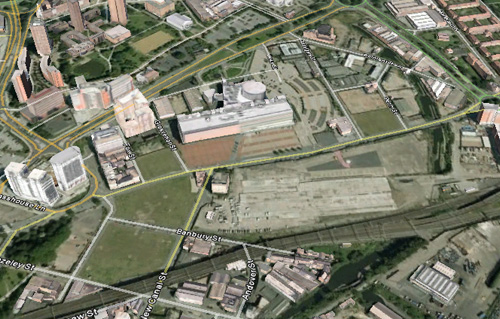
The Google Earth view of the area (with imagery that seems to be from 2007) is already drastically out of date, but it gives a rough idea about the range of contrasting terrain there now.

As well as spending hours walking all the streets in the zone I’ve selected, concentrating on paying attention to the details of the spaces, I’ve been collecting and processing GPS data to use as a measure of how developed the streets are. I will repeat this over the years to come as a way of logging the changes taking place on both macro and micro scales.

Google Earth view of the area I've been investigating

Google Earth view of the area I've been investigating

At the bottom left of the image above there is a relatively green area: old factory plots that have now turned to grassy wastelands and the park on the corner at the top of Fazeley Street.

Bartholomew Street, now closed to traffic and without any buildings around it. The bottom right corner shows where my path passes under the railway arches at the corner of Fazeley and New Canal Streets

Bartholomew Street, now closed to traffic and without any buildings around it. The bottom right corner shows where my path passes under the railway arches at the corner of Fazeley and New Canal Streets

Here the GPS data is fairly consistent. Water-heavy buddleia bushes overhanging the pavements on closed roads induce a few wobbles and railway viaducts cause momentary loss of signal, but on the whole the open terrain doesn’t interfere much with calculations of position.

Contrast this with the data gathered from around the various Further and Higher Education buildings on and around Fox Street and Grosvenor Street.

Tall buildings closely packed together reflect and block the satellite signal, causing the GPS calculations for position to be very inaccurate.

Tall buildings closely packed together reflect and block the satellite signal, causing the GPS calculations for position to be very inaccurate.

At one point one of the GPS devices calculated I simultaneously had one hand next to the halls of residence and the other on Digbeth high street opposite the coach station! (About 800 metres away.)

If even a small proportion of any of the various plans for Eastside are realised we look set to get more lines like this in the future.

I’ve come to refer to those two areas respectively as the Green Zone and the Learning Zone. The third zone in the area is the Rubble Zone – the plots between Millennium Point and the ring road that have been razed with the exception of 3 buildings: Belmont Row Co-op works, the lock keeper’s cottage and the Moby Dick’s pub.

From left to right: Cardigan Street, Gopsal Street, Penn Street and a tiny piece of Belmont Row. Currently mostly rubble.

From left to right: Cardigan Street, Gopsal Street, Penn Street and a tiny piece of Belmont Row. Currently mostly rubble.

The presence of all three of these buildings can be seen to affect the GPS traces. The image above hints at Moby Dick’s on Gopsal Street. For now the lines are uniformly short, but stand by for Eastside Locks. [link to pdf of proposed developments]

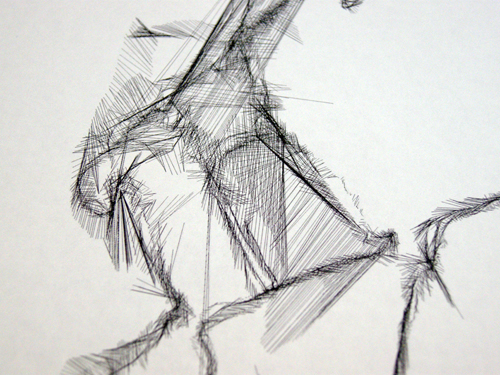
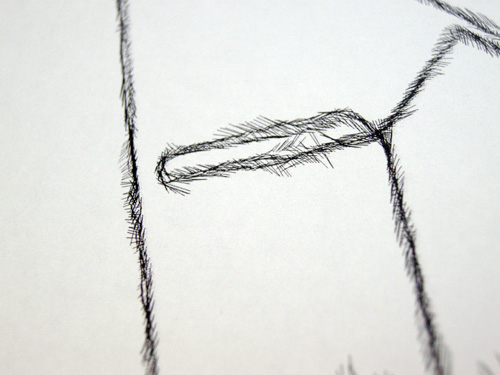
So there we have it: a snapshot of a part of Birmingham before it changes beyond recognition. Quantitative data gathered over several hours of walking a set pattern of streets whilst paying attention to the details, the changes and the people – I’ll tell you about it on a walk or in a pub sometime. Qualitative data in the form of 19, 264 lines that speak volumes if you know how to listen – probably a limited edition print coming soon.

19,264 seconds of qualitative and quantitative data (Curzon Street, 2010)

19,264 seconds of qualitative and quantitative data (Curzon Street, 2010)

A trace of the Traverse Me walking and talking

On a whim I left some GPS modules in my bag, logging for the duration of yesterday’s Traverse Me walk and talk event at Warwick University.

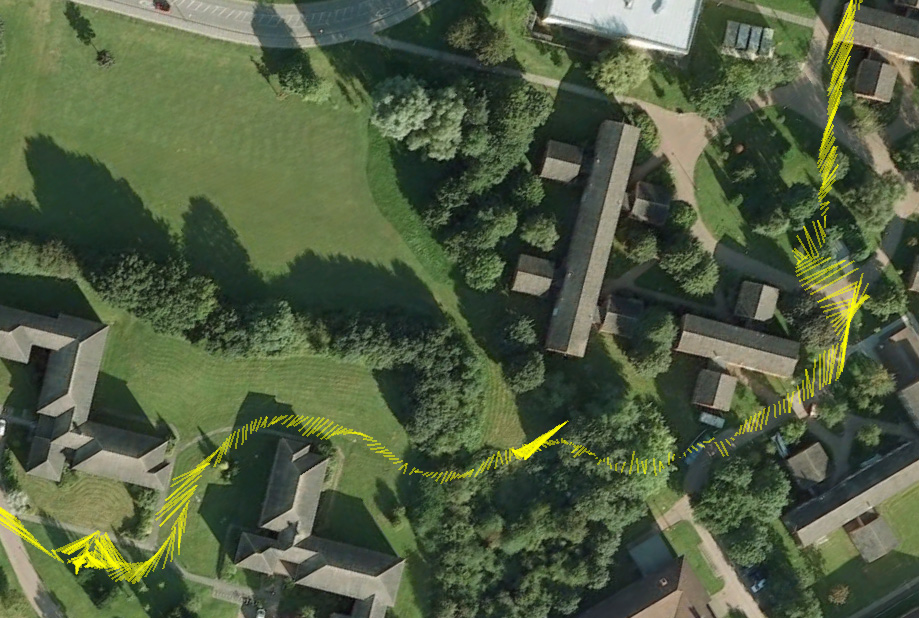
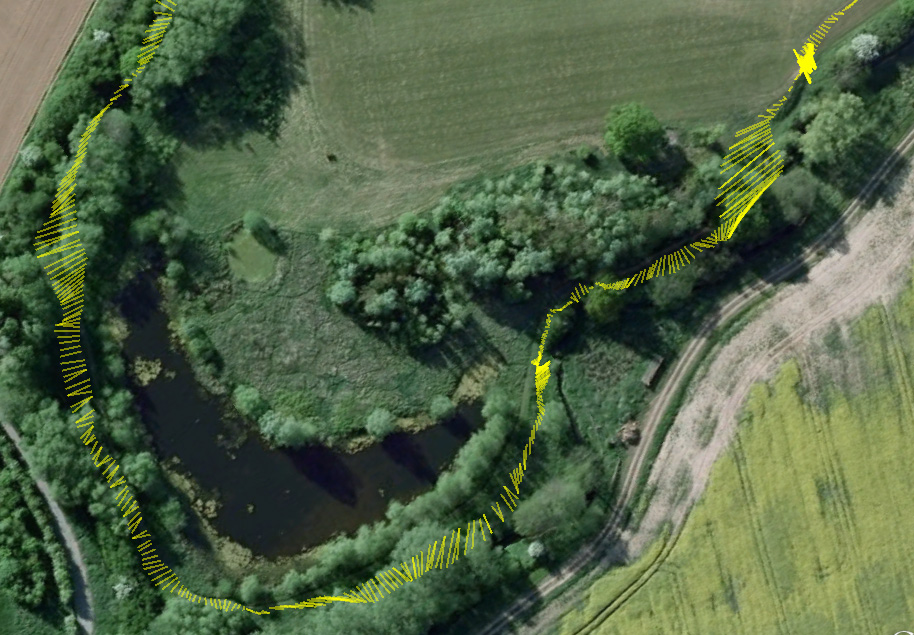
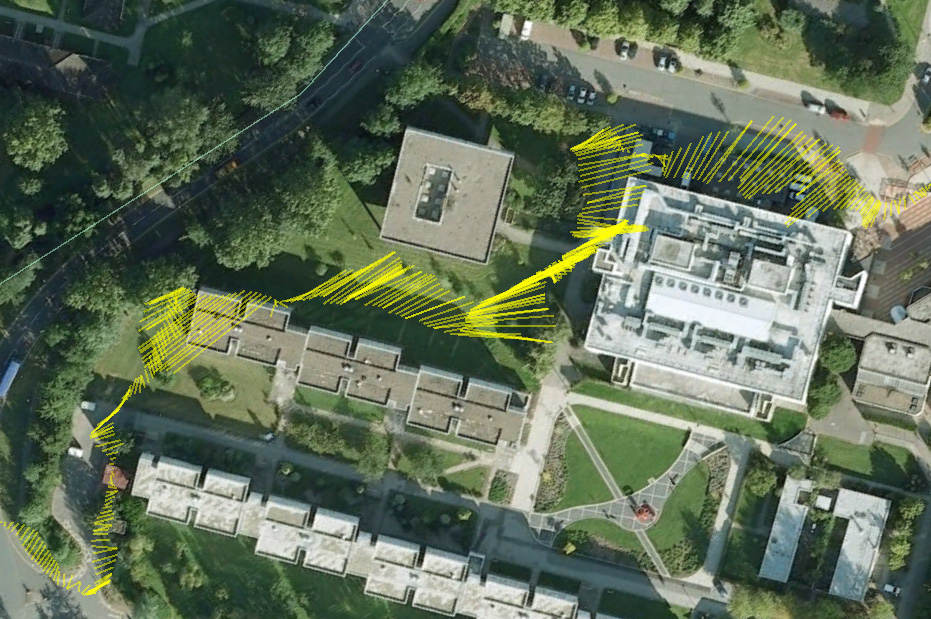
I wasn’t expecting to get much of a trace off them, but it turns out that it worked quite well! Here are a few shots of the data I got overlaid onto Google Earth. If you have Google Earth installed on your computer you can download the .kml file and have a zoom around for yourself.

..

Jack Martin and Tocil halls of residence, with a few pauses along the way

..

Walking up Library Road and then walking alongside the WBS Teaching Centre. Is it the trees making the GPS lines longer, or the bricks?

..

Walking across the fields on the hill, the lines are much shorter as both modules agree more closely in their calculated positions.

..

A diversion around the lake

..

Back to civilisation and once again the scattering effect of the buildings can be seen.

I’m still fascinated by how the quality of the lines are affected by the fabric of the landscape and, as shown by the images above, the walk we did covered several different terrains so the resultant drawing has several different characters in different places.

Until yesterday I’d never seen much more of the campus than the Arts Centre, so I found it very difficult to try and relate where I was to Wood’s map of walkable space (with the buildings left as empty space). I’m really pleased that the GPS logging worked so well and I can now figure out where we went and link that back to Traverse Me.

I also like the little clusters of lines that show where we paused and had little conversations. Now I can link thoughts back to where we were when they bubbled up.

Traverse Me and me

Today I was completely fortuitous in stumbling across Jeremy Wood‘s Traverse Me GPS drawing project at Warwick University and the walk and talk event being run this afternoon.

Detail from Traverse Me

Detail from Traverse Me

I hit send on the email I had been writing, jumped in the car …and managed to get to the Mead Gallery minutes after the group had departed! Luckily though, I located a “tall man with a beard” just outside and managed to join the walk. It’s safe to say that if I hadn’t have spotted them then, then I would never have found them.

Jeremy’s walk took us behind carparks, through hedges and across fields, revealing both the hidden-away secret places and the huge extent of the land owned by the university.

Having spent the last week or two working on another round of walking Eastside using GPS data to map the extent to which the landscape has been built upon, Wood’s work and the discussion around it was great for making me consider my own work.

A central concern of his project (238 miles walked over 17 days) seems to have been to fill in space; casting a network of lines over that which could be walked. Wood says he “responded to the structure of each location and avoided walking along roads and paths when possible”. The resulting mapdrawing – complete with scale mark, title and signature – is covered in swirls, contour-like lines, pictures and spirals.

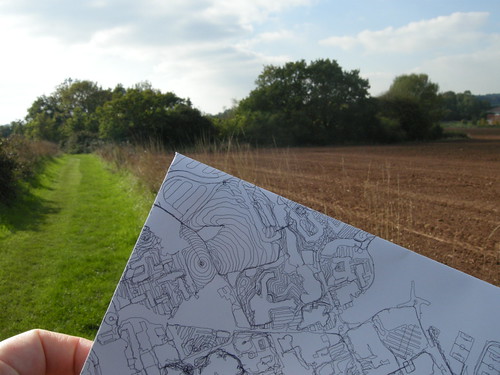
The white tooth sticking out from the heavier line in the top left of the map corresponds to the copse. The spiral just below it and to the left originates from the highest point and spreads out over the field.

The white "tooth" sticking out from the heavier line on the top left of the map corresponds to the copse. The spiral just below it and to the left originates from the highest point - to the left of where I am stood - and spreads out over the fields.

By contrast, the Eastside walks I’m doing are very much dictated by road layout. As previously observed, Birmingham’s regeneration zone is very much defined by the road boundaries around its edges (c.f. Southampton‘s cluster of relevant cultural organisations).

The more recent work I’ve done to document the development in the Curzon Street area is also very road-centric, using them as a natural (man-made) grid by which to, well, traverse the area I’m investigating. Since I’m interested in measuring change, I need a certain amount of consistency so I can walk the same route in the years to come. Changes in my route have to come from changes in the built environment.

route

It was nice to hear of similarities in Wood’s experience of recording GPS trails to mine. The way you balance confidence as you stride about an area with deference to the possible intrusions you are causing to the people living and working there; the way you can be intent on following a predetermined route, but can savour the contrivances of circumstance that throw you off your course.

I asked Wood about his thoughts on how he felt the act of carrying a GPS receiver legitimised his erratic behaviour whilst out walking. I’m very aware of how in projects of mine such as Sites of Potentiality Guidebooks, Invigilator and Uncertain Eastside the objects I am carrying or wearing greatly add to my feeling that I have a right to behave a little bit strangely…

I may not want to draw a lot of attention to the fact that I’m holding two PDAs in my hands, but I want them to be visible so people know I am Doing An Art Project.

iPAQs and gum

Having recently also been working on the first Uncertain Eastside publication, I was also curious about the need for telling the stories of the things we see and encounter whilst out on our, largely solitary, walks. The traces from the GPS data are all well and good, but I also want people to know about the security guard at the halls of residence who jokingly asked me if I was counting my steps as I veered around outside his office, or the rain-heavy rhododendron bushes that cause particular squiggles on my drawings.

Today walking and talking events are seeming increasingly important to me as a means to transmit the story of the work.

Above is a slideshow of a few photos I took on the walk. This post includes some GPS traces I made too.


Copyright and permissions:

General blog contents released under a Creative Commons by-nc-sa license. Artworks and other projects copyright Nicola Pugh 2003-2026, all rights reserved.
If in doubt, ask.
The theme used on this WordPress-powered site started off life as Modern Clix, by Rodrigo Galindez.

RSS Feed.