June 23, 2013

Inkvisible #2: Provocations

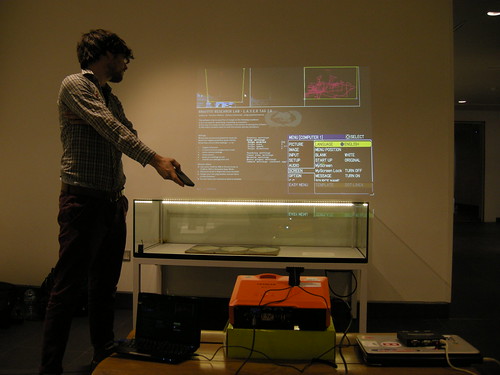
Last week we had our second playtesting day for the Inkvisible project. (Here’s the write-up of the first one.) This time I was at BMAG with Dr Gretchen Larsen, our King’s College academic.
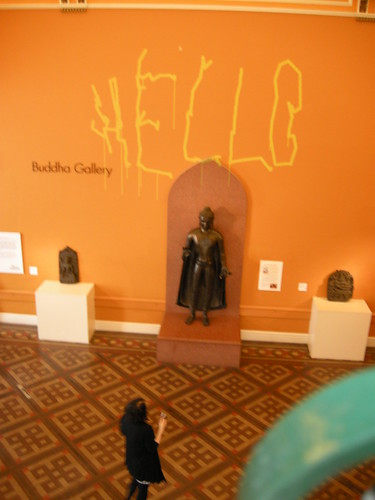
With or without a PhD, we all start in the same way!

After struggling to get the L.A.S.E.R. Tag software we’re using to track our green laser pointer in the orange space of the Buddha Gallery, I’d bought a purple laser pointer to try out. In parallel to this, we’d also been talking to a BMAG conservator to ensure our lasers aren’t doing any damage.

It turns out there’s not a lot of published research regarding the use of laser pointers for drawing graffiti within the museum environment!

The conservator is going to do some calculations and research into fluence and intensity, and whilst we think we’re a long way off the sorts of powers, spot sizes or exposure times that would be needed to do any damage, we’re making sure we err on the side of caution.
Inkvisible Day 2

This means that we will restrict the use of our green lasers to glazed oil paintings (framed behind glass), ceramics and sculptures, and our purple laser (with its shorter wavelength and increased likelihood of generating ultra violet radiation) to only ceramics and sculptures. Fortunately the area in the Buddha Gallery we were interested in using contains stone and bronze statues.
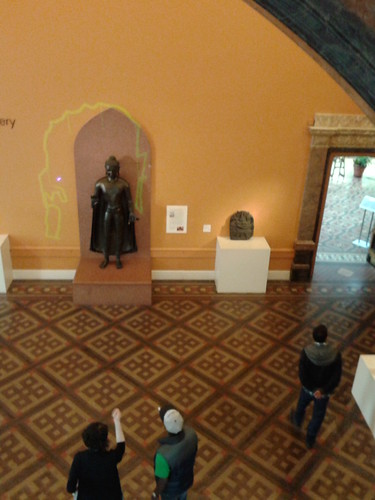
Inkvisible Day 2

We’re interested in this particular gallery partly because of its links to a community that come to leave devotional offerings and partly because of the overlooking balcony that means we can potentially project down into the space.

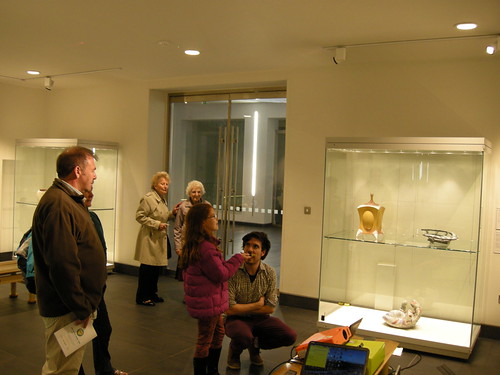
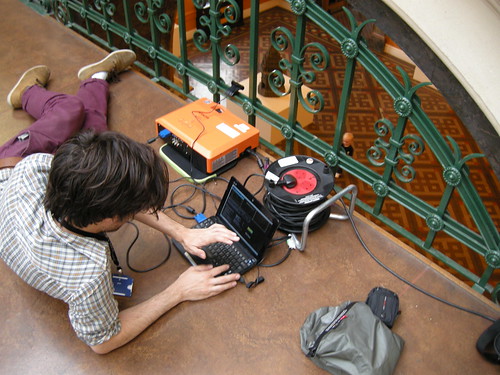
This affordance of being able to have all the technology up out of sight seemed to have a distinct effect on the interactions with museum visitors. In contrast to when we had the projector and laptop out in plain view and people readily came up to ask us what we were doing, here the mechanics were somewhat hidden and people tended to stay back to watch from a distance. We could still hear the appreciative exclamations, but it was almost as if when the workings are visible they act as an invitation for people to come up and ask what’s happening and how it works.

We’re also wondering if this effect is related to how many people are with the laser – if it’s just one, do visitors feel they need to leave them alone to do whatever it is they’re concentrating on?

Whilst the invitation seemed to have been removed, it was replaced with more of a sense of magic. “Is it real?”, one man was heard to say.

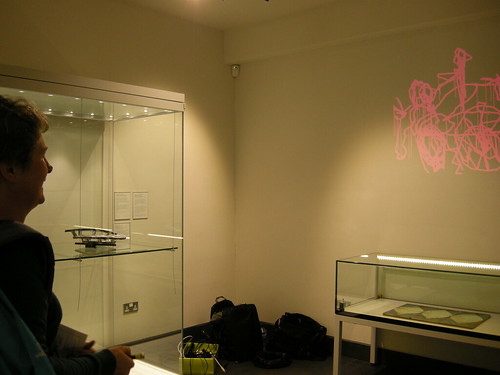
Something else was to become apparent too: the big bronze statue of Buddha didn’t like the laser!
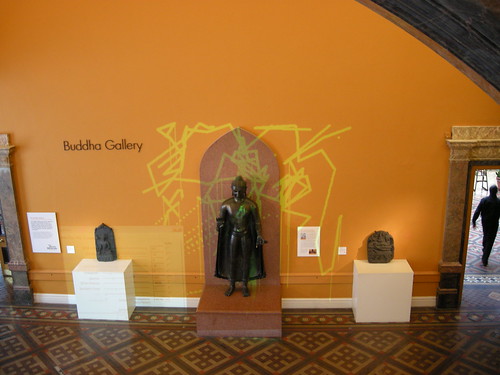
Inkvisible Day 2

The above image might look like a lot of indiscriminate scribbling, but it’s us trying to figure out why the projected graffiti would stop as the laser passed over the statue. With a bit of tweaking of the software settings, we managed to get the laser to track over the (basalt, I think) surround, however we could not directly draw any traces over the statue itself. (Only drips or traces that were offset due to tracking misalignment.) We think this was because of the reflective relief metallic surface bouncing the laser off in all sorts of directions therefore making it invisible to the tracking camera.

The result was really quite eerie and added to the feeling of transgression.

The same thing happened when we tried the statue of Lucifer in the Round Room.

Our next stop was one of the Pre-Raphaelite galleries. Having had a wander around the museum we felt that Inkvisible would work best in the more traditional galleries: the new history galleries for example are lovely and spiffy, but our stuff would just look too normal in them, it would disappear.

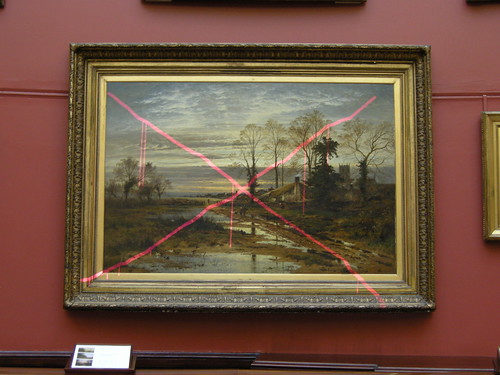
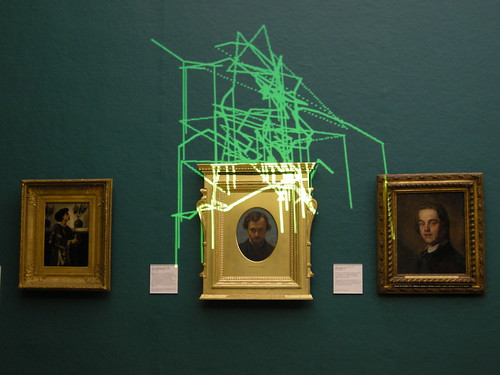
The Pre-Raphaelite collection at BMAG is renowned and attracts a lot of visitors expecting a particular kind of museum experience. We deliberately sited ourselves here to get a feel for what sort of responses disrupting that would produce.
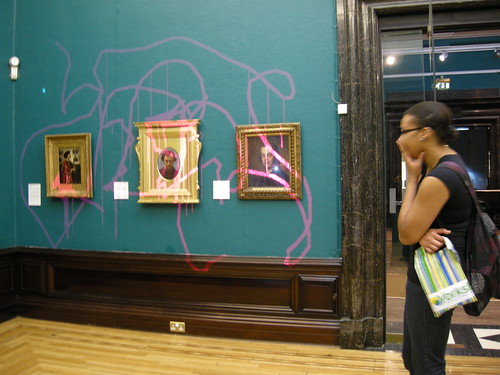
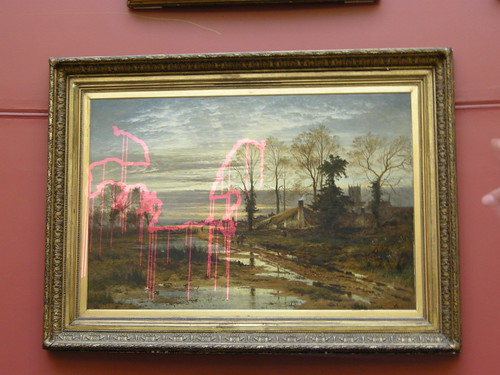
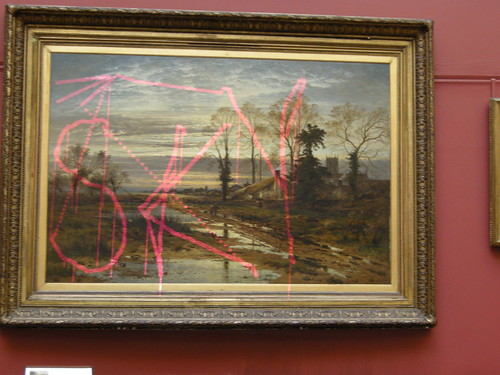
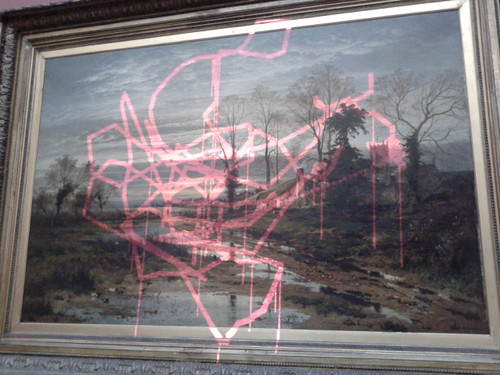
Inkvisible Day 2

This was our first interaction: a woman who was drawn to it as if to a car crash. She was horrified at the prospect of having marked over the paintings, but couldn’t tear herself away. Result.
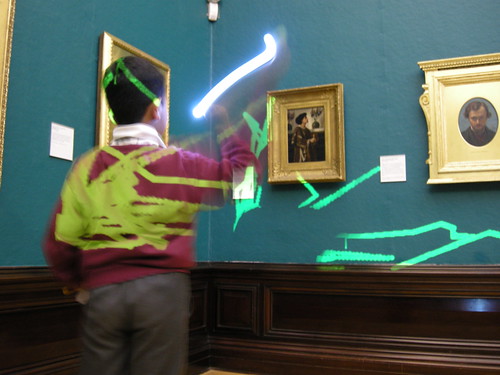
Inkvisible Day 2

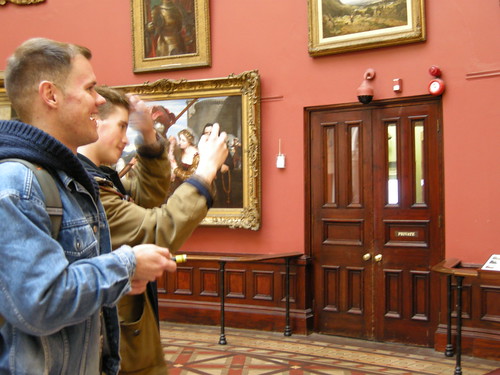
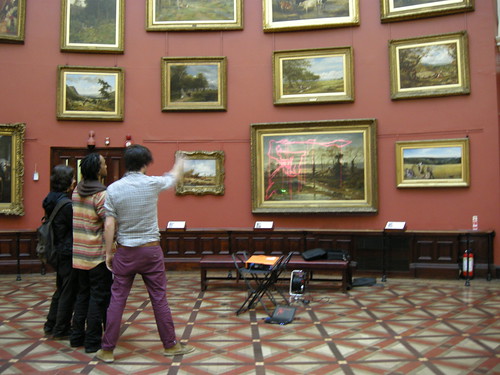
Not long afterwards we were descended upon by a series of groups of school children. Rising to the challenge we invited them to take part, giving as many of them a go as we were able to.

This was good learning for us as up until now we had only dealt with participants in twos or threes. Instigating countdowns to mark the end of turns and designating a Special Assistant to help with clearing the screen, we kept groups of about 10 7-year-olds engaged at a time.

Chatting to them between changeovers it was interesting to explore the extent to which they had already been trained in ‘appropriate’ museum behaviour. They enjoyed the opportunity to draw all over the walls and to not get into serious/expensive trouble!
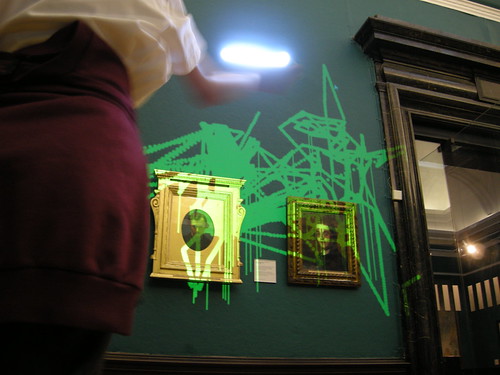
Inkvisible Day 2

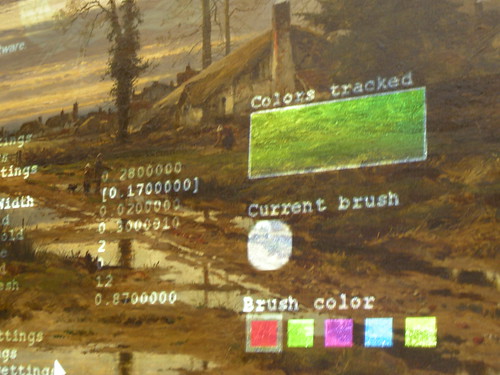
We were a bit nervous about handing over some Class 2 lasers to some excited small children, so for the most part we used an alternative method. Rather than tracking laser light reflected off of the walls and paintings, here we used a torch held so it pointed straight back towards the camera.

This had obvious advantages in terms of safety for both the artefacts and the participants, but it lacks something in the feedback for your movements that you get with the laser pointer unless you are right up close to the projection surface.

I like this a lot – it’s a very different experience when you can see the brush marks on the surface you are graffiti-ing over and this method also encourages you to move your (whole) body in a different way. We got some of the groups to try jumping and making marks as high as they could.
Inkvisible Day 2

Struggling a bit with the lack of correlation between movement and mark, also with the tracking system not being able to keep up with very fast movements, we switched back to the laser pointer method with some of the later groups.

Here it was very apparent that the children would treat the area of wall above the paintings as their canvas, avoiding the artworks below unless they were specifically encouraged to work lower down.
Inkvisible Day 2

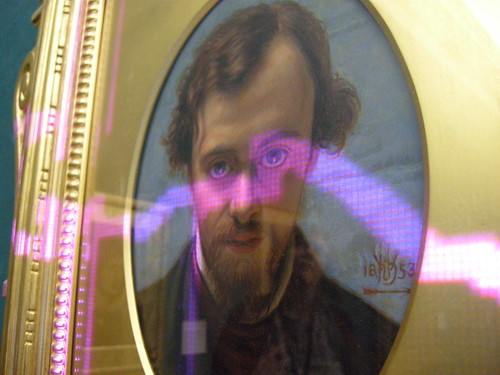
After the school groups had all got on their respective coaches, we were paid a few visits by chaps from the Digital Heritage Demonstrator project. One of the comments was “I bet everyone draws lines across the eyes straight away”. Well, er, no, actually. Nobody had! It was interesting to think about what people assumed would be the obvious first thing to do.

We’ll be running a public event on the 26th of July where you can come and do some mark-making of your own.

What will you do?

Many & Varied

A couple of months ago I was approached by the arts team at The Public about spending some time with them on a residency based around hackspace activities – something they want to be more involved with in the future.

Following a successful application for Arts Council funding, I’m now working under the umbrella of Many & Varied to deliver a programme of events and consultancy based around themes of maker culture and DIY technology.

maker hands

I learned a lot through co-founding and helping to organise events for fizzPOP for a year or two. Also during the following years where I have run various workshops as myself. Many & Varied is the next iteration in the evolution of these and my attempt to respond to things I have noticed, struggled with and aspired to.

First stop is the programme of events at The Public and we’re working on some Big Exciting Things for after that.

Stand by for events that embrace and nurture a wide range of skills, media and fun.

Inkvisible #1: Getting to know the medium

Last month I was invited to take part in in Arts and the Digital Ideas Lab (part of King’s Cultural Institute’s Creative Futures programme, produced in collaboration with Caper) as a creative technologist.

About 40 people took part – split more-or-less evenly split between representatives of academia (primarily King’s College London), cultural organisations (such as the Maritime Museum, Coney, Crafts Council and the Royal Shakespeare Company) and the creative technologists (always a delightfully ‘misc’ collection).

At a previous event 19 challenges had been arrived at and we started off by aligning ourselves to one of these. I gravitated towards “How can we nurture and sustain spaces for collective creative and critical thought in the digital world?”.

By the end of the day I was on a team pitching an idea that we later wrote up as:

Inkvisible is a hybrid framework of digital, projected graffiti; game mechanics; and narrative applied within the interior space of the museum.

Our aim for this phase of the project is to playtest different variations of the framework at Birmingham Museum and Art Gallery (BMAG) in order to gain an understanding of how it can be applied to create a channel through which the audience’s critical voice can be expressed and heard.

We got some money; we got the go-ahead from BMAG and now we’re doing it!

Starting yesterday, we began what’s effectively a 4-day residency to get to grips with what the affordances of this idea might be.

‘We’ now being a team consisting of:

(Others also contributed to the development of the initial idea.)

So, our first task was to get to grips with the technology we would be using to project the graffiti. We’d short-listed the Graffiti Research Lab’s L.A.S.E.R. Tag system (which seemed very much in the spirit of the voices we’re trying to encourage and the brief to use open source software as much as possible) and an alternative using motion sensing via a Kinect and outputting with Processing.

Ben and I set up in Gallery 10 and started experimenting…

Inkvisible Day 1

We had a bit if hoo-hah caused by insufficient cable-age and interference from the display cabinet lights, but before too long we were up and running and attracting curious observers.

Inkvisible Day 1

Inkvisible Day 1

It was immediately obvious that this was something that draws people (of all ages) in and can be used as a catalyst for conversation. Our task next is to make those conversations productive. We’ll be exploring that more when Dr Larsen and I are back in the museum again on Tuesday and Thursday next week.

For the remainder of yesterday’s experiments, we tried a few more locations.

Inkvisible Day 1

Our attempts at projecting down from the balcony into the Buddha Gallery were thwarted by what we think was a combination of distance, reflection angles and the background orange light.

Next we tried the iconic Round Room – the first bit of the collection you encounter as you come in from the main entrance.

Wanting to cover an area that overlapped with several paintings, we struggled again due to angles of incidence and the matt paint on the walls preventing the laser spot from being detected. We’ve been given permission by the conservation team to use our lasers on certain materials (not egg tempera, textiles or watercolours), but we don’t really want to upgrade to using a more powerful laser (we’re currently using Class 2).

So, out of a combination of necessity and curiosity, we then tried honing in on one single painting.

Inkvisible Day 1

Inkvisible Day 1

As you can imagine, this had a very different feel compared to when we were using a blank area of wall above the cabinet in the ceramics gallery.

Inkvisible Day 1

Inkvisible Day 1

Having a specific and almost-tangible object to interact with (you really get a sense of the (im)materiality of both the pigment and the overlaid light when you’re up close) gives the opportunity to respond to something in particular.

Inkvisible Day 1

Inkvisible Day 1

We had people telling us about what they thought of the painting, for example: having grown up in that area of Oxfordshire and how the landscape reminds them of home. We also had someone backing-off to sit down and think for a bit before returning and asking to write the word ‘sky’ – the element that struck her the most.

The location in this part of the museum was very well trafficked and we had an almost constant stream of people coming up to us to ask questions, share their thoughts and give it a go.

People’s responses were not always positive – which I think is fair enough – and these were also important conversations to have. A few people said they didn’t see the point and one man in particular felt that we were being quite disrespectful to the work of the artist.

That last conversation came towards the end of the day when the overlaid projections were getting quite scribbly and doodley. Our experiments also came the day after a portrait of the Queen was defaced with real spray paint.

Inkvisible Day 1

It seems that use of the laser pen and seeing the resulting ‘paint’ traces is experience enough, and we’re not sure how much narrative we want – or need – to wrap it up in. What I think we will have to focus our efforts on is how to steer the use of this tool towards eliciting comment on the institution.

We’re in again playtesting on Tuesday and Thursday next week (18th and 20th of June) – do pop in and join the experiment.

Building Fun

Following on from the Gallery Hack Camp at The Public back in February, I’ve been working with fellow attendees Rachel Sutton, Dave Checkley, Kim Wall and Garry Bulmer on a commission to build a Mobile Fun Factory to inhabit The Public’s atrium space over the summer.

Our brief was mostly centred around this steel frame that’s just a leeeetle bit smaller than the goods lift:


We’ve been tasked with turning it into a Mobile Fun Factory: a structure that can rove around the atrium space of the arts centre and be used to display the products of the summer workshops, as well as being a playful thing in its own right.

brainstorm

First step: a ginormous brainstorm to figure out what a Mobile Fun Factory might be…


cardboard

Second step: breaking out the cardboard and gaffa tape!


We’ve moved on a bit since that first cardboard maquette built in March. For a bunch of people who, for the most part, had barely even met before, it’s turned out to be a formidable team. I’m also in the role of project manager, so it’s my job to keep an eye on these things, and my considered opinion is that these guys have some truly formidable making skills. HIRE THEM!

As we slowly get closer to completion, here are a few images from the build process so far…

sketch

An early sketch. The final Fun Factory won’t be entirely dissimilar to this…


anglegrind

Fettling new plates for the new castors


yellow

Yellow is the colour of Fun


top accumulations

Possibly the sexiest assemblage of soil pipe ever.


bunker

Seekrit bunker


ireye

Testing the camera feed


periscope simulator

Periscope simulator


secret cinema

The Secret Cinema starts to take shape…


We’re pretty much onto the final assemblage of component parts now, so hopefully the Mobile Fun Factory should be mobile and fun soon.

fun button

Other people’s brains

I just felt the need to mark that this week has been a good one for meeting people and having meaty conversations.

On Monday I was in London hanging out all day with Lynne Bruning, Rain Ashford and Jamillah Knowles [Outriders]. I’m not even going to attempt to sum up the topics covered, suffice to say that there were many and they were heartfelt. And there was a lot of cake. Rain took loads of photos, of which the above is one of the few that didn’t feature cake.

To be honest, some of the ones I took featuring cake didn’t technically feature as much cake as they could have done…

Tuesday featured a Pecha Kucha Night afternoon Coventry event – always good – and a meeting that involved much passionate talk about making stuff and making stuff happen.

Wednesday I got to chat to some knitters as I started a new residency at The Public (you’ll be hearing more about that later…)

And yesterday I was back in London for a Creative Lab at King’s College London helping to develop projects and new digital prototypes for cultural organisations. I was in a lovely team with a stimulating blend of familiar names and faces and people I hope to hear from more in the future.

There was no cake.

Cause and effect

I’ve been commissioned by Andre de Jong at the artist-led space VINYL to produce a piece of work for this Autumn, the set-up being that I’ve been paired with artist Nita Newman and Andre’s leaving us to riff off each other and see what happens.

A while ago Nita and I went for a stroll around Digbeth looking for inspiration. We explored a few different spaces and ideas, but we kept coming back to the Duddeston viaduct: 355 yards of futile endeavour.

Duddeston viaduct

… originally built to connect the GWR‘s B&OJR line to the LNWR‘s Curzon Street station. As stated elsewhere, the GWR fell victim to the LNWR’s politicking which meant that whilst the LNWR stopped the GWR gaining access to their station, the LNWR still demanded the viaduct be built even though they knew it would never be used.warwickshirerailways.com

Nita’s developing a site specific audio composition (call for participants currently on her website at http://nitanewman.wordpress.com/news/), so I’m taking my cues as being the following:

  • effort
  • journeying
  • separation
  • railways and engineering

I have some proto ideas that I’m investigating for feasibility since they’ll involve some data-streaming from a moving bicycle.

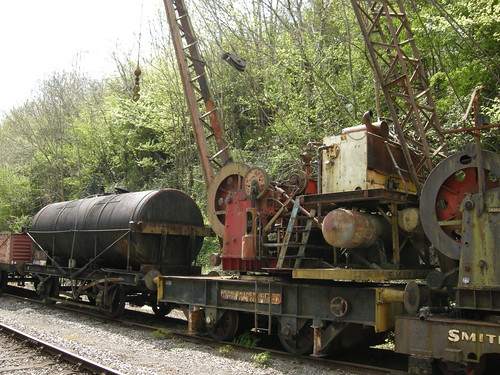
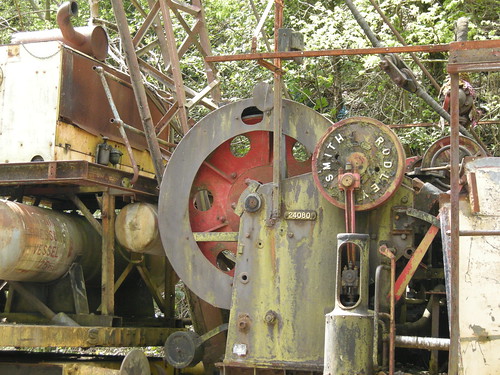
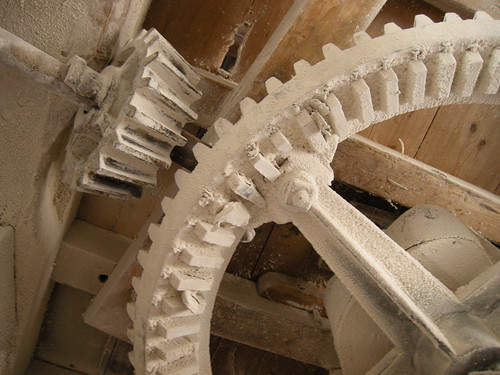
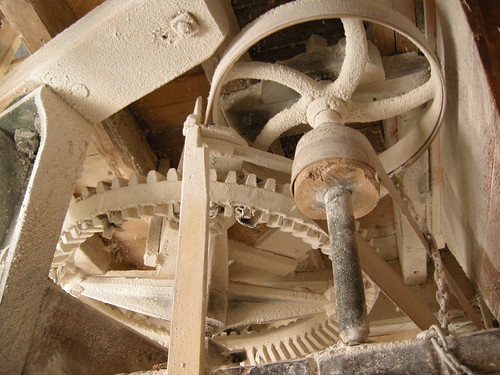
In the meantime I’ve also been doing some exploring of old railway lines and cunning mechanisms.

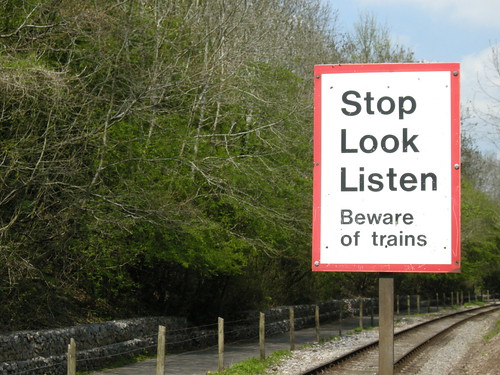
Stop. Look. Listen.

Machinery!

Machinery!

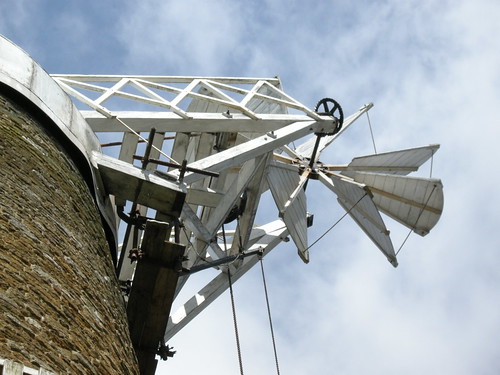
mill pr0n

mill pr0n

mill pr0n

mill pr0n

There is a shipwreck…

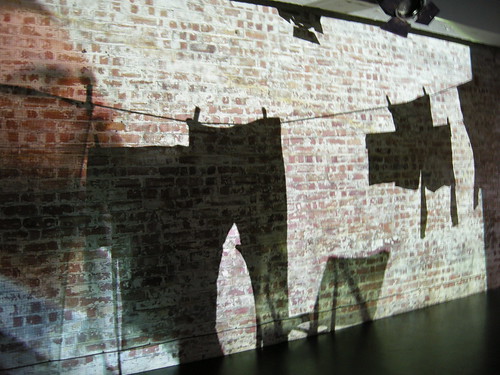
A few days ago I spent the day down in London with Lisa May Thomas at the Chisenhale Dance Space. Lisa’s been in residence there developing a version of her piece There is a shipwreck in my bones.

Shipwreck in my bones

I was invited to get involved after Lisa heard me talking at the Pervasive Media Studio last year – she liked the combination of technology, sculptural materials and the sense of movement within my projects.

So, having already armed her with a selection of wax pods, on Sunday I filled a large rucksack full of microcontrollers and sensors and headed over to see what I could add.

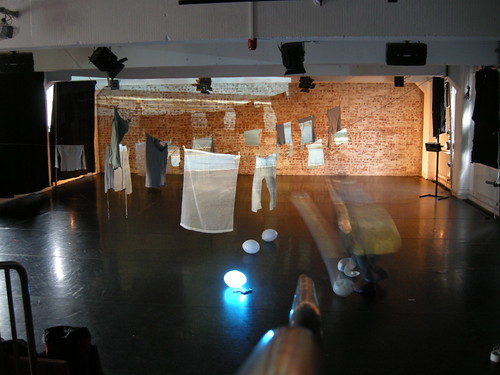
Lisa was already experimenting with projecting onto different surfaces, including the pods which resulted in a really nice scale and distorted image.

Shipwreck in my bones

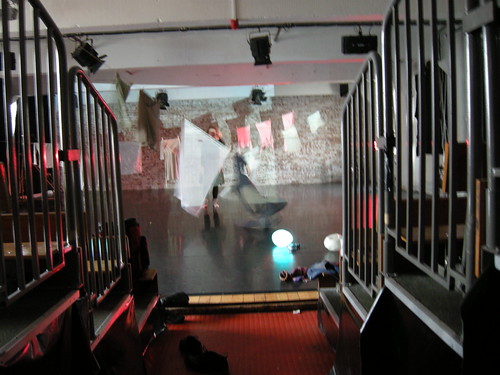
I made some systems for colour shifting some LEDs in response to inputs of touch and distance. I also grabbed some snippets of the audio accompanying the piece and rigged up an ultrasound trigger in the passageway leading through the seating tiers to the performance area (Shipwreck is to be a promenade style experience where the audience moves freely around the auditorium, making discoveries along the way.

Of life.

Of death.

Of sea.

Shipwreck in my bones

What was really interesting though, was the process by which I decided to not include any of these. Putting circuitry in the pods limited the way they could be carried and the sense of otherworldliness. The effect of the proximity sensor in the corridor could so easily be replicated with an mp3 player for a fraction of the stress and uncertainty in my absence (I was only there for the one day).

In the end it may be that the one make I have contributed to the eventual realisation of the performance is a scrunched up soaked piece of brown paper.

Sometimes that’s just the way it should be.

Shipwreck in my bones

Curzon Street GPS traces at Re:Call

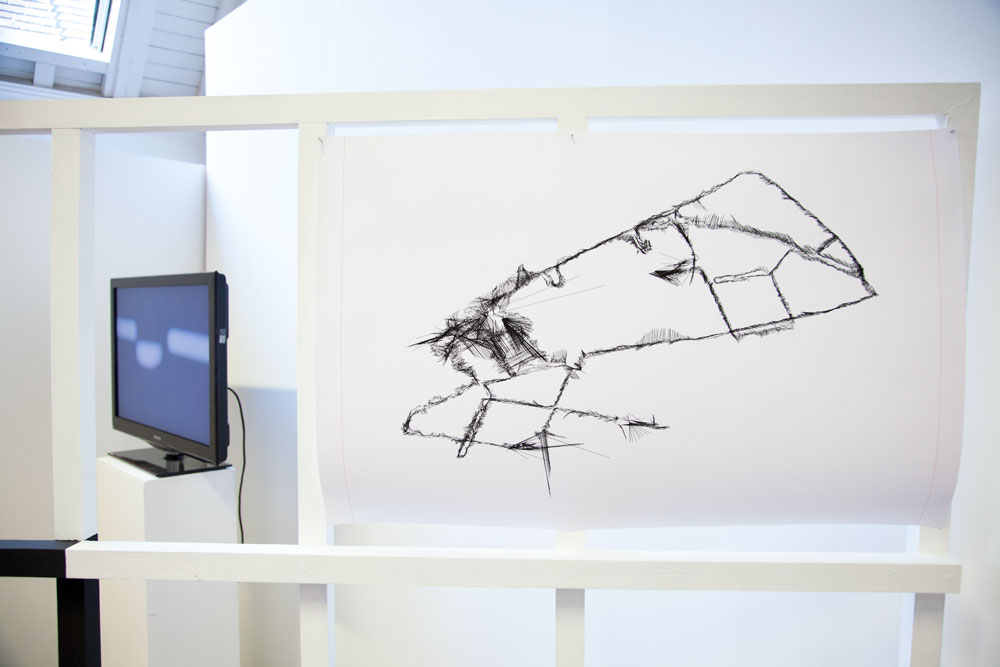
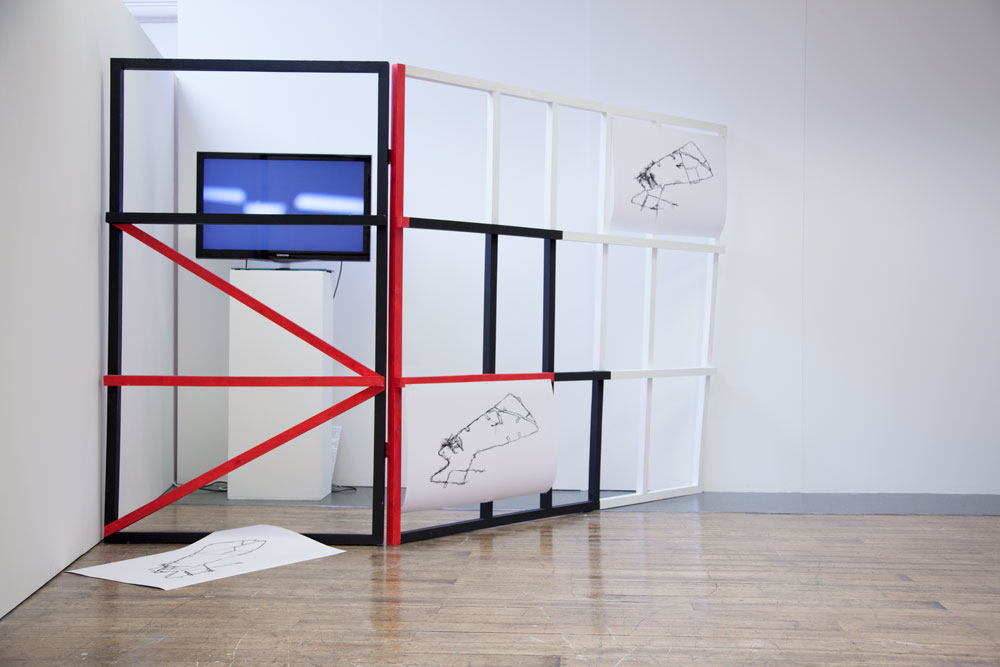
The 3 composite GPS ‘fingerprints’ I have so far made from repeatedly walking around one of Birmingham’s ‘Eastside’ regeneration areas (the smaller, AWM one) have recently been exhibited as part of Re:Call at Bournville School for the Visual Arts.

Qualitative and Quantitative Data, 2011a (After the multistorey car park had been built, but before the roads had been closed.)

Re:Call is a rolling exhibition of work by graduates from the BA and Foundation courses that have been based at the site.

Re:Call in turn is part of ‘Art has left the building‘, a multi-strand project curated by Amanda Grist to commemorate and celebrate Bournville School of Art in the lead-up to its closure in July 2013.

Whilst the Re:Call exhibitions have mostly been aimed towards the Bournville community, on Wednesday March 20th there will be a public closing party at Ruskin Hall – all are welcome to attend.

3 – 6:20pm, Ruskin Hall, Bournville Centre for the Visual Arts [map]

The event also doubles as part of the fundraising activities for this year’s graduating students – this means there will be drinks and cake available to buy!

3 Bridges in Libre Graphics Magazine

When I was in New York in 2011, I made a few new pieces of work using my GPS difference technique. One of these was 3 Bridges, made by collecting the GPS data as I walked across the bridges that connect the Southern tip of Manhattan to Brooklyn. From North to South, these are the Williamsburg Bridge, the Manhattan Bridge and the Brooklyn Bridge respectively.

Each of these bridges is a completely different experience to walk across – you may be in a tunnel of iron girders, alongside busy subway tracks or out in the open with a criss-cross of suspension cables rising above you. The different characteristics of the the bridges are reflected in the different GPS ‘fingerprints’ shown by the lines in the drawing.

3 Bridges

3 Bridges has been reproduced in Issue 2.1 of Libre Graphics Magazine (entitled Localization/Internationalisation).

We react to regional differences, as well as efforts at internationalisation, in varied ways. In a world that has become increasingly globalised, we may hope for ways to communicate more effectively with others, or we may cherish our own regionally-specific terms and ways. We may create habits and classification systems which help us to trade knowledge and understanding with others, or we may take refuge in personal eccentricities.Editor’s Letter: Localisation and internationalization, ginger coons

I was given a sneak peek at the print copy a few days ago and it’s a lovely piece of work. You can order your copy from http://libregraphicsmag.com/ or you can download pdf versions to view or print yourself.

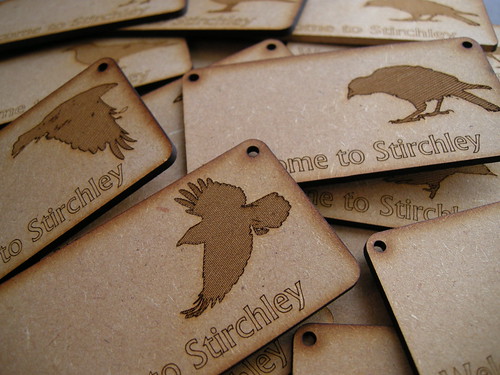
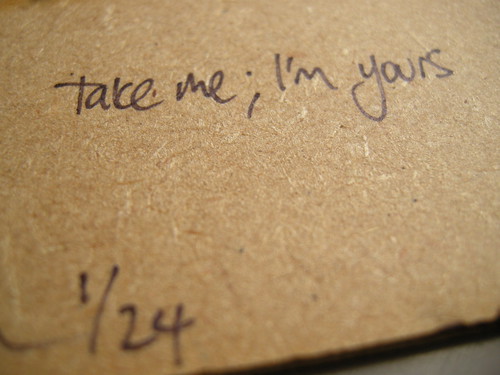
Welcome to Stirchley (Take me; I’m yours)

Limited edition laser-cut plaques for those who know where to find them.

Welcome to Stirchley

Welcome to Stirchley


Copyright and permissions:

General blog contents released under a Creative Commons by-nc-sa license. Artworks and other projects copyright Nicola Pugh 2003-2026, all rights reserved.
If in doubt, ask.
The theme used on this WordPress-powered site started off life as Modern Clix, by Rodrigo Galindez.

RSS Feed.