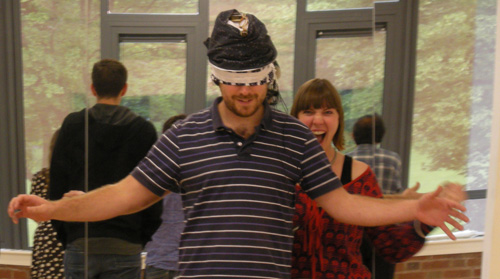
Ant trying out the sonar goggles at fizzPOP yesterday. He said he had very good spatial awareness and could tell where he was in the room, this video was a little experiment with his awareness of where I was.
(If you listen carefully you can hear the different beep patterns the goggles make depending on how close things are to them.)
Following on from last week’s pervasive games lab, some or all of Hide&Seek, Fierce and/or Screen West Midlands awarded me a grant to develop the sonar stuff into a game to be played at the Sandpit event at Warwick Arts Centre this Saturday. (Not quite sure who to thank, but thanks!)
So, it’s been full steam ahead to turn the whale hat prototype into something that will survive a game. Several games. Maybe some of them outdoors in the British summer…
For various practical and arty reasons, the hat has been replaced by goggles. For financial and logistical reasons, the ArduinoRBBB I used in the prototype has also been replaced by a bare bones equivalent on stripboard.
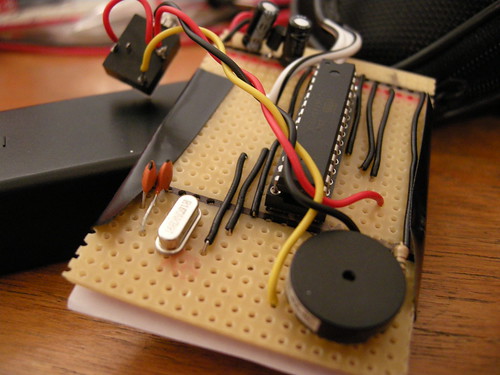
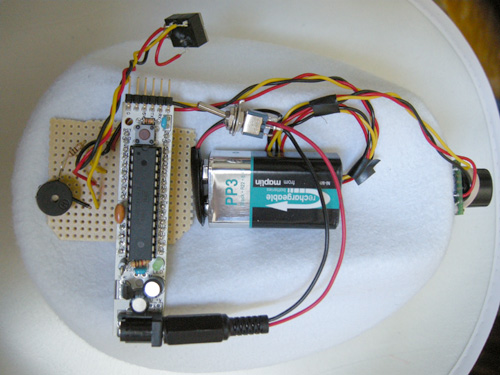
Here’s the finished circuit, the goggles and the first unit being user tested…
There’s still a lot of soldering, spraying and sticking to be done to get ready for the weekend, but several people have used the googles now and I’m really pleased with the result. Join me at Warwick Arts Centre from 6pm this Saturday to experience the game – which is undergoing a similar evolutionary process!
At yesterday’s game lab (a team effort from Fierce, Screen West Midlands and Hide&Seek) I finally got a chance to try out the whale hat I’ve been making. By which I mean I got other people to try it out!
Andy gets to be whale for the first version of the game, unaware that krill Laura is trapped between him and the mirrored wall behind!
The whale hat was conceived in response to Hide&Seek’s call for games relating to the theme of ‘international‘. I wanted to develop a game based around the idea of epic whale migrations, where the person playing the whale navigates around the game space using echolocation.
The electronics that power the whale hat.
Using a sonar range-finder commonly used in robotics, I hooked it up to a RBBB running Arduino code that generates different patterns of beeps depending on how close objects are in front of the hat-wearer: a continuous loop of 4 beeps when there’s something within 50cm; 3 beeps when there’s something within 1m, 2 beeps, 1.5 metres etc
During the game lab I first got a chance to try out the experience of wearing the hat (complete with headphones and blindfold) and then I roped in the other attendees to help me try out some simple game mechanics. The sorts of things I had written down in my notes as things to explore were “finding objects”, “avoiding objects”, “detecting stationary objects” and ” detecting moving objects”.
Kind of a slow-moving version of the arcade game space invaders: the whale (in the hat) can move from side to side and has to try and ‘catch’ the krill (other players) who are approaching steadily.
If I were to try this again, I might try and set the krill off on their journeys with bigger intervals between. As it was though, this was a beautiful visual spectacle with the gradual advance of the krill contrasting nicely with the clumsier movements of the whale!
This time the krill remained stationary and the whale had to move around trying to locate them.
We talked about what might be motivating the krill (we found ourselves using many phrases we hadn’t anticipated using that day!) and also identified that we kind of needed to justify the sonar more. For example, it would have been possible for the whale to have caught the krill just by walking up and down and waving their arms around at random. We also toyed with the idea of limiting the number of grabs per game.
Although the krill aren’t doing much during the game, I love how you can see all the different emotions they’re (silently) going through!
Trying to give the krill a role that couldn’t be performed equally well by a chair. Now the krill are allowed one step per click and have to gather as many plankton (small pieces of paper) as possible whilst avoiding being caught by the whale.
A shift from object detection to object avoidance. Now we’re justifying the sonar and it’s starting to feel more game-like!
The whale has to avoid the er, the whatever they are. The other players are probably no longer krill, but in the absence of any other term we ended up calling them nuclear krill to signify that they were something not very nice.
The whale’s objective is to get from one end of the playing area to the other.
The nuclear krill are trying to block the whale’s progress. They are allowed one step per clap (approximately every ten seconds) and can move across the playing area, but not up and down it.
We also tried a variant of this where the nuclear krill could only move across, until the whale had passed them, at which point they became locked in to a ‘vertical’ line and could then only move up and down. This change was made to try and prevent redundant nuclear krill. Bad things happen when nuclear krill get bored…
If I can get to the stage where I can build a few more whale hats then the next thing I want to try is having multiple whales. We discussed how having one whale trying to get from A to B at the same time as another whale trying to get from B to A would make things more of a challenge for the nuclear krill and would also reduce the problem of redundancy.
So…
Overall I’m happy with the experience of being the whale (another one of those unanticipated phrases!). I like the combination of vulnerability with the almost super-hero power of being able to see by sound.
I love the spectacle of the game as seen by an audience. All of the versions we tried worked well at this and I think slowness and silence could be a really nice contrast within a busy event environment where this could eventually end up.
That leaves the krill. How can I make life for the krill more interesting?
Just a quick note to say that, although things may seem a little quiet around here in terms of my own personal projects, many exciting things are happening over at fizzPOP (the hackerspace I’ve been co-running with Antonio Roberts.)
If you’re interested in collaborative learning or creative use of technology, then you should check it out:
We meet on a fortnightly basis at The Edge for our informal hacksessions at which you can just pop in, have a mooch and/or work on a project (we can always find stuff for you to get involved with if you’re a beginner).
This year we’ve also been ramping up the volume with a programme of workshops and events. The next of these will be Theremin Day as organised by Sam Underwood (also featuring in the video above!).
This is an opportunity to see one of the nation’s most renowned Theremin players. She has trained with Lydia Kavina, the grand-niece of Leon Theremin, and performs in many genres from classical to surf-rock to industrial. She has given numerous performances and recordings for artists including Bob Moog, Damien Hirst and TV appearances include “James May’s 20th Century” and “New Paul O’Grady Show”. In 2009 she performed on the fourth plinth, Trafalgar Square, as part of Anthony Gormley’s “One and Other” project and in April 2010 she will perform at Ether Fest at Royal Festival Hall in a 20-piece Theremin orchestra.
Mr. Underwood & Friends
Yes, me! I’ll be doing a super rare performance of Steve Reich’s Pendulum Music, using four torches and four Optical Theremins (of the same kind made in the afternoon workshop). The performance will be in darkness and will peak in a cacophony of squealing sound.
Pete Ashton
Pete will be wowing us with his Thingamagoop (see video below) and some 8-bit sounds. He will also be collaborating with Ms Hypnotique and myself in an improv session.
In May fizzPOP will be in residence at independent artist studios The Lombard Method for an intense two weeks of workshops and making of stuff, 1st – 16th of May. Stand by for more details of how you can get involved with making contraptions and contributing to blinky light extravaganzas!
There’s loads more in the pipeline too, with the British Science Festival in September, exciting partnerships with Aston University Eng Soc, robots, Arduinos and dorkbotbrum. No surprise then that we’ll be moving to weekly hacksessions after Easter in order to try and fit in everything that we want to do!
a two day workshop event … for museum professionals who are interested in innovative new ways to energize audiences and create more engaging experiences for museum and gallery visitors.
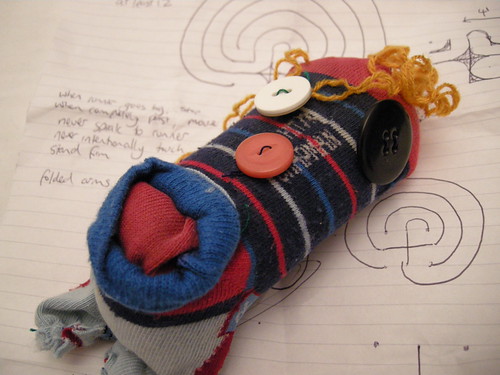
We made sock aliens; constructed quilt panels from Action man clothes; killed virtual spiders; and made Frisbees out of milk bottles (of the plastic variety).
It wasn’t long though before we were down to the serious business of the 7 Wild Ideas that had been submitted to the conference as the case-studies we would work on.
I joined the Exhibition Gaming team in response to Daniela Bauer’s vision of museum visitors being pawns in a game. Unlike some of the other Wild Ideas that were very much linked to specific contexts faced by particular institutions, Daniela was approaching this as a Psychology researcher and so our discussion was in general terms rather than attached to a particular location or design brief.
That didn’t stop it from being very in-depth though.
I first came across some of the awesome participatory work being done by museums via people from the sector involved in games such as Superstruct and Signtific Lab. Although I’ve as yet had no direct experience of working with museums, the discussions I’m reading coming from this direction have definitely inspired and influenced my thinking regarding participation. I therefore attended MuseumNext expecting to be out of place – in a good way – and expecting to learn loads.
I was and I did! Hurrah!
I’m fairly sure we didn’t answer any of Daniela’s initial questions, but in exploring them we came up with about 20 new questions. These questions were quite wide-ranging, but also with a significant amount of overlap. We were originally trying to work towards a framework for designing a museum-based game, but I think what we may have ended up with was more like a framework for institutions to start putting together a design brief for a potential game.
Collaboratively-made sock alien
The second day of MuseumNext started off with a very interesting presentation from Nina about participatory museums, after which we had two un-conference sessions. Incentivised by the prospect of being able to take a sock alien home (he needs a name, btw) I had offered to run a practical Lost Sport of Olympia session.
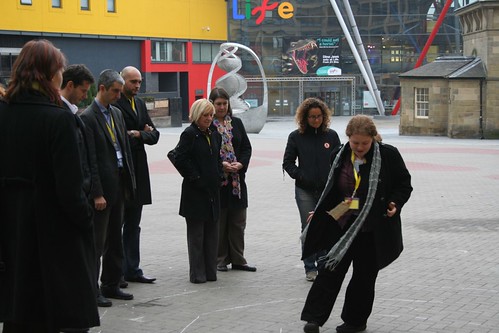
Although the people in our Wild Idea group had some great ideas about doing interesting stuff in interesting places, not many of them seemed to have had any experience of being on the receiving, playing end of such things. I thought the best thing I could offer was to give them a chance to actually feel what it’s like to be in a group of strangers doing something a bit odd in a public place. I asked for chalk and permission to temporarily deface the forecourt of the Centre for Life and got both.
So, I missed the first of the un-conference sessions because I was outside figuring out how to draw a couple of labyrinths without the usual marked-out length of string. Fortunately the ground was paved with bricks so I was able to use a combination of counting them and using my shoes to measure out radii.
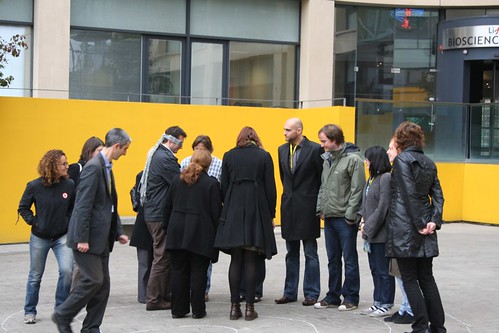
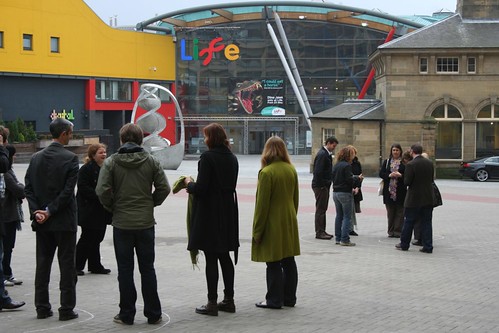
It was well worth the effort – a good group of people decided to brave both the weather and the public gaze to come outside and play for the second un-conference session.
Action shot of me explaining how it works (photo from MuseumNext on Flickr)
A brave volunteer gives it a go (photo from MuseumNext on Flickr)
Things get competitive as we split up into two teams. (Photo from MuseumNext on Flickr)
After the un-conference sessions wrapped up, we reconvened our Wild Idea groups. Daniela had identified three parties that she wanted to investigate their motivations for getting involved in museum gaming: the institution, the audience and the urban gamers (there was a little confusion over this, but I think she meant the game designers, rather than players already in pervasive/urban gaming communities). It was really useful to examine these three groups and see where their motivations overlapped and where they differed.
After that we returned to our big list of questions and, working in threes, we tried to answer a few each. Again, I learned loads from this.
I’ve been working with game mechanics both in my own work (for example, Emergent Game and the Bournville scavenger hunt) and also through BARG for a year or two now, and I’m keen to start applying some of my skills to some issue-led contexts. I want problems to try and address!
I gained a lot through speaking with museum (and psychology!) professionals of all sorts and it has really helped me to better appreciate the sorts of issues institutions might be trying to address through the use of games and playful experiences. Also what the main concerns they may have in doing this and where likely pitfalls may be.
A massive thank you to all the MuseumNext team and all the participants: I have a feeling that the effects of this one will be reverberating around for quite some time to come.
A few weeks ago, one @kitlarks (who I don’t know) appeared on Twitter, apparently having been blackmailed to sign up in order to receive a huffing duck from, I believe, @EmmaGx (who I don’t know either).
I don’t really know what the deal was, but it appeared to involve signing up, a certain number of posts and an uploaded avatar in exchange for a drawing of a huffing duck. This seemed to me to not be a Twitter-like way of approaching things.
Anyway, one thing led to another (not exactly crowd-sourcing, I know, but an interesting exercise nonetheless) and a collaborative huffing duck was incrementally produced in a vaguely exquisite corpse-esque manner. Ok, not exactly exquisite corpse either…
You can see the animations of the cumulative contributions here: 1, 2, 3, 4, 5, 6, 7, 8.
As you can see, the internet badgers ate the huffing duck during the process of adding the head at stage 8. Unfortunate, but if you look carefully there’s a nice after-image huffing duck in glorious Technicolor burned onto your retina, and that’s perhaps as it should be.
I’m not sure what happens to the huffing duck next: whether it fades to white, or whether it will be resurrected to continue its evolution. In the meantime however, this post is by way of setting aside a small slice of cyberspace to say that a huffing duck happened and it happened because of these people (alphabetical order):
We are the Interstitials is a metaphor based on principles of interstitial solutes in metals.
We are the Interstitials:
We are smaller than the structures around us. We inhabit the gaps the host matrix cannot occupy itself.
Our small size gives us speed and responsiveness and though the sites we may occupy are ultimately determined by the host matrix, we are mobile and select which of the available positions we inhabit.
Our host is rigid; bound to the other similar entities around it in predictable patterns. We are independent; we may cluster around locations or other interstitials, but our interactions shift as required. We frequently move on, jumping between adjacent sites. There’s no problem, it’s just how we are.
Our host may regard us as defects, but though our numbers are small, our effects are wide-reaching and can drastically change the properties of the matrix we operate within. The energy-fields around us, induced by our presence, often make it easy for us to interact with other types of perceived ‘defect’, often impeding their motion or changing the way they in turn affect the matrix.
We are small, we are mobile, we affect. We are the interstitials.
On the 19th of September, players of Call and Return will start to tackle a series of creative missions that will send them out across the city exploring places, materials and the way contemporary culture permeates through them.
The city in question could be Birmingham or Tokyo, Bristol or Kyoto, and as well as negotiating their immediate surrounding, players must also negotiate interactions with other people across different geographies, languages and time zones.
Call and Return is the second in the Emergent Game series: projects that investigate group dynamics, collaborative creativity and the use of digital technologies to adjust how we relate to public spaces.
Missions are not location-specific, so players can be based anywhere: all you need is access to an internet connection, a sense of humour and a soft toy to represent you in the game (we play anonymously).
Instructions on how to sign up can be found here: http://ludogeography.org/projects/callandreturn/
(don’t worry, this is the most complicated bit of the process – it gets easier from here on in!)
To complement activities taking place on-line (once again most of the conversation will take place via twitter.com) there are opportunities to get involved in various events:
Then we pull together the contributions from the workshops and on-line conversations in a weekend of creative missions as part of a festival of pervasive games in Bristol:
It doesn’t matter if you can’t make it in person to any of these events – remote players have an equally important role to contribute. Sign up now to join the conversation and influence the directions the game goes in. For a flavour of what it might evolve into, see the Emergent Game website for what happened last time.
Ludogeography
Call and Return is a project initiated by The Ludogeographic Society. The Ludogeographic Society grew from collaborations central to the development of the first Emergent Game earlier this year: Ana Benlloch, Stuart Tait and myself.
To coincide with Call and Return, we are also launching www.ludogeography.org where we will document the activities of the Society. Likewise for http://twitter.com/ludogeography: if you use Twitter follow @ludogeography for updates on what we are doing, or perhaps just subscribe to the RSS feed.
This was an amazing experience in itself, but to turn it into Learning we are doing it again.
Next month Ana and I will fly out to Japan where we will be contributing to the Dislocate08 festival.
Dislocate is an ongoing project examining the relationship between art, technology and locality. Exploring the impact of new media upon our experience and expression of place, Dislocate08 examines the creative potential of the technologies which surround us to heighten our awareness of our locality, transforming our encounter with our direct environment and the manner in which we attempt to communicate this to elsewhere.
Being in Japan also gives us the opportunity to work with hanare: a sort of artist-led space/meeting space/café space in Kyoto. (You may remember the 4649 project.)
On the 8th of September we’ll be doing a workshop at hanare, and on the 13th of September we’ll be doing a workshop as part of Dislocate. We’ll be using these workshops to shape the Japanese component of a long weekend of Emergent Gaming happening on the 19th, 20th and 21st of September. Why? Because Emergent Game has also been accepted as part of igfest (Interesting Game Festival) in Bristol.
So, coming up is the second iteration of Emergent Game in which we’ll be investigating what happens when you have two groups of players exploring places separated by differences in language, culture, geography and timezone.
As some of the players will be in the UK and some in Japan; some having online access and some not; there will be variations in what is possible: part of the game experience will be how your avatar negotiates this. Perhaps you will make friends with a player in another country and barter things with them by post; perhaps you will be a ‘lone avatari’ with a mission of your own; perhaps you will find new spaces online where participants can interact.
We’re still negotiating the starting points for these activities and, of course, the eventual shape of them will largely be determined by those who get involved. But for now the initial instructions from the first game apply to the one coming up in September.
We’d quite like players based in the UK (or elsewhere) to get involved (online) in the two workshops on the 8th and 13th and we definitely want you guys involved in the weekend of the game itself (19th-21st) which is when we’ll be running the mission challenges. The way we see it working is that you now have a few weeks to find a toy to represent you, set up a Twitter account for it and to start some conversations with other players. Be sure to set the location in the Twitter settings to “emergent game” and to follow the likes of @yohmoh and the other soft toys located in emergent game. The rest will take care of itself.
This headstart will substitute for the workshops we’ll be doing with the players in Japan, so use this time productively…
The Ludogeographic Society
During the course of the first Emergent Game, a new collaborative group was formed between myself and two other artists I worked very closely with to realise the project: the aforementioned Ana Benlloch and also Stuart Tait. The Ludogeographic Society will be an identity we will use for future collaborations that explore similar territory to Emergent Game so this upcoming game will be realised as a project under the name of the Society, rather than under my name alone.
We’ll let you know when The Ludogeographic Society’s website is up and running, but in the meantime announcements will be made here and via the usual channels.
All theotherstuff that happened as part of the Hide&Seek festival was great, but the highlights of the day for me were what happened after the festival had officially finished.
The hardcore gamers loitered around for half an hour or so, not yet ready to concede that it was time to wrap up and go home. A few people were constructing a board game from rules appropriated from different parts of the festival, the stewards were starting to take down the banners and one of the iglab Simons was pootling around on a little orange bike…
Then somebody suggested KerPlunk and half a dozen of us huddled in the corner playing with straws and marbles. One round of KerPlunk (Just for the record, Simon and I won!) was enough to bridge the transition and then suddenly everyone was properly back into game-playing mode and it was clear none of us would be going home just yet.
Gype
I also remember that it was we who invented the well-known and widespread national game of Gype. All sorts of variations and complications were invented in connection with Gype. There was Land Gype and Water Gype. I myself cut out and coloured pieces of cardboard of mysterious and significant shapes, the instruments of Table Gype; a game for the little ones. It was even duly settled what disease threatened the over-assiduous player; he tended to suffer from Gype’s Ear. My friends and I introduced allusions to the fashionable sport in our articles; Bentley successfully passed one through the Daily News and I through some other paper. Everything was in order and going forward; except the game itself, which has not yet been invented. Autobiography_(Chesterton)/Chapter_X
Simon had been proposing a motion that we played Gype since before KerPlunk and, after explaining a bit about the rules (not dissimilar to those of Mornington Crescent), that now took off.
I also had to take off at this point because I desperately needed to take on board more fluids. When I got back from the bar the game was in full swing with 2 pieces of A5 paper, three dice of a sort that I didn’t recognise and the counters from a chequers set.
I haven’t got any photos of this first round of Gype – I was too busy tending to my drink – but you’ll just have to take it from me that it was an awesome thing to watch. These were people who take playing very seriously indeed, given free reign to make it up as they went along. Dare I say there was an element of competition there too…?
Watching it, there was no way you could tell that it was being fabricated on the spot. At one point one of the players drew a distinction between Land Gype and Water Gype in such a matter-of-fact way that I had real difficulty in sorting out fact from fiction. Seriously: probably not until an hour or so later …and now I see the two different Gypes are mentioned in that quote above. Now I don’t know what to think!
I finished my drink and got re-absorbed into the group of players. Another strange position to be in as you try and dream up a creative move for your turn, but the landscape keeps shifting so much after the moves made by previous players that it becomes all but impossible to do anything but wait and then react spontaneously when it’s your go. I found out later, via Jane’s post, that this had been designated a game of Speed Gype. I’m not sure if this was just a follow on from the Speed KerPlunk we had been playing before, but it’s a really nice tweak to keep the pace up and get the creativity flowing nice and fast without too much analysis.
As it happens, I was just planning how I would see if I could score some points by throwing the dice at each of the three counters in the central triangle formation when Simon, the player before me, used a tablecloth move.
Our reaction was similar to that in the video and, to an enthusiastic chorus of “GYPE!” Simon was declared the winner.
Fort Gype
Turns out Speed Gype was just the warm-up.
We then moved over to a court that had been marked out on the floor earlier in the festival (possibly for freemasons) and Fort Gype began.
Fort Gype follows the same sort of rules as Speed Gype, but utilising the cool Southbank Centre squidgy furniture to (we assumed) build a fort. Spectators from the last game joined us as players so we were probably up to about 20 players now.
The opening moves were fairly straightforward placements of the furniture, with the occasional “lock-in” move thrown in for good measure.
Things got more interesting once there were more things to respond to. [How about starting a game of Fort Gype with randomly rolling a few items onto the ‘board’ to kick-start this process?] I was about 10th to make a move and, with my lime green seat-like-thingy I opted for an ‘entrapment’ move with one arm pinned under the furniture. Seemed like a good idea at the time, but the way things worked out I had an increasingly restricted view of what was going on!
From my not-so-much-of-a-vantage point I tried to take a photo every move. You can see the results here on this Flickr photoset.
As the play progressed we started to build upwards and more and more people added themselves to the structure. I think this would be a really good aspect for Fort Gypers to investigate further: I mean, if you’ve got a bunch of people with squidgy furniture it’d be a shame not to incorporate more bodies, right?! OK, OK thinking like that blatantly goes against the fundamentals of Gype! Still, I would have liked to have played a few rounds to see how things got refined.
Eventually the inevitable happened and the tower collapsed: thereby signalling the end of the game. This was good because then we didn’t feel so bad when the member of Southbank staff came over and informed us how expensive the squidgy furniture was and, sorry to be the bad guy, but would we mind stopping abusing it please…? Fair enough!
The third bus
There was no escaping it: the festival had drawn to an end and it was time to relocate. After a lot of conferring the general plan seemed to be food and then more games. Several people stated the need for showers before anything else happened and so we arranged to meet an hour later in the middle of Westminster Bridge. By this stage we knew that locating food was not going to be a straightforward matter and would involve getting on the third bus and then, whilst on the bus, figuring out the rules that would allow us to then get off the bus…
I told you these were hardcore gamers.
The last train
Unfortunately for me, the last train back to Brum on a Sunday is horribly early so I had to say my farewells before everybody had even reconvened on the bridge.
Whilst the others got up to whatever banana-assisted adventures their journey took them on, I had my own trials awaiting me: “the train is to long, can you all move forward a carriage please”; delays in leaving Marylebone; the train in front hitting livestock…
Sat in the foyer of Banbury railway station waiting for the replacement coaches to arrive at 1am felt so incredibly desolate compared to the atmosphere I had left a few hours before. The stark difference in attitudes between the pissed-off travellers and the Stag-chasing gamers was huge.
I wanted to suggest a game of Gype or Werewolf, but thought I’d get lynched. For real.
My main area of enquiry is centred around interactions between people and place: often using tools and strategies from areas such as pervasive games and physical computing to set up frameworks for exploration.
If you'd like to commission me or collaborate with me, please get in touch via the contact page.
General blog contents released under a Creative Commons
by-nc-sa license.
Artworks and other projects copyright Nicola Pugh 2003-2026, all rights reserved.
If in doubt, ask.
The theme used on this WordPress-powered site started off life as Modern Clix, by Rodrigo Galindez.