Following on from the recent playtest at Warwick Arts Centre and feedback from the players, I’ll be making some changes to the rules and I want to test these out before unleashing the new iteration on the Weekender crowd.
If you’d like to get a sneak preview of the new game and also a chance to try out the sonar goggles I’ve been making, come along to the mac at 4pm on Saturday for a playtest.
You’ll be able to find me in the Terrace Gallery with a host of games people at the bargmeet, once that’s finished we’ll head outside into Cannon Hill Park for an hour or so to try out some Bloop variations.
All are welcome, although don’t expect a full run of the game – this’ll be more about little experiments and tweaking variables. The video above gives you a good idea of what sort of thing to expect though.
It’d be really useful if you could let me know if you’re intending to come along – that way I can bring along an appropriate amount of kit.
See you there! Terrace Gallery (by the stairs) 4pm, moving out into the park until about 5pm. We’ll be the ones with the whales on our heads.
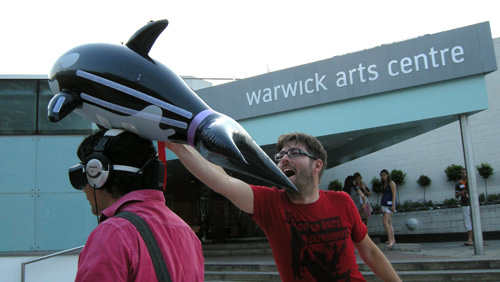
Warwick Arts Centre: where we discover krill have surprisingly long reaches...
Following on from the initial lab and adventures with electronics, it was time to test evolved game The Bloop with some players and see how it was shaping up as a fun thing to play and entertaining spectacle to watch.
I think we did alright!
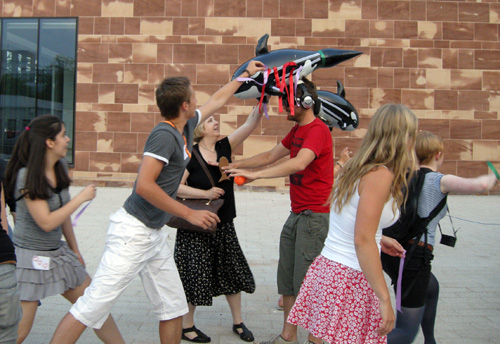
2 krill tag a whale after getting it on a classical pincer movement
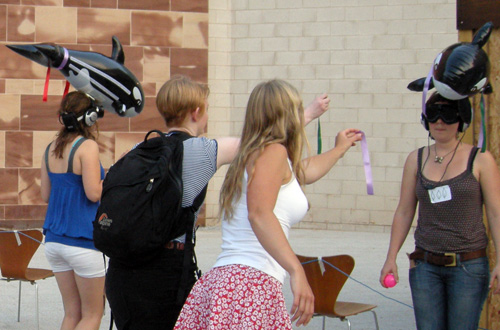
Krill await a whale about to leave the exclusion zone around the breeding waters
I had several people approach me as I was preparing for the game saying how much they were looking forward to playing it. When asked why, the answers usually related to the ridiculousness of it and how much fun it looked. Considering the game hadn’t been played anywhere yet I consider this pretty good going!
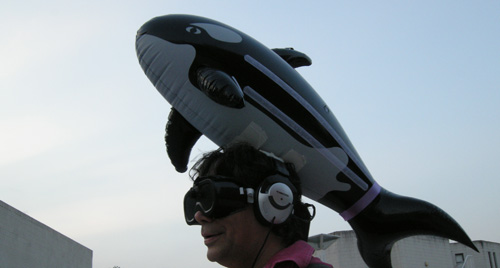
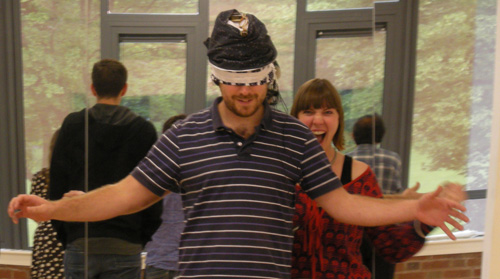
Bloop headwear: perhaps a contributing factor to perceived levels of ridiculousness... (photo courtesy of Marie Foulston)
There were a few issues with a wave of exhausted batteries for the music, but other than that the tech worked well, with only one on-and-off-again required for the sonar goggles. We’re oh so nearly there with the game design but all the major ingredients are in place and what remains are tweakings rather than re-thinks. A big thanks to everyone for their feedback and also to Hide&Seek and Fierce for hosting.
I didn’t get much of a chance to stand back and observe, but I shall leave you with a few short videos to whet your appetite for further iterations of the game. I’m talking all over the second one I’m afraid, because two security guards came up and asked me what was going on and then were curious to find out more. Job done!
If anyone’s got any photos or video from the game that they’d like to share, I’d be very grateful. Give me a nudge with a link in the comments or send me a message.
In practical terms, what this means is that you can come to Warwick Arts Centre (at the University Of Warwick in, er, Coventry) for 6pm and take part in a whole host of games and playful things, for free!
Sonar goggles
The Bloop (set in the deep ocean off the coast of Chile) will be the first public outing of the sonar goggles I have been developing. If you are playing as a whale, you will be using these goggles to navigate the playing space by sound rather than by sight.
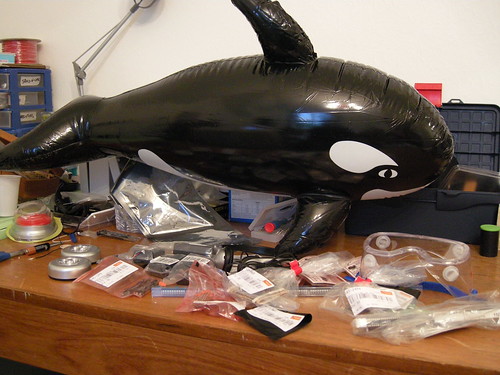
There will also be colourful ribbons, inflatable whales and bothersome krill.
Hope you can come and join us for an evening of fun and challenge!
Extremely loud and low frequency, this noise defies explanation. Scientists have yet to identify its cause: we have no knowledge of a creature large enough to make a sound of this type.
Whatever it is, it’s still down there.
Welcome to 50°S, 100°W.
Whales traverse the deep waters off the coast of Chile on their seasonal migrations between breeding grounds and feeding grounds. Relying solely on their instincts and use of sonar to navigate these murky depths, the whales nonetheless perceive that something a little odd is going on around here.
The krill here – normally a tasty snack for the whales – seem motivated with a strong sense of purpose. When The Bloop calls to them they move in unison in a way the whales don’t quite understand and yet intuitively understand should be avoided…
Ant trying out the sonar goggles at fizzPOP yesterday. He said he had very good spatial awareness and could tell where he was in the room, this video was a little experiment with his awareness of where I was.
(If you listen carefully you can hear the different beep patterns the goggles make depending on how close things are to them.)
Following on from last week’s pervasive games lab, some or all of Hide&Seek, Fierce and/or Screen West Midlands awarded me a grant to develop the sonar stuff into a game to be played at the Sandpit event at Warwick Arts Centre this Saturday. (Not quite sure who to thank, but thanks!)
So, it’s been full steam ahead to turn the whale hat prototype into something that will survive a game. Several games. Maybe some of them outdoors in the British summer…
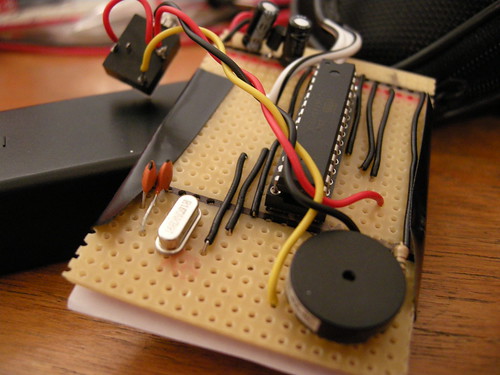
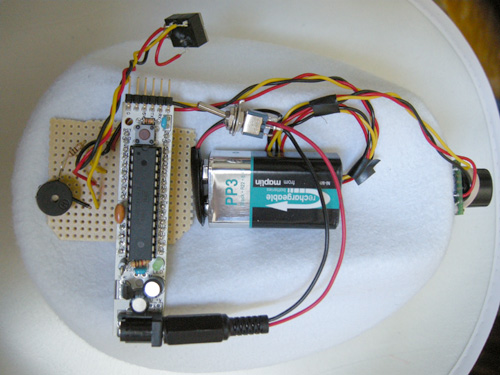
For various practical and arty reasons, the hat has been replaced by goggles. For financial and logistical reasons, the ArduinoRBBB I used in the prototype has also been replaced by a bare bones equivalent on stripboard.
Here’s the finished circuit, the goggles and the first unit being user tested…
There’s still a lot of soldering, spraying and sticking to be done to get ready for the weekend, but several people have used the googles now and I’m really pleased with the result. Join me at Warwick Arts Centre from 6pm this Saturday to experience the game – which is undergoing a similar evolutionary process!
At yesterday’s game lab (a team effort from Fierce, Screen West Midlands and Hide&Seek) I finally got a chance to try out the whale hat I’ve been making. By which I mean I got other people to try it out!
Andy gets to be whale for the first version of the game, unaware that krill Laura is trapped between him and the mirrored wall behind!
The whale hat was conceived in response to Hide&Seek’s call for games relating to the theme of ‘international‘. I wanted to develop a game based around the idea of epic whale migrations, where the person playing the whale navigates around the game space using echolocation.
The electronics that power the whale hat.
Using a sonar range-finder commonly used in robotics, I hooked it up to a RBBB running Arduino code that generates different patterns of beeps depending on how close objects are in front of the hat-wearer: a continuous loop of 4 beeps when there’s something within 50cm; 3 beeps when there’s something within 1m, 2 beeps, 1.5 metres etc
During the game lab I first got a chance to try out the experience of wearing the hat (complete with headphones and blindfold) and then I roped in the other attendees to help me try out some simple game mechanics. The sorts of things I had written down in my notes as things to explore were “finding objects”, “avoiding objects”, “detecting stationary objects” and ” detecting moving objects”.
Kind of a slow-moving version of the arcade game space invaders: the whale (in the hat) can move from side to side and has to try and ‘catch’ the krill (other players) who are approaching steadily.
If I were to try this again, I might try and set the krill off on their journeys with bigger intervals between. As it was though, this was a beautiful visual spectacle with the gradual advance of the krill contrasting nicely with the clumsier movements of the whale!
This time the krill remained stationary and the whale had to move around trying to locate them.
We talked about what might be motivating the krill (we found ourselves using many phrases we hadn’t anticipated using that day!) and also identified that we kind of needed to justify the sonar more. For example, it would have been possible for the whale to have caught the krill just by walking up and down and waving their arms around at random. We also toyed with the idea of limiting the number of grabs per game.
Although the krill aren’t doing much during the game, I love how you can see all the different emotions they’re (silently) going through!
Trying to give the krill a role that couldn’t be performed equally well by a chair. Now the krill are allowed one step per click and have to gather as many plankton (small pieces of paper) as possible whilst avoiding being caught by the whale.
A shift from object detection to object avoidance. Now we’re justifying the sonar and it’s starting to feel more game-like!
The whale has to avoid the er, the whatever they are. The other players are probably no longer krill, but in the absence of any other term we ended up calling them nuclear krill to signify that they were something not very nice.
The whale’s objective is to get from one end of the playing area to the other.
The nuclear krill are trying to block the whale’s progress. They are allowed one step per clap (approximately every ten seconds) and can move across the playing area, but not up and down it.
We also tried a variant of this where the nuclear krill could only move across, until the whale had passed them, at which point they became locked in to a ‘vertical’ line and could then only move up and down. This change was made to try and prevent redundant nuclear krill. Bad things happen when nuclear krill get bored…
If I can get to the stage where I can build a few more whale hats then the next thing I want to try is having multiple whales. We discussed how having one whale trying to get from A to B at the same time as another whale trying to get from B to A would make things more of a challenge for the nuclear krill and would also reduce the problem of redundancy.
So…
Overall I’m happy with the experience of being the whale (another one of those unanticipated phrases!). I like the combination of vulnerability with the almost super-hero power of being able to see by sound.
I love the spectacle of the game as seen by an audience. All of the versions we tried worked well at this and I think slowness and silence could be a really nice contrast within a busy event environment where this could eventually end up.
That leaves the krill. How can I make life for the krill more interesting?
It’s proved to be very popular, so it’s time to take it out of its prototyping stage and into something a bit more robust.
The version I’ve been using so far runs off a Real Bare Bones Board mounted on a breadboard. It’s OK, but I need to keep checking it all the time to make sure the wires haven’t come out. Not ideal if you’ve got a dozen young children clamouring around to try and guess the hidden knock!
I could move it to perfboard or something similar, but I suspect I’m going to be making several of these in the future, so I’m using it as a project to learn a bit about making Printed Circuit Boards (PCBs).
I then combined this with the power supply from this ITP tutorial on breadboarding an Arduino. And finally added all the switches and gubbins from the original circuit.
Freestanding ATMEGA with additional project circuitry
It worked!
…and was a nice bit of learning too – I feel all empowered now!
Putting it all together. With arrows.
Having ascertained that it wasn’t all going to go fizz or POP, the next stage is to start arranging all the bits into a nice PCB layout.
…And for me to profusely thank Dr Sugden and the Eng Soc students at Aston University who are proving to be top notch fizzPOP collaborators and walked me through this afternoon’s learning. Much appreciated.
In the second of my two interviews this week, I was invited by Whitmore Park Primary School in Coventry to help them look at ways to develop their children’s skills as active learners in mathematics.
With only a day and a half’s notice for the interview – which required me to design and deliver a ten minute activity with a group of pupils – the only sensible thing to do was not only to figure out the content of the activity, but also to embark on constructing a technological doohickie, the workings of which I had no prior experience in! Well, it’s all good learning, isn’t it?!
The things I wanted to achieve through the activity were:
To have the activity pupil-led as much as the restrictions in time would allow.
To use a medium that highlighted a ‘special’ technical skill that I could contribute to the mix – ie something not likely to already be available or in use within the school.
Something that felt to me like it was a genuine activity, and not too much like ‘maths dressed up’.
Something with a bit of ‘wow’ to it.
Riffing of something I had referenced in my application, I decided to do something based on code-breaking, but I wanted this to involve a physical object – one that would respond when the code had been broken. This, I felt, would give me a chance to make something using my hack/electronics skills which, whilst not being up to much in the grand scheme of things, should be adequate enough to impress a 9 year old…
After much searching of Instructables and Hackaday looking for the right combination of inspiration and cold, hard instruction, I decided to work with a system for recognising sequences of knocks in order to open a box. For this I am deeply indebted to Steve Hoefer’s detailed documentation of his Arduino-based Secret Knock Detecting Door Lock, which I only modified slightly to take into account the resources I had available.
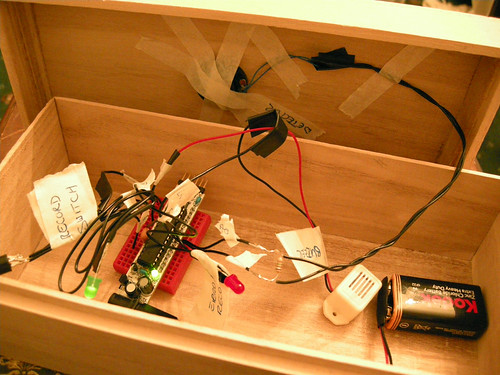
Secret knock box gubbins: components labelled up to facilitate explaining what they were for, free ends of wires labelled up so that they could quickly be replaced in the right row of the breadboard if they accidentally came out...
Since it was only a ten minute activity, I decided to leave the components on the breadboard, rather than permanently soldering them up. It was also for this reason that I was reluctant to drill holes in the box I had acquisitioned to use as the casing. The downside of this being that there wasn’t really much in the way of a feedback mechanism, because the LEDs were not visible. As a compromise, I fitted a buzzer in the place of the door-knob opening motor so that the box would buzz when the correct knock was given. I also implied a lock through the way that I introduced the box and handled it in front of the children.
When it was time for the kids to go into action, I reverted to the now familiar Agent N role and gave them an introduction that indicated that they were a specially selected team of code-breakers and we’d been given a mission to investigate this box.
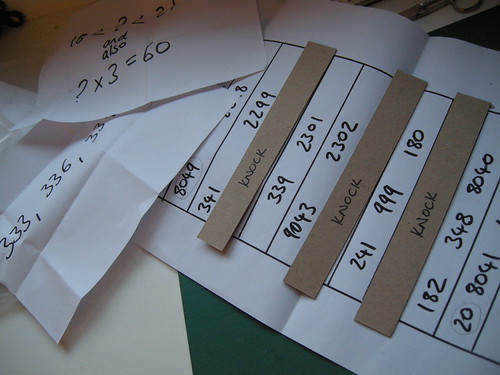
I had some vague knowledge about such things, but I certainly didn’t hold any answers. After telling them they needed to find the secret knock, I handed them two folders containing stuff that might be clues and asked to “please tell me what you think”… I encouraged the children to help eachother out, and also to offer lots of different ideas and hypotheses.
A selection of clues from which the children successfully built up and interpreted a diagram of the secret knock's rythmn.
From there I nudged and guided, seeking to let the pupils make the connections between the different clues wherever possible. We just managed to open the box in time!
The session was a bit slower and lower energy than I had imagined it would be. On reflection I think this was as much to do with nerves and shyness on the part of the pupils (I was the first artist they were interviewing) as much as anything in my control. Certainly the three children who had previously accompanied me on a tour of the school seemed more relaxed and outgoing than the others who had only just met me. The nice moment was when the Deputy Head came back to the room and asked what they had done. The description they gave, with no input from me, was spot-on and showed a sophisticated understanding of the principles involved.
Given the opportunity, I would love to expand this into a much longer activity in which we could solve the initial code, investigate how the box works and then – because obviously the code was too easy – reprogramme it with another knock and get the children to invent ways of codifying that information in an even more fiendishly difficult manner…
My main area of enquiry is centred around interactions between people and place: often using tools and strategies from areas such as pervasive games and physical computing to set up frameworks for exploration.
If you'd like to commission me or collaborate with me, please get in touch via the contact page.
General blog contents released under a Creative Commons
by-nc-sa license.
Artworks and other projects copyright Nicola Pugh 2003-2026, all rights reserved.
If in doubt, ask.
The theme used on this WordPress-powered site started off life as Modern Clix, by Rodrigo Galindez.