February 28, 2016

Playtesting for loneliness

Following on from our first experiments a few weeks ago, on Friday we (Tarim and I) ran a short playtest of the system we’ve been developing to measure what will eventually become the extent to which the critters are connected to the rest of the Colony.

25276557435_ae57807271_z

24908890549_833b7e4909_z

I built the circuits from before into some tupperware containers in order to make them more suitable for being jollied around the city centre, and we added a feedback system of heartbeats to indicate how panicked (lonely) the critter (tupperware) was feeling. If the critter became so removed from the rest of the group that it was no longer able to receive the radio signals from any of the other critters, then the heartbeat reach a ‘hammering’ state – something it could only sustain for 23 seconds before the critter died. So, if your heartbeat gets that fast, you have to quickly find someone from your Colony. Really quickly.

We repurposed the LEDs from before into ‘lives remaining’ indicators and also built in a mechanism by which dead critters could be reincarnated so they could rejoin the playtest: once dead, if you could surround yourself with enough colony members you would be revived. Only up to 5 times, though.

24980953090_1f9096f595_z

Our first group was given the task of making their way to the centre of Millennium Square whilst making sure they had exactly four lives remaining when they finished their journey.

25158301802_e94a00a255_z

24980948960_f4943a28d0_z

There was an interesting split in the group nearly immediately, but we did manage to reconvene in the square and reincarnate those who needed it.

24646003484_7ef3284711_z

The second playtest involved a slightly longer walk over to Castle Park. In order to seed a few conflicting dynamics within the group, we gave different people different target numbers of lives to end up with.

24908871809_e0e6b4c4d8_z

I think I had only one spare life for the whole journey, so at one point I ended up diving into a lift with one of the other playtesters in order not to get stranded alone upstairs in Watershed.

25250360246_d1902bc69e_z

This longer challenge had a coulple of distinct phases to it: initially our tendency was to walk together in clusters, chatting, however as we drew closer to the park and people realised they still hade lives to lose, things got a bit more interesting, with people dashing down side streets, crossing over to the other side of the road or making a quick dash for the church.

Some of us even finished up with the right number of lives!

25158344232_af5b13bf71_z

The next variant was to allow people to choose the number of remaining lives they were going to aim for. This resulted in some extremes of behaviour as some frantically tried to first die off and then re-join with enough other colony members to reanimate.

25158333492_f54e9e2388_z

I’d donated my tupperware critter to a fresh playtester who had tracked us down at Castle Park, so I was in a purely observational role for the return journey. I really enjoyed a little exchange where someone hid behind a tree, then crept up on someone she knew was trying to lose a lot of lives, preventing them from doing so. Apparently this dastardly life-preserving tactic didn’t go down so well as shortly afterwards both players were spotted sprinting down the road – I assume one trying to get away from the other!

25250312006_29c1871e6d_z

We tried a few experiments in Queen’s Park to see how big the colony could get and then we headed back to the Pervasive Media Studio for a chat and a debrief.

24649782103_00932c4a49_z

It seems the technology mostly worked as expected, so we were able to mostly focus in on the psychology of the experience: at what points did it feel like a game; did the critter’s perception of separation from the group match with your own; how did the task of losing/preserving lives affect your awareness of the location of the rest of the group?

It was a very interesting chat with lots to think about now as we start to move the mechanics closer to what will eventually be integrated with the GPS-based movement behaviour. All looking very promising for a first playtest though, and it was great to see an actual colony moving around the city for the first time!
Processes of identification

As indicated previously, the conceptual base for the project I’m doing as part of my residency at Wolverhampton School of Art has shifted radically over the last few weeks. One of the results of this is that the old title – Ride – now neither seems to belong to this project, nor feels appropriate.

The project needs a new name.

The project needs a new name …and it needs one reasonably soon because I’m starting to bring in funders and collaborators and, if you’re asking people to come in on on a thing, it really helps if that thing is a named entity. Naming things is hard, though; especially things that don’t yet exist. On top of these usual difficulties, this is one of those projects where I’m building the thing to better understand the nature of the thing, so naming it now seems even more back-to-front.

Needs must, however, so I took to my virtual studio (Twitter) in order to try and find some of the right words for the as yet hazy associations I’m trying to corral and give form to.

I must have hit a good time to catch people on their lunch breaks, because what followed was a very intense hour with various concurrent conversations taking place in which several people shared references and parts of their own stories. I’ve gathered together the individual threads here.

Several days later, the images and associations that are still lingering with me include:
* Migration (of going away and coming back again, of an instinctive urge to travel, of seasonal rhythms)
* Orbiting (of having some central point about which to circle, and also of the centripetal forces that continuously nudge the orbiting body)
* The final verses of A Valediction: Forbidding Mourning, where John Donne uses the metaphor of a pair of compasses to illustrate the sense of one person remaining rooted in place, thereby allowing the moving person to accurately complete their circuit. [notes]
* “The thin warble of telemetry”
* More of a sense of what it means to be the person left behind (who the cabinet will fulfil a function for)
* And orreries as a similar form to the mechanical cabinet I’m making.

Although I had a lot of stuff coming at me in that hour, it really helped me to focus in on the things that are important to me with regards to this piece of work. (Thanks everyone!)

What I hadn’t anticipated was how this process would also help me to be able to visualise more clearly the form I want the insides of the cabinet to take. Whereas previously I had a sense of what I wanted to pull out of the data and that this bit might be communicated through a series of cams and how this bit might be converted into light etc, etc, now I’m thinking in terms of “this bit will reference constellations” and “this bit will reference a flock of birds”.

Alongside the naming process, I’ve also had to start articulating what the project is about to potential collaborators. Articulating it outside of my head. Out loud. With sentences and that.

In a phone conversation a week ago I found my articulations falling over at the point where I was trying to describe the sort of stories I might want to curate to sit alongside the sculptural element of the work. I found myself resorting to the word ‘epic’ a lot in describing some cycled journeys and fumbling around trying to express the not-so-epic cycled journeys I think I’ll want to bring into the mix to balance these. I’ve since spent some time thinking about why this was so problematic and have come to the realisation that the epic nature of the first batch of rides is not the story of them that I want to be telling.

Remember how this project is about exploring how we might have different conversations with my mechanical cabinet as the prop (compared to Strava maps or live-trackers). I think I’m coming to realise that’s partly about recognising that the big, epic rides comprise the same battles with gravity and weather and stubborn thought patterns that everyone else’s rides are made from too, just that there are more of them strung together in one trip!

[I’m very tempted to name the piece “Orrery for Bastard Hill and Headwind, but I will attempt to come up with something more poetic before that sticks!]

I don’t think I was very likely to do so before, but now I have a renewed pledge to not keep a tally of miles travelled, instead thinking more in terms of just quietly marking their passing and of the rhythms of the miles rather than the size of the cumulations or the speed of their acquisition.

So yes: quite a lot of identification having gone on over the last week, both processes having hinged off of conversations and speaking/typing things out loud. Here too, blogging about it in order to continue to coalesce those thoughts and encourage things to continue to take shape.

Let’s talk about feedback

Most of my work comes from conversations, or from self-made opportunities, or from people approaching me with projects they think would suit me. I’m fortunate in that when things are trucking along nicely I don’t have to put myself through the mill of constantly applying for advertised calls for artists. When things are trucking along nicely.

Sometimes though, the momentum stalls and I do find myself hunting through Arts Jobs or similar, composing expressions of interest, hunting out the relevant images that represent my work and wrangling proposals in under application form word limits. I could probably write pages and pages about the investment of time and emotion that goes into each of these applications, but for this blog post I want to try and think a bit about a different type of investment; a longer term one.

Let’s talk about feedback.

Let’s talk about how practitioners can get better.

I’ve had many rejections for things I’ve applied to over the years, but what I rarely get is any sort of understanding as to why. …and this means I have no understanding of what I might change in order to get a different result with the next thing I try. And that feels like stagnation.

Is it that my idea was poorly matched to what the organisers were looking for? Did I not articulate my proposal clearly? Is my CV presented in an unhelpful format? Was my application nowhere near as strong as the others received, or did I make it through several rounds of shortlisting only to not quite fit into the final curatorial selection of a coherent programme from a group of submissions?

Some of these could be fairly easily addressed from my end, whilst others are completely out of my control. But the knowledge I could leverage to move my practice (or my admin) forwards remains elusive.


Let’s hop over to the other side of the fence…


You want to put out an open call for the exhibition/conference/commission you’re running. You’re probably horribly over-worked as it is, how do you efficiently deal with the couple of hundred applications you get for the dozen or so places you’re curating?

For the two Bees in a Tin conferences I’ve co-organised for the Many & Varied project, I took the approach of offering feedback to those who got back in touch and requested it. It turns out not many people took us up on that offer, even out of the 150 or so applicants we had last time around. Still, it’s a fairly hefty drain on resources when you’ve got to crack on with organising the event.

A lot of organisers take the approach of either stating up front that if you don’t hear anything back assume you’ve not been successful, or of sending out a bulk generic “thanks, but unfortunately…” email. Sometimes these are accompanied by a line something along the lines of “due to the high number of applications, we are unable to offer feedback”.

This got me thinking: the implication here is that, if there were far fewer applications for the opportunity on offer, the organisers would be happy to offer feedback to everyone. So what’s the cut-off point? What’s a manageable number of people to give feedback for their applications? And could we pledge to give at least that number of people feedback, rather than a blanket silence to everyone?

It turns out giving good feedback is hard though. So maybe thinking about it in terms of numbers alone isn’t a fair representation of the amount of time it takes to structure some constructive criticism to someone you don’t know, on the basis of a few hundred words written on an application form?

I’ve been giving a lot of thought to how to reconcile my desire as an artist to be able to get better at what I do, and my need as an organiser to do what I do as efficiently as possible. I think the solution I’ve arrived at is something like this (and I’m sharing it here in case we can maybe act together to move our sector forwards a bit):

What if, as organisers, we pledged to offer feedback to whatever number of applicants that is manageable for us. But what if we pledged to make that meaningful feedback. Maybe to the people who were close, but not quite there. Not necessarily the ones that didn’t make the cut due to curatorial decisions, but the ones who you think could improve their chances of success next time around if they made a few changes. Maybe it’d only be to six people out of the 150 who applied, but that’d be better than nothing, wouldn’t it? Better only half a dozen people getting some insight into how their proposals are being received, than everyone being left none-the-wiser and puzzling over how to improve?

Can we do that? Can we make a small change like this that might just make a difference to a few people at a time, but cumulatively help move our sector forwards?

Comments are open for a while if you’d like to add any constructive feedback…

Playfulness and navigation at BM&AG

I’m going to be working on a short project with Birmingham Museum & Art Gallery helping them to explore a few questions loosely themed around behaviour and navigation in the museum.

There are things we want to poke at about where visitors go, but this is also about the museum trying out different ways of working so, rather than me spending all of my 10 days working on producing a single thing for them, I’m instead going to be working in a much more open and collaborative way with staff and visitors to cycle through some rapid prototypes. The idea is that, through working in this way, we can come away having learned more and with much more of an understanding of where to direct time and resources in the future.

It’s making me think of the the vital failure in the manifesto Hannah Nicklin and I wrote. We stand to learn as much from what goes ‘wrong’ as to what goes right. Not that a single big outcome doesn’t also stand to fail(!), but this way we then get to ask why, make some changes in response and then try something a bit different.

Here’s the brief I’m working to:

  • 10 days of experimenting with fast, iterative methods of prototyping.
  • 10 days of trying out playful, collaborative approaches to designing.
  • 10 days in which to try out different methods of encouraging people to dwell in, and interactive with, the quieter parts of the museum.
  • 10 days in which to gauge how visitors react to more playful activities happening within these areas.
  • 10 days of demonstrating that playfulness is not just for children.

We set the precedent for some of this with the Invisible project I did at BM&AG in 2013. Inkvisible was the result of a hackday type event run by Caper at King’s Cultural Institute (King’s College, London), and a resulting commission that saw Linda Spurdle (BM&AG), Dr Gretchen Larsen (King’s College), Ben Eaton (Invisible Flock) and I working together over 4 days.

Inkvisible Day 1

Inkvisible Day 1

There were lasers and things – which was exciting, yes – but the most important thing for me was that we did all our experimenting and testing out in the gallery spaces where visitors and staff could easily approach us and be a part of the conversation: trying things out, explaining to us where they found things difficult, and giving us a chance to see when people’s eyes lit up and they had big grins on their faces.

That’s the main thing I want to build on: transparency of the process and paying attention at each step so we can adjust the process as necessary as we go along.

Very important meeting

I met with Linda and a few other relevant members of staff a while back to get a feel for the lie of the land. Literally, it turns out. We shunned the basement meeting room and instead opted to talk as we walked. We’ve got a few areas within the museum that we’d like to focus on and a couple of starting points. Favourite excerpts from my notes include “go to the owl and turn right”, “doorway giggles” and “giving the snake full directional control”.

I’m not sure where this will go next, but it seems likely that there’ll be a few call-outs for volunteers to help us try stuff out. Watch this space!

Prototyping for loneliness

After a few days a while ago finding my feet, I’ve been back at the Pervasive Media Studio in Bristol getting started on the next wave of development of Colony – the walking experience I’m developing that involves a group of landscape-reactive animatronic ‘critters’ being carried through the city.

Colony Playtesting 12/09/2014

I was here in the summer of 2014 for a previous residency working on the project, and it was so productive that I’m back again as part of another batch of R&D activities – thanks to Arts Council for funding both of these residencies.

Last time around I arrived at an interesting design for the physical form of the critters and we did some playtesting to get a feel for how people responded both to this and the behaviour we (Tarim and I) had programmed in response to the interaction of GPS radio waves interacting with the built environment.

Last time the question was “can you see the sky?”; this time it’s “can you see your friends?”

loneliness5

Again working with Tarim, we’ve been working on the second strand of critter behaviour to do with how connected they are to the rest of the colony. We’re using XBee radio modules to set up a communication network amongst the colony so each critter can monitor how long it’s been since it last heard each of the other critters announce their presence. If it goes quiet for too long, loneliness sets in and the person carrying the critter will have to hurry to rejoin the rest of the group.

loneliness4

That’s the plan, anyway. For the last couple of days we’ve been using breadboarded prototypes to get a feel for how this might play out in practice.

First tests involved a couple of LEDs and me wandering up and down the PM Studio corridor in a slightly shifty manner looking for when the connection between two radios was lost.

loneliness3

Yesterday we scaled things up to five prototype boards and many LEDs!

After more odd behaviour in the corridor (the sacrifices I make for my art!) and a quick venture outside, we gathered a team of volunteers to get a feel for how things might be with a group of people.

loneliness2

We gave ourselves a basic rule-set: scatter until you have only one LED lit (but try try not to lose all of them and become totally disconnected from the group) and then try and link up with everyone again. We were curious about how attenuated the group might get in the urban environment and what sort of shape it might take at that point. We were also wondering about what might happen at that inflection where some of the colony were still trying to get down to one light whilst others had already started to seek out more companions again.

loneliness

Our first test was in amongst the Watershed buildings along the harbourside, so quite linear (although I did see Tarim heading down a jetty at one point!), so then we went around the corner to Millennium Square and a big open space. We all radiated out to get away from each other, but even at the edge of the open space we were still within range and had most LEDs lit. Then it got interesting with people ducking behind vans and nipping into buildings to try and block the signal radio waves. We liked that!

All in all the first experiments have been very positive. We’re discovering some quirks of the XBee system – of course – but there’s a definite sense that we can translate the behaviour of the radio modules into something that can be read as loneliness. Mostly I’m super happy to have caught a glimpse of an actual colony moving through the streets.

I’m going to build up a few more prototypes, we’re going to tweak the code and the feedback system and then, next time I’m in Bristol, I think we’re going to run another playtest where we observe how people move between two pre-determined points. Stay tuned…

Maquettes and learning through doing

For the last couple of days at Wolverhampton I’ve been working through what form the cabinet might take this time around.

Last time around it was a rectangular Nikki-sized construction with a porthole through which you could peer through and see the innards moving around. Except not everyone could peer through – I was mortified when I realised a friend in a wheelchair couldn’t quite get high enough to have a look at what was going on inside.

Since then I’ve been trying to find a balancing point between accessibility and also being very attached to not wanting the cabinet to reveal all of itself too easily. I like it when you have to make a deliberate physical action to view something, bringing you out of passive viewing mode and back into a body and 3D space.

maquette

I’ve been experimenting with a sort of locket form, trying to get a feel for what it’s like to look inside and move around to see different parts of it.

Here’s the first maquette I tried to work out what sort of angle of the top part might function best at:

maquette

It seemed like it might be somewhere along the right line, so I’ve been thinking about how this might then scale up and how it might be made out of more structural materials. Top of the list at the moment is a layered form out of plywood, but I wasn’t sure how that would work out, so back to the cardboard…

maquette

maquette

maquette

Still feeling optimistic about it!

Next stage is to work out what’s to go inside it and then scale things up accordingly.

Meanwhile, it’s now looking unlikely that I’ll be able to do the cycle ride I’d planned to use to animate the cabinet. As a result I’m having a bit of a rethink about how the cabinet might manifest as part of a final piece of work. It’s been a bit hard to let go of my original plan, but mixed in with that is also the realisation that it’s also almost certainly going to be a stronger piece of work now as a result.

The original plan was, after all, based on the pilot project I did back in 2013 and my thinking has moved on a bit since then, as have the questions I’m asking of/through my practice. With last year’s Where the Sky Widens and current R&D for Colony I began to pay closer attention to the spaces and frameworks I was making for conversation and for the sharing of stories. Of where we could get to through using the things I make.

Whereas so far in this residency I’ve been talking about how I’m interested in how having a visualisation of the effort the rider is having to put in (rather than a pin-marker on a map giving just location) changes the conversation, now things are shifting more towards me actively seeking out those conversations rather than disappearing off on my bike for a week – which would have been differently good! – but I always had the nagging feeling that that wasn’t really where the action was and that something was missing.

The thing is I’ve not worked much in this way before, so I’m having to feel my way through in much the same was as I’m doing with the maquettes to help me arrive at the physical form of the cabinet. Try something; sit with it a bit; see how I feel about it; next steps; iterate.

Tell Me About a Time…

I’ve just installed a little corner in Birmingham Open Media as part of their Live R&D exhibition which opens tomorrow and runs through until March the 19th.

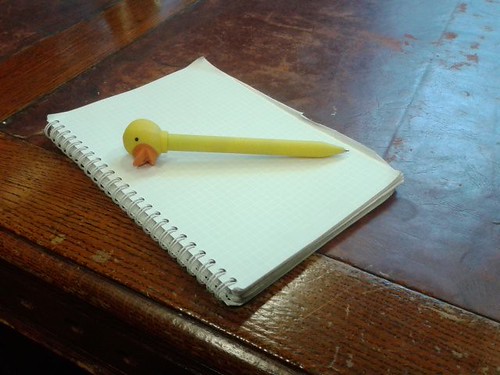
It’s intended as something of a story-gatherer and conversation-starter, so please do add to the little yellow notebooks with any tales you have to tell. Big or small.

corner

tell me

tell me about

Tell Me About a Time…


Before the research, before the development, comes the blank canvas and the nebulous first whispers of an idea. Swirling around in Nikki’s head at the moment are themes of connectedness, journeying and adventure, all seeking places to settle and take form.

In Tell Me About a Time… Nikki invites you to share your stories that relate to some of these themes; because this is the time where talking to other people often provides the speck of a thing around which thinking and making nucleate. This is the time where you get a sense of the lie of the land before then deciding what sort of a path you might choose to navigate through it.

So please share your stories by writing them in the notebooks below, helping to gather together and celebrate poetic details of the everyday, moments of modest heroism and those tales that remind us who we are or can be.

1000

miles

Travelled Just Over 1,000 Miles


When Gran died I inherited her postcard collection. Looking through the wooden boxes my Mum and I found a slightly incongruous handwritten list of place names…

The list outlines a coach trip taken by my great grandmother Ida and two of her sisters: seven days travelling from Northenden (Manchester), down between Birmingham and the Welsh border before touring around Devon and Cornwall. There are accompanying postcards, but it’s the photo of the three sisters and their travelling companions that tell us most about how the journey might have been.

How do you tell travels to those who were not there?

Land’s End

As a follow on to the previous post, this morning my mum came into the room brandishing a photo:

Lands End

A group photo of all the people on the coach tour my great grandmother Ida took in 1950.

Here she is in the dark hat on the left with two of her sisters to the right of her:

Lands End detail

The coach is branded “Smiths”. I assume it’s the same Wigan-based Smiths that went on to become Shearings through a series of mergers.

The back of the photo is stamped 7th of June and marked up as being taken by Richards Bros, photographers based in Penzance.

Travelled just over 1,000 miles

When my gran died, I inherited her postcard collection.

Tucked in amongst the postcards, we found a handwritten list of British placenames.

Quite a long list.

The list

The list

It’s the itinerary from a seven-day bus tour my great grandmother Ida took in June 1950. Departing from Northenden at 7am (presumably where she’d been staying with some of her many sisters – we’re not sure if any of them accompanied her on the tour update – we’ve got this photo), she then got a taxi into Manchester, a bus over to Wigan and then boarded a long-distance bus bound for the South West.

Ida

Some of the photos we have of my great grandmother Ida

Her journey took her down the Welsh Marches then into Devon and Cornwall, where she spent most of her week away.

I’ve plotted the places from her list onto a map:

All of the places on the list plotted on a map

All of the places on the list plotted on a map

(Did I mention it was quite a long list?)

1000

1000

The reason this list found its way into my gran’s postcard collection, was that Ida had bought various postcards during her tour to mark the places she’d visited: Tewkesbury Abbey; caves at Cheddar Gorge; the postbox at Land’s End…

Some of the postcards Ida bought as mementos of her trip

Some of the postcards Ida bought as mementos of her trip

I knew as soon as I found the list that one day I would re-trace the journey that Ida documented, but it’s taken 15 years for the right time to come. With the residency I’m currently doing at Wolverhampton being based around a mechanical cabinet as a device for linking observers with someone travelling by bicycle, I needed a suitable journey to undertake to provide the data to animate the cabinet’s workings. A journey that would feed the themes of effort and connection that I’m wanting to explore. That’ll be this one, then!

So I started looking at that sequence of locations in more detail, wondering how it might work out as a cycling route. Not too badly, it turns out. One thing that rapidly became apparent however, was that I’m not going to be able to do the whole trip in one go. Taking just her first day though, Northenden to Bristol, works out at a decent 300 mile cycle tour and about 8 days of pedalling.

Day One of Ida's tour

Day One of Ida’s tour with purple place-markers and my cycle route starting to get filled in between them.

My planned route in blue, and a likely route Ida may have taken in cyan

My planned route in blue, and a likely A-road route Ida may have taken in cyan. Not a bad match for most of the route

I’m planning on taking camping gear with me and overnighting at campsites, so that’s influenced my route a bit, as has trying to avoid too much unpleasantness in urban areas. I’ve also afforded myself leeway to divert a bit for good bridges or other points of interest such as the Dramway – a horse and gravity powered line transporting coal from collieries north of Bristol down to the River Avon. ‘cos, y’know, if I’m going to cycle 300 miles, I’m going to make sure I savour the opportunity to see things that I’d otherwise be oblivious to if I was travelling by car.

Other diversions have also had to be put into operation. I’ve not done an awful lot of cycle touring before, but I’ve already learned that the official National Cycle Network‘s approach to routing isn’t always amenable to a fully-loaded touring bike. These two bits across fields, for example:

National Cycle Route 5

National Cycle Route 5

National Cycle Route 5

National Cycle Route 5

So, with my route largely based on some of the National Cycle Routes, but amended after checking with others’ experiences and scouring the satellite view of it all, I think I’ve pretty much got 8 days of 30-40 miles pinned down. This should be a nice balance between covering ground, being able to stop and explore stuff encountered en route, and having time to sketch and reflect.

I’ve really enjoyed the last week of poring over maps and putting together my cycling route. Hat tip to http://www.gpxeditor.co.uk which has been an invaluable tool. It’s tempting to jump in and start doing the same for the remaining 6 days of Ida’s tour. If nothing else it’s like vicarious cycle touring pleasure whilst the weather’s wet and wintery.

Whereas I think her first day was mostly about getting to the South West, it seems she leapfrogged about a lot more once she was down in Cornwall. That first stage of translating a series of place names into a journey through the in-between places is going to be an interesting one. I suspect the terrain’s going to get a lot lumpier too!

It looks like this section of the trip’s going to happen in early June. So quite an excruciatingly long wait between now and then. I do need to build that mechanical cabinet though, and I also want to experiment with making a few modifications to my tent, so there’s plenty to be done in the meantime! First task, whilst I’m waiting to get back in the workshops: read Rebecca Solnit’s Wanderlust…

[Edit: me actually cycling this in June is now looking unlikely due to knees] :-(

Artist in residence at Wolverhampton School of Art – beginnings

I’m one of several artists in residence based at Wolverhampton School of Art this academic year.

My proposal was based around improving the sculptural and theoretical elements of the Ride (Birmingham – York) project I did in response to a commission from VINYL in 2013.

A few years ago I conducted a successful proof-of-concept for a project called Ride. I cycled 240 miles between Birmingham and York whilst a mechanical cabinet back in Birmingham glowed, spun, levered and whirred in response to how much effort I was having to put in on the other end.

I have a basic functioning prototype of the technology that broadcasts data from a phone (with me on the bike) back to the cabinet in near-real time, however the cabinet I used with it had workings made from foamboard and other materials that I could easily build with in my flat. Not great, sculpturally. I would like to use the residency with Wolverhampton School of Art to develop the form of the mechanical cabinet and also to refine the way in which I present and frame the project.

So, post MA and time spent thinking about sense-scapes and embodied experiences, I’m using the residency to start again from the beginning and really examine how a responsive cabinet such as this might be an interesting object/system for prompting conversations about connection, distance and effort.

Remotely watching someone travelling by bicycle often boils down to looking at a marker on an online map. Here’s the marker and map I’ve been watching in 2015: Steven Abraham’s attempt to beat the One Year Time Trail record:

Most (but not all!) of Steve's tracks Jan-Dec 2015.

Most (but not all!) of Steve’s tracks Jan-Dec 2015.

This is an extreme case: at the time of writing, Steve has cycled 60,004 miles since January the 1st, 2015. (He’s aiming for more than 71,039 miles.) Whilst the map and the orange track lines help to give a sense of the accumulated achievement, they don’t very well communicate the blood, sweat and tears experience of cycling about 200 miles a day every day for a year. The forum threads I’ve seen seem to be characterised by speculation about routes, plans, diets etc, but when someone reports having seen Steve out on the road, the questions suddenly shift to asking about how he seems to be getting on and whether spirits are high or not.

So my starting questions include: what is lost through using the marker-on-a-map approach, and what are the affordances of a more embodied approach focusing on physical manifestations of the exertions of a rider?

space

I’ve been installed up in one of the studios with a table and a bit of wall space which I’m currently using to get some words down and try and get at what the key starting questions might be and what it is I actually want to make and do in order to activate these.

Here are two bits of insight that have come out of the brainstorming so far:

accumulations

mini brief

That second one is a mini brief that’s emerged for the cabinet. I don’t want to make literal illustrations of heartbeat, pedalling or headwinds, but instead create a complementary sensory experience for the watcher. (I’m going to have to find new names for the different roles, too – “watcher” sounds a bit too creepy!)

Also on the to-do list is to experiment with different mechanisms I could use to make things happen in the cabinet.

I used my first day to suss out the laser cutter and made this:

links

chain

It’s perilously close to being illustrative, but there may be a supporting role for a chain and sprockets somewhere!

grubby


Copyright and permissions:

General blog contents released under a Creative Commons by-nc-sa license. Artworks and other projects copyright Nicola Pugh 2003-2026, all rights reserved.
If in doubt, ask.
The theme used on this WordPress-powered site started off life as Modern Clix, by Rodrigo Galindez.

RSS Feed.