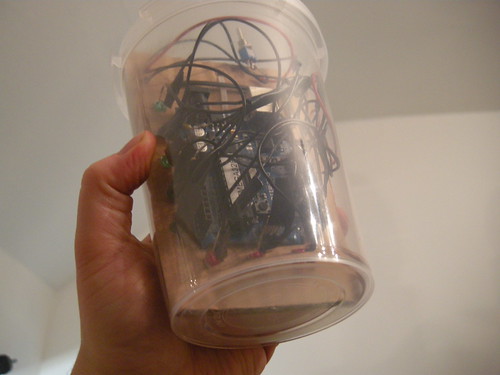
I originally named the Synapse the Synapse because I imagined the arduino-powered, instruction-delivering oojamaflip to be at the head of a chain of people, something a bit like a neuron.
I’ve just now discovered courtesy of wikipedia that:
The word “synapse” comes from “synaptein”, which Sir Charles Scott Sherrington and colleagues coined from the Greek “syn-” (“together”) and “haptein” (“to clasp”).
Which is even more apt; so if anyone asks, that’s my story and I’m sticking to it.
So right, the question is how to give as many members of the playmakers teams (usually about 15 people, I think) important jobs to do. (NB important does not necessarily equate to sensible.) Rather than thinking of the camera as a huge physical device, I see it more as a large mass of people having to move in unison. On the Ludocity forum I initially suggested remoting the power supply to the video camera so that several people had the responsibility to keep switches closed in order to keep the camera filming. This was an extreme example, and probably not one you’d actually want to do because the stakes are a bit high if someone breaks the circuit and the camera loses power. You’d have to stop play and get things set up to start recording again = too much of a handbrake.
So, back to the old staple of loud noises and flashy lights. Loud noises instantly draw attention to the players both from bystanders and from other teams they may be trying to sneak up on/away from. Flashy lights because if you’re watching playback on 3 screens simultaneously, you’re not going to be able to identify which camera the sound came from.
At tonight’s fizzPOP I hacked together a bike light, an attack alarm and a couple of push-to-break switches to see if the approach looks like it’s got legs. Both switches have to be continuously held down or else lights will flash and noises will be noisy.
After the session the other hackers were kind enough to humour me and help give it a little test. It was raining, but fortunately we were in a building next to a railway viaduct, so we headed for that.
Can confirm lights are bright enough and noises loud enough.
Prior to going outside, we’d had a really good discussion about the Playmakers project, possible roles of technology and what were appropriate roles of technology.
A really interesting idea that bubbled up was what would the scoring be like if you could use augmented reality software to recognise the presence of players from other teams and therefore automate durational scoring? We imagined ridiculously big It’s a Knockout style marker images being carried around the streets.
Could have some interesting implications for superimposing graphics over the videos during the playback too…
Anyway, back to loud noises and flashy lights. From the test we learned:
Switches need to be more tricksy: maybe tilt switches or something that rely on the position of whatever you’re carrying – push buttons as they are are too easy to hold shut.
Things will get interesting with upwards of about 5 people in a chain.
The camera person needs to be quite a way back from the loud noise and flashy light device…
… but I like the way the video shows the team doing stuff, having the camera pointed down the line like this.
Croc clips can’t be relied upon if you’re running around!
There’s a group of Birmingham arty folk doing stuff over at Pitt Studio in Worcester today and I want to tell people about it. But I can’t. They’ve hidden all the information.
The Pitt website has this on their front page:
…which is sort of useful if you’re looking at it in the context of the Pitt website so you a) know where abouts it’s being held and b) aren’t relying on a screen-reader or anything like that. There’s nothing on either of the sites relating to the two main curators involved.
I’m frustrated because a while ago I had a press release with loads of information in it. You know, the sort of information likely to encourage the usual Birmingham suspects to go over to Worcester and check out what’s happening at Pitt (something I’ve been meaning to do for months, but just needed a prod to do so).
I don’t often use this site for rants, but this has got me really worked up. So much of the art stuff around me is stuck in the flyer mentality that it really hinders spreading the word. Grrrrrr.
Here’s the press release I got, that I’m forced to publish on my own site if I want to link to it. (Which I will be doing from my Twitter account in just a few seconds…). Forgive me, but I can’t be bothered to add links in.
Press Release
MENAGERIE OF BIRDS
Preview 4-8pm Saturday 6th June 2009
Pigeon Party 7-8pm at the Preview
Artists include: Claire Brewster, Annabel Dover, Dicky Graham, Harminder Singh Judge, David Miller, Michelle Munn, Scott Robertson, Stuart Tait with Alex Lockett and Ian England’s Pigeon Party
Curated by Charlie Levine
In historical terms ‘Menagerie’ is used to describe the collection and captivity of exotic animals. It was defined in the Methodical Encyclopedia of 1782 as an ‘establishment of luxury and curiosity.’ For Menagerie of Birds curator Charlie Levine has bought together a collection of artists whose work encompasses the thoughts of captivity, luxury and curiosity represented through the image of the bird. From a subtle sound piece by Stuart Tait, books by Annabel Dover, paintings by Michelle Munn and Scott Robertson, a light drawing by David Miller, delicate cut outs by Claire Brewster, sculptures by Dicky Graham and a film piece by Harminder Singh Judge this show is certainly eclectic.
For the final hour of the preview Alex Lockett and Ian England supported by [insertspace] will host a Pigeon Party as part of Project Pigeon. Ian and Alex invite you to ‘come and celebrate the pigeon (especially theirs), dance to pigeon songs, eat speed cake, drink whisky and meet the birds.’
Menagerie of Birds seeks to combine various methods of artistic practice with Levine as the bird fancier as the first invited curator at Pitt Studio.
Menagerie of Birds Preview Saturday 6th June 2009 4-8pm
Exhibition continues until Sunday 28th June 2009, viewings by appointment only, please contact Nathanial on 01905 616660
Project Pigeon is an art, curatorial and education project; Alex and Ian are keeping and racing pigeons, running workshops, holding open loft days, and exhibiting artworks carried by pigeon.
Curated by Charlie Levine at Pitt Studio, 62 Chestnut Walk, Worcester, WR1 1PR
Contact Charlie at charlie_levine@yahoo.co.uk or Nathanial at info@pittstudio.com
I think the game’s been played several times now with varying rules that I’ve not really been keeping track of. Key components are (I think) 3 teams of about 15 players, each (teams, not the players) with a flip video camera on a large tripod and running around to film different objects/actions/people within a set time to score points. The teams then assemble together to watch all three videos being played back at the same time and some sort of scoring takes place.
These are the main areas that have been identified as needing some thought (reproduced from the Ludocity forum):
So, the video playback – is it fun to watch, should it be more fun? How should people be filming? Is there some way to make the videos… prettier, and if so is that a desirable end, or should the focus be purely on making it easy to score?
One of the problems with the basic game is that it’s very open to one player grabbing the tripod and running off, and some of the players feeling peripheral or not having anything to do. Should there be more roles for specific players? Different jobs to do? The traitors were a step towards this, as were the encoded clues, but should it be clearer, more extensive? What should the different team members be doing?
How is the game introduced, how should the rules be explained? Should there be actors? Pieces of paper in envelopes? Skywriting (we can’t actually afford this)? Should it be part of the game, or clearly set apart from it?
So, there’s a tripod. There’s a video camera. There’s a brightly-coloured feather-duster. But maybe there should be something else… a mobile phone, ringing with extra tasks, or letting teams communicate with each other? Some sort of tiny computer doing… something? GPS tracker?
The game will be played at the H&S Weekender around the Southbank Centre, and it’d be nice if the basic game could work in a variety of locations, but what’s happening in the space? How far should people go, and what’s there when they get there? Is there a secret dance extravaganza that they need to find and film? A hot air balloon (this is another thing we can’t actually afford this)? Something happening, something installed, something participatory, something they need to create themselves – what’s there?
At the moment, there’s the tripods; there are sports bibs. That doesn’t have to be the case. Maybe there could be different costumes for different roles within a team; or maybe the people presenting the game need costumes, or someone running around the space as a target has a costume, or something else entirely. Maybe the tripod isn’t a tripod, but an enormous teddy-bear. Maybe it’s a balloon that’s gradually inflated over the course of the game. Maybe it’s a perambulator with a goldfish bowl inside, who knows?
One problem with the game as it stands is that there’s not that much of a feeling of good gameplay being rewarded. The balance of points for filming targets and opposing teams isn’t right; adding extra ways to get points (for example, by identifying traitors successfully) doesn’t necessarily work with the rest of the game. So, how should scoring work – how many seconds of filming another team’s tripod, for example, should be equal to successfully finding all the targets?
How should all these different components fit together?
I like those questions a lot. Seems to me it’s a basic arsenal of interrogation for any game designer to ask of any game they’re designing. Bing! Preserved here for future reference!
In this particular instance though, the two I’ve homed in on are how to make the video work (in terms of making it watchable and also making it scoreable) and also how to ensure that all team members have roles to play.
Meanwhile, I’ve recently made and used The Anticipator. Techy GPS thing hidden innabox in such a way that it becomes a prop for getting a group of people to work together as a team. Round 1 was with primary school children and now I’m thinking about how to apply this to BARG-related stuff.
So, something I want to explore that can easily be attached to a live project with real design criteria and real deadlines.
…I spent the weekend doing some rapid tinkering ahead of meeting up with some of the Hide&Seek folk at an event tonight…
I now have a working prototype for something I’m calling the Synapse. It’s basically a portable arduino-powered device that buzzes and flashes out a sequence of warnings and cues for players to do stuff.
Because the timing is now independent of any filming taking place (when I played Shrine it was done off the flip’s counter: cunning, but caused a few problems) players can take their time to get into position and check the equipment is all working ok. The LEDs and buzzer also make it really easy to sync up multiple films.
The only thing left to do now is to figure out how to use it…
I was struggling before with matching up the concept of the film documentation and the style of game-play. They didn’t seem very compatible somehow and the end result was some meandering video that [during the scoring for the version I played in] wasn’t in step with those from the other teams and just wasn’t that interesting to watch[Disclaimer: I haven’t particularly watched any of the video from the other games. They might be very different …or that may underline my point…].
I had a bit of an epiphany when I changed the way I was looking at things and rather than seeing a game followed by a scoring phases that conveniently produced some film documentation too, saw it as teams competing to produce the video that would beat the other videos.
That and seeing the collated videos as a film that therefore needed moments of tension and conflict and suspense in order to keep the audience interested. (Humour’s a given in this situation, I reckon.)
So, each team has a task to do. It could be filming objects or actions; it could be finding things; it could be collecting objects. It’s the background action of putting balls in holes. (Collecting physical objects would make it a lot easier to score this aspect, rather than the durational stuff we were trying to do in Shrine.)
Interjecting into this are the unnecessaries – the tasks you have to complete when the Synapse gives you a very defined time limit in which to do them in. These are like jousting an invisible opponent – you either have to be the best imaginable or put your fate down to chance… Will it be rock paper scissors, will it be doing the best improvised dance routine or will it be waving a flag at a checkpoint?
The synchronised unnecessaries where each video component goes head-to-head with the others are what potentially start to make the videos into a film.
I have plans for how to develop the synapse as a way for making several people work together, but for now let’s just get some feedback on what we’ve got so far…
It’s taken a while, but I now finally get to say “we did this!” and link to the blog and video from a school project I worked on earlier this year. I’ll let them speak for themselves.
A fab afternoon with a great crowd of people. Heather wrote a nice summary of the first section and Nicky Getgood did a great job of capturing the non-games aspect of the afternoon which was to explore, and temporarily reclaim, some neglected urban spaces.
A song for Skatz
I spent 4 days being a secret agent at Linden Primary School.
We investigated, we hypothesised, we made a humming labyrinth, we transported a minstrel over from a parallel dimension where planets were losing their sunlight, and we helped him write a song that contained all the knowledge about light and shadows that they needed to bring the the sun back.
[audio:http://www.npugh.co.uk/media/WOW.mp3]
An excellent project where I was able to draw on a lot of the theory from game design in order to make an immersive experience that each of the 60 pupils could engage with in different ways. I hope to be able to write more about this once I know more about the permissions situation.
Rhubarb Radio
On the 17th of May I was a guest on Steadman and Grimes’ Sunday Social show on Rhubarb Radio. We talked about BARG and the w i d e o p e n s p a c e event. I’ve written the first of two posts on the BARG website that include the audio and a selection of links and further information relating to the things we talked about.
BARG website
Now BARG has been running for a few months and we’ve got a feel for what shape it is, pindec and I spent a lot of time last week coding up a website to cater for the different aspects of the network’s activity. Here’s the result: http://barg.org.uk/. We’ve loads more events planned and we’ll be using the website to put out all the details when the times come, so subscribe to the news feed, or make sure you join the mailing list if you want to get information by email.
Post Digital
Mudlark heralded their transfer to Birmingham and their arrival at Fazeley Studios by organising a “day of talks from inspirational friends and allies”.
Post Digital brought together an interesting collection of view-points and practices, to which I added a deliberately lo-fi potted history indicating how I had arrived at a practice where I hack up cardboard and masking-tape interfaces for GPS units.
I ended my presentation by asking what sort of post-digital spaces a pro-am sort of someone like myself might be prodding in a few years’ time…
Edit 10th May: Scroll down to the comments to see links to documentation of the event.
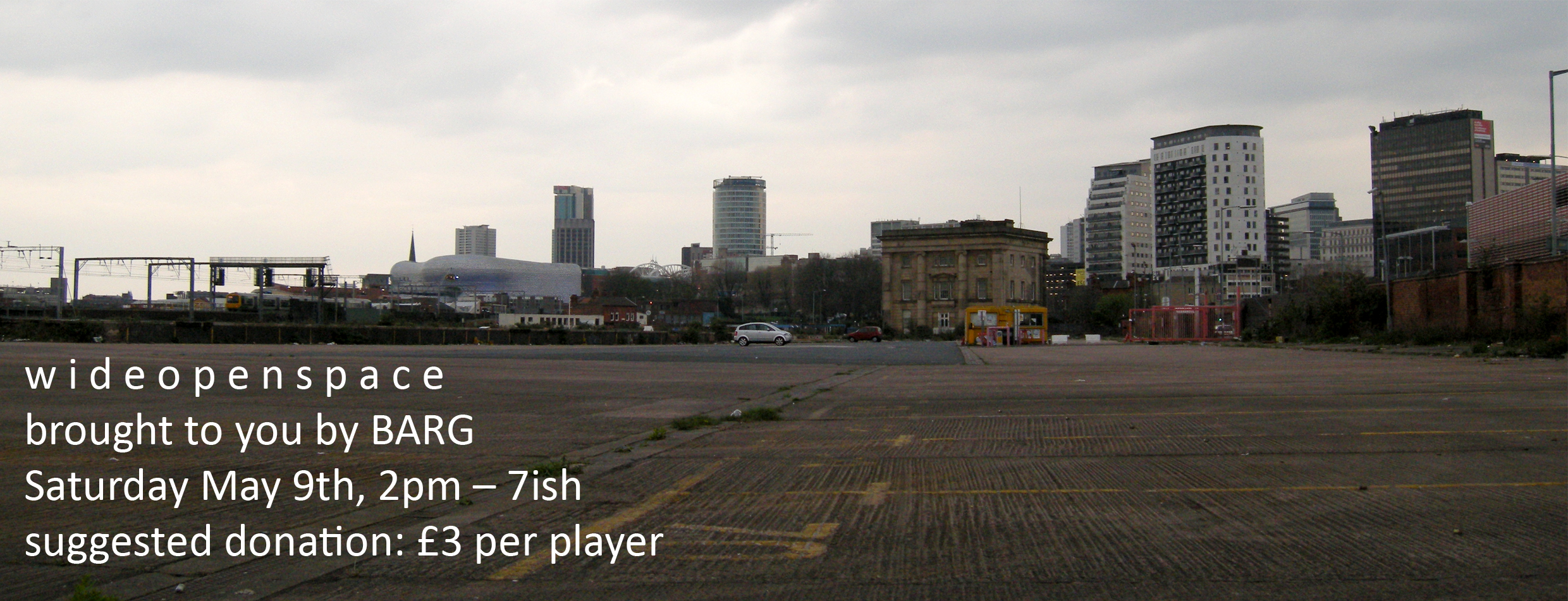
w i d e o p e n s p a c e is an afternoon of fun, games and picnics around the Curzon Street area of Birmingham. Come and explore the terrain and its possibilities with us. All are welcome although we ask that parents bringing children keep an especially close watch on them. We’re asking people to make a donation of at least £3 each to help fund future BARG events.
Here are the games we’re planning to run. (But there will also be plenty of opportunities for you to invent your own!)
Hat Snap
(variant of a game designed by Krzysiek “Semp” Bielecki)
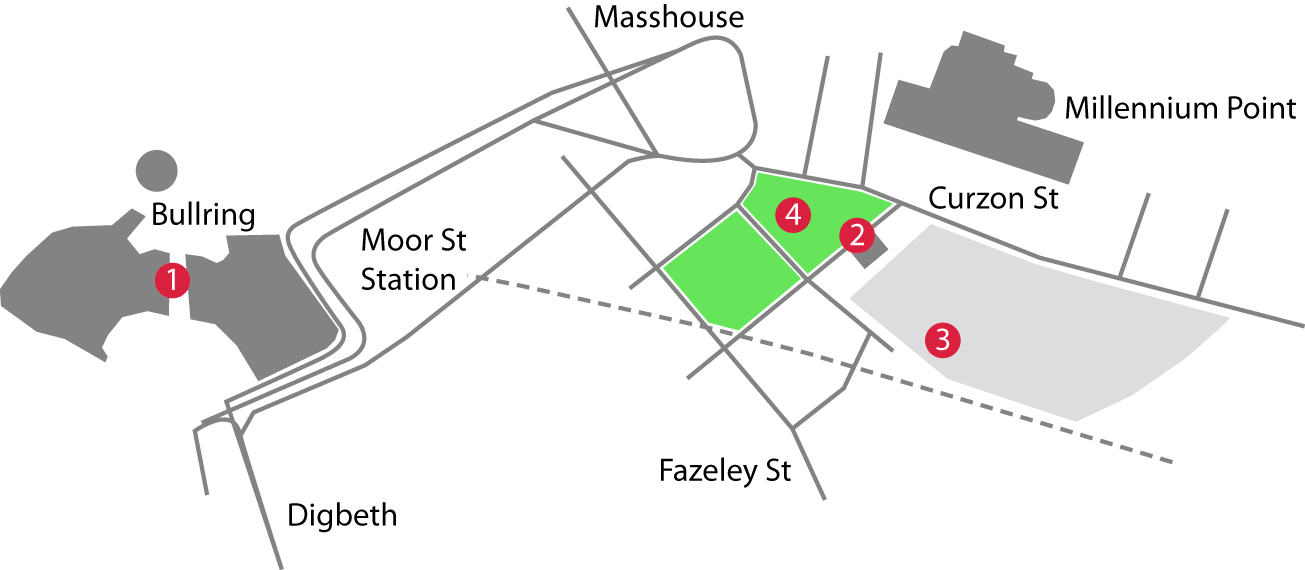
The first game runs between 2pm and 3pm, with sign-up in the Bullring shopping centre at the cube seats near Baguette du Monde and Café Rouge (the open-air bit between New Street and Saint Martin’s Square, [1] on the map, see below) between 2 and 2:20.
You will need to bring a digital camera or a camera phone and it will be to your advantage to not be carrying too much other stuff. If you’ve brought a big delicious picnic with you, you might want to sign up at the front of Curzon Street Station ([2] on the map) and leave your baggages with our stewards.
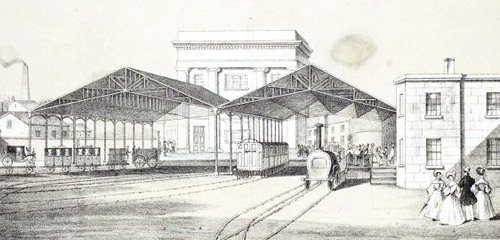
Players will rendezvous at the Curzon Street Station building at 2:40 to tally up the points and determine the winner ([2] on the map). Full instructions will be given to you when you sign up; it’s up to you to decide on your strategy…
The Lost Sport
(rediscovered by Jane McGonigal and Kiyash Monsef)
The Lost Sport of Olympia is believed to be a 2500-year-old game invented, and ultimately banned, by the Ancient Greeks.
At 3pm we will move to the Curzon Street car park (probably the bit at the back, between the skaters and the railway lines, [3] on the map) for a team game with no opposing team: listen carefully as your team-mates guide you around a labyrinth. Make sure you’re wearing shoes you can run in.
Picnic
(designed by you!)
Not a game, but still very enjoyable!
Bring some food and join us on the grass area in front of the station building between about 5 and 6 for a leisurely picnic ([4] on the map). Sharing of food and ideas encouraged!
Bocce Drift, Croquet and GPS Sketches
Grab a few friends and have play with these things that will be available after the carpark bit. The rules for Bocce Drift (designed by David Jimison and Jeff Crouse) are here: http://ludocity.org/wiki/Bocce_Drift and we encourage you to invent your own rules for croquet (bear in mind it’s a borrowed set though – please don’t damage it). As an additional challenge, we’re asking for people to bring along random (non-valuable/non-dangerous) spherical objects for some further games improvisation.
2 iPAQs will be available for you to use to record your movements around the area: what pictures can you make? After the event we’ll convert everyone’s tracks to a Google Earth file so we can see what people drew. (You’ll need to leave your credit card or driving licence as a deposit for the iPAQ.)
Human Snake
(designed by Minkette)
You’ve seen the game played on mobile phones, now it’s time to play it in real life. Conga around between 6:30 and 7 to collect the fruit before the other team gets it first.
In the event of good weather, please make sure you bring the appropriate hat/cream/parasol to stop yourself getting sunburnt – there’s not a lot of shade available around Curzon Street.
The Map
(Click to embiggen.)
The Small Print
w i d e o p e n s p a c e is an exercise in exploring a part of the city that is currently something of a wasteground. We’ll be playing in unloved areas that may be littered with things like rubble and broken glass, so if you’re joining us we ask that you dress appropriately and be especially careful of your safety at all times. Play at your own risk, etc etc, but have fun and spare some time to look at the cityscape in a new way.
BARG is a Birmingham-based network for playful people who like to make and/or play interesting games.
I think the keys to interesting mscape projects (as far as my practice is concerned) are either in some seriously nifty programming, or in the interface. I currently lack the programming skills, however I did save a load of cardboard boxes from when I moved house…
The Anticipator wraps a PDA (Personal Digital Assistant) in a new housing and uses locational information from the GPS (Global Positioning System) to light some, none or all of a series of LEDs (Light Emitting Diodes).
The Anticipator will be used on the first day of a project involving 60 year 3 pupils in a Leicester school: working in teams of 5 for about 10 minutes, all the pupils will be required to help a Special Agent (me) use The Anticipator to sweep the school grounds looking for whatever it is that The Anticipator detects. (At this stage all the pupils will know is that something unusual is brewing, we’ll use this contact time to get them to speculate on what they think is about to happen and what The Anticipator is measuring.)
The Anticipator will indicate 2 large areas of high Anticipatory activity: one is where we will put the investigation shed, and the other is where… well, who knows what could happen in the other location…
Anyway, that’s the background, here’s how it’s done…
Except for a few lengths of dowel and some bolts, all the structural stuff is made from supermarket fruit boxes. I love this stuff – I don’t have a studio or workshop so it’s great for layering up and using as pseudo wood.
The main block holds the PDA mounted on top of an array of 6 LDRs (Light Dependent Resistors: when light hits their top surface their electrical resistance falls allowing current to pass more easily around the circuit). Each LDR is wired in series with an LED and all the LDR/LED pairs are wired in parallel in a circuit with a 9V battery and a rather nice switch I got from a chandlery (it’s got a very satisfying feel to the switch action!). The LEDs are housed about a metre away in a smaller block.
In the video below you can see how the amount of light hitting the LDRs controls the brightness of the LEDs. I’m using a really simple mscape consisting of concentric regions that show one of 6 .gifs with between 1 and 6 small white squares on a black background. When there is a white square above a LDR it lights the corresponding LED. It turns out that there’s enough light coming from the black background that LDRs without a square above them still make their LEDs glow a little. Placing a few layers of tissue paper between the screen and the LDRs cuts out enough of the ambient glow that the contrast between “on” and “off” LEDs is adequate for use outside in daylight.
And that’s it really; it’s not rocket science. Well, it might be, but that’s up to the imagination of the kids interacting with it.
There will be one child either side, carrying the main block (thereby stopping their bodies from getting too close to the PDA and affecting the GPS signal) and a third carrying the LED block. The LEDs will need shading from direct sunlight (it’s a project about light and shadow – can’t hurt to get them thinking about stuff like that right from the start!) and there will need to be people noting down how many LEDs are lit and whereabouts in the school grounds we are.
I’ve deliberately not labelled anything so there’s enough space for it to be whatever each child wants it to be. This is part of a very deliberate strategy to try and leave as many gaps as possible where there are no right or wrong answers. Using the principle that “the pictures are better on radio”, leaving details to the imagination makes for a vivid experience. Each child can have their own interpretation of what’s going on and that’s what makes it powerful: it’s theirs.
Working with the children and The Anticipator on day one will allow me to plant whatever seeds are necessary and see what direction they’re growing in. It also gives the children a space in which they can meet my character and ask any questions they have. I’m not saying I’ll be able to answer them though… that’s for them to do by the end of the week!
A game for Curzon Street would make full use of how Curzon Street is now.
A game for Curzon Street would make people explore.
A game for Curzon Street would make people interact.
I’d like there to be a game designed specifically for this part of Birmingham.
BARG will be hosting an afternoon of play and picnics in the Curzon Street area (image of the full area) on the afternoon of Saturday the 9th of May. We can playtest either complete games or partial mechanics …or make something up when we’re there.
My main area of enquiry is centred around interactions between people and place: often using tools and strategies from areas such as pervasive games and physical computing to set up frameworks for exploration.
If you'd like to commission me or collaborate with me, please get in touch via the contact page.
General blog contents released under a Creative Commons
by-nc-sa license.
Artworks and other projects copyright Nicola Pugh 2003-2026, all rights reserved.
If in doubt, ask.
The theme used on this WordPress-powered site started off life as Modern Clix, by Rodrigo Galindez.