A sign of a great place is triangulation. This is the process by which some external stimulus provides a linkage between people and prompts strangers to talk to each other as though they were not.[source]
The video below is an extract from William H. Whyte’s ‘The Social Life of Small Urban Spaces’ and at 42m29s there’s some discussion and examples of triangulation. The whole video’s worth a watch if you’ve time, though…
I’m thinking of some of the urban spaces I encounter on a regular basis and wondering what sort of triangulation + mayor combination it would take to inject some social life into them.
I’ve been tempted before to adopt a non place and make it the subject of my projects until it becomes adopted by a wider community, this film has added fuel to that fire.
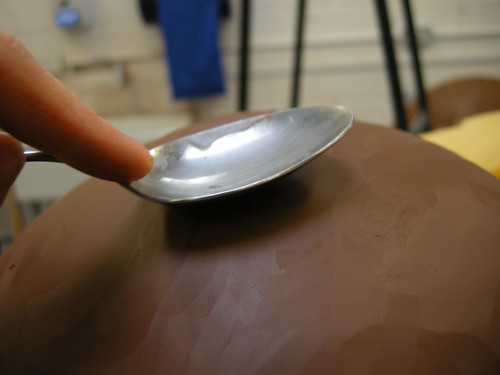
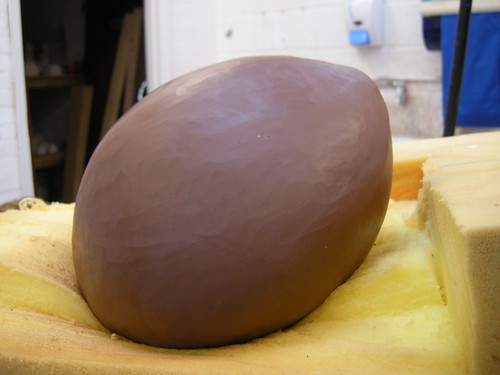
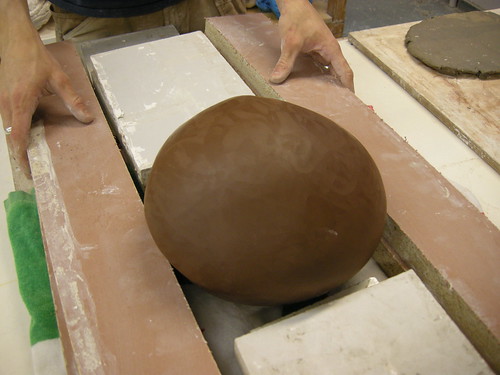
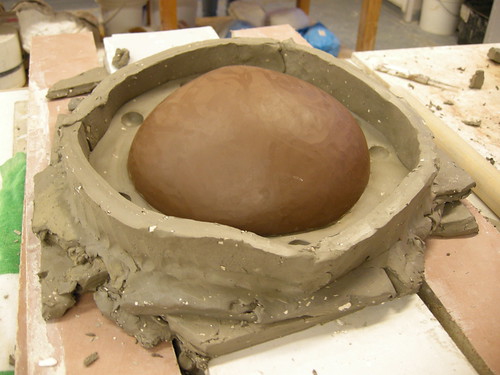
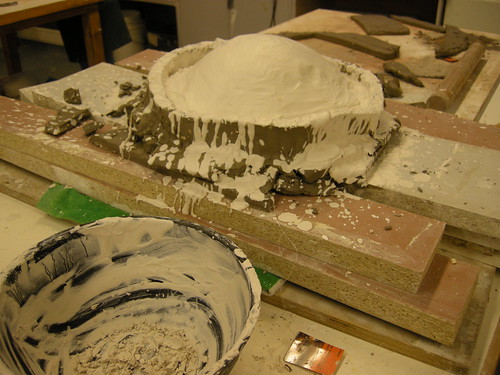
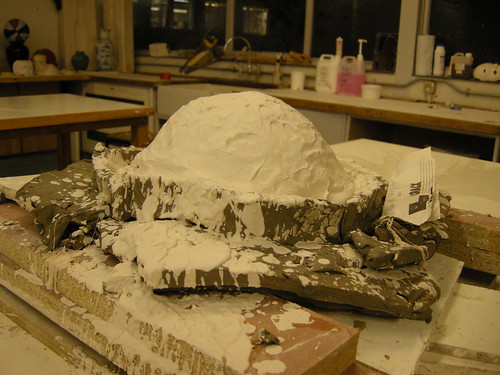
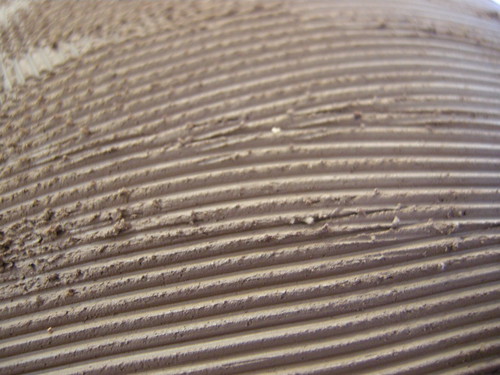
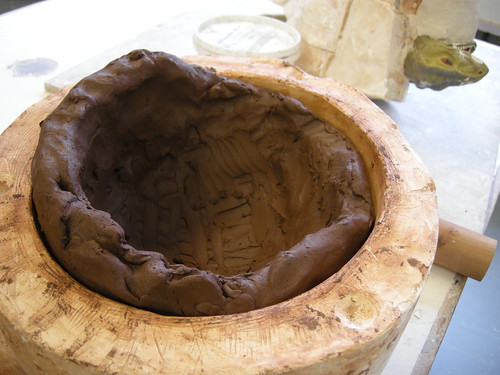
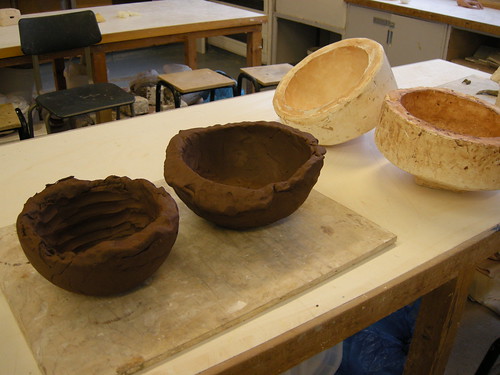
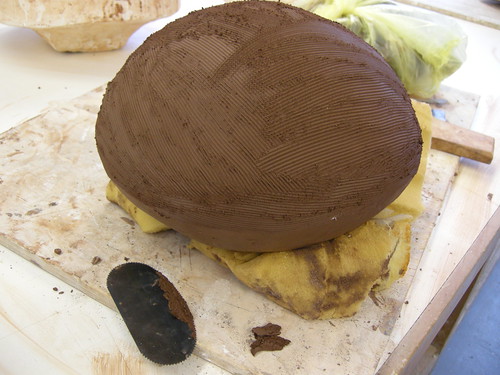
This week’s making saw the clay finally dry out enough to do the last of the shaping, a quick burnish to try and make the surface detail look a little less ‘made’, and then a speedy 2-hour mould-making dash.
With both halves of the mould now plastered, it’s a case of waiting a few days before I can get back into the workshop, prise them open and see how it’s worked.
On Friday the 23rd of November I’ll be back at the Pervasive Media Studio again for a lunchtime talk. This time though, I’ll be stood at the front of the room…
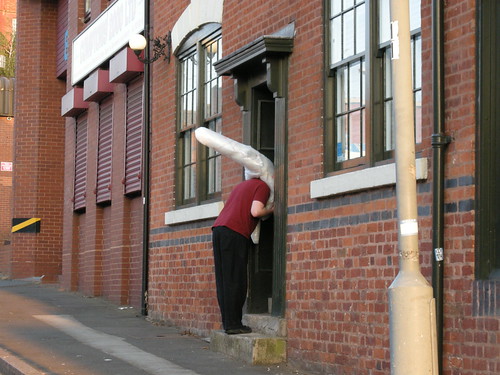
I’ll be talking about recent/current projects Colony, Dust and Waggle and their interactions, interfaces and materials. The full title of the talk is Place interfaces – thoughts on bubblewrap, bees and lumps of clay.
I’m enjoying the chance to get hands-on with different materials and really have some options when it comes down to choosing what to make my interfaces out of.
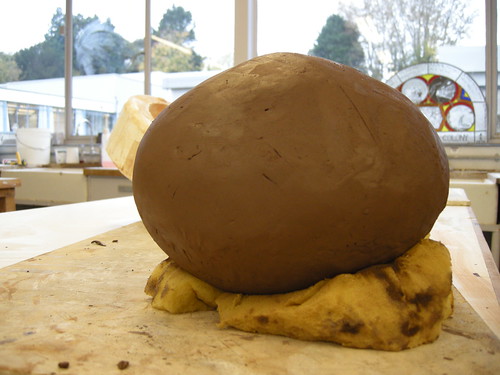
For this project I’ll be casting some forms in wax. Yesterday and today I began the process of making a pattern from which to make the mould for the casting.
Last weekend I went for a loooong cycle ride with a bunch of strangers. Having recovered enough to get back in the saddle today – and keen to learn the route to Clent Hills for myself – I retraced part of the journey.
Green! This is why I want to learn the way to Clent!
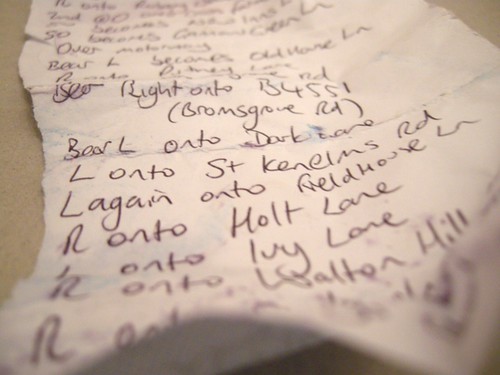
Thanks to the ride leader having provided some GPX files ahead of the loooong ride, I was able to study the route and equip myself with the necessary high-tech navigation equipment:
But it turns out that, for the 13 mile ride out, this was all but unnecessary: there were enough located memories along the route – sarky comments, llama farms, junctions with spooked horses – that I was able to recognise where I was and where I had to be. I think that’s pretty interesting! (And a measure of how lively the group was – thanks guys!)
Also interesting was how disorientated I was by comparison on the way home (going back the same way). Here the main instance when the landscape looked familiar to me was when I managed to take a wrong turn and loop right back round on myself. That was very disconcerting in a deja vu stylee!
I had a sleepless night a few weeks ago when, seeded by GPS Orchestra, inspiration for a project struck.
Actually, less inspiration and more a vision of the finished thingy. The task now is to figure out how to make it.
Whilst that’s going on, I’ve been looking for ways to describe what it is that I want to make (happen). The image that seems to capture something of the quality of the movement of people that I’d like to see is that of a shoal of fish. You know the epic, deep water, deep deep blue natural history films; you know the voice over; you know the big shoal of fish, moving through the ocean as a group of individuals; and then flash! suddenly there’s a coordinated movement and a moment of silver.
I think that’s what I’m after.
Looking for video, I’ve also got sucked into murmurations.
I also aspire to the reaction at 1m 40s in the video below:
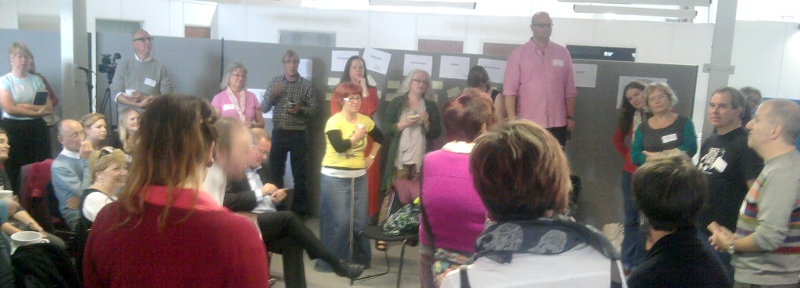
On Monday I attended Museum Camp. As with MuseumNext in 2009 it was a) rather marvellous and b) a stimulating place to discuss ideas that relate directly and indirectly to my practice. Thanks to all involved!
Hello. We are interested in Museums and we want to think about...
I hadn’t intended to lead a session, but as a spur-of-the-moment decision I offered to instigate a session on ‘interesting digital stuff that doesn’t involve screens’. This was largely from a desire to carry on the conversation that had begun with my recent residency at Coventry Artspace linking in with Heritage Open Days, but also fly the flag for this other face of digital that perhaps institutions aren’t aware of.
I was really happy to see so many people come along to take part in the session. Sitting-on-tables-or-the-floor room only! This post is intended as a reference for those that were in the session and those that weren’t able to join us: pulling out the main areas of discussion and linking to some of the examples mentioned.
I started off by talking a bit about my background and why I was interested in interesting digital stuff that doesn’t involve screens: my journey through gradually more expanded forms of people+place and then influences from pervasive games (I like this definition) and the hackspace/makerspace movement.
I sat on a table and waved my hands a lot as I talked about two recent digital installations that encapsulated a lot of stuff I’m passionate about: making people look up; affecting how people interact with a space; instigating collaboration; making people think and speculate and do experiments to try and find out.
Rebecca Shelley took some comprehensive notes on the conversation that followed as has been kind enough to share them, so here’s where we went from there…
But how much does it cost and is it something we can realistically implement?
Not got a local hackspace? Why not host one? Museum 2.0 post
At the time of MuseumNext 2009 The Life Science Centre in Newcastle had got a long way towards planning to host one, not sure how far they got with implementing it.
Arduino is the platform I use: a small computer but also a community that shares a massive amount of information. A standard board costs about £25 and a lot of the sensors are available now as things aimed at a hobbyist market. It’s probably people’s time that’ll be the main expense.
Sensors include distance-measurers, motion sensors, noise detectors, humidity sensors… You can link up sensor inputs to a variety of different outputs, with some decision-making in between if the result is this, then do this.
Remember…
Later on we reminded ourselves that the behaviour or effect we wanted to induce should lead the design, rather than the technology.
Use what you have in terms of resources and the space.
Secrets, missions, games, small groups of people who are in-the-know and pantomine (as seen with the Secret Police Disco as people who had found it tried to enable others to make the discovery too).
How do you set/stage the space?
How you describe what’s going on and the process by which people enter that activity (or not).
Do I see it as performance? No – mostly because the idea would terrify me! – but I do see it as performative sometimes, and I’m interested in spectacle and different types of audiences that observe it.
I tend not to emphasise art (it’s scary to a lot of people!)
I tend not to emphasise technology (it’s scary to a lot of people!)
Can you pique people’s curiosity? Reward those that seek out the hidden things?
The Heritage Open Day event that Trapeze Monkey and the Secret Police Disco were a part of had a short paragraph and the end of the heritage-orientated handout that said I’d been in residence and things were ‘available for discovery’.
Question from Nikki: How does this sit with pedagogical aims of institutions? Does it matter if only a small number of people make the discovery?
[Silence…]
How do you connect these experiences with the outside?
One participant talked about experience using gamification, linking in to people’s online social networks and harnessing the technology people carried in their pockets.
Another reminded us that not everyone has smart phones and I reminded us this was a session about non-screen-based approaches!
We then talked about the urge to share stories/experiences and possibly also how to close the feedback loop and do something useful with the contributions coming in from social media (or I might be conflating that with later discussions).
Education and fun
I noticed a few undertones that seemed to suggest these two are mutually exclusive…
(I disagree.)
Flows of visitors
Institutions are aware that visitors tend to stay in the areas that are more populated. Can we use interactive installations to draw people into the less well-trodden areas?
We talked about conferring agency, and how this brings people back if they can see their actions are having a direct effect on the space.
Someone talked about the audio piece Shhh… at the Victoria and Albert Museum and how it had enabled things like men transgressing into the ladies loos.
Can I give some examples of exemplary projects?
Um, this threw me a little as I think this is what I’m trying to move towards understanding through getting more of the museums’ points of views. I fell back on describing things I had encountered that had resulted in me having a powerful experience.
Ran on blindfolds, binaural recordings and the gentlest of touches leading you down the rabbit hole.
We talked again about spectacle, and returning to see what things look like from the outside. Also buying in to an activity and submitting to the experience.
Blast Theory were mentioned as the technology big guns. I’d seen some of their control room for I’d Hide You. It’s a lot of tech!
Reminded me to say that things will go wrong. Embrace it! (And design for it!)
This linked us back to an open approach and fostering a sense of agency and ownership – you can playtest your prototypes and people will appreciate it, it doesn’t matter if it’s not polished and flawless.
Hide&Seek’s Sandpit approach (and use of low tech).
I also mentioned the previous week’s Heritage Sandbox showcase and the Ghosts in the Garden project at the Holburne Museum. Smartphone technology wrapped up in an intriguing interface and an engaging narrative.
Worried about a lack of budget? Cardboard props are great because they flag up that this is something running on imagination-power and you can do anything with that!
Today I started wondering if I might be an interaction designer. [Interface designer for landscapes?]
I’ve also just come across this in William Mitchell’s Placing Words:
One role of designers, then, is to reproduce things that there are words for – thus providing cultural continuity. But another role is to operate at the ambiguous and contested margins of the system, conceiving of things that there are not yet words for, and providing concrete referents for words that there are not yet things for.
‘The ambiguous and contested margins of the system’ feels like it might be an interesting place to have a business address.
Last Wednesday night we held the A&Q discussion session to round off my Artspace Research Commission. Present were representatives of the Coventry Artspace community including artists, studio holders, directors and board members.
Jon Randle bought along recording equipment, so we are able to share this documentation of the 90 minute free-form conversation:
Topics covered include:
teaching,
multiple histories,
interacting with spaces,
unsuspecting audiences,
hooks,
looking up,
the (non)exchange of stories,
non art audiences,
playfulness,
online experiences,
audience feedback,
to tweet or not to tweet,
the things you get used to,
secret messages and secret lives and giving the secret things voices,
invisible people,
existing as different things at different times,
connecting with the monkey,
unexplored spaces,
almost hearing the sermons,
doing it again,
attractions,
engendering happiness,
discomfort,
foundations,
steel-capped boots and caring for the building,
eradicating smells,
glitter balls,
non visuals,
void spaces,
not realising the basement is derelict,
Specials cotton wool and not being beholden to it,
what could be done with the xxxxx space?,
mythologies,
allowing cultural squatters,
ownership and territories,
heritage graffiti,
slightly blinkered views
and whitewashing.
Thanks to everyone who took part for an interesting conversation and a chance to look at the building, the residency and its various outcomes from various different perspectives.
My main area of enquiry is centred around interactions between people and place: often using tools and strategies from areas such as pervasive games and physical computing to set up frameworks for exploration.
If you'd like to commission me or collaborate with me, please get in touch via the contact page.
General blog contents released under a Creative Commons
by-nc-sa license.
Artworks and other projects copyright Nicola Pugh 2003-2026, all rights reserved.
If in doubt, ask.
The theme used on this WordPress-powered site started off life as Modern Clix, by Rodrigo Galindez.