February 6, 2006

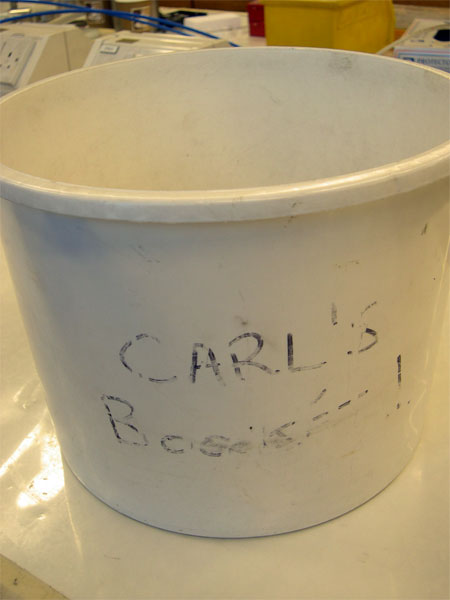
Carl’s bucket (according to Carl)

Damn!

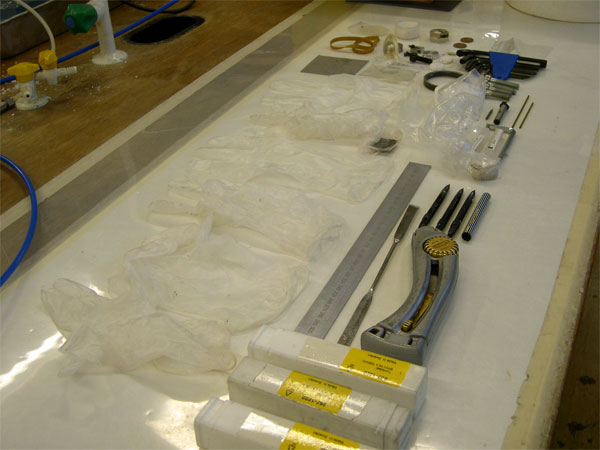
I described the contents of Carl’s bucket, and then I recorded Carl describing everything as he put it back in.

Carl and the contents of his bucket

I was going to put the recording here, but the machine ate it. No recording.

Idea posted here for future reference…

Carl’s bucket (according to me)

Carl’s bucket

  • 6x latex gloves: all used
  • 3x boxes: labeled 267-1222, tool steel, 8mm sq x 100mm, made in Sweden, PE
    • Box 1: contains 1 piece of toolsteel, 8mm sq x 100mm
    • Box 2: contains 4 tools, various shapes, total length approximately 8mm
    • Box 3: contains 1 piece of toolsteel, 8mm sq x 100mm
  • 1x 30cm ruler: steel, metric on one side, imperial on the other
  • 1x double-ended spatula
  • 1x Stanley tool: name and shape unknown
  • 3x biros: black, stubby
  • 1x biro tube: black and white striped, cut to approximately the same length as the biros
  • 1x cylindrical stub of Milliput(?): in knotted transparent plastic bag (bag split, Milliput dirty)
  • 2x small plastic cases: labeled Industrial Tooling Corporation SE. 0769, cutting tools may shatter: eye protection should be worn
    • Box 1: empty
    • Box 2: contains a small drilling tool
  • 2x length of brass tube: different lengths
  • 1x countersink: HSS, 12.4mm, 90°
  • 1x small drilling tool: shattered
  • 2x bolts: 40mm long, allen key top
  • 2x bolts: 50mm long, allen key top
  • 1x set of allen keys: 10mm, 8mm, 6mm, 5.5mm, 5mm, 4mm, 3mm, 2.5mm, 2mm, 1.5mm, complete
  • 1x plastic disc: white, slightly sticky about 60mm in diameter
  • 1x metal ring: approximately the same size as the plastic disc
  • 1x plastic bag: small, transparent, self-seal
  • 3x plastic discs: white, about 20mm in diameter
  • 2x pennies: one minted in 1976, one minted in 1989
  • 1x square of metal gauze
  • 1x rubber band: large
  • 1x small plastic self-seal bag:contains thin, sticky, transparent plastic discs
  • 2x thin, sticky, transparent plastic discs
  • 1x roll of sellotape: small, nearly finished
  • 1x metal component: about 25mm in diameter, with shoulder, hole through centre
  • 1x metal component: about 35mm in diameter, without shoulder, hole through centre
  • 1x 35mm bolt: black
  • 2x 18mm bolts: black
  • 1x small metal block: cutting blade attached
  • 1x resin moulding: bullet-shaped with internal screw thread

the contents of Carl's bucket

18 mugs

(drawn very quickly with my other hand)

18 mugs

39 mugs

(drawn very quickly)

39 mugs drawn very quickly

jeroen offerman

Jeroen Offerman is a Dutch artist working and living in London, UK and Berlin, Germany. Works are conceptual and often of a performative nature. Materials and media used range from living plants, to flies and birds, video, music, dubplates, sculpture, computers and installations.

Offerman spent three months learning to sing Stairway to Heaven backwards and recorded his performance on the steps of St. Paul’s for confused spectators.

via eightface

character sets: a tale of kanji and praseodymium

Last week I spent some time with a friend helping to get her website working more smoothly.

She hadn’t been aware there was any problems: sat in Tokyo, using a machine set with Japanese defaults, all the text on her site looked fine. Both the text in Japanese and the text in English:

english and japanese

Unfortunately, to me (sat in Birmingham with my machine set to rule-Britannia-there-couldn’t-possibly-be-anyone-speaking-any-other-language defaults, the pages looked like this:

english and garbage

A mixture of English and absolute garbage.

We tracked it down to a missing character set declaration and, with the addition of a simple line of code, I can see both types of text correctly now.

Great!

Ami’s website is here: www006.upp.so-net.ne.jp/AMIKO/. Most of the important pages have been fixed now. If you can’t see the Japanese script properly, at least now you know why!

Meanwhile…

I’d been asking around the Department for any posters that people could let me have.

I managed to get my hands on a couple of rejects. A few of the mistakes were fairly obvious, for example where the printer had jammed, however some were much more subtle.

Presumably the printing computer lacked the correct character set information to be able to display greek letters correctly. Thus, what we normally consider to be a fairly infallible discipline instead confessed its ignorance…

infallible science?

infallible science?

other people’s words

(unaccredited and taken out of context)

| If my work’s in there too, it’s a different agenda. The whole thing changes. They don’t trust you | encourage people to sit in the space and, you know, just use it | call and return | you’ll be amazed: you’ll learn lots, it’s fun | it’s always been touch or go | it just seems to work | you lower your principles. You lower the standard. It’s just not good. | collaborating is the key to everything | you need to be a name in people’s heads…with work attached to it | the danger of becoming formulaic | very bad translations: doing a very literal translation has a poetic of its own | gamble | my feeling is they are my guests | my influences are not so much other artists but literature; what I hear on the radio; and very bad science fiction | using your imagination to articulate things you don’t quite understand, with the materials you have to hand | terrifiying | make yourself visible | is there such a thing as wilderness? | a shift in cognition | humour is a fantastic tool to draw yourself in | effecting a change with a tiny piece of graphite | loaded spaces | If you go to one of these things, don’t go with any expectations. NONE. | the pressure to have a body of work, but to keep developing | the choreography of the room | if there’s a needle going in at the same time as you’re being amused, then that’s ok | own up to the fact that I don’t have a studio | everything is a choice | promote stuff by using it to create space. Make architecture with it | found, appropriated and put out of context | prove something happens here | I’m based in Birmingham, but my practice isn’t | a very odd person…he’s nice though | look useful | meet a new network | what audience is your work going to reach? | what’s the point in making something unless you know where it’s going to go? |

andre’s balloon

http://homepage.mac.com/andre66/balloon/iMovieTheater48.html

the scanner photography project

Instead of building a camera that mimicked the functionality of a traditional photographic camera, I had stumbled across a new tool for examining the relationships between time, motion, and image. What I though would be a two week art project has turned into one that has lasted for almost three years, and shows little sign of stopping. My cameras work a lot better now, although most of them still use a lot of duct tape, cardboard, and cheap flatbed scanners.

http://mirror.geo.localizedmedia.com/scannerphotography.com/

seven walks

A part of the degree course I’m doing, I have to give a short presentation on presentation methods – we’ve been analysing different exhibitions and the strategies they use to present artists’ work.

When I say a short presentation, I mean a short presentation: 5 minutes.

This is going to have to be focused!

[Update: At 6 pages, the documentation of the preparation certainly is not focused!

The first few pages are basically just thinking aloud including the main points I wanted to make, in response to the project brief and a room-by-room walkthrough.
By page 5 I’ve got to the stage where I’m starting to look at how to make the presentation.]

Over the past few months I’ve been reading the articles over at Presentation Zen. I came across this site through my webdesign work and I’ve continued to read it because it’s very relevant to my webdesign work. How do you guide your audience along a path that transfers to them the information you want them to acquire?

I am starting to write this post on Saturday morning. The presentation is on Tuesday morning.

I’m also going to have to be focussed to get this prepared on time! Sitting here now with the task ahead of me, I have mapped out my plan of attack:

  1. Quick survey of visual resources.
  2. Identify the main points I want to convey.
  3. Structure these points.
  4. Decide how to distribute these points between the presentation and the accompanying handout.
  5. Build the powerpoint presentation.
  6. Build the handout.
  7. Practice.
  8. Present.

I have other, longer, presentations to do later in the year, (and it will almost certainly form a part of what I have to do as a fully-fledged artist) so I thought I would document the whole process here so I can refer back to it and progress.

1. Quick survey of visual resources.

It’s been a few months since I saw the exhibition so this step will serve to refresh my memory as well as give me an awarenss of what I can use for my visuals later.

My main sources will be the book that accomapanies the show; my own notes and photographs; and various webpages.

I’ll list the webpages here for future reference:


Copyright and permissions:

General blog contents released under a Creative Commons by-nc-sa license. Artworks and other projects copyright Nicola Pugh 2003-2026, all rights reserved.
If in doubt, ask.
The theme used on this WordPress-powered site started off life as Modern Clix, by Rodrigo Galindez.

RSS Feed.