February 22, 2009

drift

I’ve been doing lots of GPS legwork in preparation for a piece of place-specific work I’m developing for a section of Digbeth.

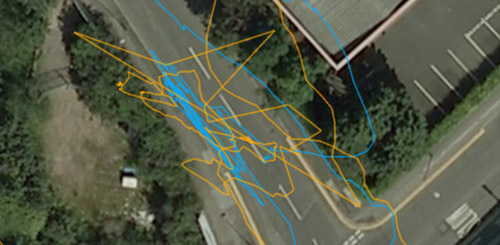
Basically this means walking a fixed route many times whilst carrying a GPS device so I can then look back at the trace of where it thought I went and get a feel for how much the buildings deflect the GPS signal. The things I’m particularly interested in (sorry – can’t be too specific at this stage!) are extremely liable to do this, so let’s just say I’m spending a lot of time walking around Digbeth at the moment!

Each walk takes approximately an hour to complete: I walk up and down particular roads, always staying on the right hand side and walking in the middle of the pavement (or as close to it as I can get seeing as how the pavements are often substitute carparks in Digbeth).

A few days ago I did a nice walk in the sunshine, but it was sullied somewhat when I got home and processed the traces – only the first 400m or so of my walk had been recorded! After that I decided to take both of my devices out with me, so I had a safety net if one of them didn’t record properly.

Yesterday I walked with a device in each hand:

iPAQs and gum

Check out those gum constellations! nice.

As I walked, I noticed that the device in my right hand was consistently giving me more erratic readings for my position than the one in my left hand. At one point I left them both next to each other on a wall for a few minutes so that when I could tell if it was my body disrupting the signal, or if it was because the device in my right hand was closer to the buildings I was walking past.

side by side

jitter

As you can see in the above screen-grab, there’s still a lot of discrepancy.

This got me thinking: by taking two devices out with me, I now had two traces that could be synchronised because the data that’s logged also includes time.

With a bit of fiddling around in notepad and calc I was able to merge the two sets of data and combine it with some mark-up so that that rather than having a line per device that joined position at time1 with position at time2, I could generate a series of lines that joined position from device1 and time1 with position with device2 at time1. Approximately.

Here’s a screen grab:

pretty!

Most of the lines really aren’t that short though and Digbeth is criss-crossed with a mesh of yellow. The best attempt so far at describing it comes from Tom Maillioux:

Like you reprogrammed your GPS to make not just a point, but a line from everywhere you were, showing all the places where you COULD have been.

I love how this has turned the data-collection into a drawing project and how it’s resonating with aspects of psychogeography, belief in technology and the whole sort of indecisiveness of Digbeth.

Now all I need is a way of extracting those lines from the .kml file so I can print them out big.

I want: Signtific Lab

I want to tell you about last night’s Signtific Lab game thing developed by the Institute For The Future futures research group.

Why?

@genzaichi I think I need some serious mindmaps and trees to understand #signtific

@publichistorian I suspect it’s a self-writing mindmap… #signtificgenzaichi

The Background:

A scenario was released into the wild about a fortnight ago:

Starting last night, and only for a day or so, you can respond to this scenario.

From this central node you can branch off in either a positive or a negative direction. In Signtific Lab parlance, each node you add is a card. After the initial bifurcation (see, I know some Science!) you can respond to each card in 4 different flavours: “No way!” (antagonism); “Yes! And…” (momentum); “Yes! But…” (adaptation) and “Hmmm…” (investigation).

You can play as many different cards as you want as a response to any other card contributed by anyone in the lab and you’re encouraged to contribute any idea you can imagine that might be possible (more information about the game mechanism here if you’re interested).

Here’s the thing: it’s a really nice tool for riffing off and building on ideas.

You’re equipped with 140 characters to post any given idea. Is there a Twitter feed of ideas? I’m not sure, but the character limit is great at a) removing the barrier of feeling you have to construct beautiful prose b) makes you focus on the key idea and c) makes you focus on only one idea per card/node. And that’s what you need for a mind map, right?

You have a few other tools to help you:

  • A favourite-ing button
  • A naked RSS feed of ideas as they are generated
  • A naked RSS feed of ideas the moderators have selected as being super-interesting
  • A leaderboard, so you can see who is contributing how much. (though there’s no measure of quality!) :)
  • And a dashboard so you can see what you have favourite-ed, what you have contributed and how this breaks down into the different flavours of thinking mentioned earlier.

Everything (cards, responses to cards, feed items, user profiles etc) is linked. In the hypertext sense, as well as all having been born from the same starting scenario.

Such a simplecomplex thing that fed my brain in a way that suited it perfectly! I always have been better at responding to things than I have been at just generating ideas out of the ether. Link. And. Shift.

My Wants:

  1. After this thought experiment has played out, I want to be able to see the resulting mind-map.
  2. I’ve recently started using mind-mapping tools to brainstorm ideas for projects. I want a tool like signtific lab to let me do this collaboratively.
  3. After that all I need is the hive of lab assistants to react to/with/against!

exporting mscape traces to Google Earth

I’m not very familiar with either GPS or Google Earth so this took me a lot of trial and error – there’s probably room for some refinement!

Problem:

You have used mscape to log your GPS route, but the overlay trace function within mscape isn’t useful for comparing multiple traces or for sharing with others.

One possible solution:

Strip your log file

Open your log file and save a copy somewhere else to work with.

I’m generally working with coordinates in decimal degrees in Google Earth (Tools > Options… >3D view), so that’s the format I want my log data in.

Open the file in notepad (or other text editor) and check your data is in the right format. Here’s a sample line for Birmingham, UK (wrapped):
21:05:32,Place,centre_and_digbeth,E,OnLocationChange,
52.4545033333333,-1.892005

We need to strip out all the first part so we’re only left with the coordinates.

Open the text file (you did save a different copy to work with, right?) in Calc or alternative spreadsheet application. You’ll need to open it as text CSV so make sure you select that file type after selecting the file you want to work with:

text CSV

The next window will give you some options. Check the box to select comma as a separator and double-check in the preview below that this splits your data up into the appropriate columns:

comma

After the file has opened, select columns A-E and delete them:

delete columns

This will leave you with just your longitude and latitude data in columns F and G. They’re the wrong way around though so we need to select column G and cut and paste it into column A, and then cut and paste F into B:

For me, calc defaults to showing numbers to 2 decimal places, so I right click and format cells to bring it up to 14 decimal places which is how accurate my log data is:

14 decimal places

(You may need to increase the column width to display the full number rather than ###.)

We now have data that we can insert into a .kml file for Google Earth. Nearly.

data

Save your spreadsheet as a .csv file, making sure to check the “edit filter settings” box at the bottom:

save as CSV

In the next window make sure you’re using a comma as your field delimiter and then save.

You can now open up your .csv file in notepad. It should look something like this:


-1.89200500000000,52.45450333333330
-1.89200500000000,52.45450333333330
-1.89200500000000,52.45450333333330
-1.89213000000000,52.45448500000000
-1.89213000000000,52.45448500000000
-1.89213000000000,52.45448500000000
-1.89210666666667,52.45450333333330

This is what you will carry over into your .kml file.

Note for UTM data:

Some of my logs are in UTM format, (I think it’s something to do with importing a pre-existing maplib file, this may help) in which case they look more like this to start off with:

20:32:17,Place,centre_and_digbeth,E,OnLocationChange,
575850.093317163,5814462.83102075

(You can check what you’re aiming for by hovering the mouse over your location in Google Earth and reading off the coordinates at the bottom of the window.)

To convert from UTM to decimal lat/long I used the batch convert sheet of this spreadsheet from Steven Dutch. In the case of Birmingham (and most of the UK) set column D cells to all have a value of “N” and column E (aka UTM zone) to “30”. You’ll then have to copy your data into F and G and extend the formulae down on either side to the appropriate length.

I then had problems trying to copy and paste the results into a different file because the cells were still trying to reference cells in the first spreadsheet for the formulae. My eventual work-around was to save as a .csv file and then open it again before copying into a different file, switching the column positions and then taking it into notepad.

The .kml file

Working from the examples here, I got my basic .kml structure down to this.

Save that file and then you can open it up in your text editor.

Copy and paste your coordinates into the gap between the tags near the bottom and then fill in the titles and descriptions as appropriate.

Save and then cross your fingers as you open the .kml file in Google Earth!

huzzah!

tikitag to twitter

My tikitag stuff arrived in the post today and I’ve spent the last several hours making something almost entirely useless.


what sat on the mat? from nikkipugh on Vimeo.

Tikitag application – .bat file – command line – Bmail – posterous – rss – twitterfeed – twitter

There’s probably a better way of doing this (ie without the time delay) with the twitter API, but I don’t know how to do that. Yet.

the tikitag project

Thanks to @Bookmore, @bounder and @karmadillo for their input.

BARGBARG.ning.com

Many thanks to everyone who came to the first BARG meeting last week.

As suggested, pindec has put together a ning site for us to use for discussion and planning between meetings: www.bargbarg.ning.com.

BARGBARGBARG

Anyone interested in games and play and social mechanisms etc is welcome to sign up and join in the conversation, although the events will (initially, at least) be directed towards people who can get to Birmingham.

We’re aiming to have a regular meeting once a month – probably in the Old Lamp Tavern as before – that has a few structured activities as well as space for banter and serendipity. These will be complemented by other events and shenanigans taking place elsewhere such as games held in the city centre or visits to completely different cities.

Last week several people were suggesting things they’d like to make happen at BARGs, ranging from organising marauding gangs of razor-bladed hoodlums chasing consenting adults across the forgotten corners of Birmingham, through to person-sized board games. There were also murmurings relating to things like getting 10 people simultaneously playing the same computer game and explaining a card game we discovered several different people played. Hopefully, given time and an ecosystem to support them, projects involving pervasive technology or massively multiplayer narratives will start to emerge too.

Let’s start with what we can get our hands on now and get the momentum going.

Anyone interested in BARG should sign up to BARGBARG.ning and those within striking distance of Brum please add your thoughts to this thread where we’re talking about when to have the regular meeting.

I’m also keen to get people down to Bristol for an iglab so you can experience some of the possibilities for general BARGiness. The date of their next meeting is unconfirmed, but drop me a line if you’d like come.

Here are a few things investigating swarming mechanics to have come from that direction:


Comfort in Union Square from Simon Evans on Vimeo.


holler lu lu from iglab on Vimeo.

Surpass the Parcel

Surpass the Parcel is a game designed by Kevan Davies and Holly Gramazio. It’s released under an Attribution-Noncommercial Creative Commons licence and you can read the basic rule set (and others) on the rather marvellous Ludocity website.

We ran a variant of Surpass the Parcel as part of the first BARG meet-up so this post is a summary of what we did in order that I can link back to it from the discussion section on the Ludocity wiki. If you’re not familiar with the game, you should probably read the Ludocity entry first or what follows won’t make much sense!

The aim of the first BARG gathering was to find out a bit about why people where there and what aspirations and interests they had game-wise. In order to enliven this data-gathering process and to get people mingling a bit we moved some of the questions we might have asked in a standing-up-and-talking-at-people bit into the game of Surpass the Parcel.

Here are the criteria we used for the different layers of the parcel:

  1. Find someone taller than you.
  2. Challenge someone to Rock, Paper, Scissors. If they win, they get the parcel. If you win, they get the parcel but you can write your name in the box first.
  3. Find someone who will recommend a good game to you.
  4. Find someone with longer hair than you.
  5. Find someone who will give you a definition of what an Alternate Reality Game is. [Tongue in cheek! I was hoping for some blatantly made-up nonsense definitions, but I don’t think that happened in the end.]
  6. Find someone who has an idea for a game they would like to make.
  7. Challenge someone to a staring contest. If they win, they get the parcel. If you win, they get the parcel but you can write your name in the box first.
  8. Find someone who’s up for playing a game in the city centre
  9. Find someone who’d be prepared to spend a few minutes talking about something at a later BARG meet
  10. Find somebody with more points than you. [This could probably do with expanding on so that the person left holding the parcel at the end realises it’s the last layer and they shouldn’t open it unless they’ve go the highest score of the evening.]

pass

The parcel itself was wrapped in (wallpaper) lining paper with the main prize being a stunningly pink set of fluffy dice and each layer having a small toy (dinosaur, marbles, little painting set, etc). Total cost: well under a fiver, with most of it going to local charity shops. Many of the gifts got incorporated into the play taking place throughout the evening. Which was nice.

T-shirt vs Dinosaur

The game calls for a Loud Noise to signal when each layer is to be unwrapped. There were only two of us hosting the evening and our main priority was to talk to as many people as possible, so we automated the Loud Noise Making.

Before the event I solicited requests for people to send me an mp3 file of themselves saying “BARG”. This resulted in a deliciously piratey “BAAAARRRG” from Laura E. Hall. I added some pot-clanging noises on the front end to make sure it stood out from pub chatting noises and then used Audacity to quickly make a series of tracks consisting of the Loud Noise followed by 10-15 minutes of silence.
We used a mp3 player hooked up to the venue’s rather large sound system. (Do a sound check first to make sure it all works!)

Here’s some video of the Loud Noise caught in action:


Surpass the parcel from nikkipugh on Vimeo.

And here’s the Loud Noise by itself:

[audio:http://npugh.co.uk/media/SurBARG_the_parcel_single.mp3]

Using a series of tracks instead of one continuous one meant that we could either let them run at the original pace, or easily fast-forward some of the silence to speed things along.

We were running short of time in the second half of the evening (having paused the game for a talky bit in the middle) so we made use of the fast-forwarding option bringing each round down to about 4-5 minutes. This had the side-effect of emphasising to people that there was a limited amount of time, changing the dynamics quite a lot! Up until then, the points list had lots of names with one or two points each, but now people started to realise that they could actively try and be passed-to.

points mean prizes

It’s useful to have a pen to pass around with the parcel and, if you’re using the layers to gather information as we did, it’s a good idea to have a system in place to make sure the used layers with everyone’s names on don’t get thrown away at the end of the event!

BARG: in tweets

From doing the links in the last post it became apparent that about 90% of the BARG attendees were using Twitter. Here is some of the Twitter trail as found in my search stream:

Everyone I know seems to be going to #BARG tonight. Wish I could be theregoodhen

Getting ready to make my way to #Barg @ Lamp Tavern. i shall see what i shall see.midge_uk

Going to head down to BARG later, so I’ll see (and meet for the first time) some of you there.duncautumnstore

@genzaichi There’s #BARG cake? Oh joy! I can have an adventure in cake! W00t.benjaminbrum

Seriously considering going to BARG tonight, if only to satisfy my curiousity.ArtyType

#barg 10minutes in and @peteashton has hacked connect 4 alreadynicklockey

A twitter based #barg game would be goodKatchooo

just won battleships against @hellocatfood- yay!nicklockey

Enjoyed #BARG, some interesting possibilities presented themselves. Mainly excessively silly ones in my own mind!
robotvsdinosaur

Quite excited about #BARG. Loads of like minded people and the potential to push things in weird and interesting directions.duncautumnstore

Or in GTA3:SA terms – #BARG is like coming across San Fierro for the first time. The mechanics are the same but there’s a new terrain.
duncautumnstore

#BARG excellent. Clearly I’d like to be kidnapped, travel places & am willing to do _anything_ for a good game.
benjaminbrum

ARG now not so confusing #BARGmidge_uk

#BARG was ace. Lots of fun.getgood

@getgood The slashy people didn’t get you on the way home then? #BARG was much fun. Lemonade and cake and Connect 4 and interesting ideassiwhitehouse

#BARG was great. Looks like start of a whole new network based around games. Woo! Will report more later.peteashton

Thanks to the #BARG people (salute). I reckon something pretty good could come out of this.dazwright

I now ‘know’ what ARGs basically are but now have to use the limitations of 26 letters to describe them in a blog post!?midge_uk

@genzaichi good to find out about #BARG tonight. Quite excited about where it’ll go next.duncautumnstore

Back home finally #BARG was great, and so was cake. Yummershellocatfood

mustnotkidnap@benjaminbrum mustnotkidnap@benjaminbrum mustnotkidnap@benjaminbrum mustnotkidnap@benjaminbrum #BARGanamilgram

BARG: in pictures of people

listening to introductions

These rather serious-looking people are listening to eachother introduce themselves and describing what their ideal BARG would be.

Introductions

The 20-or-so of us there were artists; social media people; people from music; people from web; people interested in communities; people interested in digital; people interested in history; people interested in telling stories; people interested in kittens. We were there because games and play relate to our thinking, our work and our leisure. We were interested in indoor games, outdoor games, board games, video games, card games, online games and offline games. We want to play games, we want to make games, we want to understand games. Some of us are just curious. (Much respect to the people who came just because they were curious.)

pete's fizzy brain

The first part of the evening saw the meeting of new people, the hacking of Connect 4 and, unbelievably, some people‘s first ever games of Ker-plunk! We provide an educational service.

battleships by torchlight

Other people improvised in the darker corners of the function room.

Cake Hunting

Some people hunted for cake.

Surpass the Parcel

Surpass the Parcel

plan, points and pint

Some people surpassed the parcel; in the process finding out about recommended games (I heard kiss-chase being mentioned!); games planned for the future; and people who were up for playing games in the city centre.

Ben gesticulates whilst entertaining the troops

mwah-ha-ha

Ben educated and entertained.

What do points mean?

Pete won some fluffy dice and then gave them to Duncan.

turtle tower

Duncan stacked the fluffy dice in, on and around Mr Turtle.

AdLib and Mr Turtle

Mr Turtle played surpass the parcel and also supervised a few rounds of Ad-Lib.

The Bloggers (and Ben)

The Bloggers demonstrated swarming mechanics.

T-shirt vs Dinosaur

Midge played with his dinosaurs.

Dinosaur, scratchings, kerplunk, and cake

We ate BARG cake and Lamp pork scratchings. It was all good. Mostly.


BARG Zero from nikkipugh on Vimeo.

Fun vs. work?

makes you sound like a nutter, Ben

At last night’s BARG meet-up Ben gave a great intro to some of the “online/offline imaginary/real world experiences” he’s been involved in. It was a nice contrast to the board games that had been occupying people up until that point!

As well as serving as a cautionary tale of cranes, shovels and monkeys, it also prompted a remark from one of the other people there along the lines of “All this puzzle solving sounds a lot like work. What’s fun about it?”.

This of course immediately made me think of the Gaming the Future of Museums webcast hosted by the Center for the Future of Museums the previous day in which Jane McGonigal outlined some of her theories about happiness. The video of the lecture was on YouTube for a short time, but now appears to have been made private (it may be added to the CFM paged linked to above at a later date). Meanwhile the slides are available and Nina Simon has written a summary and interesting discussion on her blog, Museum 2.0.

Here’s the redux of the redux:

Happiness research shows that four things make people happy: having satisfying work to do, the experience of being good at something, time spent with people you like, and the chance to be a part of something bigger.

(Whilst hunting around for the YouTube video mentioned above I came across this news interview with McGonigal. It’s not hugely relevant to the main thrust of this post, but it echoes some of Ben’s themes nicely and if I embed it here I’ll know where to find it later. It may also be useful to some of the BARG attendees just starting to discover massively multi-player things.)

The other reference point I had for “what’s enjoyable about it” was some posts on the unfiction forums. I’ve never played in an Alternate Reality Game, but these people have so I’ll just point you to this thread and let them do the talking. Note the emphasis on community and learning new skills.

Back in Nikki-world, work-play is firmly on the list of dichotomies I don’t really understand/recognise (Art-Science being the other major one).

2 quick things about packaging

A couple of days ago I bought an “authentic replica on antiqued parchment” map of Warwickshire. Mostly because of the tag line on the packet that says “It Looks Old and actually Feels Old!”

Old Map of Warwickshire

Meanwhile, I’m also only just beginning to appreciate the packaging for vintage MB board games.

MB Games

All in all a successful day in Kings Heath’s charity shops!


Copyright and permissions:

General blog contents released under a Creative Commons by-nc-sa license. Artworks and other projects copyright Nicola Pugh 2003-2026, all rights reserved.
If in doubt, ask.
The theme used on this WordPress-powered site started off life as Modern Clix, by Rodrigo Galindez.

RSS Feed.