We’re being very ambitious with our plans for Dust, in lots of different ways. The one that I’m most nervous about at the moment is the new technology I need to master in a very short amount of time – compass and mp3 player modules for the Arduino platform.
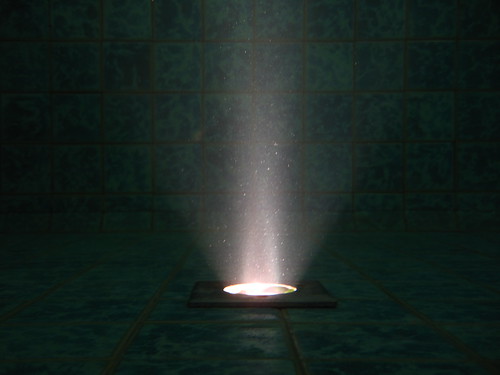
Quick test of wave shield and switching between files
Despite the temptation to BUY, BUY, BUY immediately, I’ve spent the last couple of evenings doing lots of internet research, trying things out and asking around for the opinion of others. It all still looks possible and I’ve just clicked the button on a couple of large component orders. Fingers crossed!
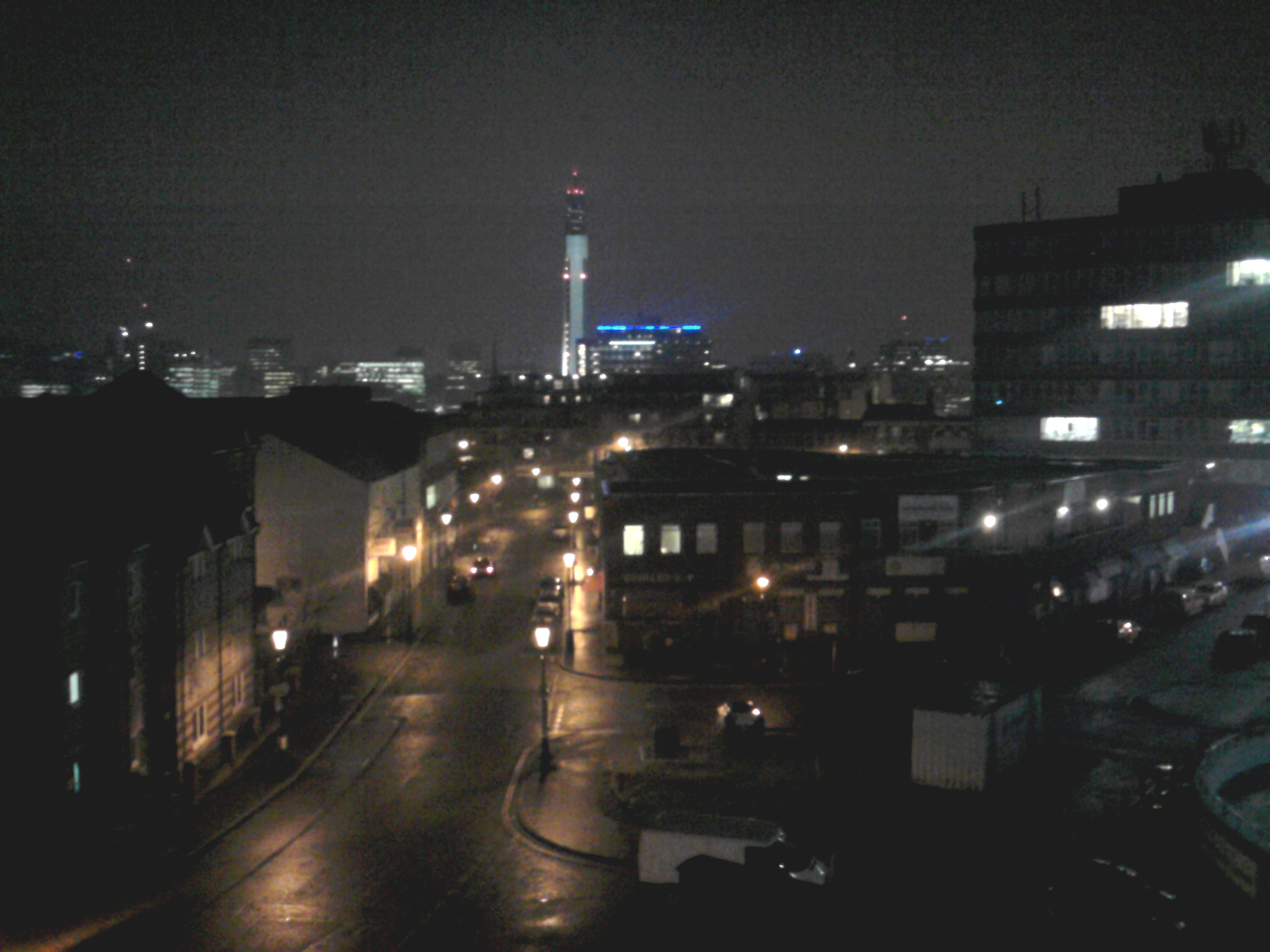
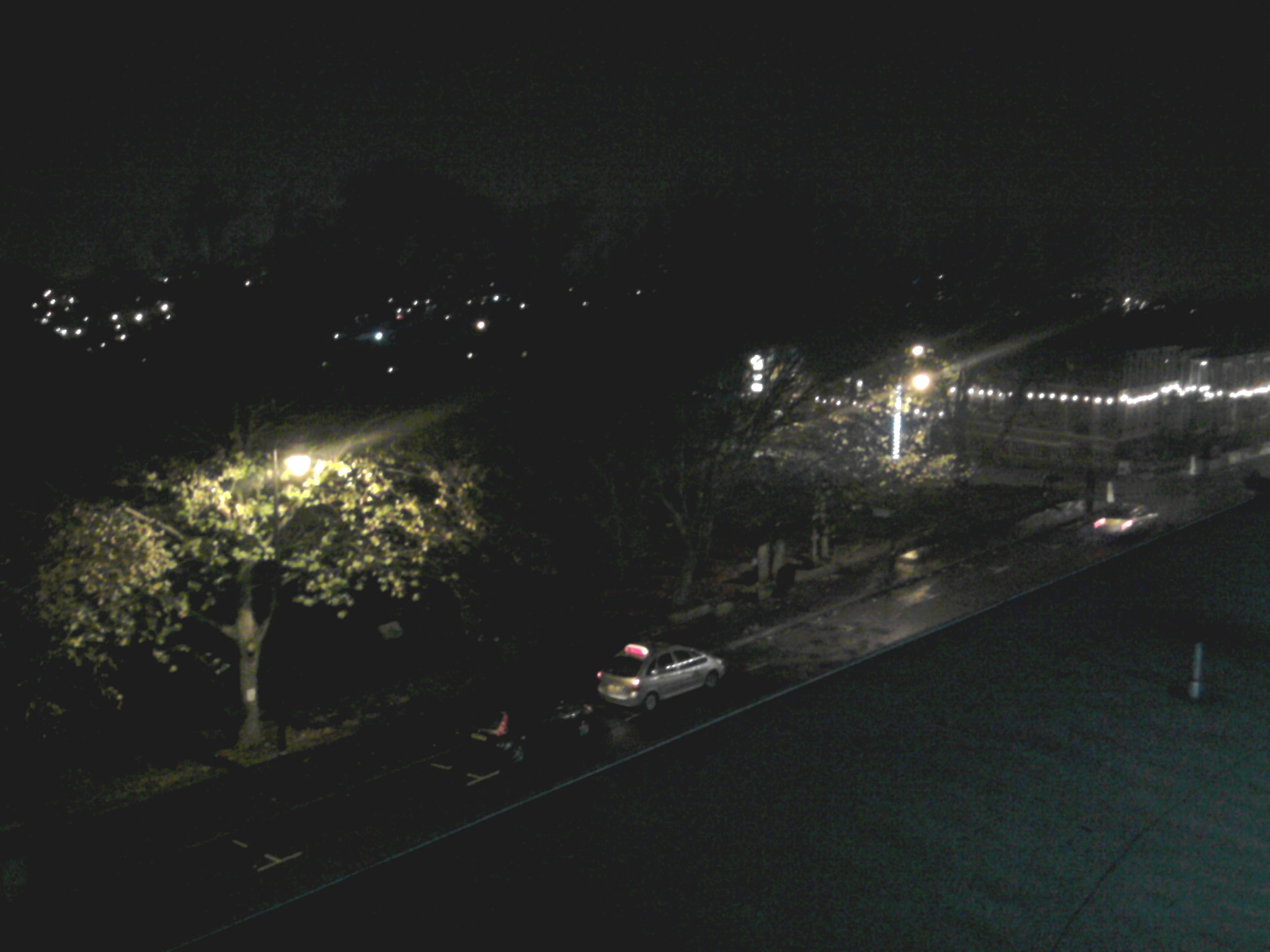
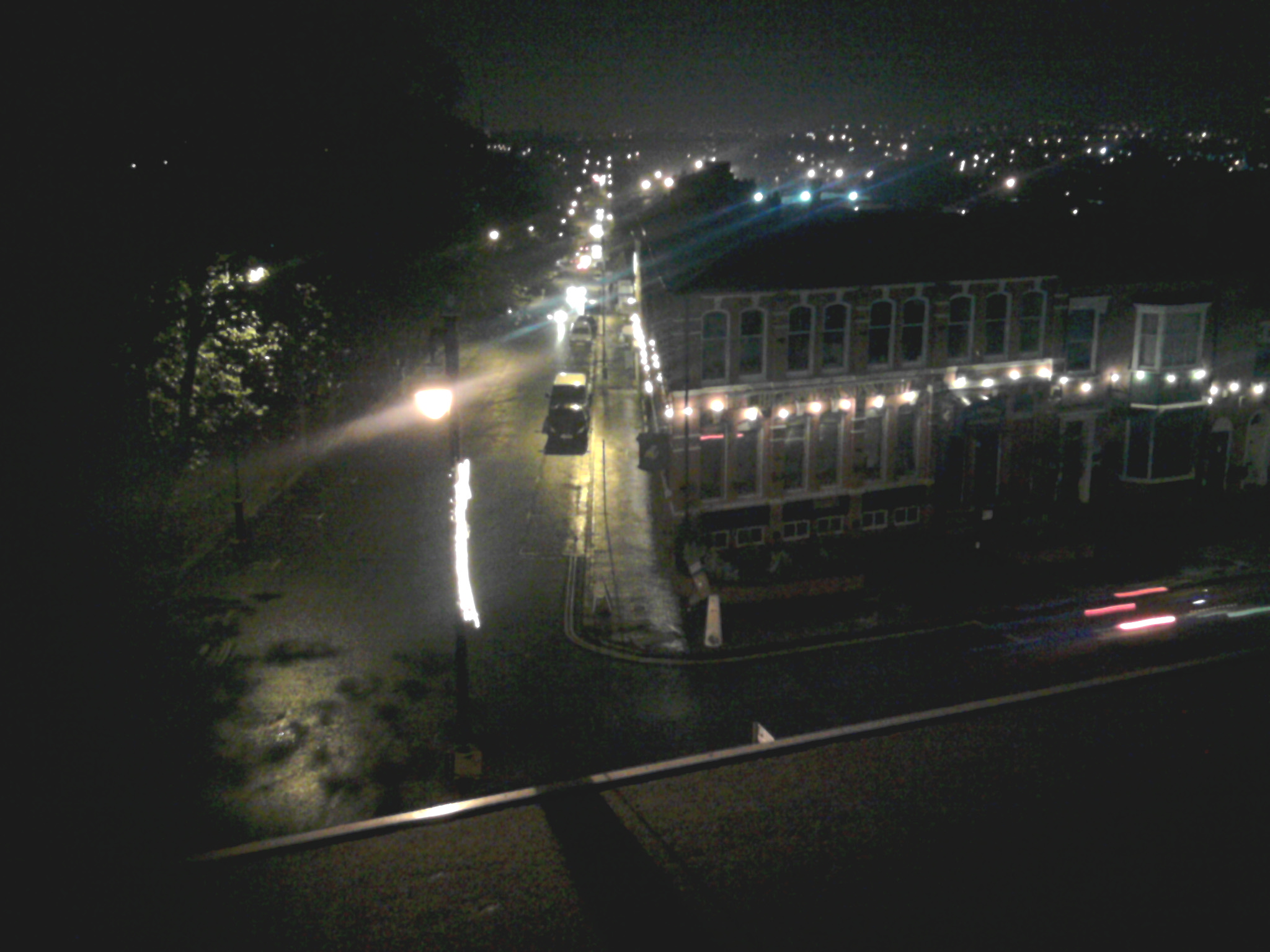
This scoping out of the tech has been complemented with a site visit to our main location.
View looking towards the city centre
Cemetary tree
Street corner
I like how the height of the car park takes you up to a height just above most of the surrounding buildings and also gives you a kind of buffer zone of space horizontally as well.
On Wednesday the 30th of November we’re going to gather people together on and around a car park in the Jewellery Quarter to search out some motes of memories. We’d love it if you’d join us. (It’s free, but there is a registration list so we can gauge numbers.)
“Dust” will be the result of a collaboration between myself and Hannah Nicklin, commissioned by MADE. MADE is a centre for architecture and built environment; Hannah makes lovely, thought-provoking theatre-y experiences; and I’m thinking hard about interfaces for locative technology at the moment. That should give you a rough idea of what to expect, but Hannah has blogged the thought processes that came out of our ideas session yesterday if you’d like to delve a little deeper.
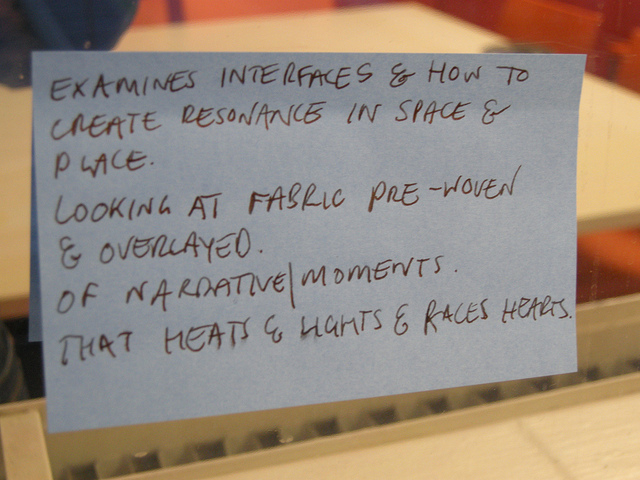
Here’s the brief we ended up giving ourselves:
... to make something that ... examines interfaces and how to create resonance in space and place. Looking fabric pre-woven and overlaid. Of narrative/moments.That heats and lights and races hearts.
We have only two more days working together between now and the 30th, so we’d like to ask you for a little contribution to help seed the piece.
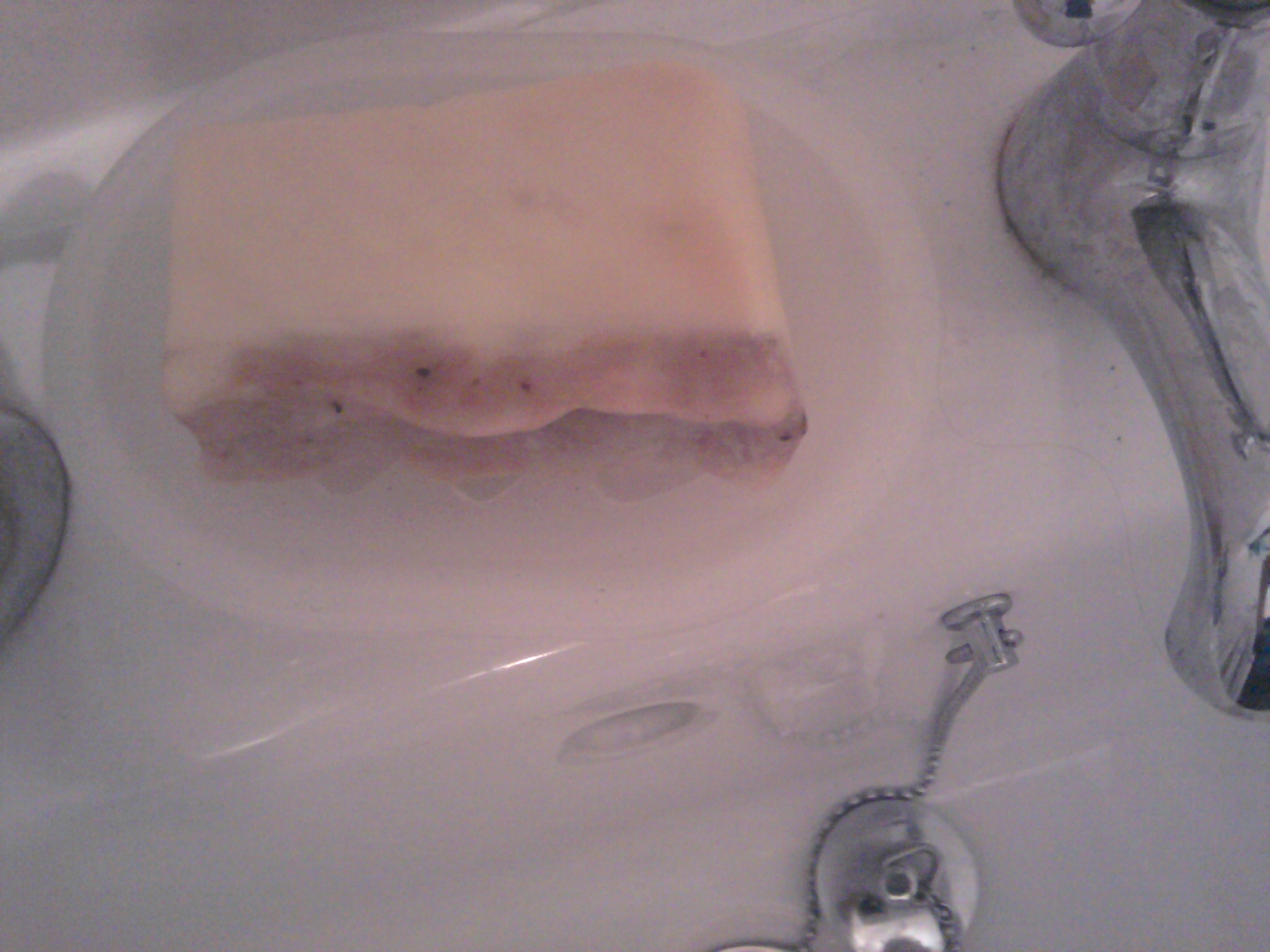
The soap in my bathroom reminds me of an afterthought, a twinkle in an eye and a delicious sense of humour.
What objects trigger memories for you?
You can share your objects and memories with us via Twitter by using the hashtag ‘#dust’, or write it in a couple of sentences in the comments for either this blog post or the one on Hannah’s site.
You don’t have to go into much detail; about the amount of writing you could fit on a post-it or in a tweet or two. You can send pictures if you like, but please briefly tell us about an object that is significant to you and why.
A few days ago I was on the Mobile, Location and Games panel at the Hello Culture conference.
Along with Oliver Williams (chair), Jon Bounds, Katie Day and Jason DaPonte we were tasked with talking to cultural organisations about “developing a new generation of mobile and location-based experiences and services”.
The audio for the whole session is available (very quietly) on this Hello Culture site. Below is the audio for my presentation alongside the slides I used. I gave an overview of the main things that get me about working in this area, with illustrations from various projects and experiences.
Looking at them now, the slides seem to be mostly people pointing and gesturing towards the things around them – I think this is A Good Thing!
Mr Catfood has only gone and organised a day-long festival of glitchy goodness!
It’s part of a wider programme of linked events happening worldwide and the Birmingham component is happening on November the 19th. That’s next weekend!
I’m running a circuit bending workshop at VIVID as part of the festival – guiding you through the process of turning a Staples Easy Button desk toy into a light-controlled scrambled noise device:
The workshop is at VIVID, takes place from 12:00 – 14:00 and is totally FREE. I’ll provide you with kit, tools and instruction and by the end of it you’ll have a glitchy doodad to take away with you.
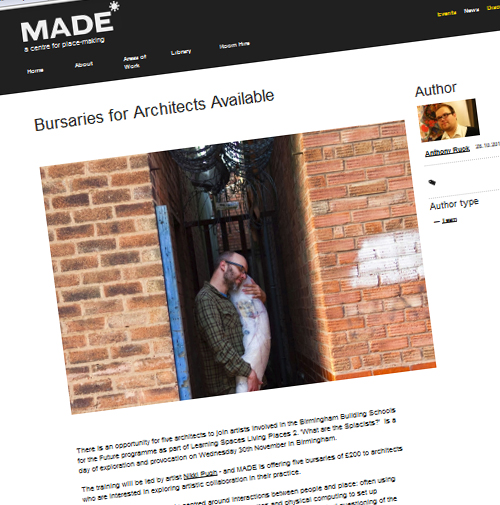
MADE are offering five bursaries of £200 to enable architects to participate in the 'What are the Splacists' CPD day on the 30th of November
Some time ago I was approached by MADE – an architecture and built environment centre based in Birmingham – to design and deliver a day of CPD for the cohort of artists on their ‘Learning Spaces Living Places 2’ programme.
Plans are now well and truly afoot for this and we’re so excited about it we’re opening up the day to a limited number of architects interested in collaborating with artists. Further information can be found at http://www.made.org.uk/news/view/bursaries_for_architects_available/, please email anthony@made.org.uk to register your interest.
Alongside the daytime activities where we’ll be questioning exactly what the Splacist manifesto might mean in practice, there’s an evening event open to all interested in this sort of work.
It’s difficult to pin down exactly what we mean by “this sort of work”. On the MADE blog posts it’s illustrated by Mr Pete Ashton stood in an alleyway gently holding a bundle of bubblewrap that vibrates in response to GPS data. This indeterminacy is in part why we felt the need to write the manifesto: to try and begin to mark out the territory…
So, to be part of the conversation, please do join us:
Who are the Splacists? // 5:45pm – 8:00pm // MADE 7, Newhall Square, Birmingham. B3 1RU // Free, registration required
We’ll be describing the context and development of the Splacist manifesto as well as reporting back on the outcomes of the daytime experiments. We will also be presenting an as yet unknown thing…
MADE have commissioned Hannah Nicklin and I to make a work in response to the manifesto. This is all very exciting for a number of reasons!
In the weeks leading up to the 30th of November, Hannah and I will be challenging ourselves to put our art where our mouths are and make a Splacist work. In three days.
We don’t yet know what will emerge from this collaboration, but we’re very much looking forward to finding out! If you bring warm clothes suitable for the weather, we’ll provide the talking points and a few mulled somethings. Please register here so we know how many people are coming: http://www.stubmatic.com/made/event/6899
We will own this city.
We will take it back.
We will link and shift; across time, space, people, places and processes
We will weave throughout the fabric of people’s lives.
We will unpick it.
We will affect and be affected.
We will glory in the moment, the collage, the marking and then passing on.
We reject your shopping centre, your pavement, your cultural quarter;
We will under mine pre-defined spaces. We reject them.
We will reclaim the city, not for you, but with you.
We are you.
An accumulation of GPS tracks in Google Earth - the series of lines across Central Park and the set of three bridges represent two new pieces of work, the loop of yellow near the bottom represents two new friendships and the remainder represent a lot of looking and learning.
I recently went through my notebook and pulled out what are, for me, the resonant points from my 38 days in NYC. These come from various – and often multiple – sources:
Radical changes occur when you link solutions to a new system.
Fringes are very important.
Porosity (leaving gaps for others to work in) is very important.
What you think of as being possible is dictated by your past experience and/or what you think of as being the problem // You cannot see what the future post-leap will be // People will use the X in ways you cannot predict.
Failure as a measure of progress.
The importance of documentation and of working in a do-ocracy // Mapping possibilities through experimentation.
Often the best teachers are those who have just learned for themselves.
We’re not making things, we’re making things that help us to learn about ourselves // Making probes to reveal more about the world // our apparatuses and questions reveal new possibilities .
The importance of triangulation // We show up through our interactions and relationships with others.
A few nights ago I was trying to convey to a friend my incredulity at being able to assemble things like the brains for the Colony creatures.
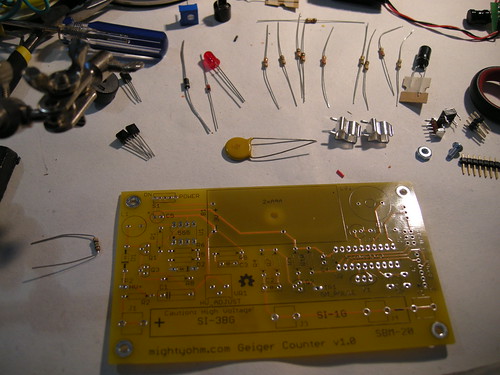
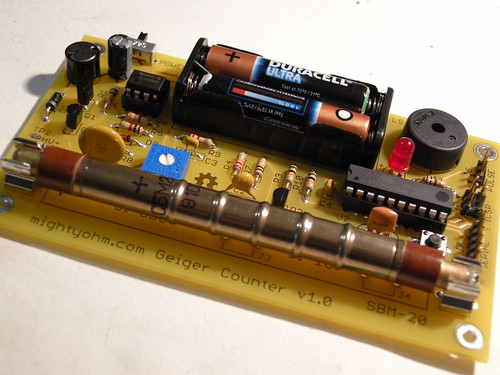
Here’s something to blow your mind: parts to fully-functioning gieger counter in about 40 minutes. Thank you open source.
In blatant disregard of my pledge to not let projects be led by the technology, I’m now sat at my workbench, listening to the sounds of the universe, wondering what I can connect this up to…
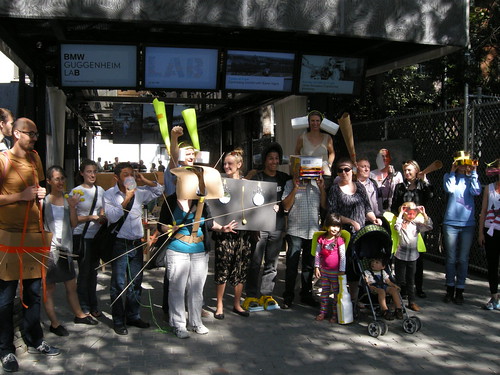
Participants will create wearable objects that alter and enhance their experience of the sites surrounding the Lab.
And that’s what we did!
Urban Sensation Transformers about to embark on a tour of the neighbourhood
I’m a big fan of things that provide an alternative lens through which to experience the city, and this did exactly that in spade-fulls. With the added bonus of working with other senses, not just sight.
Following on from the Spurse workshop where we had explored sensing the environment through a stick whilst blindfolded and wearing earplugs, I wanted to delve a little deeper into the idea of an extended sense of touch. I’d found that with the single stick we were using before, there was a tendency to use it to jab at the ground. Sweeping movements often resulted in the tip getting stuck and everything seemed very ground orientated, neglecting the new possibilities of now being able to reach up far higher than usual.
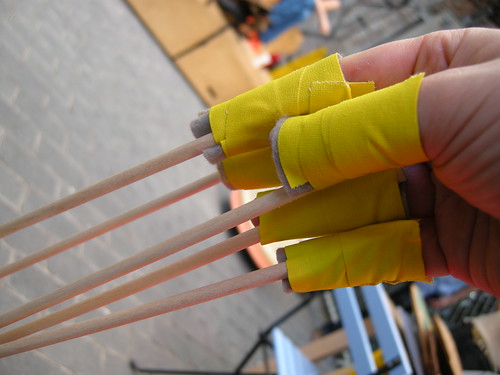
To try and remedy some of this, I attached a dowel (this time a lot thinner and shorter) to each of the digits of my right hand:
I could now not only reach up a lot higher than usual, but also explore gripping and stroking my surroundings in a way that felt like a more natural extension of my sense of touch. A strange combination of something that at times seemed quite sinister, but also led to much childlike exploration of sound on railings and other bits of street furniture.
[I note I’m using the word “explore” a lot – this is a good thing!]
I particularly enjoyed my new super powers of being able to reach up to touch leaves, being able to feel both sides of a tree trunk at once and touching a few NYC icons such as the metro signs and crossing lights.
I also made a few connections with others – those with modified senses of touch, those who stopped us to ask questions and those who were also carrying sticks…
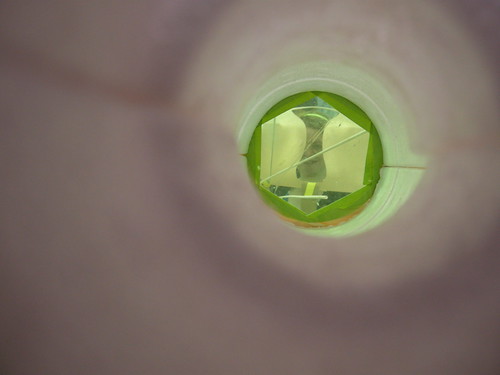
I was also sporting a visor designed to encourage me to look up more. I’ve been kind of self concious about this since over-hearing some New Yorkers saying you could always spot the tourists because they were the ones looking upwards!
The visor has some unforeseen effects on communication (my voice seemed muffled to me, so I ended up speaking LOUD LY AND CLEAR LY in stereotypical Brit abroad fashion, and I could only address people directly in front of me) and on navigation (I could still see in front of me and still had my peripheral vision, but was now missing the stuff in between – crossing roads became a matter of trusting those around me because I couldn’t see what the traffic was doing). It worked nicely in terms of affecting my perception of place, though – even the most grotty of locations seemed to be all blue sky and treetops to me!
Below is a slideshow of my photos from the workshop. I love how much we achieved with our craft materials and a short build time. I’d very much like to repeat this again on my home patch somewhere…
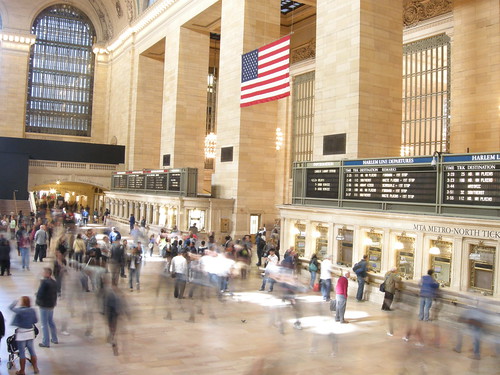
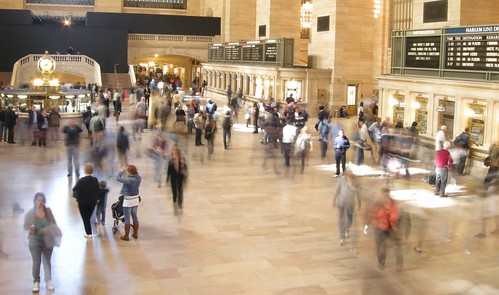
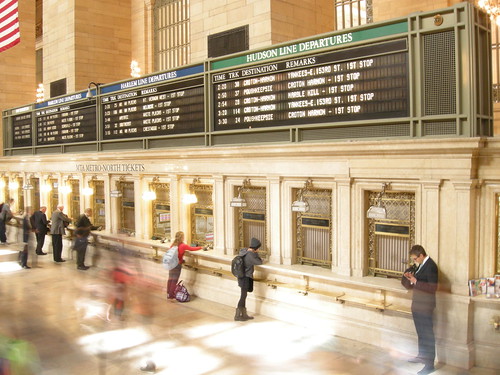
Grand Central Terminus. What’s the opposite of terminus? An appropriate term to signify beginnings? How is the man in the burgundy jumper feeling? What will the mother decide to do? Does the young woman in the red top want to go?
~~~
Today I intended to walk across the Manhattan Bridge, but I lost the detour and spent ages trying to find where I was supposed to go. When I found it again, it was dark and I got scared and gave up. I should have heeded the sign.
~~~
Two minutes and sixteen seconds at Canal Street station standing still, leaning against a pillar listening to the different sounds all around me. You probably won’t hear the rats bickering, but it made those around me pause and take notice too.
My main area of enquiry is centred around interactions between people and place: often using tools and strategies from areas such as pervasive games and physical computing to set up frameworks for exploration.
If you'd like to commission me or collaborate with me, please get in touch via the contact page.
General blog contents released under a Creative Commons
by-nc-sa license.
Artworks and other projects copyright Nicola Pugh 2003-2026, all rights reserved.
If in doubt, ask.
The theme used on this WordPress-powered site started off life as Modern Clix, by Rodrigo Galindez.