invigilator 4
Like the memorial in the park, all I really feel confident about saying regarding each of the pieces in the Invigilator series at the moment is simply that they happened.

Nuneaton: George Eliot and Invigilator were here.


Like the memorial in the park, all I really feel confident about saying regarding each of the pieces in the Invigilator series at the moment is simply that they happened.
Nuneaton: George Eliot and Invigilator were here.
This morning I went along for an introductory visit to the local primary school where I will be doing a project with some of the students.
I found myself in the staffroom with some teachers fresh from an assembly where they’d had two dancers performing. One thing led to another and suddenly the conversation had evolved into the one about Not Getting Modern Art. You know the one – it always starts with The Bricks and The Bed.
I let it go. I didn’t have the heart to introduce myself as the artist who’d just been asked to do something with the reception class’ bricks.

Observation became participation after stepping in to perform banana-opening duties at break time and the food-related theme continued with invisible chocolate soup and an invisible glass of wine with cream on top.
You gotta love it.

Well, I’m feeling like a proper 4649 veteran now, but it’s actually only 3 weeks today that I was first invited to join Kissa Hanare‘s project!
Taking part has raised all sorts of interesting questions: not least about my own lack of political awareness of what’s going on in my own country. I haven’t got anywhere close to answering those, but in the meantime I wanted to note down a few thoughts about my photographic contribution.
In the introductory post I challenged you, dear reader, to take some images of the 4649 stickers that would stimulate a chat. Having already challenged myself to do likewise I had previously gone into Birmingham’s city centre and headed straight for two obviously very charged locations: the Hall of Memory and the Peace Gardens.
Yikes! Red poppies everywhere! Giant red poppies. hmmmm, not sure what I feel about that, think it’s possibly crossed a line somewhere…. (Oh, and by the way, Happy Christmas Birmingham)

Heading off somewhere equally disturbing in the opposite direction, I also suddenly became aware of how noble and, well, perfect the statues around the Hall of Memory are.

What exactly are we saying here?
… and how do I want to use the stickers to respond to it?
After a fairly predictable set of images involving statues and red telephone boxes I headed off down past the Mailbox towards the Peace Gardens – a distant memory from first-uni days and the number 44 bus up from the Vale.
This is when I started getting a bit more creative and started incorporating parts of existing signage into my images. Sod possible language barriers, this was much more interesting. I also loved the ambiguity that came from me not actually knowing what the text on the stickers says, or in what tone it says it.
What happens to 九条死守夜露四苦 when you put it next to a sign that says “For how long?”?
Anyway, I felt using the stickers to react to more subtle details in the city landscape was a lot more interesting.

I probably spent about an hour and a half taking photos and have whittled the results down to 39 which I’ve uploaded to a Flicker set.
Which ones are most successful and why? (How do you judge success for something like this?)

I just want to say a big thankyou to everyone who responded to the mailout and have requested stickers either from myself or directly from Hanare.
There’s not much time left before the Monday-night event, but you can still print off a few if you’d like to contribute.
Of the original batch of stickers Hanare gave me I’ve given away 11 to people who wanted to join in and I’m now left with just one. Where should I put it? Should I go for a good photo, should I stick it somewhere it’ll get left up for a while, or should I seek out somewhere where it’s likely to be seen by people who can read the text?
Every Monday (but not holidays, they don’t like to work on holidays!) Naho, Yufuko and Sakiko transform a Kyōto living-room into Kissa Hanare – something I like to think of as Café Independence (…but I’m now told the detached-ness I was inferring from dictionary searches is just an architectural reference). Not only does Hanare provide a menu of, where possible, locally-sourced, organic food, but they also work hard to create an atmosphere in which they and their guests can freely address a range of pertinent social and political issues.
In my limited experience, I’ve only just begun to scratch the surface of Japanese culture, but I have a small sense of how difficult it must be to create this type of space. (Hell, I can’t even really imagine it happening here!) What’s more, judging by the blog, I believe they’ve managed to make it sustainable to the extent that the project’s been running for at least 18 months now. Impressive!
Regular café nights are interspersed with lectures, workshops and larger projects.
4649 (representing “yoroshiku” – a Japanese term I’m not even going to begin to try and translate, let alone the significance here) is Hanare’s latest project and they’d like to ask you for your support.
Since 1947, Japan has had a pacifist constitution arising from Article 9.
Aspiring sincerely to an international peace based on justice and order, the Japanese people forever renounce war as a sovereign right of the nation and the threat or use of force as means of settling international disputes.
In order to accomplish the aim of the preceding paragraph, land, sea, and air forces, as well as other war potential, will never be maintained. The right of belligerency of the state will not be recognized. wikipedia
Its exact origin is disputed, as has been its interpretation by successive governments. As you can imagine, there has recently been increasing talk from various Japanese politicians of revising this article.
I’m not going to start passing judgement here based on a few articles I found on the internet, however what I do feel strongly about is that there should be a space for Article 9 and the potential consequences of amending it to be highlighted and discussed freely amongst people who are not politicians.
I’ve exchanged emails a few times with Sakiko recently. Here’s how she introduced me to the 4649 project (slightly edited, my emphasis):
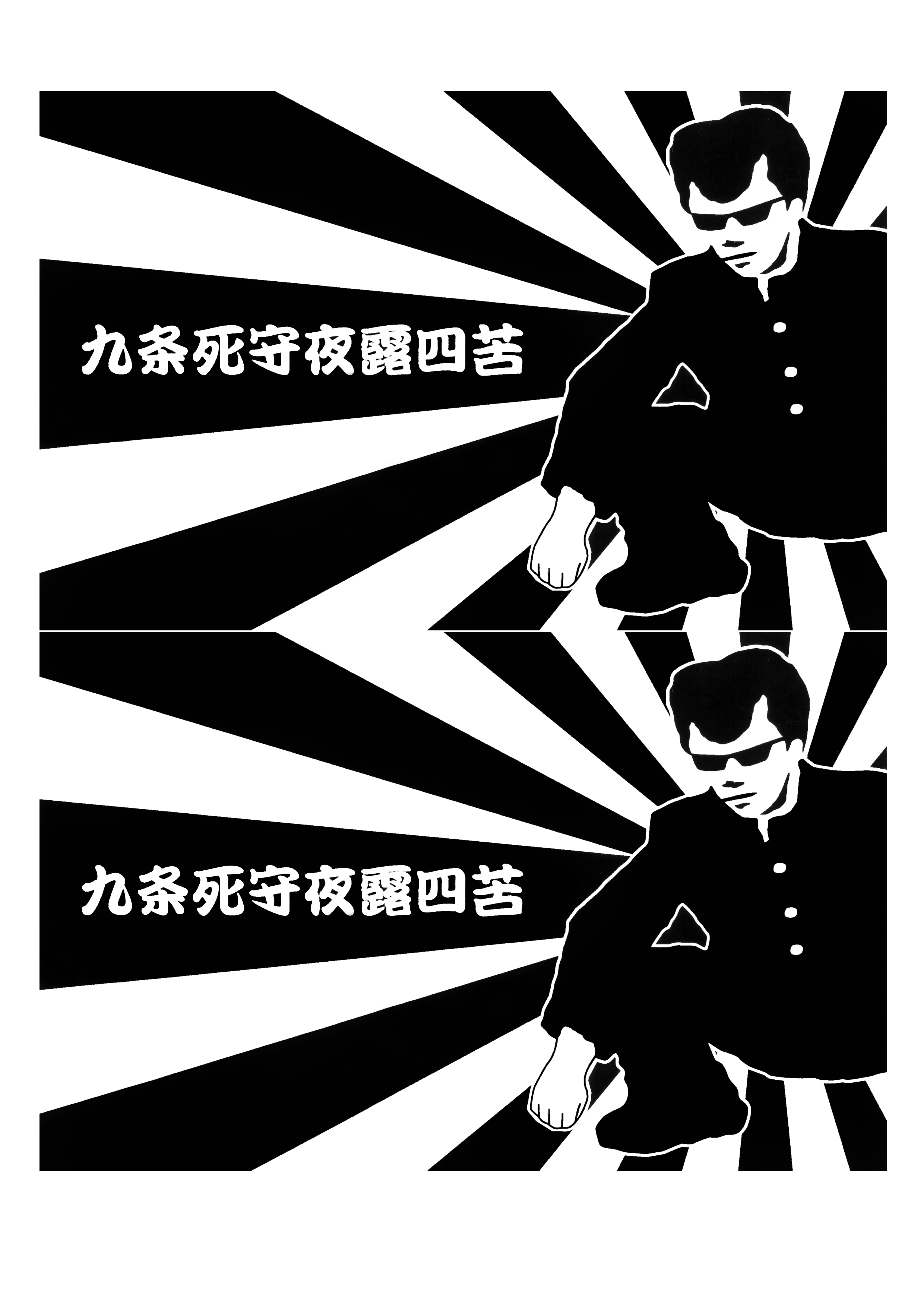
…we are planning to have a t-shirt silk-screening party on November 12th, in which we will print images of a Japanese gangster with the statement written also in the gangster style font that opposes amendment of the Article 9 of the Japanese constitution, which prohibits Japan from possessing any military force and use it to solve international conflicts.
Additional Information about Article 9
Article 9 is, in a way, an apology for neighbouring countries for what Japan did before and during WWII, as well as a promise that we will never become a militaristic country. The Japanese government has been attempting to transform the beautiful part of this constitution for a long time, yet have met huge opposition from Japanese people. Since Koizumi, though, the danger of the article being amended has been greater than ever, and we want to do something about it.
Here is what we are planning to do for the party. Prior to the party, we will print tons of stickers with the same image and send to those of you living abroad and outside of Kyoto. And I want you to put the stickers out on the street and take pictures of them and send to us, which we will project as a slideshow at the party and upload to a Flicker site. People attending the event are able to see the image in other parts of the world, and hopefully feel that we are not alone. Showing the photos is really critical because based on my experiences in Japan, we are so isolated from the rest of the world, physically, and mentally.
By showing the pictures, I want people to have a sense that what we are fighting matters, and is supported by people abroad, NY, SF, BCN, Pula, London, etc. plus, Japanese people living abroad might see the image too!
Here is an idea behind the image. In contrast to the States and Europe where there is a very sophisticated visual resistance culture, Japan lacks it so badly that young people here have a hard time getting involved with political activity. By taking the aesthetic of Japan’s gangster culture and twisting its violent and rather nationalistic representation, and saying goodbye to the conventional peace movement images like the dove, we are hoping to encourage Japanese young people that there are many creative ways to express their opinions.
Here is the image she’s talking about:

There’s a nice quote I came across whilst Googling stuff earlier:
To reach consensus in democracy, it is necessary to guarantee a free space where even the oppressed can express their opinion without concern for logical consistency and truth. The fact that chats have been neglected as the fundamental element of democracy shows that past democracy has been only for the few who could speak logically and consistently.Polylog
It doesn’t bear close scrutiny, but there’s a few nuggets in there that resonate strongly with how I perceive Hanare. My challenge to you is to use that graphic above to make an image that stimulates a chat at Hanare (or beyond).
Remember the aims are a) to have the sticker on the street and preferably somewhere that is obviously not Japan and/or b) to demonstrate the potential of creative techniques to express an opinion.
You could be provocative:

You could be subtle:
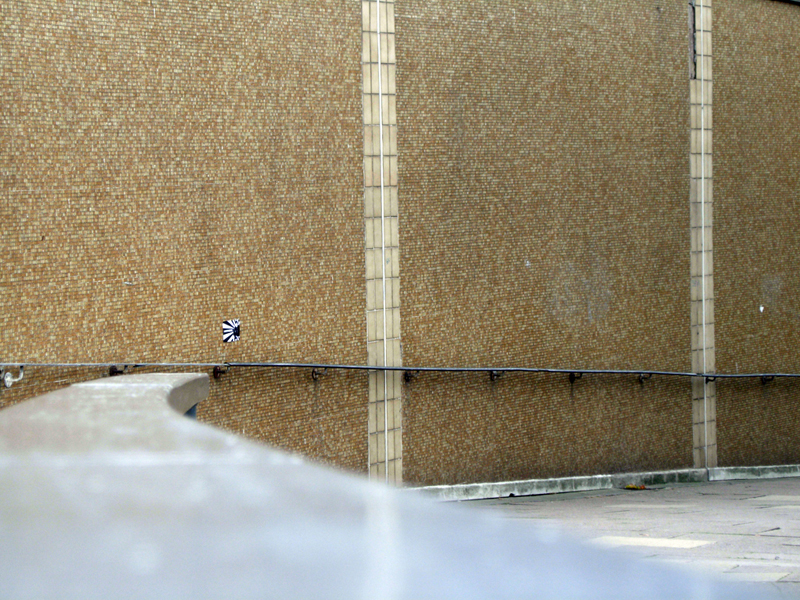
You could be surreal:

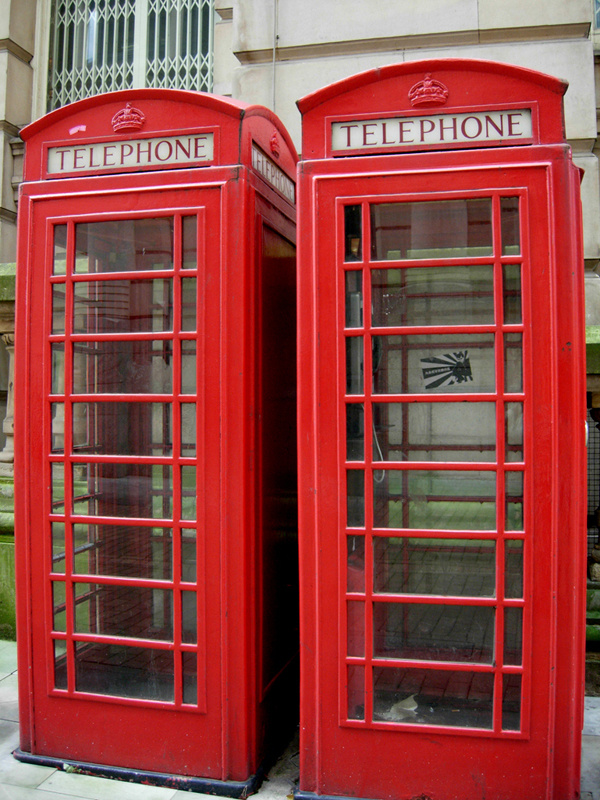
You could be terribly, terribly British (or whatever):
Here are some suggestions for some low-energy ways of showing some support for Hanare:
I’m sure you can think of others – be creative!
update: I wrote a little about the photos I took in this later post.
Still working my way through the backlog – this time another attempt at documentation that doesn’t involve sticking a video camera or a telephoto lens in anyone’s face. Including mine. urgh.
Here I walked with a voice recorder in the side pocket of my rucksack and a camera on interval timer just held in my hand as I walked. The result is some fairly snap, crackle and pop audio and some blurry photos…
…I think it works quite well!
The images [portrait format, distorted horizontally to fit the video’s dimensions – apologies to the woman in the brown dress] appear at minute intervals so there’s a long gap in between them where you only have the audio. Initially I was planning to have the images on screen for longer, thinking that visual = interesting. What I actually found was the images became something of a distraction. Ideally I’d just plug myself into my headphones and settle back with my eyes closed, but here I have to stay mindful of the screen and a minute is a really long time…
Instead we have flashes of imagery to act as sort of orientation for the sounds, but not until you’ve had a while between photos to imagine up your own images to accompany the noises. In this way I think I regard the white as a blank canvas to paint your own pictures onto. Maybe not being able to understand what the people are saying is another aspect to this too?
There comes a point when you just have to back off and leave space for people to make their own meaning.
The full walk lasts for over 1 hour and is not for the faint-hearted, so here is a 10 minute extract. I really recommend headphones; whether you keep your eyes open or not is up to you.
Oh, and I was also hooked up to a galvanic skin response sensor at the same time, but that’s another story.
2 done, only another 27 left to go.

When I first went to Japan I had no concept of where I was geographically other than “somewhere to the left of Tokyo”.
When I went to Japan the second time, I had no concept of where I was geographically other than being slightly savvy with the metro map.
After going to Japan for a third time I decided to plot the places I had been on a map. See the full interactive version here: http://npugh.co.uk/jmap
A week or two ago I posted an incomplete post about invigilator: Tokyo.
Well, I’m back in the UK now and sorting through all my documentation from the trip to Japan.
I’ve uploaded a few images to Flickr. There’s a slideshow here, but the pages on Flickr include captions giving more detail about each image.
but I was a bit wary about taking too many photos during the invigilation. I think it’s just a little bit too intimidating for a project that’s so much about how people react to subtleties within a space.
So, as an experiment with alternative forms of documentation, here’s a sound recording we made of the invigilation:
[audio:http://www.npugh.co.uk/media/invigilator-tokyo%20fade.mp3]A 6 stanza themed renga form collaboratively written with Paul Conneally.
Form devised by poet Gary Gay.
Twenty Jaffa Cakes
a rengay
twenty jaffa cakes
a mistake to try and take
in her hand luggagea slow and silent pat down
from the woman on gate onestilettoes x-rayed
but her carbon footprint is
not for scrutinya hugely fat man
asks for the front port aisle seat
to rest his bad legsmile and permanent jetlag
slept in uniform againdeep into morning
i finish my book somewhere
over africapaul conneally and nikki pugh
July 12th 2007
My plane leaves at 8.30 tomorrow morning. I arrive at Narita on Saturday morning and from there I have to negotiate my way to Yokosuka. After a week or so in various locations around Kanagawa-ken I dive into Tokyo for about a fortnight.
On the way back from invigilating a small section of the New Forest, we encountered Copythorne Carnival.
I was interested in the resonances with what I had just done and the presence of the stewards and the bystanders.
Copyright and permissions:
General blog contents released under a Creative Commons
by-nc-sa license.
Artworks and other projects copyright Nicola Pugh 2003-2026, all rights reserved.
If in doubt, ask.
The theme used on this WordPress-powered site started off life as Modern Clix, by Rodrigo Galindez.