Sonar Goggles and The Blind Fiddler

Paul Conneally has been using his cultural foraging technique to bring together (cf ‘curate’) an exhibition at the Snibston Discovery Museum exploring home entertainment between the years 1806 and 2012.

Paul Conneally, transform’s Cultural Forager, discovered that The Blind Fiddler was painted in the kitchen of Coleorton Hall Farm in 1806 – the same farm that the great poet William Wordsworth lived in with his family. The picture was commissioned by Sir George Beaumont and given by him to the nation and now forms part of the TATE collection.

The exhibition will feature artefacts held by Leicestershire County Council’s Museums Service, new works by Conneally, other artists and local communities where the picture was originally painted.

The exhibition’s starting point is the painting The Blind Fiddler by David Wilkie 1806 painted in Coleorton Hall Farm Kitchen North West Leicestershire.

Starting at The Blind Fiddler, Conneally has linked and shifted to an eclectic range of artefacts and references – one of which gets him to my sonar goggles!

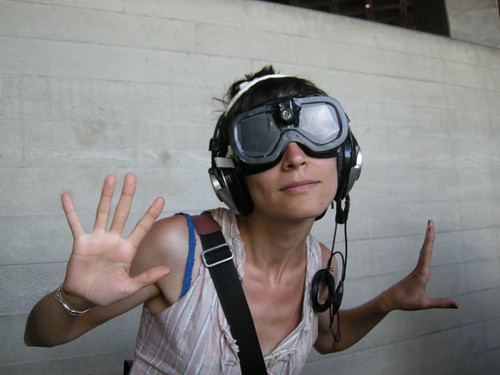
Experimenting with the sonar goggles

A pair of sonar goggles being experimented with at the Hide&Seek Weekender at the National Theatre, 2010

The Blind Fiddler – Home Entertainment 1806 – 2012 opens at Snibston tomorrow (Saturday the 14th of January) and runs until Sunday the 4th of March). Pop along for some Happy Families and maybe a bit of SingStar.

Testing, testing…

Please ensure the gate is bolted after entry and exit.

I’m test-driving a few ideas and approaches in preparation for a week in residence at New Walk Gallery as part of their Play Ground exhibition programme:

What rules do we follow in galleries? What rules would you most like to break? What new rules would you write?

The Ministry of Rules (MoR) is a fictional organisation that will be based in the Play Ground exhibition. The MoR needs your help to research, observe, explore, enforce and re-write the rules people may or may not be following in the art gallery and museum.

As part of this I want to check having a Flickr account that people can post to. Would you help me out, please?

I’m looking for examples of signs and notices with some sort of imperative about them. The theme is rules, so the sorts of things that tell you to do this, or not do that or that such-and-such is forbidden.

I suspect road signs and other massively mass-produced signage might get a little dull, but there are loads of examples out there that are custom-made or more interesting because of their context. Can you help me hunt them down and then email them to church20arts@photos.flickr.com ?

Just add the photo as an attachment and, if you want, put a title as the email’s subject. The photos will get posted to this photostream: http://www.flickr.com/photos/therepositoryofrules/

I’ll leave it running for about a week to see how it shapes up. Get noticing!

Things we have learned #1:

You can add descriptions for the photos in the main text of the email. If your email automatically adds a signature with your contact details etc, you may wish to remove it…

Things we have learned #2:

If you don’t add a title via the subject line, Flickr will use the file name of the image.

We are the experts. Who are we?

An open sketchbook post in preparation for 5 days residency-style alongside Play Ground. See this initial post for more background. Open to influence, rather than just on display: all constructive conversations and contributions welcomed. All posts in this series can be found under the Play Ground tag.

In this post I ask for suggestions for the name we will work under. Probably some sort of government ministry, but we don’t know yet. What do you think?

***

We work closely with professionals from affiliated departments.

We are the experts in how the public behave in cultural institutions. We work with theory, observation and practical experimentation. We work in large groups and small teams. We work alone. We sometimes go undercover. We make the decisions about what is proper behaviour within museums and art galleries. We enforce those decisions.

Who are we?

Please add your suggestions for the name of this group to the comments, or tweet @genzaichi

Getting stuck into The Participatory Museum (part 2)

An open sketchbook post in preparation for 5 days residency-style alongside Play Ground. See this initial post for more background. Open to influence, rather than just on display: all constructive conversations and contributions welcomed. All posts in this series can be found under the Play Ground tag.

In this post I continue reading The Participatory Museum to get a critical foundation in different approaches to… participation in museums.

As before, below are fragments from the book that seem particularly pertinent. I’ve copied and pasted them across to here as a sort of scrap book as I’ve come across them. Sometimes I’ve added notes, sometimes I’ve added italics, sometimes I’ve added nothing. In an attempt at making things easier to find again later, I’ve organised the cuttings under links to the sections of Nina’s book that they came from.

***

http://www.participatorymuseum.org/chapter2/

This technique, like all audience-centric initiatives, requires staff members to trust that visitors can and will find the content that is most useful to them. When staff members put their confidence in visitors in this way, it signals that visitors’ preconceptions, interests, and choices are good and valid in the world of the museum. And that makes visitors feel like the owners of their experiences.

Reminds me a little of the saying “the pictures are better on radio”. Leave space for people to make their own meaning etc etc

Cultural institutions are often terrible at this, especially when it comes to visitors. Even at museums where I’m a member, I am rarely welcomed as anything but another body through the gate. This lack of personalization at entry sets an expectation that I am not valued as an individual by the institution. I am just a faceless visitor.

To some extent, ameliorating that facelessness is a simple matter of providing good guest service. Vishnu Ramcharan manages the front-line staff (called “hosts”) at the Ontario Science Centre. He trains hosts with a simple principle: hosts should make every visitor feel wanted. As Ramcharan put it: “The hosts shouldn’t just be excited generally that visitors are there, but that you specifically showed up today. They should make you feel that you are someone they are thrilled to see at the Science Centre.” This may sound trite, but when you see Ramcharan’s smile, you feel as you do in the hands of any accomplished party host—desired, special, and ready to engage.

Magic vest! Can I wear a magic vest?!

The small presentation of self-expression becomes a kind of beacon that links me to others in a loose social network of affinity.

Aspirational stickers :)
Which behaviour do you secretly most harbour a desire to do when faced with a staid gallery setting?

These kinds of profiles are only useful if the institution can deliver an enhanced experience based on them. In Heroes, the enhancement was the opportunity to find and explore hero-specific content threads throughout the exhibition, and to connect with other people about their different identities.

hmmmmm. What enhanced experience? Link aspirations to the exhibits?
Will people chant together at Sculpture for Football Songs if they’re all wearing stickers saying they want to be noisy in galleries?

Rather than focusing on extending single visits with a pre- and post-visit, it can be more valuable to link multiple visits with offsite experiences.

Starting to sound very transmedia!
(I also think I’ve started reading this through the lens of other projects, since a lot of this chapter is way beyond the scope of my 5 days in the corner of a room. Will be good to see what I can apply, though.)

There’s no “delete” button for the postal service

:)

establish an expectation that you might visit multiple times

See you in a day or two for the next chapter!

Getting stuck into The Participatory Museum (part 1)

An open sketchbook post in preparation for 5 days residency-style alongside Play Ground. See this initial post for more background. Open to influence, rather than just on display: all constructive conversations and contributions welcomed. All posts in this series can be found under the Play Ground tag.

In this post I do some research to get a critical foundation in different approaches to participation in museums.

***

Nina Simon‘s writing on the subject of participation in museums – and the communities that I have been linked to from it – have been a stimulating influence on my work involving games, schools and more for a few years. Now I’m actually responsible for participatory activities in a museum it seems like a very good prod to get on and read her book The Participatory Museum.

Below are fragments from the book that seem particularly pertinent. I’ve copied and pasted them across to here as a sort of scrap book as I’ve come across them. Sometimes I’ve added notes, sometimes I’ve added italics, sometimes I’ve added nothing. In an attempt at making things easier to find again later, I’ve organised the cuttings under links to the sections of Nina’s book that they came from.

http://www.participatorymuseum.org/preface/

I define a participatory cultural institution as a place where visitors can create, share, and connect with each other around content. Create means that visitors contribute their own ideas[1], objects, and creative expression to the institution and to each other[2]. Share means that people discuss, take home, remix, and redistribute both what they see and what they make during their visit[3]. Connect[4] means that visitors socialize with other people—staff and visitors—who share their particular interests. Around content means that visitors’ conversations and creations focus on the evidence, objects, and ideas most important to the institution in question.

[1] Another reason to do a signtific brainstorm at the start of the residency? (see previous post). Preferably leave it up for the duration, too, so it can keep evolving.
[2] Make exchanges with spaces! 2 way exchange. (Ref Counsel for the Artist.)
[3] Seeing, making… different modes of engagement – provide different ways in.
[4] Makes me think of the “sense of community when it snows” example (see previous post)

http://www.participatorymuseum.org/chapter1/

visitor co-produced experiences.

Need to do prep-work and have a few ideas in back-up, but mostly focus on providing the platforms that enable the visitors to be creative.

Like schools work! “It’s not your job to be creative”!

This may sound messy. It may sound tremendously exciting. The key is to harness the mess in support of the excitement.

How much mess can we get away with?

But people who create content represent a narrow slice of the participatory landscape, which also includes people who consume user-generated content, comment on it, organize it, remix it, and redistribute it to other consumers.

creators are a small part of the landscape. You are far more likely to join a social network, watch a video on YouTube, make a collection of things you’d like on a shopping site, or review a book than you are to produce a movie, write a blog, or post photos online.

When designing participatory components to exhibitions, I always ask myself: how can we use this? What can visitors provide that staff can’t? How can they do some meaningful work that supports the institution overall?

What happens to the results? What’s the point? How does this translate to 5 days straight in and straight out? Might be about making it relevant to my practice?

If you focus solely on participation as a “fun activity,” you will do a disservice both to yourself as a professional and to visitors as participants.

As Geoff Godbey, professor of leisure studies at Pennsylvania State University, commented in a Wall Street Journal article: “To be most satisfying, leisure should resemble the best aspects of work: challenges, skills and important relationships.”

Games researcher Jane McGonigal has stated that people need four things to be happy: “satisfying work to do, the experience of being good at something, time spent with people we like, and the chance to be part of something bigger.”

Make them just tricky/taxing enough. How to make the museum activities just taxing enough? (esp for all age ranges!)

to collaborate confidently with strangers, participants need to engage through personal, not social, entry points.
Starting Points

An open sketchbook post in preparation for 5 days residency-style alongside Play Ground. See this initial post for more background. Open to influence, rather than just on display: all constructive conversations and contributions welcomed. All posts in this series can be found under the Play Ground tag.

In this post I unpick the exhibition blurb, looking for a way in.

***

The Learning Officer for the exhibition is giving me free rein on this project. My brief, such that it is, is to instigate activities that encourage people to work together whilst having a sense of fun. This could be in the form of competing against each other within a game, but the example she’s used a few times is like the feeling of community after it’s snowed.

The expected audience is predominantly families: “some with large quantities of kids, some a mum and a pushchair”. The activities therefore need to be interesting and accessible for potentially very young children getting involved for, say 20 minutes. My games-based work has mostly been with adults though, so I’ll be wanting to provide more challenging things for that sort of audience – say hello, let me know if you’re interested in visiting, so I can cater for you too!

So that’s it then. Blank piece of paper.

I started by dissecting the listings blurb:

At an art gallery we usually have to follow a series of rules. Don’t touch the work, don’t run, don’t shout, don’t play. Don’t, in short, have fun. We thought it would be good to try something else – this exhibition shows contemporary artists that treat the gallery like a fairground rather than a church.

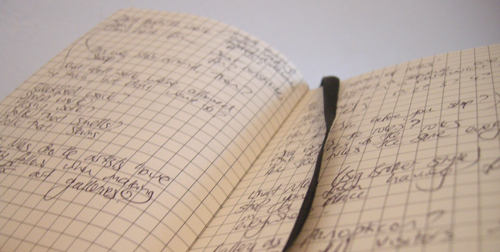
What follows is a reproduced version of a list from my paper sketchbook, tidied up a bit and with more added as I think about it again now. I’d have preferred to have mind-mapped this stage, but was out and about without a large surface to work across. Oh for a large portable whiteboard!

Trying to capture the thoughts as fast as they pop into my head

A series of rules.

  • What rules do artists have to follow when making work for galleries?
  • Can we make a piece of work that, in being experienced, requires you to break all the rules?
  • Series? The sum of a sequence of rules?
    • To me implies one after the other, in a particular order.
    • How many rules in a row in the sequence?
    • How many rules in a row before you give up?
    • Who writes the rules?
    • Who teaches us the rules?
    • Are the rules the same everywhere?
    • What rules, Nineteen Eighty Four style, would stop you from having fun outside the gallery?
    • Panopticon gallery design to ensure rules are enforced.

Don’t touch the work,

  • Is remote touching an option? How would that work?
  • Can you have a member of gallery staff who is an authorised toucher? They then relate the sensations back to you…
  • What about work we’re allowed to touch, but don’t want to?
    • Electrified work?
    • Sharp work?
    • Fleshy work?
    • Work that smells?
    • Work that stains

don’t run,

  • Can we slob around then?
  • Take a nap?
  • How fast can you go?
  • Is there a lower limit on speed?

don’t shout,

  • Would people notice if there was absolute silence?
  • What would you like to shout?
  • Do we actually do much shouting elsewhere?
  • Gallery Tourettes

don’t play.

  • Is it not already an elaborate type of game?
  • There’s a particular article I’m thinking of, trying to find the reference…

Don’t, in short, have fun.

  • What constitutes fun?
  • Do we go to the gallery looking for fun?
  • If we were offered fun, would we be comfortable accepting it in those surroundings
  • Consensual? Same thing fun for all? Does everyone want to have fun?
  • Can you accommodate fun and not-fun in the space at the same time?
  • Covert fun vs overt fun.

We thought it would be good to try something else

  • I like the empirical approach! What can we get away with?

this exhibition shows contemporary artists that treat the gallery like a fairground rather than a church.

  • Imagining the artists themselves on display. A rogues gallery or police line up of people who flout the rules!
  • The artists may treat the gallery as a fairground, but what happens when the gallery re-appropriates the work and displays it under its own rules? Still can’t touch etc
  • Fairgrounds: Thrills, entertainment, paying for the ride, going on the ride again and again, sensory overload, eating candy until you are sick…

So, lots of questions – which is a good start for a residency!

I think taking the theme of “rules” would be a good starting point: from here we can link to the exhibition text, rulesets for games and also a lot of my work where I use rules as frameworks for exploration.

I also think it would be good to start off with a brainstorm in the space at the beginning of the residency. I’ll use the signtific approach which is a really nice way of getting away from your initial (predictable?) ideas and into new territory. I wrote about the process when I first came across it, and have used it in schools since then with some nice results. It’s also a nice way to plaster a wall or floor with post-it notes and get away from the scary empty space we start off with!

Limbering up for Play Ground

The City Gallery, Leicester have asked me to lead some activities for the education programme for their upcoming exhibition Play Ground at New Walk Gallery.

At an art gallery we usually have to follow a series of rules. Don’t touch the work, don’t run, don’t shout, don’t play. Don’t, in short, have fun. We thought it would be good to try something else – this exhibition shows contemporary artists that treat the gallery like a fairground rather than a church.

I’ll be there over half term, (21st – 25th of February) and treating the time as a residency where we’ll be exploring process rather than aiming towards a particular end result.

In the spirit of starting how we mean to go on, I’ll be using this blog as an online sketchbook as I explore some initial ideas. You’re invited to join in with any constructive responses and suggestions – everything is wide open at this stage so this is your chance to influence what happens at New Walk in just over a month’s time.

To get started then, here are some of the things that will be in the exhibition that I’ll be working alongside.

Mungo Thomson – Skyspace Bouncehouse

Skyspace Bouncehouse by Mungo Thomson

Skyspace Bouncehouse is bulbous and luminous as if designed to be a comic book rendition of a log cabin for the Michelin man, and the title refers, in part, to those brightly colored, inflatable structures one might see in an urban front yard, waiting for kids to climb inside and jump until they lose their birthday cake. Thomson first created customized “bouncehouses” for the Frieze Art Fair Sculpture Park in Regent’s Park, London in 2002, where the public could freely enter and bounce. [source]

Fischli/Weiss – The Way things Go

The Way Things Go (German: Der Lauf der Dinge) is a 1987 art film by the Swiss artist duo Peter Fischli and David Weiss. It documents a long causal chain assembled of everyday objects, resembling a Rube Goldberg machine.

The machine is in a warehouse, about 100 feet long, and incorporates materials such as tires, trash bags, ladders, soap, oil drums, and gasoline. Fire and pyrotechnics are used as chemical triggers. The film is nearly 29 minutes, 45 seconds long, but some of that is waiting for something to burn, or slowly slide down a ramp.[source]

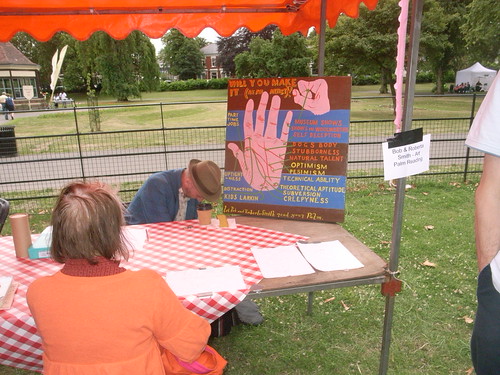
Bob and Roberta Smith – Will you make it as an artist?
Bob and Roberta Smith. Will you make it (as an artist)

Angela Bulloch – Sculpture for Football Songs (T12307)

Bulloch has made a number of works using Belisha beacons, which are more commonly used to illuminate pedestrian crossings. Here they are linked to a microphone in the gallery space and respond to sound, which initiates a sequence of flashing lights. The colours of the lights reflect the colours of the West Ham football strip, and the work’s title suggests that football anthems are a particularly appropriate trigger to speed up the light display. The unpredictable interactive element of this work is typical of Bulloch’s practice. [source]

That’s a small flavour. There will also be work by Cory Arcangel, Takashi Murata, Chris Marker, Hassan Hajjaj, Erwin Wurm, Marcel Duchamp, Annika Ström and Martin Creed. …And doings by me – we’ll find out more about what they could be over this series of posts.

West Midlands Open at BMAG

Uncertain Eastside at the West Midlands Open

Uncertain Eastside at the West Midlands Open

Follow up to an earlier post. Verdict on the presentation: just the right amount of wonkiness.

The exhibition runs from 6th March to 2nd May and is at the Gas Hall. Entrance is free.

Uncertain Eastside prints selected for the West Midlands Open

I got the news through a while ago, but had to double-check that they were ok with my instructions for display…

My Uncertain Eastside drawing generated from 6 circuits of the Eastside Regeneration Zone in Birmingham has been selected for exhibition at Birmingham Museum and Art Gallery‘s Gas Hall as part of their biennial collaboration between with Wolverhampton Art Gallery to celebrate the work of artists in the region.

My letter tells me there were over 1200 entries to the Open, from which 146 were selected for the exhibition …so that’s something nice I can tell my Mum!

West Midlands Open, 2010

West Midlands Open, 2010

Expect more details closer to the exhibition’s opening in March…

Pieces of Eight

Earlier this year I worked with Linden Primary School in Leicester to take over their timetable for a few days in order to create an immersive experience to develop Y3 pupils’ scientific vocabulary around the theme of light and shadows.

An under-informed Agent N appeared on the Monday, having received information to do as much research as possible at the school because something amazing was going to happen (we just didn’t know what). By Thursday, the pupils had successfully scanned the school grounds for signs of activity; been inducted as secret agents; used humming paths to guide a travelling minstrel called Skatz across from another dimension; investigated light and shadow to find some good wow words; used the wow words to compose a song for Skatz to use to return sunlight to his home planet; and performed a farewell ceremony to send Skatz safely back home. (see below for photos)

A day or so ago I had an email telling me that this and other Creative Partnership projects in the region are presenting their work at the City Gallery in Leicester.

…there will be an exhibition sharing the Creative Partnerships work of the eight schools that the City Gallery has been working with.

The exhibition is entitled ‘Pieces of Eight’ is at The City Gallery and runs from 7th – 11th July 2009.

There is a drinks reception on Thursday 9th July from 6.00 – 8.00pm and a celebration event for pupils and parents on Saturday 11th July 1.00 – 5.00pm.

I’ve not been able to find out any more details, but I’m going to try and get across to Leicester tomorrow night for the reception. I’m looking forward to seeing what happened in the other schools and it would be great to see you there too. Hopefully it’ll also be an opportunity to get some feedback from the schools on the success of these sorts of projects.

In the meantime, here’s a song that’ll get stuck in your head, stuck in your head, stuck in your head

[audio:http://www.npugh.co.uk/media/WOW.mp3]

The Anticipator

feed the spiders

one of the humming paths

Skatz

farewell


Copyright and permissions:

General blog contents released under a Creative Commons by-nc-sa license. Artworks and other projects copyright Nicola Pugh 2003-2026, all rights reserved.
If in doubt, ask.
The theme used on this WordPress-powered site started off life as Modern Clix, by Rodrigo Galindez.

RSS Feed.