
Uncertain Eastside at the Created in Birmingham shop
Yesterday I added some Uncertain Eastside limited edition prints to the stock of the Created in Birmingham shop in the Bullring shopping centre, Birmingham.

Uncertain Eastside in the CiB shop
You can read more about the Created in Birmingham shop on their blog, although obviously it goes without saying that you should go and visit if you can. It’s a nice example of creative communities making use of what would otherwise be an empty retail unit.
Location: Bullring, Level 3 Upper Mall West
Opening hours: Mon-Sat 10am to 8pm. Sun 11am to 5pm
West Midlands Open at BMAG

Uncertain Eastside at the West Midlands Open
Follow up to an earlier post. Verdict on the presentation: just the right amount of wonkiness.
The exhibition runs from 6th March to 2nd May and is at the Gas Hall. Entrance is free.
Uncertain Eastside prints selected for the West Midlands Open
I got the news through a while ago, but had to double-check that they were ok with my instructions for display…
My Uncertain Eastside drawing generated from 6 circuits of the Eastside Regeneration Zone in Birmingham has been selected for exhibition at Birmingham Museum and Art Gallery‘s Gas Hall as part of their biennial collaboration between with Wolverhampton Art Gallery to celebrate the work of artists in the region.
My letter tells me there were over 1200 entries to the Open, from which 146 were selected for the exhibition …so that’s something nice I can tell my Mum!

West Midlands Open, 2010
Expect more details closer to the exhibition’s opening in March…
Uncertain Eastside prints
The Uncertain Eastside limited editions prints are now officially available to purchase!
All the prints are A0 (841mm × 1189mm), signed, unframed and come in protective cardboard tubes – you will look after them now, won’t you?

The first batch of prints, rolled up, labelled and ready to go.
There are 2 different series available: A and B.
Series A:

Detail from a Series A print: Digbeth Deritend and Coventry Road.
A set of 3 individual prints, each of one of the double-circuits of the Eastside regeneration area. Limited edition of 10, £50 per set.
I walked around Birmingham’s Eastside regeneration area in pairs of 90 minute circuits – the two walks in each pair happening one straight after the other. These prints make the traces of each walk visible.
Series B:

Detail from a Series B print: Moat Lane and the Bullring markets area.
The traces of all 6 circuits overlaid. Limited edition of 100, £15 each.
These prints show the cumulative traces of all 6 circuits overlaid on top of each other. It becomes a lot harder to pick out the individual circuits, but instead it makes the patterns of glitches visible and you can see how the physical landscape of the city affects the different parts of the drawings.
How to order
These prints are available through my online shop The Invisible Hand. Simply send me a message via the order form telling me which items you would like to purchase and I will then contact you back with confirmation and postage/delivery information etc.
Uncertain Eastside presentation for Performance Fictions symposium
Sadie Plant invited me to contribute to her presentation on ‘psychogeography and the city’ as part of the Performance Fictions symposium held at the Electric Cinema yesterday.
‘Performance Fictions’ is the fourth event in art-writing-research network created by researchers from BCU, Goldsmiths, Reading University and University of the Arts London. Article Press, BCU, will publish the papers and contributions from the various events in Spring 2010, to be distributed by Central Books. The volumes will constitute series one of Article Press’s art-writing-research publications.
After Sadie explored Birmingham’s historical rootlessness and uncertainty of place – its location at and function as, a junction – I gave a 10-minute presentation about the Uncertain Eastside work in progress. Below is a transcript with images.
___
When I graduated from BIAD about 3 years ago, it was to emerge into a lot of talk about plans for a brand new cultural quarter covering a chunk of one side of the city. I was concerned and confused by the apparent desire to suddenly plonk a fully-formed artist-led space into position amongst the warehouses.
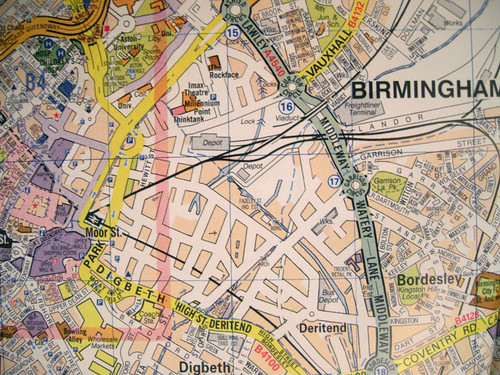
Detail from THE ANTI-TALENT ZONE
My response was to wipe the streets of the designated area free of their existing names. And to add one.
The politics of regeneration is beyond the scope of today’s presentation, and I have little patience for it anyway, but I want to take the opportunity to use this image to show you how closely the borders of the City Council’s Eastside regeneration area are linked to the major traffic routes in and around the city.
In green, as we go up the left hand side is the ring road, going up, just out of shot to the roundabout where it meets the A38 on its way to spaghetti junction. Coming down via Corporation Street, the pedestrian routes of Hight Street and the Bullring area, and the across Digbeth Deritend back to the ring road. The criss-cross of roads and pathways are again being used to define parts of Birmingham.
In 2006 this was mostly all unknown territory to me. By 2009 it was still mostly unknown territory, but now with small incursions around Digbeth and Curzon Street. When I decided I wanted to return to some of the questions raised by the area’s regeneration, it was apparent that my first step should not to be to research it in an academic manner, and subject myself to all the spin, but to get out there and experience it directly.
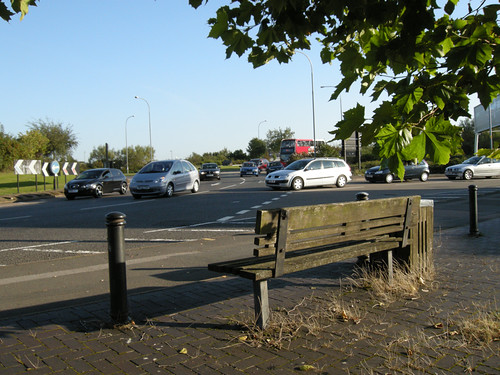
Bench on roundabout on Coventry Road
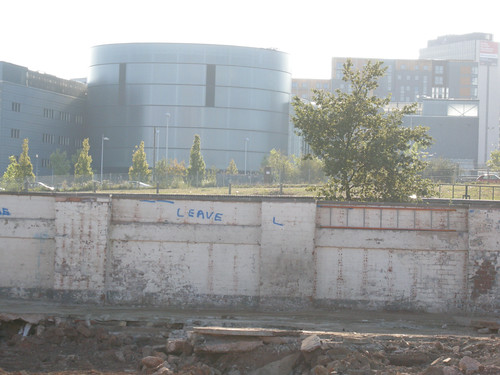
Construction site with sort-of graffiti
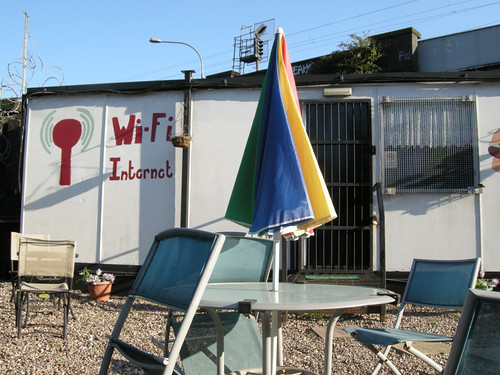
Greasy spoon internet café
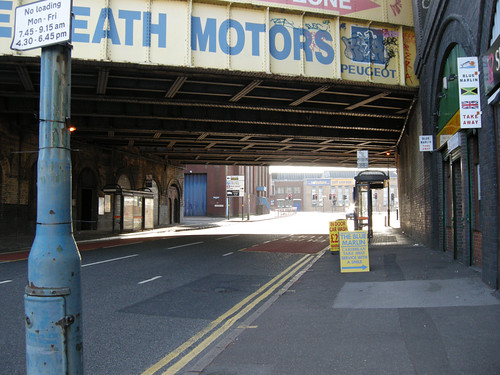
Shops and bus stops under the railway lines
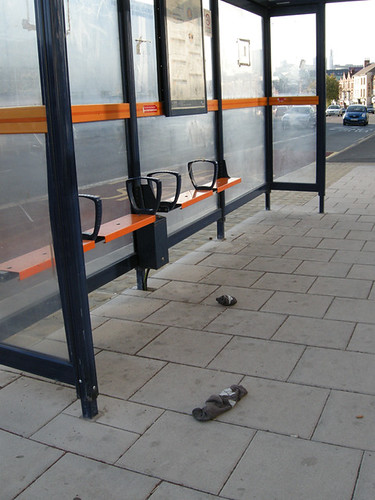
Socks
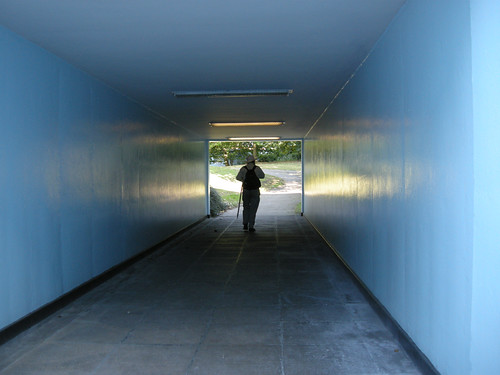
Subway rambler
I’ve spent the last month and a half repeatedly walking around the perimeter that defines Eastside, paying attention to how these spaces are being used at different times and by different groups of people. I’ve also been wrestling with how I might fit into the picture.
I wanted to document the process of walking this line, so on each 90-minute circuit I took with me 2 satnav GPS devices that I have programmed to log my position once every second. Rather than doing a straight-forward trace of my journey though, I was interested to see how the cityscape affected my position as seen by the machines.
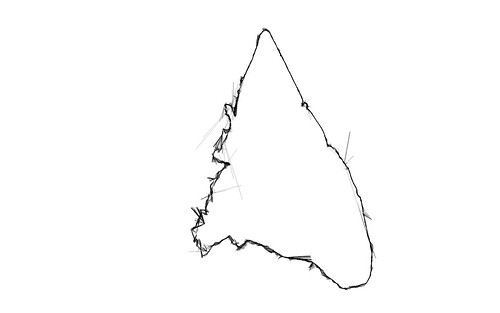
GPS drawing from two laps around Eastside
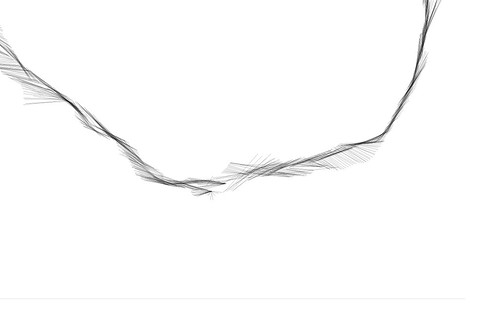
Detail from previous slide
Each of these lines joins my position as determined by the machine in my left hand to my position as determined by the machine in my right hand. The longer the line, the more they disagree.
Despite what we are led to believe, GPS is actually pretty flaky. All sorts of things can affect its accuracy. There may be 3 rather than 8 satellites overhead at that particular time; my body may be blocking the satellite signal; and large buildings and areas of concrete can bounce the signals around. All these affect the perceived position.

Errors and glitches
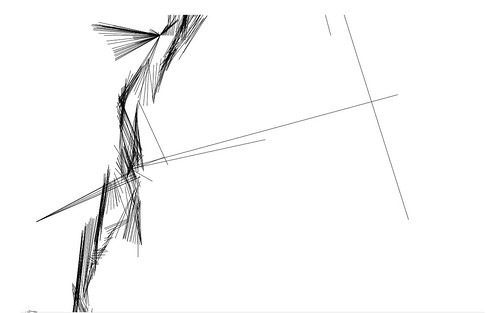
Errors and glitches
Looking at the results from any one walk I can see a whole host of different glitches and errors. To be honest, they’re what make GPS an interesting thing for me to work with.
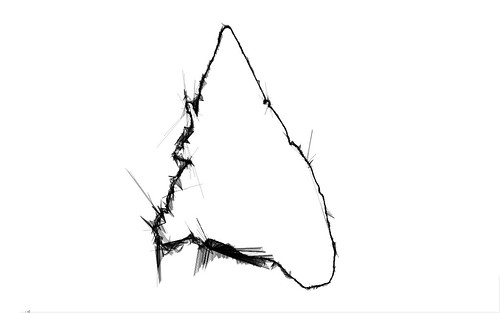
Composite drawing from 6 laps around Eastside
Through overlaying the traces of several laps, however, you can start to filter out the anomalies … or at least start to read which of them are caused by the fabric of the city-scape.
Here’s the cumulative result after 6 laps…
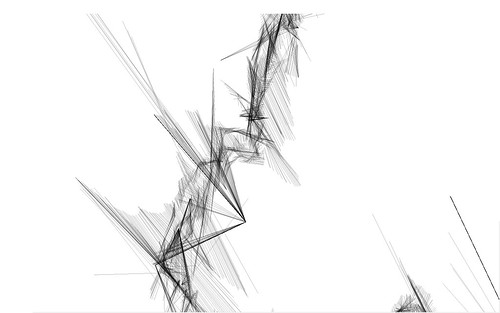
Stood near the base of the Rotunda
This detail is from the area at the base of the rotunda, at the edge of the Bullring shopping centre. The long, haphazard lines caused by the tall, closely-packed buildings.
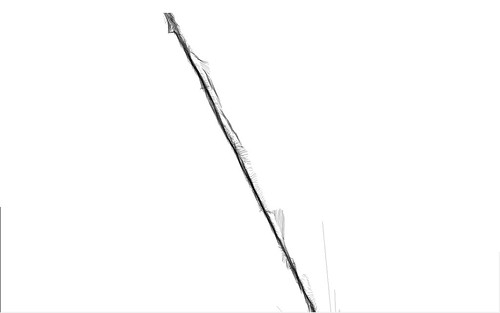
Ring road
By contrast, the comparatively open space of the ring road gives shorter, much more uniform lines, occasionally buffeted around by a large warehouse building.
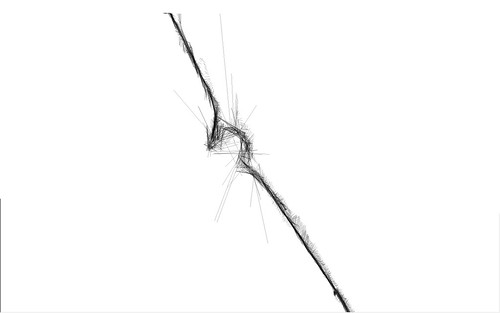
Ashted Circus
Here is Ashted Circus, where I momentarily loose contact with the satellite signals as I go through some underpasses.
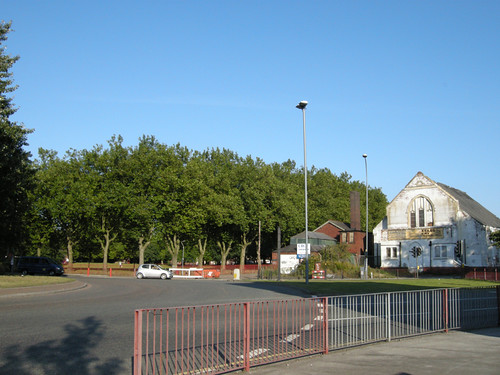
The Other Side
Whilst walking with the satnavs I was given glimpses of other sorts of errors – biases towards the car, roads I couldn’t cross, residential areas the other side of seemingly impassable road boundaries.
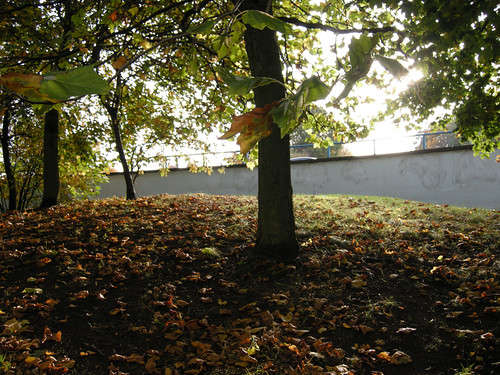
Beautiful scary
Sunken oases inside the rings of roundabouts – beautiful but also possibly harbouring great danger.
However, due to restraints in using the GPS logging, I could only observe these in passing. I had to keep moving at a steady pace. I could speculate, but never investigate.
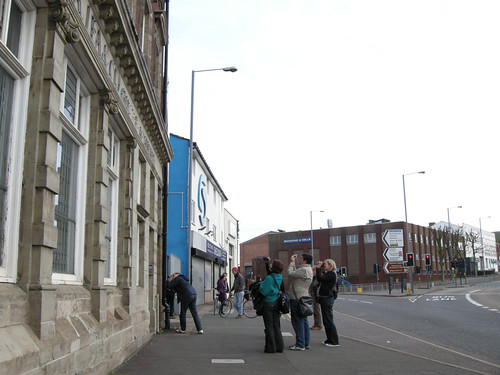
Participants document a building in Digbeth
So, last Sunday I invited others to join me for an investigative walk. Nominally following the route around the edge of Eastside, but allowed the freedom to drift from it to explore things that caught our eye.
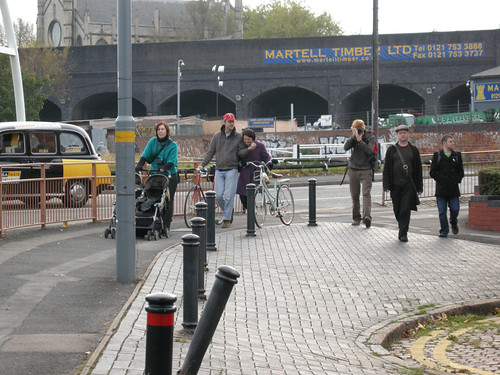
Walk
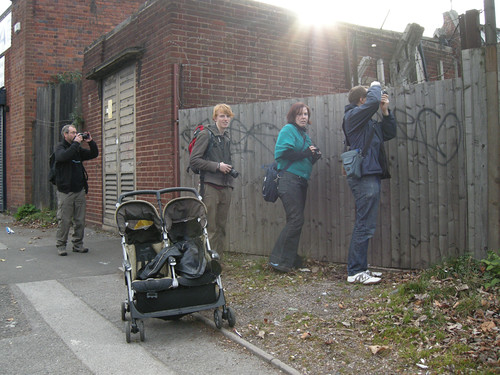
Look
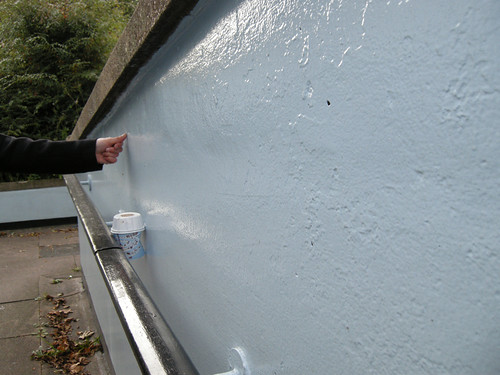
Touch
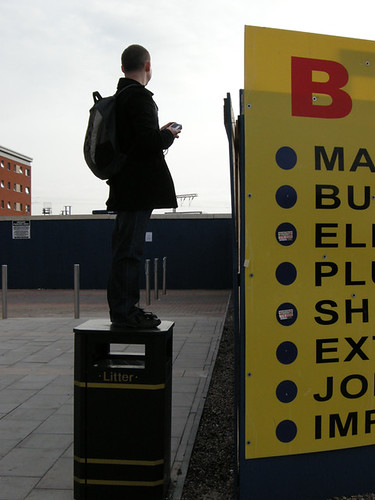
Climb
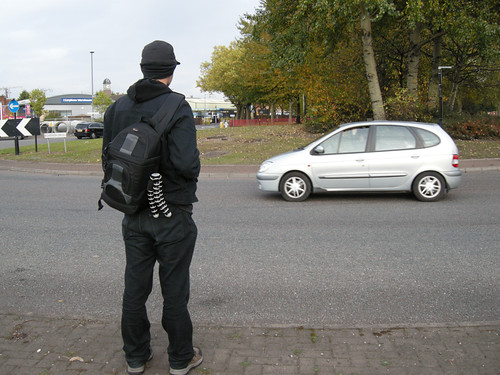
Dare
We walked, we explored, we looked at stuff, we touched stuff, we climbed on stuff and we dared to cross to the in-between places.
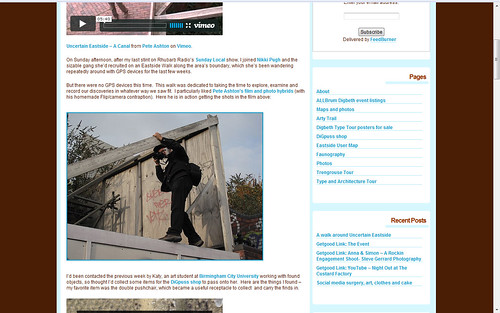
Blog post on Digbeth is Good, http://digbeth.org/2009/10/a-walk-around-uncertain-eastside/
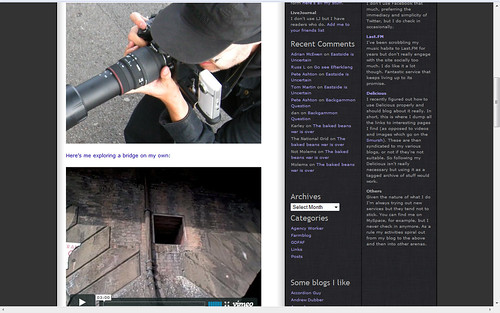
Pete Ashton's blog post, http://peteashton.com/2009/10/eastside_is_uncertain/
People are now starting to post their photos from the day online, and their accounts of what happened are starting to appear on blogs where the stories and viewpoints overlap. We also exchanged stories between us whilst we were walking along the route. In situ. It’s my feeling that we needed the 3.5 hours of walking to get to the point where we could gather around the ‘map’ at the pub and have an in-depth conversation about what it signifies. I find this happens a lot – that you need the group performance before you can get to the meaty discussion.
I guess that in terms of this symposium, we’re talking more about performed narratives, rather than performed fictions per se, but I’m expecting the edges to blur somewhat, especially as we move into the phase where we compile the accompanying publication of thus chapter of the project.
After unfurling some of the stories, we will gather some of the images taken by the participants into a publication with the aim of making a document to record this face of Birmingham before it reinvents itself again.
___
From here, Sadie speculated that this sort of drift along a route defined by roadways, exploring the details, progress logged by satnav devices, might be psychogeography 21st Century style.


Eastside Walk and Talk Event, Sunday 18th October
I’ve been walking many laps of the Eastside regeneration area over the last month or so, each time carrying a GPS unit in each hand, logging the positions they record and then converting the data into line drawings.

The drawings are different each time. We knew that would happen.
What’s increasingly striking me though, is the amount of change I’m seeing in the landscape I walk through, even on the timescale of a couple of weeks: hoardings go up around construction sites; piles of rubble are shifted; graffiti is removed; and subways re-painted.
When I’m walking with my GPS units however, I cannot stop to investigate these things in more detail, or even to properly document them. I must keep walking past at a steady pace.

On Sunday the 18th of October I’m going to do a different type of walk, and I’d like you to join me.
Weather permitting, we will meet at the Old Crown pub (Corner of Heath Mill Lane and Deritend, Digbeth) from 2pm for a 2.30 start. We will then walk once around the perimeter of the regeneration area taking great care to stop, investigate, prod, document, tell stories about and explore things along the way. A no-frills walk takes about 90 minutes, so be prepared for this one to last 2 or more hours. No route march though – this will be very stop-start.
Bring comfortable walking shoes and clothing appropriate for the weather. Kendall mint cake optional. If the weather is too wet we’ll postpone things ’til another time. Announcements for rain-checks or otherwise will go out via my Twitter stream and via the Sunday Local show on Rhubarb Radio where I will, sometime between 12 and 2pm, be talking about the Eastside drawings I’m making. (‘cos that’ll work great on the radio!)
I have the beginnings of an idea that I might collate the photos, GPS drawings and other documentations into a printed magazine so that there is some sort of a record of what things are like now (and how we remember them being in the past) that we can look at a few years down the line when everything will have changed beyond recognition. When we do the walk again, maybe.
