Volume 21
Volume 21 gets posted to Kyushu where the first page might have something to do with clay, something to do with computers or something to do with something completely different…

Volume 21 gets posted to Kyushu where the first page might have something to do with clay, something to do with computers or something to do with something completely different…
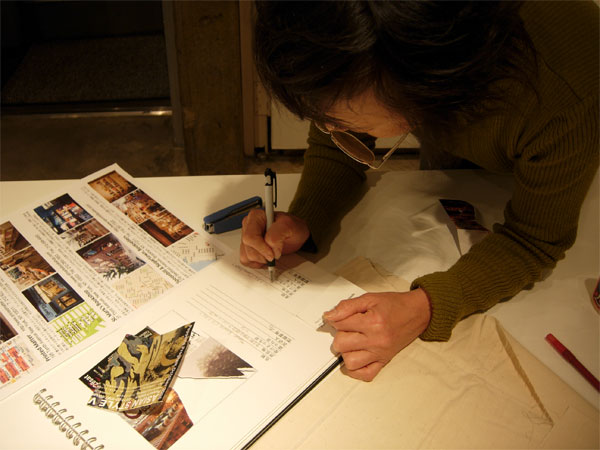
Surrounded by artists’ books of all shapes, sizes and types, Pepper’s Project not only agreed to take part in the project, but also completed their page there and then!


Every so often I get a little kick up the pants that reminds me where I am.
(Click on the image below for a decent size version.)

 Sites of Potentiality Guidebooks offer an excuse to just stop and look/observe and absorb. Follow ambiguous directions to a non-descript place and there will be something interesting there.
This is an ongoing series of works exploring how the format can be adapted and applied to different situations.
Locations so far include Tokyo, Japan and Ansdell, near Blackpool, UK.
On Suturday 4th of November, 2006, the Free Hugs Campaign came to Shibuya.
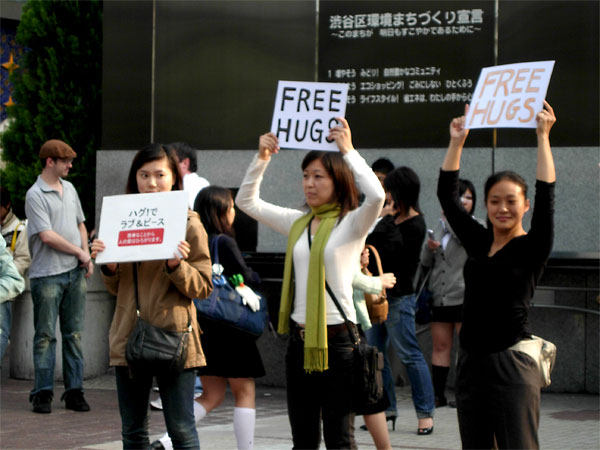
After 3 free hugs and managing to completely confuse them, I gave them a free map and continued with my journey…
and the video appears on YouTube:
Come back home; start to open front door; hear loudspeaker below; peer over railing; there’s a band. It’s not moving. Band starts moving and it’s LOUD! Grab camera; start filming; battery dies.
I have now embarked on a tour of Tokyo.
My guide is a map from the back of a gallery postcard, with all the labels surgically removed.
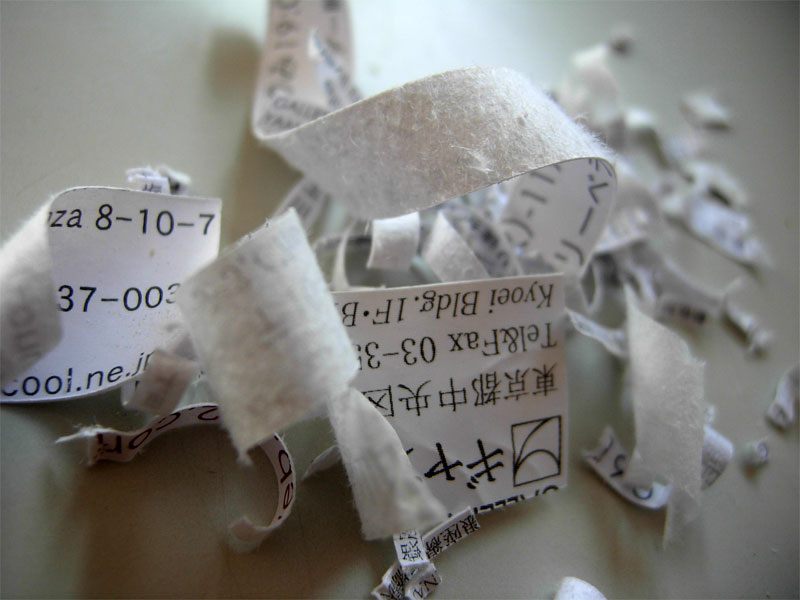
My starting point is every station on the Yamanote railway line.

I’ve been doing it for 2 days now, and I’m halfway round. I don’t know where the map will take me, but there’s always something interesting to be found at the other end…
Update: this became the Sites of Potentiality: Yamanote Line project.
Shortly after an observation that the art in Japan often happens outside of the art scene, Felicity took me to a toyshop.
By that stage the conversation had moved on to architecture and the toyshop was to be an example of a building that, let’s face it, probably wouldn’t be around for much longer.

Yes the toyshop sold toys. But it also sold customised jeans.

It was a toys and jeans shop.

After purchasing a song book (from the toys and jeans shop) we were invited to have a look upstairs.

To what is the jeans customiser’s studio.
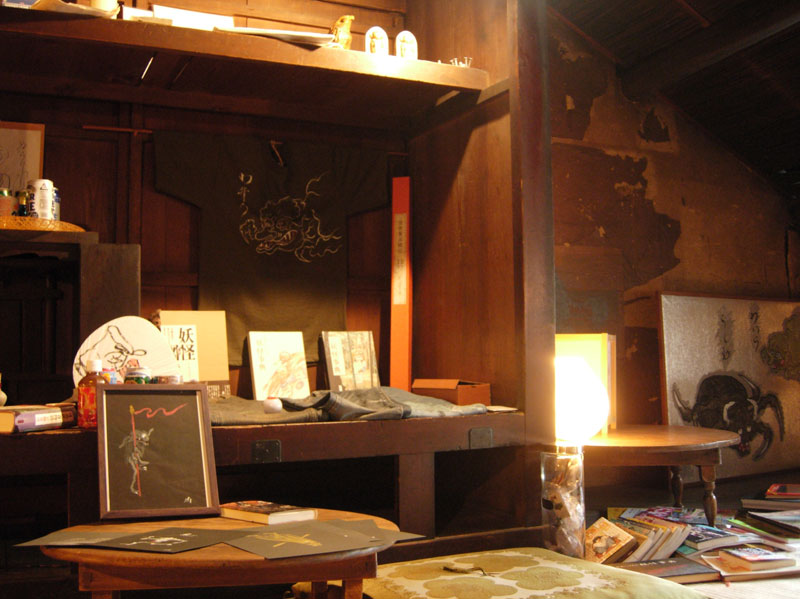
The previous owner had been in the building for 50 years and never used the upper floor. But the jeans customiser had cleared it out. The paper screens were brown with age, and there were ancient newspapers pasted onto the walls.
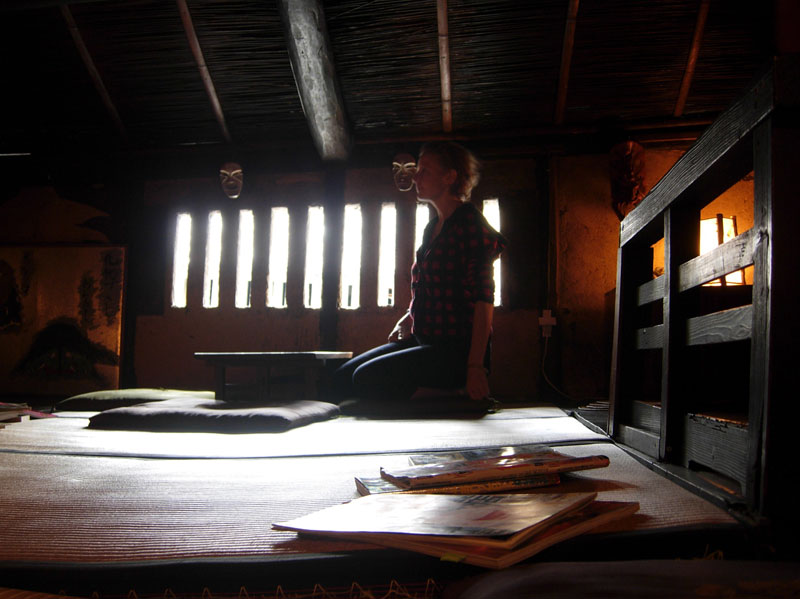
Bloody marvellous, but I bet it’s Baltic in the Winter.
[Oh, and recently the studio of the toys and jeans shop had also been turned into a tea shop.]
Having excused myself early from the last segment of Johnny Hillwalker’s walking tour of Kyoto, I made a (not so) quick dash over to the Shimogamo Shrine to meet artist Markuz Wernli Saitô.
The last time we’d met was on the Kamo Obashi bridge when, having randomly followed a link from this article, and discovering the momentarium website I thought it would be great to invite Markuz to be a starting point for the Peer-to-Peer Sketchbooks project.
This time, however, was to be much more involved…
Wednesdays in Markuz’s programme are city canal tour days where “surprises and wet feet are guaranteed”. Well, I certainly got both, starting with performing the opening ceremony!
A condensed version of the tour can be viewed here http://momentarium.org/service/popup/1025.html (Quicktime format), but the actual event lasted about 2 hours.

It was fascinating to peer into people’s gardens from what was effectively ground level, and there were some nice little discoveries within the limbo territory of the canal itself: sights, sounds and smells.
Mostly the people we saw did a double-take but recovered enough to give us a friendly “konnichiwa” or “kombanwa”. There were a few quality encounters though, such as the woman throwing food across the canal and two fences to a dog in a garden on the other side, and The Guy in the Red T-Shirt.

I didn’t catch his name, but he just sort of appeared alongside the canal on his bike. After a brief introductory chat with Markuz, he left his bike propped up at the side and came down to join us. …but only for a few seconds before he started sprinting down the canal path!
He reappeared some time later completely out of breath and stopped to chat some more. We saw him a few more times after that as he cycled over various bridges and gave us a friendly wave. I wonder if he ever got back in touch with Markuz later by email?
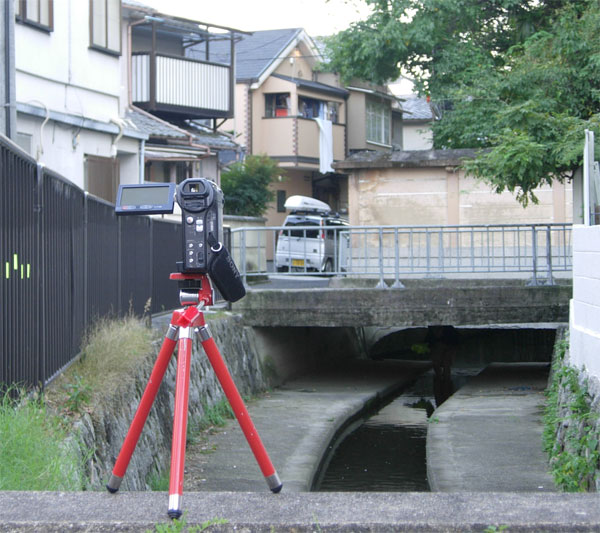
I’m very much intrigued by how encounters like this can be documented. I was repeatedly amazed by the fact that, in Japan, Markuz has been able to leave his video camera set up on a tripod on the other side of busy bridges and in railway stations etc unattended and without fear that it would get stolen. How would you manage this in the UK or elsewhere? Some sort of hidden camera? An entourage of beefy cameramen?
Is there some other way of documenting the process besides video? Does the record need to be visual and time-based?
Maybe a more comforting way to regard my dozens of mosquito bites is as some form of alternative documentary record…

Self Service invites a series of speakers to converse with a guest of their choice in front of an audience in the Lillie Langtry room at the Old Lamp Tavern, Birmingham.
In our quest to counter-balance the flood of talks about development/infrastructure of the arts/creative industries in the city of Birmingham, we’re talking about art practice over a pint.
More information from the Pub Conversations website.
Subscribe to the podcast by entering this address into your feed-reader (eg i-tunes):
http://pubconversations.jellycast.com/podcast/feed/2
Copyright and permissions:
General blog contents released under a Creative Commons
by-nc-sa license.
Artworks and other projects copyright Nicola Pugh 2003-2026, all rights reserved.
If in doubt, ask.
The theme used on this WordPress-powered site started off life as Modern Clix, by Rodrigo Galindez.