Gronk’s BrainFlame

Welcome to the inside of an artist’s mind–a 5,000 square-foot digitally animated depiction of what happens during epiphany.

I’ve yet to hunt out more information, but this looks like it’s an animation for one of those dome-shaped 3D immersive environment things.

update: Yes. It is.

update on the update: more info including some background on the residency.

observations of audiences

update: I haven’t seen it with any audience, but this might be a contender

I’ve been thinking about 2 different shows I saw last weekend.

Different shows; different settings; and completely different ways that people were engaging with the work.

I went to the preview of The 18th Storey: 10 artists installed on the 18th floor of a soon-to-be-demolished tower block.

The 18th Storey

I really liked the idea (‘though I wonder how it compared to similar enterprises) and I loved the poster-sized, blue-print styled exhibition info, but somehow it was really difficult to engage with the work.

I think part of the problem was that the large, poster-sized, blue-print styled exhibition info was a bit to unweildy to refer to at the time so I didn’t really get much of a feel for what the work was supposed to be about (there was little or no information accompanying the work itself).

It was cold, it was busy, we just sort of scooted ’round.

By way of a contrast, the next day I was envigilating VASULKA LAB 1969 – 2005 at Vivid.

Also a cold space but…

vasulka installation view

…people we coming in (often for a second time, to finish up on what they missed at the preview), plugging themselves into the headphones and standing in front of the video screens for about 45-90 minutes at a time.

Wow. That’s some level of engagement for video peices in a gallery setting.

intersection: talking about collaboration

Artquest is hosting a one-day conference to discuss collaboration between designers, applied and fine artists and professionals from other disciplines. The event is designed to appeal to established practitioners who want to hear first-hand from their peers about the critical, conceptual and practical challenges that arise when working as collaborators in a variety of settings.

http://www.artquest.org.uk/intersection/

I went to this and generally it was a good event – the first I have been to where the nature of collaborative practice was actually analysed. We need more of this!

Some collated thoughts follow…

What is a collaboration?

Collaboration is when you can’t create/ can’t complete the project without the other person

A definition of collaboration was first given in this form by Rebecca Early, but it was repeatedly picked up and echoed by following speakers and in questions/comments from the audience throughout the rest of the event.

We needed a way of distinguishing between collaborators and people you just work with. Interdependency was a key feature in identifying collaborative relationships as opposed to working for, or working with, people. It was this idea that that when collaborators come together there is the creation of what was termed a “third space”; the whole is greater than the sum of the parts.

Collaboration is not about one person servicing another: it is more than simply facilitation.

Why collaborate?

So, what is the value of collaborative working and why should we work this way?

Nipa Doshi acknowledged that her skills were severely lacking in certain areas (for example visualisation in 3 dimensions – something her design partner Jonathan Levien finds very easy). She and Early both seemed to view a benefit of collaborative working to be in its ability to allow you to build a custom team. For whatever project you are working on you can create your own chain of experts to allow you to go on and achieve your vision.

Doshi said that “you can’t always imagine all the things that you can do”. In addition to feeding creativity and invigorating individuals, working collaboratively can expand your awareness of what is possible.

For people working with few or no resources, it is simple: you need to collaborate to be able to produce.

A question from the audience went on to challenge exactly how you can prove that collaborative outputs are more valuable…

It was suggested that it is the thing that the collaboration produces, rather than the collaboration itself, that should be valued. I think the question has two aspects: value to the creative individuals and value to a wider community outside of the collaboration.

Terminology

Several people indicated that they found current terminology problematic and frequently inhibitive.

Dualistic concepts such as supply/demand, user/producer and professional/amateur were found to be particularly problematic.

The general feeling was that to view audiences as clients/users/consumers no longer adequately captures the relationship. Audiences no longer always want only to be audiences: people increasingly want to comment and contribute and this has implications for the priesthood of the knowledge hierarchy. The role of the professional won’t go away, but it will have to exist in a more complicated universe.

Is there a need for a new language?

Authorship and the moment of birth

The issue of authorship was one that the event specifically identified as one they wanted to address.

Leadbeater talked about how we traditionally associate creativity with a single moment of authorship: one second the idea is there but the previous second it was not. He contrasted this with the cumulative process of creativity within collaborations, suggesting that the role of collaborations was more architectural: the skill being in seeing how ideas that have been developed over a long period of time fit together.

Conversations

This is incorporated into the cumulative nature of collaborations, but was emphasised so often that I have given it its own section.

Conversations are critical to creativity.

again:

Conversations are critical to creativity.

Speakers indicated a need to just keep on talking. All the time.

Establish a policy for communication right from the outset.

It was recognised that a period of absorption is required before finalising the brief to be worked on.

Early described the process for one of the projects she worked on:

All the designers were given an initial brief and then went away to research this independently. They would then gather together for a period of brain-storming in the morning and then practical experimentation in the afternoon. This process was repeated for a period of 6 months before the final briefs were settled upon.

Doshi approached what I believe is the same issue, but from a slightly different angle. She stated that her best projects came from when you know what you want, rather than saying “Hey, let’s collaborate” and seeing what happens. Within a new collaboration you need this time to identify common aims and to find out about the mechanics of the working relationship.

As she went on to say later, “You need to spend time together. You can’t tell if the chemistry is there just from looking at their work”.

For collaborations no longer in the initial stages, regular scheduling of conversations can act to ease tensions because it provides a forum for airing grievances.

Leadbeater indicated that conversations take place in particular types of spaces and at particular types of times. I think there is more to this than policy-makers simply providing a “special place for special people to meet”. Probably something that needs to be worked out on a case-by-case basis.

Creative communities or Organisations make you irrational

Charles Leadbeater’s keynote speech was a great introduction to the nature of collaborations. He pointed out that organisations – these things that are supposed to epitomise the concept of collaboration – often make it difficult to work in partnership with others. His idea is that the competitive nature of working within an organisation generates a fear of sharing and kills off collaboration.

He points instead to examples of user-led collaboration: gamers generating extra items for The Sims; the collaboratively written wikipedia; and the development of the mountainbike by cycling enthusiasts. How can the huge power of user-led collaborations be harnessed? What would be the implications for Education or the Health Service if content was developed by the public?

Key features of creative communities were identified as being:

  • Organised without having an organisation
  • Distribution of cheap tools
  • Easy entry into the community
  • Strong element of peer review
  • Guiding laws
  • A critical kernel established by someone (kernels may be modular)

Two important issues that came out of this line of thinking were: just how big a threat this is to established corporations; and, wondering if societies who have not yet industrialised (for example, developing countries that function around villages and communities in the physical world) will be better at producing these creative communities.

Bad things can happen, and the importance of small print

Although collaborative relationships were generally presented in a positive manner, some references were made to the negative aspects and contractual side of things.

I don’t want anyone in my community to find fault with this book…

Does the need for the collaboration to be taken seriously from both sides force difficult compromises?

How do you split things such as power balance and workload? What happens when this doesn’t work out as agreed? Should both partners be accredited equally?

Most people said that contracts were a necessity and they should be agreed on right form the start. This is in part to ensure that collaboration does not turn into exploitation.

It was recommended that, at the beginning, both partners write statements of intent detailing what they want to achieve from the collaboration. Agree on the deal and know what you’re getting into.

This raises questions concerning how much you should define at the start, and how much you should leave open for development during the process of collaboration itself.

Conclusion

Although some of the presentations missed the target, others were spot-on! It was great to hear other people’s experiences (good and bad) of working collaboratively and several of the issues underlined trains of thought I’d already had in relation to the ISP residency. I guess I should address these directly in a follow-up post. Watch this space (but not for a day or two yet, eh?!)

jeroen offerman

Jeroen Offerman is a Dutch artist working and living in London, UK and Berlin, Germany. Works are conceptual and often of a performative nature. Materials and media used range from living plants, to flies and birds, video, music, dubplates, sculpture, computers and installations.

Offerman spent three months learning to sing Stairway to Heaven backwards and recorded his performance on the steps of St. Paul’s for confused spectators.

via eightface

other people’s words

(unaccredited and taken out of context)

| If my work’s in there too, it’s a different agenda. The whole thing changes. They don’t trust you | encourage people to sit in the space and, you know, just use it | call and return | you’ll be amazed: you’ll learn lots, it’s fun | it’s always been touch or go | it just seems to work | you lower your principles. You lower the standard. It’s just not good. | collaborating is the key to everything | you need to be a name in people’s heads…with work attached to it | the danger of becoming formulaic | very bad translations: doing a very literal translation has a poetic of its own | gamble | my feeling is they are my guests | my influences are not so much other artists but literature; what I hear on the radio; and very bad science fiction | using your imagination to articulate things you don’t quite understand, with the materials you have to hand | terrifiying | make yourself visible | is there such a thing as wilderness? | a shift in cognition | humour is a fantastic tool to draw yourself in | effecting a change with a tiny piece of graphite | loaded spaces | If you go to one of these things, don’t go with any expectations. NONE. | the pressure to have a body of work, but to keep developing | the choreography of the room | if there’s a needle going in at the same time as you’re being amused, then that’s ok | own up to the fact that I don’t have a studio | everything is a choice | promote stuff by using it to create space. Make architecture with it | found, appropriated and put out of context | prove something happens here | I’m based in Birmingham, but my practice isn’t | a very odd person…he’s nice though | look useful | meet a new network | what audience is your work going to reach? | what’s the point in making something unless you know where it’s going to go? |

seven walks

A part of the degree course I’m doing, I have to give a short presentation on presentation methods – we’ve been analysing different exhibitions and the strategies they use to present artists’ work.

When I say a short presentation, I mean a short presentation: 5 minutes.

This is going to have to be focused!

[Update: At 6 pages, the documentation of the preparation certainly is not focused!

The first few pages are basically just thinking aloud including the main points I wanted to make, in response to the project brief and a room-by-room walkthrough.
By page 5 I’ve got to the stage where I’m starting to look at how to make the presentation.]

Over the past few months I’ve been reading the articles over at Presentation Zen. I came across this site through my webdesign work and I’ve continued to read it because it’s very relevant to my webdesign work. How do you guide your audience along a path that transfers to them the information you want them to acquire?

I am starting to write this post on Saturday morning. The presentation is on Tuesday morning.

I’m also going to have to be focussed to get this prepared on time! Sitting here now with the task ahead of me, I have mapped out my plan of attack:

  1. Quick survey of visual resources.
  2. Identify the main points I want to convey.
  3. Structure these points.
  4. Decide how to distribute these points between the presentation and the accompanying handout.
  5. Build the powerpoint presentation.
  6. Build the handout.
  7. Practice.
  8. Present.

I have other, longer, presentations to do later in the year, (and it will almost certainly form a part of what I have to do as a fully-fledged artist) so I thought I would document the whole process here so I can refer back to it and progress.

1. Quick survey of visual resources.

It’s been a few months since I saw the exhibition so this step will serve to refresh my memory as well as give me an awarenss of what I can use for my visuals later.

My main sources will be the book that accomapanies the show; my own notes and photographs; and various webpages.

I’ll list the webpages here for future reference:

beermats

After this, I spent some time trying to figure out how I could follow it up once I was back in the UK. Main problems (seemingly) being sourcing raw materials and lack of the specialised equipment.

I had a bit of a eureka moment down the pub and thought I could use beermats as my source of pulp. I also thought I could utilise the whole collection process to give any resulting sculptural objects some back-story. I thought I could make a simple sculptural form that used the beermats collected over a set amount of time as a form of documentary tool.

Well, I did a few experiments but I decided that my vague ideas did not have enough weight to justfiy time spent on them at this stage.

Project status: shelved.

Meanwhile…

I had asked my local pub to collect their used beermats for me. This meant that, besides the smells and the stains, several of them had some biro doodles on them.

Project status: interesting tangent that I might come back to later but with a few samples put here for your viewing pleasure in the meantime:

fuggy fuggy and the brothers mcleod

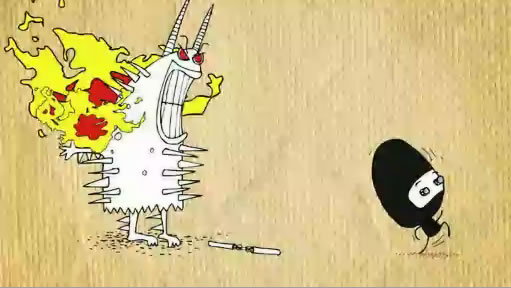
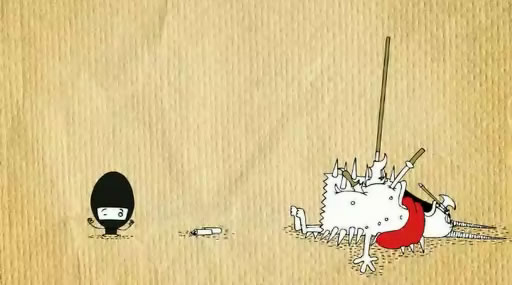
No, not another Japanese post, just some nicely pitched ninja animation.

I was immediately taken by the combination of ‘analogue’ background with simple computer graphics over the top. No, wait a minute, those computer graphics look quite analogue too…

Here are some skillls sorry, stills from the fuggy fuggy movie

skills

prudence

meditiation

Simple concept (different aspects of a young ninja’s training); simple style; simple colour pallette; all off set by a nice gentle sense of humour.

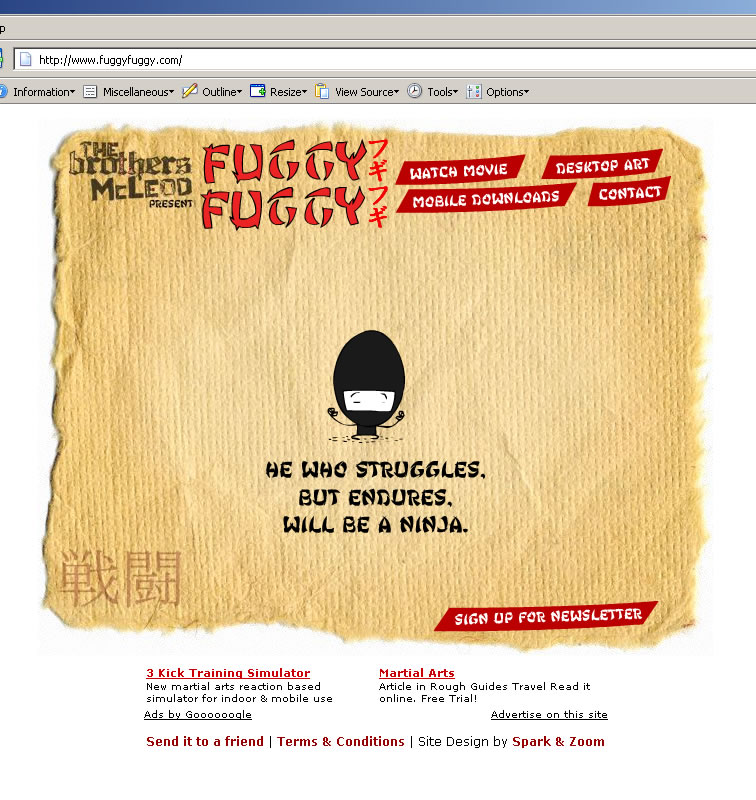
Anyway, in posting these stills I was wondering how to approach the whole copyright/credits thing, but then I remembered the fuggyfuggy home page:

fuggy homepage

After watching the movie I can get some desktop art, download to my mobile and then signup for the newsletter…

Maybe the intention with a site like this is to play off the whole viral marketing thing. I mean, that’s how I came across the thing in the first place, right?

I’m not being cynical, I just think it’s a neat little package and done well: something to bear in mind for the future perhaps?

Anyway, I ended up at the creators’ website www.brothersmcleod.co.uk/ and if I wan’t supposed to be doing other stuff right now I’d probably have a good ol’ dig around…

adjunct

I’m sat here writing a paper about interdisciplinary practice. As part of this I’ve been quite critical of ‘adjuncts’ between artists and scientists promoting themselves as ‘collaborations’ between artists and scientists.

For what I mean by ‘adjunct’, you need to read MACDONALD CROWLEY, AMANDA (2003), Creative Encounters: The Art/Science of Collaboration to see what she means by it. (.pdf file)

So, here I am working as artist in residence as part of the Interdisciplinary Support Program. Am I adjuncting, or am I collaborating?

At this stage I suspect it’s the former.

note to self: probably not an Interdisciplinary Artist, but maybe an Artist Working on the Subject of Interdisciplinary Practice. For now. Let’s see what happens…

04/01/06: commission for wedding photographs

Work in progress…

work in progress


Copyright and permissions:

General blog contents released under a Creative Commons by-nc-sa license. Artworks and other projects copyright Nicola Pugh 2003-2026, all rights reserved.
If in doubt, ask.
The theme used on this WordPress-powered site started off life as Modern Clix, by Rodrigo Galindez.

RSS Feed.