June 1, 2006

strategic question #26

What is animate?

Link minds to write an artwork for Kings Norton 3 Estates using the form of a Japanese shared writing schema. Over a period of 4 seasons produce 100 verses in 6 different sites and provide a new tool for considering the future of the estates, its inhabitants, its identity, its visions.

http://strategicquestions.org/

Now you know about as much as I do.

large smoked vessel

Previous posts for your information

seeds

walking back from work earlier today…

day off

Go to someone else’s city, and look at someone else’s art, wearing someone else’s shoes.

shoes

Adam Chodzko, M-path | British Art Show 6

You’re going to smash your pots?! But why?!

OK, so when I did this test and posted this post I was thinking that I would build on the FMG‘s existing practice of using ceramic powders as a base for screen-printing inks.

Rather than alter the process, I was interested in using different raw materials: rather that using bought-in standardised powder of controlled composition, particle size and everything else, I wanted to use something with more of a human element about it. Something with a history.

The day science/night science text that was to be printed is discssed in more detail in this post.

Bearing in mind my recent crises centering around (amongst other things) what characterised my best/more interesting work and the gradual admission that it wasn’t my more craft-oriented stuff, I chose to use some of my old ceramic works as the source material.

During the course of researching the screen-printing process and investigating different binding materials, it looked like the other materials in the ink would obscure the presence of the crushed ceramics.

I’m no longer planning to use screen-printing, but will instead use the ceramic powder in a more sculptural way…

day science/night science

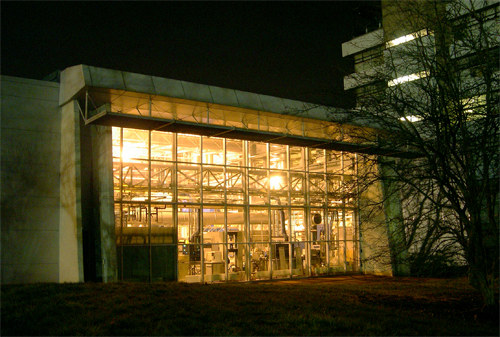
One of the buildings where I’m based as part of the ISP thing is the NetShape Centre. Basically where a load of industry-focused research is done into trying to make components as close to their final shape first-time ’round without having to do any further finishing or processing. The thing is though, its front wall is almost entirely windows and it looks absolutley stunning at night:

NetShape at night

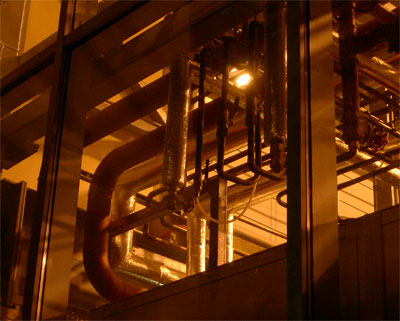
At night the building is illuminated… and deserted. But there’s still a sense that things are happening. This is probably partly because it’s stuffed full of all sorts of recognisably scientific and technological equipment, however, I think that the main contributing factors are all the pipes and wires around the place. Maybe this gives a sense of movement and of processes churning away.

You can feel it.

pipes

Right from the start I’d harboured a desire to use this space somehow, but it wasn’t until about 5 months into my time here that the perfect project materialised.

Actually, it’s a project that’s been incubating for 4 years…

Francois Jacob

When I first started the BA course I read a book on creativity by Margaret Boden.

Within this was a quote from the autobiography of a Nobel Prize winning molecular biologist:

Day science employs reasoning that meshes like gears… One admires its majestic arrangement as that of a da Vinci painting or a Bach fugue. One walks about it as in a French formal garden… Night science, on the other hand, wanders blindly. It hesitates, stumbles, falls back, sweats, wakes with a start. Doubting everything… It is a workshop of the possible…where thought proceeds along sensuous paths, tortuous streets, most often blind alleys.
François Jacob
The statue within: An Autobiography, New York, 1988, p296

I have carried these words around with me for a long time and they resonate on all sorts of levels.

The NetShape Centre provides the perfect setting to use these words beyond the obvious link to the day and night thing.

If I remember correctly, Boden’s book was looking at the similarities and contrasts between creativity as seen from an artistic viewpoint and creativity as seen from a scientific viewpoint. I can very much see both aspects of the quoted passage within my own work. Firstly within the context of a (percieved!) art/science dichotmy and later as different stages I regularly go through within my art practice.

Do the people within the building experience the same thing?

I like the way the use of these words here hint at the infallible(?) scientists just blundering along like the rest of us.

In addition to this, I now learn that Jacob conducted work on feedback witin enzymes. This links in nicely with the idea of responding to your environment and, by extension, the whole notion of residencies.

So…
The words of Day Science and Night Science will be integrated with the architecture of the NetShape Centre.

what is art?

From the glossary of Relational Aesthetics, Nicolas Bourriaud:

Art
  1. General term describing a set of objects presented as part of a narrative known as art history. This narrative draws up the critical genealogy and discusses the issues raised by these objects, by way of three sub-sets: painting, sculpture and architecture.
  2. Nowadays, the word ‘art’ seems to be no more than a semantic leftover of this narrative, whose more accurate definition would read as follows: Art is an activity consisting in producing relationships with the world with the help of signs, forms, actions and objects.

The first of these definitions is utterly pragmatic; the second screams towards the target, hits the bulls-eye and quivers for a few moments whilst the repercussions reverberate out into the surroundings…

Pauline’s mug

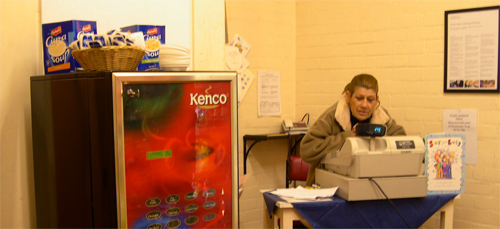
One day, at a time when various other projects had stalled somewhat, I found myself over in the other side of the building. Thinking I’d grab something to eat, I wandered into Pauline’s.

For want of a better term, Pauline was the Department’s resident tea-lady. Tea, coffeee, sandwiches and the usual assortment of crisps and chocolate bars.

Pauline 2

When I walked in though, she told me she was retiring at the end of the week.

I felt I needed to use the next few days to document the end of an era: having worked there for over 20 years, Pauline was an institution.

She told me the story of her time in the Department and we reminisced about “sunset tuna” sandwiches and Children in Need collections. She often talked about the students as being “her kids”. She’d even remembered me after 6 years!

However, in the the time since I had been there, the urn and the table bearing rows of food had all been stripped out and replaced with a couple of vending machines. Even the cash box had been replaced with an electronic till…

This was the result of catering being centralised and the ensuing rulings over Health and Safety. No more hand-made sandwiches. No more fresh(ish) tea. Apparently things had been pretty dire over the last couple of years, but Pauline stuck it out ’till she could retire.

I made some sound recordings and took a few photos, but it seemed the most appropriate way of marking the event was to make a commemorative mug.

Pauline 1

The design takes several references from the sort of thing you see to mark royal weddings and jubilees, but being hand-drawn in biro, it is kept fairly low key.

The final presentation of Pauline, includes the mug and a short text (written on a Catering Services feedback form).

Pauline 3

self-replicating repairing robot

From here: http://youtube.com/watch?v=VyzVtTiax80

vitamin creative space

(Follows on from this post.)

if you're sitting comfortably...

beanbags and tv

Through Popular Expression
at: International Project Space, Bournville
curated by: vitamin creative space


Copyright and permissions:

General blog contents released under a Creative Commons by-nc-sa license. Artworks and other projects copyright Nicola Pugh 2003-2026, all rights reserved.
If in doubt, ask.
The theme used on this WordPress-powered site started off life as Modern Clix, by Rodrigo Galindez.

RSS Feed.