January 14, 2011
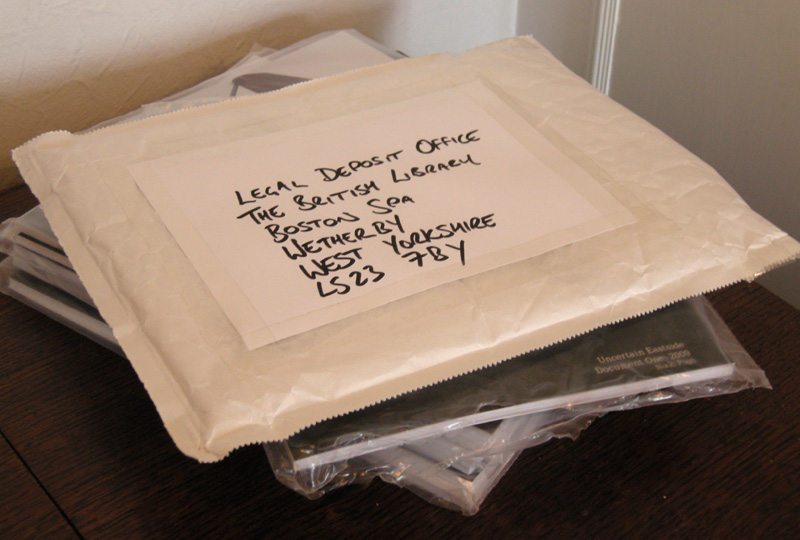
The Spotted Dog reference library gets Document One
The Spotted Dog pub on Warwick Street is home to John Tighe and an impressive collection of texts, maps, posters and other printed matter that get produced from locations unseen when relevant to the conversation. Interesting conversations have a habit of happening here…
Whilst not within the Eastside boundary I have been investigating, The Spotted Dog (and I know there are two in the area!) gets a mention both in Ben Waddington’s November 1st 1860 and and in Joe Holyoak’s Eastsiders. These are the texts in Uncertain Eastside – Document One
It seems only right and proper then that there is now a copy of Document One housed at The Spotted Dog. Feel free to pop in, have a browse and have a natter.
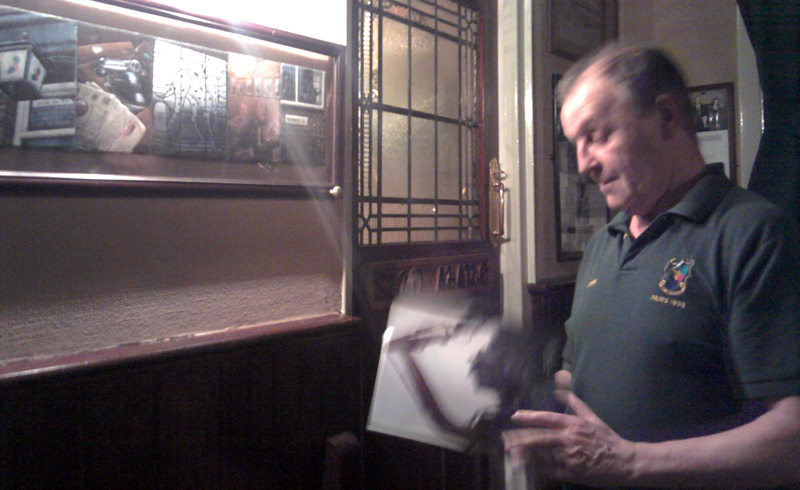
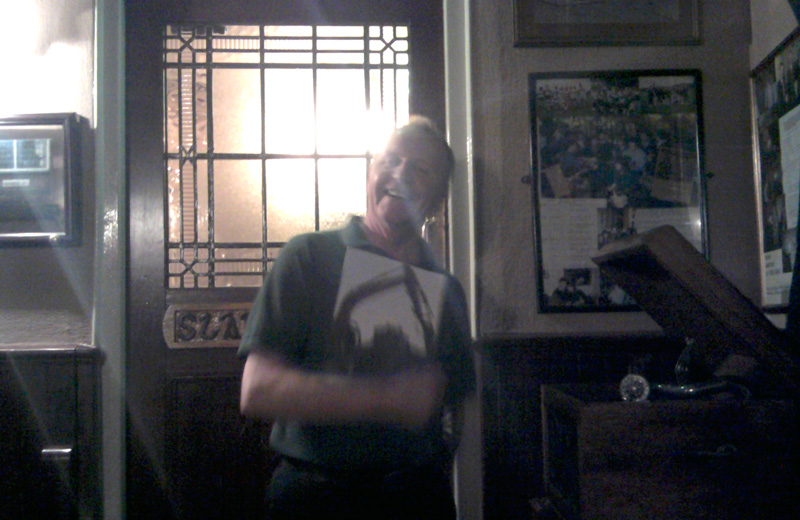
Should you wish to invest in a copy of your own, the publication is available to buy from here.
Electronics, circles, people, contexts and vibrating hats
A few months ago fizzPOP – the hackspace I’ve been very involved with over the previous year or two – fizzled out. This left me not only with a slew of new skills and awarenesses of what might be possible, but also a fine collection of amassed bits and bobs.
What it hasn’t left me with is a clear idea of how all this new stuff relates to my art practice.
I’ve done a lot of learning, a lot of tinkering and a lot of making stuff just because I can. Now it’s time to start applying some of that rigour and circularity to the things I do involving electronics, sensors and microprocessors. (I still reserve the right to make flashing superhero cuffs if I want to, but, y’know, I want to make art too…)
I’m on limited resources at the moment and mostly having to make use of what I’ve got to hand, so thoughts returned to a wii nunchuck I’d managed to get an Arduino to read the data from back in August.
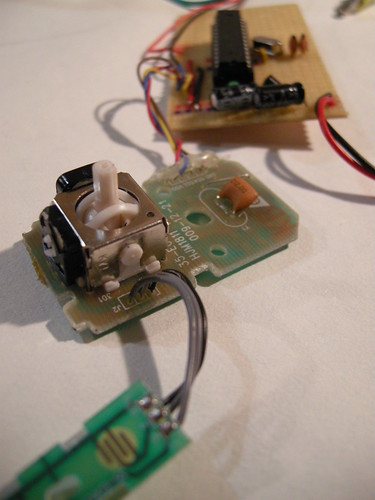
Arduino and nunchuck innards. The microprocessor reads the data from the wii nunchuk's accelerometer and then makes things happen accordingly...
I spent a long time barking up the wrong tree with an idea about modernising the old finishing school thing of balancing a heavy book on your head to improve your posture, however, after a few hours at the internet (and a few more at Central Library), I began to suspect this might be more urban myth than anything else. I couldn’t track down any nice references for it. Also, although in my mind’s eye I could easily see the book with accelerometer in it registering when it was no longer horizontal, I couldn’t figure out what it would do next. What would the output be? Why?
Anyway, at some point this thinking got bumped onto some different tracks and I’ve embarked on a series of concept pieces that I’m hoping will help bridge the gap between learning and Proper Work. This is where the vibrating hat comes in…
Starting point: what if well-known behaviour patterns were actually caused by devices?
Example (involving a vibrating hat): So, you know the pattern when someone’s falling asleep in public: their head nods forward three times and then they wake up with a snort and a small quantity of embarrassment. What if, what if, this is not actually the default behaviour? What if, when left to our own devices, we just keep on nodding? What if aforementioned falling-asleep-in-public person has had the foresight to don a special hat that recognises when nodding has commences and then discreetly wakes that person up rather than leaving them nodding indefinitely?
I’m making that hat.
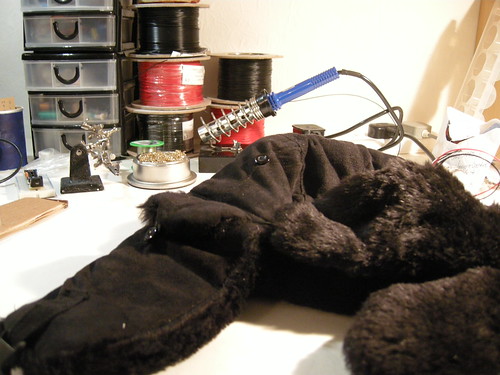
A hat with working circuitry to enable it to detect 3 nods and then buzz the motor to wake you up...
After that I’d like to make a device that reads galvanic skin response and then taps your foot up and down when you’re nervous.
After that I’d like to make a device that… what do you suggest I make? What quirks of human behaviour might it be interesting to consider from another angle? Your thoughts in the comments please!
I’m still pondering what to do with this work once it’s made: I tend to like to see things being put into use. Documentation-wise, I’m thinking something like the way Sputniko! tells stories might work. Anyone up for a train-ride with video camera and vibrating hat?
A quick test of one of the soft switches that go inside the hat's ear flaps. This one is used to toggle the alarm on and off - my next task is to refine the feedback for actions like this.
Reflective armband teardown
A quick teardown of a Poundland reflective armband, because I’m doing wearable electronics on the cheap at the moment and this has got a few useful components inside…
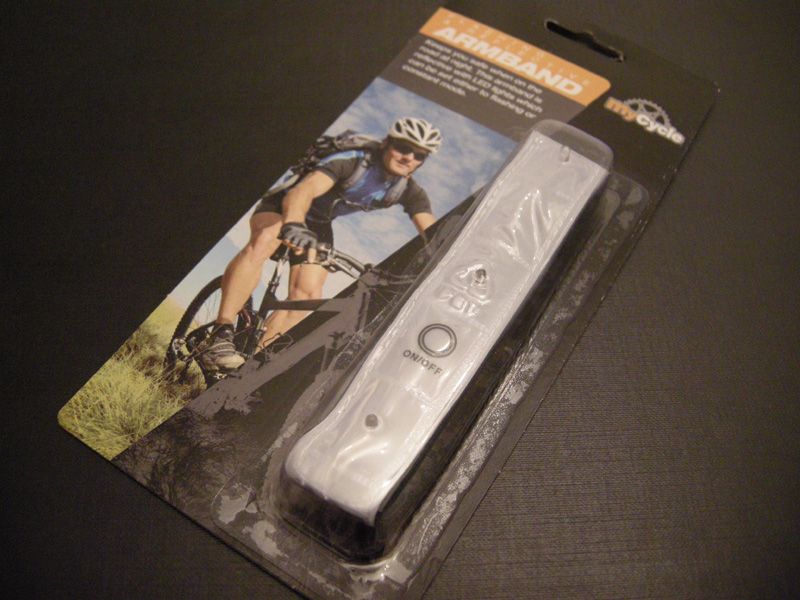
Flashing and reflective armband, from in amongst the cycle stuff in Poundland. Comes in silver and fluorescent yellow. I've also seen a variant of the packaging that's orange.

Elasticated Velcro strap attached to reflective band with 4 LEDs mounted along its length. Click the switch once to make the LEDs flash, a second time to have them on continuously and a third time to switch them off.
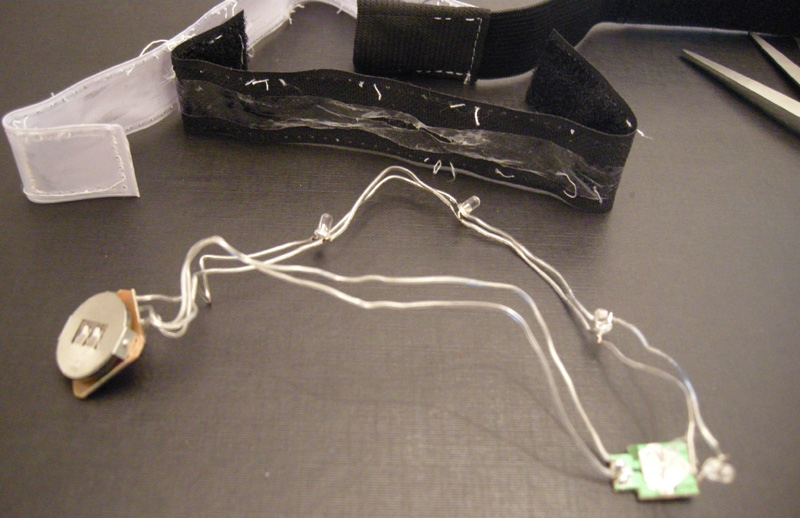
What you get when you open it up...
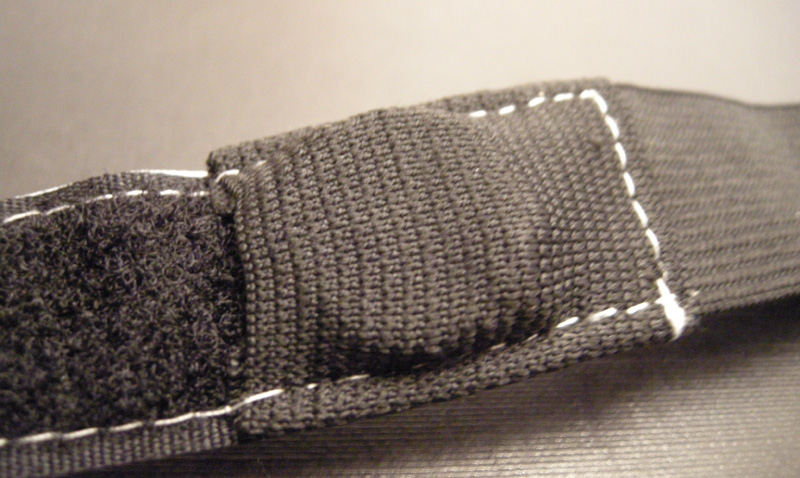
You can liberate a fair bit of Velcro from the strap. Elastic is also used to make a pouch to hold the battery.

The momentary switch isn't much to look at (you were going to wrap it in fabric anyway, weren't you?) but it makes a good click when you operate it. Nice feedback.
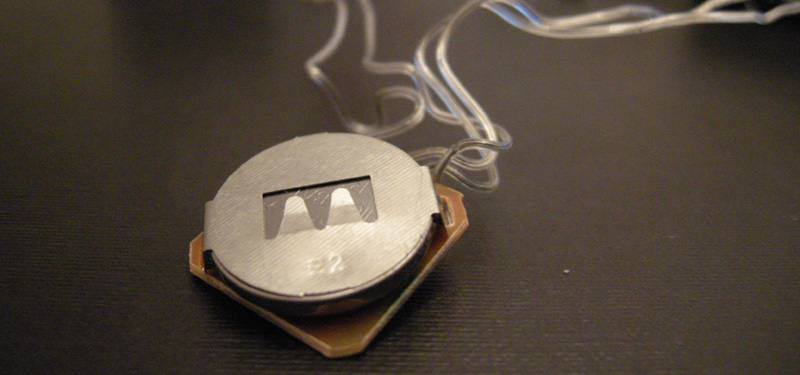
The battery clip is minimal, but does the job... Also it has a battery in it!

The battery clip is also the main PCB. You can remove the wires and connect your circuit to either of the corner tabs (+ve) and Vss (-ve/GND)
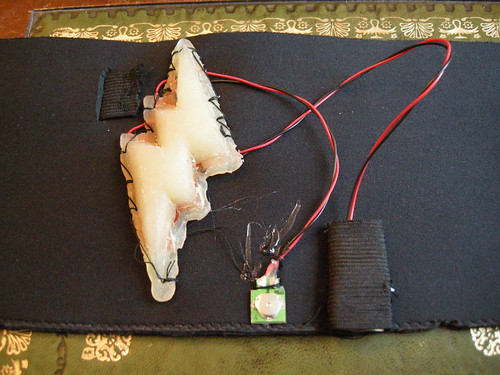
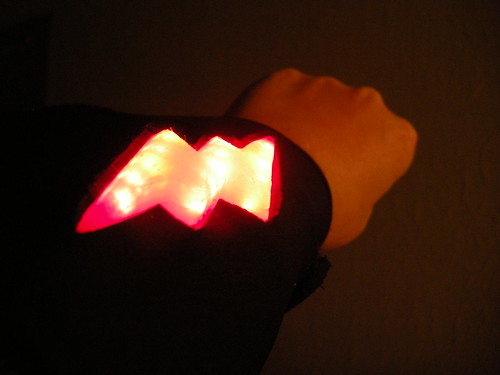
I used the battery and battery clip to power the LEDs from 3 bike lights in this superhero cuff project. The velcro and elastic were re-used as a strap to hold it in place and the switch was used to trigger the different flashing patterns for the LEDs.
Uncertain Eastside – Document One: 2009
It’s a very great pleasure to be able to announce the release of my first publication.

Having a quick flick through the 112 pages.

As shown by the rather long list on the title page, other people have put loads of effort into this as well. Thank you to everyone who has supported this project.
Uncertain Eastside – Document One: 2009 brings together activity from my first year of investigating my relationship to BCC‘s ‘Eastside’ regeneration zone and logging the micro and macro changes in the landscape as time passes. It’s Eastside in three parts: past, present and future.

Bursting with goodness over three acts!
The book starts with a manufactured history contributed by the indescribable Ben Waddington: a day as seen from the perspective of a family living in Digbeth. Pay attention – this text is as much about the present day and October the 18th, 2009, as it is about November the 1st, 1860.
Next, now firmly in 2009, the book gives an overview of my alternative cartography of the regeneration zone’s perimeter and a selection of 83 lush colour photos selected from the 1000+ submitted by participants of the Walk and Talk event.
The book finishes off with a text from much-respected architect and urban designer Joe Holyoak and Tracey Fletcher from the Eastside Sustainability Advisory Group. Written 8 years ago it describes a day in the life of a family inhabiting an Eastside of the future. 2012 now seems both just around the corner and impossibly distant.
You can buy copies of Uncertain Eastside from http://www.magcloud.com/browse/Issue/131607 where there is also a link that allows you to preview the book’s contents.
Magcloud are running a special offer until the end of the year that means you only pay $22.15 (≈£14) rather than $28.00 (≈£17.50). Your order is then printed up and delivered to you within about a week, so there’s time to get some as Christmas presents!
Again, a special thank you to everyone who has taken part in the making of this publication: Pete Ashton, Karen Cameron, Mike Cummins, Ida Deodathsingh, Emma (editorialgirl), Tracey Fletcher, Joanna Geary, Nicky Getgood, Michael Grimes, Marian Hall, Libby Heighway, Mark Hill (cybrum), Joe Holyoak, Alex Hughes, Nancy Langfeldt, Ben Mabbett, Steve Scott, Tim Stock, Chris Tomlinson, Ben Waddington and Simon Whitehouse.
Plans are afoot for Document Two. Watch this space…
New badge sets at the We Are Birmingham shop

Now available at the We Are Birmingham shop!
At their request I have now provided the We Are Birmingham shop with a supply of Counsel for the Artist badges. These should be available to buy over the next few days, if they’re not already.
Each pack costs £4 and comes with a random selection of 4 statements taken from the following:
- Set your own agenda.
- Get the message across.
- Resist the ascribed role of witness.
- Circumnavigate predictability.
- Meet a new network.
- Add to a culture of learning and experimentation.
- Make exchanges with spaces.
- Strive to achieve modest connections.
The badges are 25mm in diameter and rather nice!
If you’d like a set but can’t get to the WAB shop in Birmingham city centre, get in touch and we can make arrangements to post them to you.
Pete Ashton’s Living in the City presentation
Uncertain Eastside gets some seconds in Pete’s Pecha Kucha style presentation at the Landscape Institute:
Can’t remember what I was doing in that photo, but I think it involved someone’s hat…
Pub Conversation: Douglas White & Justin Coombes
Self Service and Pub Conversations.
In 2006 through to 2008, Self Service initiated a programme of talks taking place at the Lamp Tavern in Birmingham.
Each Self Service member chose an artist or person of influence to their practice who was in turn invited to nominate someone they would like to have a public conversation with. Topics of conversation were held entirely open and reflected the interests and enthusiasms of the artists nominated.
Each conversation was recorded and released as a podcast, however the Pub Conversations website no longer exists so the files are re-posted here by way of an archive. All posts related to the Pub Conversations series can be found at www.npugh.co.uk/tag/pub-conversations/.
Self Service is a constantly evolving group of Birmingham based artists who originally came together in 2004, with the aim of generating projects which would create intimacy and enable the development of dialogue amongst the disparate groups and practitioners in Birmingham who made up a somewhat fragmented visual arts community.
At the time of Pub Conversations, Self Service consisted of Tom Bloor, Jo Capper, Mona Casey, Faye Claridge, Ruth Claxton, Greg Cox, John Hall, Cheryl Jones, Nikki Pugh, Liz Rowe, Charlotte Smith and Matt Westbrook
The talks were supported by Arts Council, UCE and Business Link.
Douglas White & Justin Coombes, January 2008
[audio:http://www.npugh.co.uk/media/pubcon/Douglas%20White%20&%20Justin%20Coombes%2017-01-08.mp3]
[Download file]
Pub Conversation: Melanie Carvalho & Ross Birrell
Self Service and Pub Conversations.
In 2006 through to 2008, Self Service initiated a programme of talks taking place at the Lamp Tavern in Birmingham.
Each Self Service member chose an artist or person of influence to their practice who was in turn invited to nominate someone they would like to have a public conversation with. Topics of conversation were held entirely open and reflected the interests and enthusiasms of the artists nominated.
Each conversation was recorded and released as a podcast, however the Pub Conversations website no longer exists so the files are re-posted here by way of an archive. All posts related to the Pub Conversations series can be found at www.npugh.co.uk/tag/pub-conversations/.
Self Service is a constantly evolving group of Birmingham based artists who originally came together in 2004, with the aim of generating projects which would create intimacy and enable the development of dialogue amongst the disparate groups and practitioners in Birmingham who made up a somewhat fragmented visual arts community.
At the time of Pub Conversations, Self Service consisted of Tom Bloor, Jo Capper, Mona Casey, Faye Claridge, Ruth Claxton, Greg Cox, John Hall, Cheryl Jones, Nikki Pugh, Liz Rowe, Charlotte Smith and Matt Westbrook
The talks were supported by Arts Council, UCE and Business Link.
Melanie Carvalho & Ross Birrell, May 2008
Melanie Carvalho is an artist working and living in London. She has shown in solo exhibitions (Cubitt gallery, London, 2002; Hidde van Seggelen, London 2006) and group exhibitions (East International, Norwich School of Art and Gallery, 2007; Where the Wild Things Are, Dundee Contemporary Arts, 2006; The Impossible Landscape, UMass Fine Art Centre, Amherst, Massachussetts, USA, 2006; Collage, Bloomberg Space, London; Solar Lunar, doggerfisher, 2004; Plunder, DCA, 2003; Viewfinder, Arnolfini, Bristol, 2002). She also co-curated The Poster Show with John Maclean that was shown at Gavin Brown’s Enterprise, New York, in 1999 and Cabinet, London, 2000. Carvalho studied at Central Saint Martins College of Art and the Royal College of Art and received a Rome scholarship in 1998 . She recently published a book entitled Expedition: A Journey in Search of Tropical Scotland, (which includes an essay by Ross Birrell) as part of a piece of work of the same name, whereby she travelled around the west coast of Scotland drawing, painting and filming the palms and sub-tropical flora that grown there. Her work is in private and public collections, including the New Art Gallery, Walsall.
Ross Birrell is an artist and writer. He has shown in group and solo exhibitions including the 4th Gwangju Bienalle (2002), Utopia Station (Sindelfingen, 2003), Envoy, Ellen de Bruijne Projects, Amsterdam and BüroFriedrich, Berlin (2003), Between the Lines Apex Art, New York (2003), Homo Ludens: Works from the Envoy series 1998-2005, Friesmuseum, Leeuwarden (2005) and most recently the survey show curated by Jörg Heiser, Romantic Conceptualism, Kunsthalle, Nürnberg/BAWAG Foundation Vienna 2007. Since 2005 Birrell has collaborated with David Harding on a series of films and installations, Port Bou: 18 Fragments for Walter Benjamin (2005) and Cuernavaca: A Journey in Search of Malcolm Lowry (2006) commissioned by Kunsthalle Basel. In December 2007 they were awarded an SAC Artist’s Film and Video Award for a new film to be shot in Havana and Miami in Spring 2008, to be premiered at CCA, Glasgow in January 2009 on the 50th anniversary of the Cuban revolution.
Ross Birrell is a lecturer and researcher at Glasgow School of Art and editor of the online journal, Art & Research. He is represented by Ellen de Bruijne Projects, Amsterdam.
[audio:http://www.npugh.co.uk/media/pubcon/Melanie%20Carvalho%20&%20Ross%20Birrell%2029-04-08.mp3]
[Download file]
Pub Conversation: Becky Shaw & Steven Eastwood
Self Service and Pub Conversations.
In 2006 through to 2008, Self Service initiated a programme of talks taking place at the Lamp Tavern in Birmingham.
Each Self Service member chose an artist or person of influence to their practice who was in turn invited to nominate someone they would like to have a public conversation with. Topics of conversation were held entirely open and reflected the interests and enthusiasms of the artists nominated.
Each conversation was recorded and released as a podcast, however the Pub Conversations website no longer exists so the files are re-posted here by way of an archive. All posts related to the Pub Conversations series can be found at www.npugh.co.uk/tag/pub-conversations/.
Self Service is a constantly evolving group of Birmingham based artists who originally came together in 2004, with the aim of generating projects which would create intimacy and enable the development of dialogue amongst the disparate groups and practitioners in Birmingham who made up a somewhat fragmented visual arts community.
At the time of Pub Conversations, Self Service consisted of Tom Bloor, Jo Capper, Mona Casey, Faye Claridge, Ruth Claxton, Greg Cox, John Hall, Cheryl Jones, Nikki Pugh, Liz Rowe, Charlotte Smith and Matt Westbrook
The talks were supported by Arts Council, UCE and Business Link.
Becky Shaw & Steven Eastwood, July 2007
Becky Shaw has been making work that explores the relationship between individual and social since 1993. Projects often involve humorous and sometimes critical contributions to public and private contexts including hospitals, universities, business parks, factories and shops. The resulting works combine live elements, photography, made elements, writing and speaking, and may reverse or misuse existing processes. New works have been commissioned by organisations including Grizedale Arts, New Art Gallery Walsall and Kunstprijs Amstelveen, Netherlands. Becky spent three years making work in response to Liverpool Marie Curie Centre, for PhD research. Current projects include a response to Firstsite’s new building in Colchester, an exploration of retail and regeneration in Preston, and a collaboration with Joanna Spitzner, USA,that explores the American and British car industries. Becky is Research Fellow at ICIA, University of Bath, attempting to follow one object all the way back through its manufacturing process as a way to understand contemporary objectivity and subjectivity. Between 2000 and 2006 Becky was co-director of Static, Liverpool.
Her guest, Steven Eastwood, is a filmmaker whose practice spans experimental fiction, documentary and essay film, artists’ moving image and live art. His films collapse the vernacular of the cinema and the documentary, appropriating and then misusing many of the conventions of a dominant cultural media, and taking the form into unusual contexts. Some of the films are performances; others are
interventions or drifts that involve strangers, others still are unsettling in their willful lack of direction (literally) or conclusion. Steven has exhibited at the ICA, BAFTA, EMAF, Brief Encounters, the Lux Centre and Anthology Film Archives, amongst others. Recent installations include The Film, The Film, The Film at MM Luka Gallery Croatia (2006). Steven has been the recipient of a number of grants and awards, has written conference papers and chapters on filmmaking as a social situation and regularly programmes screenings of artists’ film and video. He recently curated two symposia, Interval (1) and (2), based on the film philosophy of Gilles Deleuze. He has lectured widely, and is currently on leave from his position as Assistant Professor in Film, SUNY Buffalo. Steven is about to complete a Ph.D through UCL The Slade, titled ‘Cinema into the Real’. In 1997 he formed the production company Paradogs; in 1996 he co-founded the Volcano! Underground film festival (1996-2000); and in1995 he formed OMSK, a platform (now a collective) for emerging artists with diverse practices.
www.cinemaintothereal.org
Pub Conversations from nikkipugh on Vimeo.
[audio:http://www.npugh.co.uk/media/pubcon/Becky%20Shaw%20&%20Steven%20Eastwood%20120707.mp3]
[Download file]